Ancient volcano vent in the Martian southern cratered highlands?

Ancient volcano vent on Mars?
Click for original image.

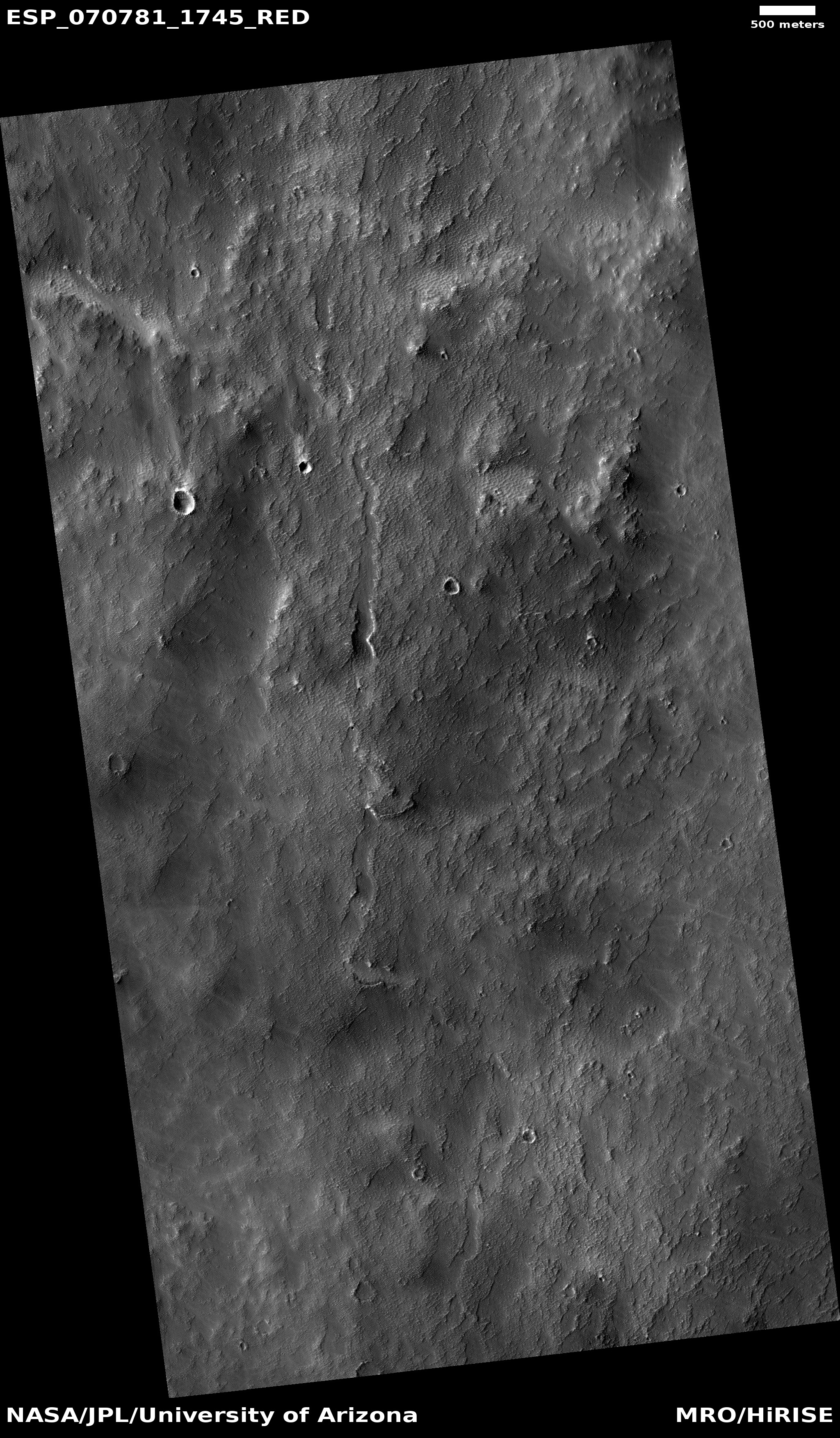
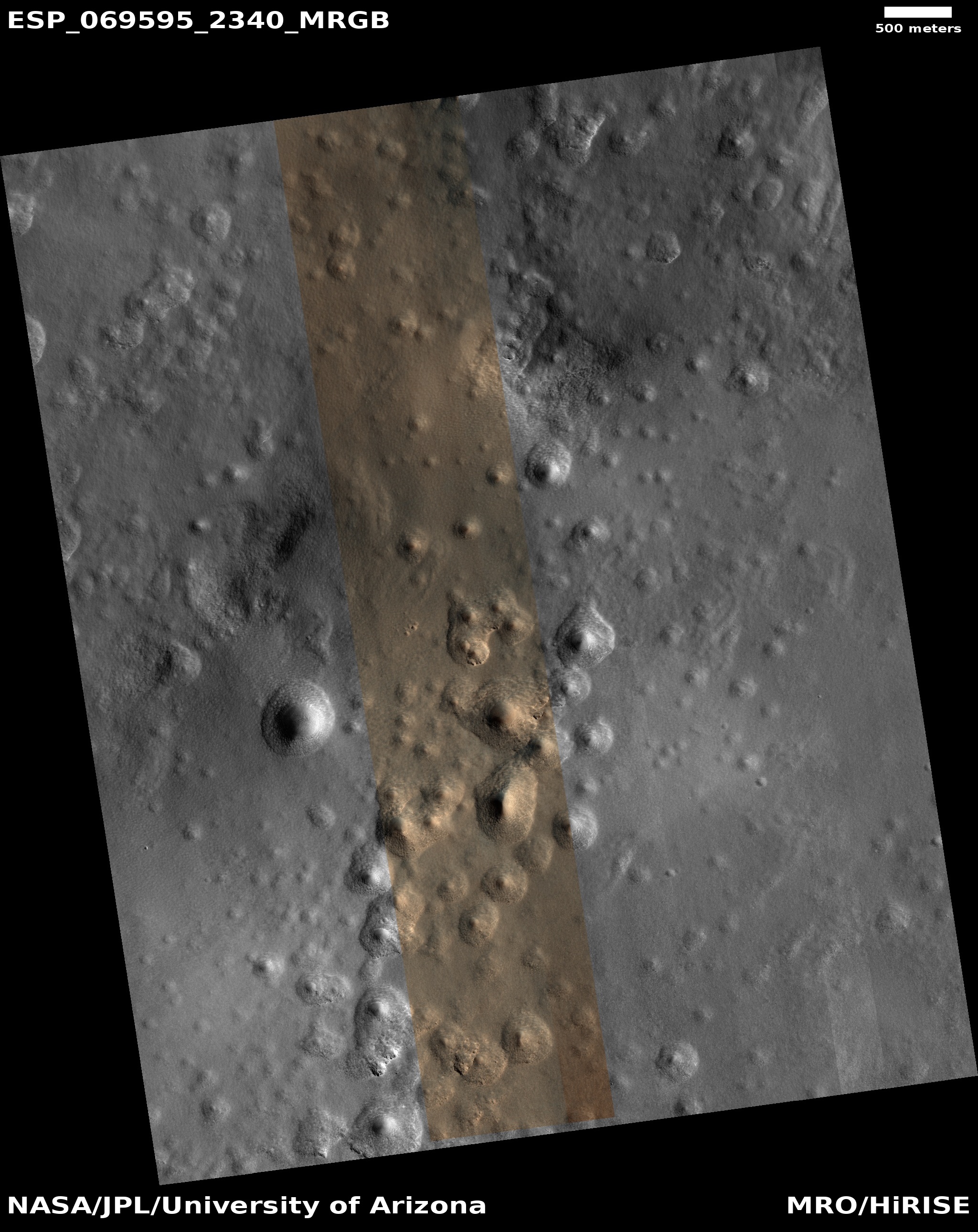
The nature of today’s cool image suggests both ancient and more recent geological activity, each coming from entirely different sources but both helping to shape the alien Martian surface.

The picture to the right, rotated, cropped, reduced, and sharpened to post here, was taken on March 13, 2023 by the high resolution camera on Mars Reconnaissance Orbiter (MRO). It shows what the science team has labeled an “elongated depression,” sitting in the middle of a relatively flat but very rough stippled circular plain about 60 miles in diameter. An MRO context camera picture, taken on February 19, 2012, covered the central strip of this plain, and shows that its surface is equally rough and stippled everywhere, with only a few craters and one or two slight changes in elevation.

So, how does this feature tell us both about the ancient and recent geological history of this spot on Mars?
» Read more

1 comment

Jellyfish galaxy plowing its way through the intercluster medium

Jellyfish galaxy plowing through the intercluster medium
Click for original image.

The European Space Agency (ESA) today released another in a series of images taken by the Hubble Space Telescope during the past two years of what astronomers call jellyfish galaxies, so named because such galaxies have tendrils that extend out beyond the galaxy like the tendrils of jellyfish. This new picture is to the right, cropped, reduced, and sharpened to post here, and shows a galaxy about 900 million light years away.

[T]he space between galaxies in a cluster is … pervaded with a searingly hot plasma known as the intracluster medium. While this plasma is extremely tenuous, galaxies moving through it experience it almost like swimmers fighting against a current, and this interaction can strip galaxies of their star-forming gas. This interaction between the intracluster medium and the galaxies is called ram-pressure stripping, and is the process responsible for the trailing tendrils of this jellyfish galaxy.

The arrow in the image indicates the galaxy’s direction of travel through the intercluster medium, resulting in the outer parts of the leading arm to be pushed backward above the galaxy, while material at its rear trail behind. Note also the blue star-forming regions at the galaxy’s bow. The ram pressure is also apparently causing more star formation in this part of the galaxy compared to elsewhere.

5 comments

China launches two satellites yesterday, one for Macau

China yesterday used its Long March 2C rocket to launch two satellites into orbit, with one the first science satellite by Macau, designed to study the Earth’s magnetic field in conjunction with other satellites already in orbit.

No information that I could find was released about the second satellite. The launch, from China’s interior Jiuquan spaceport, dropped the rocket’s first stage somewhere in China. No word on whether it landed near habitable areas.

The leaders in the 2023 launch race:

34 SpaceX
19 China
6 Russia
4 Rocket Lab (with a launch scheduled for tomorrow)

American private enterprise still leads China 38 to 19 in the national rankings, and the entire world combined 38 to 31. SpaceX by itself now tied trails in total launches with the rest of the world, including American companies, 34 to 35.

0 comments

Buried dying glacier in the Martian dry equatorial regions?

Buried glacial ice in dry equatorial regions?
Click for original image.

Today’s cool image from Mars is not so much unique visually as it is unique in terms of its location. The picture to the right, rotated, cropped, reduced, and sharpened to post here, was taken on January 31, 2023 by the high resolution camera on Mars Reconnaissance Orbiter (MRO). It shows the northern rim of a small crater, with its floor filled with an intriguing mound of material.

The picture was labeled a “terrain sample”, which suggests it wasn’t taken as part of any specific research project by instead to fill a gap in the camera’s schedule. To maintain the camera’s proper temperature, it is necessary to take pictures regularly, and when the camera team finds a gap that is too long, they fill it by choosing some almost random target in that gap that might be interesting. Sometimes it is, sometimes not.

In this case I strongly suspect this target was hardly random. The picture title also mentions MRO’s now retired radar CRISM instrument, which was used to detect evidence of underground ice. My guess is that the camera team thus likely decided to image this crater in high resolution because that radar data suggested the presence of underground ice.

This guess is strongly confirmed by a context camera picture taken of this crater on September 1, 2008. The crater appears surrounded by the typical splash apron one routinely sees around impact craters in the mid- and high-latitude northern lowland plains, where there is a lot of near surface ice.

The bumpy mound seen in high resolution on the floor of this crater could very well be buried glacial ice, as it mimics similar features in the many craters in the mid-latitudes of Mars. But is it buried ice? The location says otherwise.
» Read more

1 comment

Capstone does lunar fly-by, takes first lunar pictures, completes main mission

The Moon as seen by Capstone
Click for original image.

The smallsat engineering test lunar orbiter Capstone has now successfully ended its primary mission, completing six months of operation in the near-rectilinear halo orbit that NASA’s Lunar Gateway manned space station intends to fly.

To put a final touch on that main mission, in May mission managers at the private company Advanced Space also completed two additional experiments. On May 3, 2023 they performed a close-fly of the Moon, using the spacecraft’s camera for the first time to take the picture of the Moon to the right.

Then, on May 9 Capstone successfully tested navigation technology in conjunction with NASA’s Lunar Reconnaissance Orbiter (LRO), also in orbit around the Moon.

During the May 9 experiment, CAPSTONE sent a signal to LRO designed to measure the distance and relative velocity between the two spacecraft. LRO then returned the signal to CAPSTONE, where it was converted into a measurement. The test proved the ability to collect measurements that will be utilized by CAPS software to determine the positioning of both spacecraft. This capability could provide autonomous onboard navigation information for future lunar missions.

The mission now enters its extended mission, planned to last at least a year.

3 comments

Lucy makes course correction in preparation for 1st asteroid fly-by

Lucy's route through the solar system
Lucy’s route through the solar system

The asteroid probe Lucy on May 9, 2023 fired its engines to successfully make a minor course correction in preparation for a fly by of the asteroid Dinkinesh, located in the main asteroid belt between Mars and Jupiter.

Even though the spacecraft is currently travelling at approximately 43,000 mph (19.4 km/s), this small nudge is enough to move the spacecraft nearly 40,000 miles (65,000 km) closer to the asteroid during the planned encounter on Nov. 1, 2023. The spacecraft will fly a mere 265 miles (425 km) from the small, half-mile- (sub-km)-sized asteroid, while travelling at a relative speed of 10,000 mph (4.5 km/s).

Dinkinesh, the white dot inside the main asteroid belt in the lower left of the map to the right, is the first of eight asteroids Lucy will fly past.

1 comment

NASA picks Blue Origin’s partnership for building second manned lunar lander

Artist's concept of Blue Moon
An artist’s concept of Blue Moon

NASA today announced that it has chosen the partnership led by Blue Origin to build a second manned lunar lander for its Artemis program.

Blue Origin will design, develop, test, and verify its Blue Moon lander to meet NASA’s human landing system requirements for recurring astronaut expeditions to the lunar surface, including docking with Gateway, a space station where crew transfer in lunar orbit. In addition to design and development work, the contract includes one uncrewed demonstration mission to the lunar surface before a crewed demo on the Artemis V mission in 2029. The total award value of the firm-fixed price contract is $3.4 billion.

The other partners in the contract are Draper, Astrobotic, and Honeybee Robotics.

This is NASA’s second contract for a lunar lander, with SpaceX’s Starship the first. The idea is to have two landers available from competing companies for both competition and redundancy, similar to the approach the agency has used for its manned ferry service to ISS, using SpaceX and Boeing. I wonder if NASA’s experience on the Moon will be similar to that ferry service, whereby only SpaceX so far has been able to deliver. The track record of Blue Origin suggests it will do about as poorly as Boeing has with Starliner.

28 comments

Chaos in the southern cratered highlands of Mars

Chaos in the southern cratered highlands of Mars
Click for full image.vi

Today’s cool image takes us to a part of the cratered southern highlands of Mars that I have not featured much previously. The picture to the right, rotated, cropped, and reduced to post here, was taken on March 7, 2023 by the high resolution camera on Mars Reconnaissance Orbiter (MRO). It shows what appears to be a collection of rough hills and mesas surrounded by a sea of smooth ground that at the base of the cliffs seems to end abruptly.

The smooth ground is probably mantled by a layer of dust and debris. Since this location is at 36 degrees south latitude, there is also probably near surface ice under that layer. The abrupt edges likely indicate where the increasing slope next to the mesas and mounds caused that ice to be exposed and thus sublimate away.

As for the location, we must go to the overview map.
» Read more

0 comments

Astronomers discover Earth-sized planet 90 light years away

Using data from a variety of space- and ground-based telescopes astronomers have discovered Earth-sized exoplanet orbiting a red dwarf star 90 light years away.

The exoplanet is dubbed LP 791-18 d, and is thought to be slightly bigger than the Earth. Its orbit, close to the star, causes it to be tidally-locked, with one hemisphere always facing the star. In addition, the presence of another much larger exoplanet in the system causes other tidal effects.

Astronomers already knew about two other worlds in the system before this discovery, called LP 791-18 b and c. The inner planet b is about 20% bigger than Earth. The outer planet c is about 2.5 times Earth’s size and more than seven times its mass.

During each orbit, planets d and c pass very close to each other. Each close pass by the more massive planet c produces a gravitational tug on planet d, making its orbit somewhat elliptical. On this elliptical path, planet d is slightly deformed every time it goes around the star. These deformations can create enough internal friction to substantially heat the planet’s interior and produce volcanic activity at its surface. Jupiter and some of its moons affect Io in a similar way.

The press release makes a big deal about the volcanism, even suggesting it could produce an atmosphere that, because the exoplanet sits on the inner edge of the habitable zone, could make the exoplanet habitable. These speculations are silly, considering the uncertainties, the exoplanet’s evolving orbit, and the star it orbits, and are being pushed mostly because the press office thinks this will be the only way the public will have any interest in the discovery.

While there is an infinitesimal chance there could be life here, a more likely scenario is that it is a lifeless volcano world like Jupiter’s moon Io. Even more probably however is that it is completely different than anything we have yet observed, in ways we can’t yet predict. To find out however we would need close-up observations that will likely not be possible without an interstellar mission.

4 comments

Final assembly of Chandrayaan-3 begins for launch still targeting mid-July


Click for interactive map.

Engineers at India’s space agency ISRO have begun the installation of the payloads onto its lunar lander/rover, Chandrayaan-3, which is still targeting a mid-July launch.

The map shows the landing location (red dot) near the Moon’s south pole (indicated by the cross). Nova-C is Intuitive Machines private lander, now aiming for a late summer launch at the earliest. Luna-25 is Russia’s first lunar lander since the 1970s, and is also targeting a launch in July.

India’s first attempt, Chandryaan-2, to land a rover at this spot on the Moon failed in 2019. This new mission is essentially a re-do, except that it does not include an orbiter, since the orbiter from Chandrayaan-2 is still operational and can do the job.

All in all, it increasingly looks like the next six months will see a lot of new landing attempts on the Moon.

0 comments

Alien textured Martian lava

Alien textured Martian lava
Click for original image.

Cool image time! The picture to the right, cropped to post here, was taken on February 17, 2023 by the high resolution camera on Mars Reconnaissance Orbiter (MRO), and shows what the science team labels “regularly textured ground on Pavonis Mons.”

The arrow in the picture indicates the downhill trend. If you look at the full image, you will see that this texture pattern extends in all directions for a considerable distance, both uphill and down, and even covers the entire floor of a depression that appears to contour along the grade instead of going downhill.

The latitude here is very close to the equator. So, even though the elevation is high, being on the slopes of a giant volcano, there is probably no near surface ice here.
» Read more

1 comment
1 128 129 130 131 132 729