Russians release image of coolant system hole in Progress
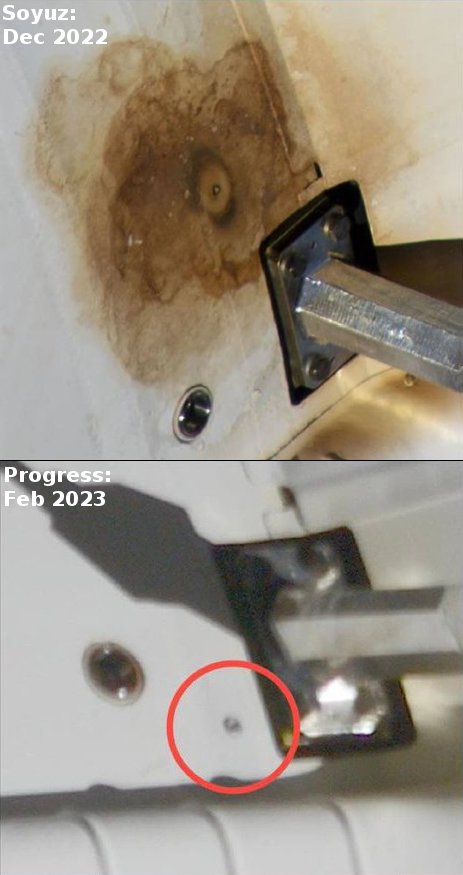
Comparing holes in Soyuz and Progress spacecraft

Roscosmos officials today released a close-up image taken on February 17, 2023 of what they think is the hole in the Progress freighter that caused a leak in its coolant system on February 11th.

The picture was taken shortly after the freighter undocked from ISS to be de-orbited over the Pacific. To the right is a comparison of pictures taken of that Progress hole and the hole that occurred in December on the Soyuz spacecraft docked to ISS. The comparison was first created by this Twitter user but rearranged by me to post here. The red circle in the bottom image marks what the Russians identify as the Progress hole. The top image shows the hole that caused an almost identical leak in a Soyuz capsule in December. The Russians say the Progress hole is about 12 millimeters in diameter, and to their mind was caused “by an external influence,” same as the Soyuz hole.

This conclusion however is suspect. If you look at the best resolution version of the picture of the Progress hole (available here), there appears to be material surrounding the hole, as if the hole broke from the inside, not from an outside impact. (Because the resolution is poor, however, this conclusion is uncertain.)

More telling is that, as both pictures show, the two holes are almost in the exact same place on these two spacecraft. As noted by the Twitter user who first made this picture comparison, “I can’t even calculate the odds of 2 spacecraft being struck in almost the same place, within weeks of each other.”

That the Soyuz leak caused so much staining and the Progress leak has none is also puzzling.

Were these leaks both caused by the impact of a micrometeoriod or piece of space junk, as the Russians now claim? Or was one by sabotage or sloppy production work on the ground? Or were both? One impact might make sense, but two at almost the same spot? It defies logic or the percentages for two impacts so similar to occur so close together in time.

Sabotage however in the same area is very conceivable, especially considering that the Russians have never explained the cause of the hole that was drilled in a Soyuz capsule in 2018, a hole that was drilled and then patched, before launch.
13 comments

Inspection of leaking Progress after undocking detects no obvious damage

After undocking the Progress freighter from ISS yesterday, Russian astronauts on the station rolled it so that all sides of its service module could be photographed and inspected in the hope of spotting the leak in its coolant system that sprung on February 11th.

No visual damage has been detected at the Progress MS-21 spacecraft after it undocked from the International Space Station. “After the Progress MS-21 cargo spacecraft undocked from the International Space Station’s Poisk mini-research module, footage was made of its exterior surface and no visual damage was detected,” the statement [from Roscosmos] reads.

Initially the Russians postponed its de-orbit as they considered the idea of redocking the freighter to another port on the Russian half of ISS in order to inspect it more closely, but eventually they decided to fore-go that plan and de-orbit it on February 19th, one day later.

In watching the live stream of the undocking and the roll maneuver, I thought I saw a partial reddish-orange stain, similar to the stain around the hole that occurred in the Soyuz capsule in December, but it was mostly hidden behind other equipment and the Russians seemed to not consider this significant.

4 comments

Roscosmos will launch unmanned Soyuz to ISS on February 21

Roscosmos today announced that it will launch the unmanned Soyuz to ISS on February 21st, only a two-day delay after doing a quick inspection of its outer surface for possible damage following the coolant leak of a Progress freighter on February 11th.

BtB’s stringer Jay provided me this translation of the announcement at the link:

The Soyuz MS-23 spacecraft has been checked and is beginning to be prepared for launch. The preparations suspended the day before at Baikonur will resume tomorrow or the day after tomorrow.
The launch is scheduled for the 20th of February.

The ship was inspected. No maliciously drilled holes were found. We decided not to wait any longer. In any case, a refueled ship must either be launched or sent to a museum.

Update: removal of the launch vehicle to the launch pad on February 18, launch on February 21″ [emphasis mine]

The highlighted words are truly intriguing. It appears Roscosmos is desperately trying to convince the world that the repeated recent leaks to Soyuz and Progress spacecraft are not related to sabotage on the ground. At the same, Roscosmos has never told us the results of its investigation into the 2018 hole in a Soyuz capsule that someone drilled and then patched before launch. It seems incredibly unlikely that the two recent leaks in the exterior coolant systems of two different spacecrafts were both caused by impact from a micrometeorite or tiny piece of space junk. Two such impacts could of course occur this frequently, but for both to happen to such similar locations on only Russian spacecraft seems beyond improbable.

Either way, the decision makes some sense. The available lifeboats on ISS right now are really insufficient. Better to get this launched. More important, they had already begun fueling it, and once that is done the clock was running. They have to launch by a certain time.

Meanwhile it would be wise for NASA to begin arranging new emergency lifeboat arrangements with SpaceX as well as Boeing (once it finally gets Starliner operational). Depending on the Russians for even part of this responsibility seems ill advised. If preplanned properly, SpaceX could certainly launch one of its Dragon manned capsules quickly in an emergency.

13 comments

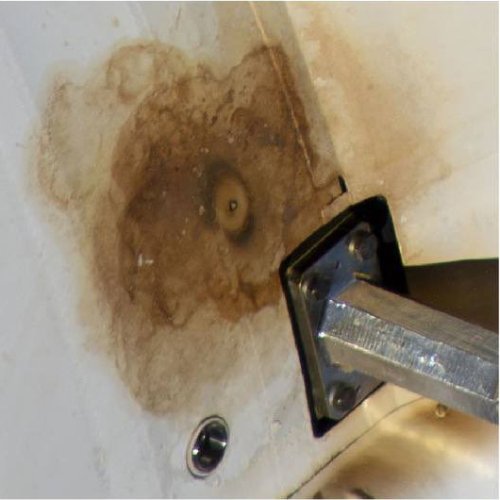
First picture of hole that occurred on Soyuz in December

Hole in First picture of hole that occurred on Soyuz in December

Russia has now released an image taken using the robot arm on ISS of the leak that occurred on its Soyuz capsule docked to ISS in December.

The picture to the right, cropped and reduced to post here, is that image. This is not the coolant leak hole on the Progress freighter on February 11th, this past weekend. As of now no image of that hole has ever been released.

No interpretation of this hole and the stain around it has as yet been released. However, Russia has now postponed the launch of the next Soyuz capsule from February 19th until early March in order “to give investigators time to rule out similar issues in the upcoming mission.” This Soyuz was to launch unmanned to replace the Soyuz that leaked in December and provide the astronauts that launched on that leaking Soyuz a safe lifeboat that they could come home on.

Meanwhile, all communications with ISS have now been shifted to the private channels, so the public cannot hear them.

All these actions strongly suggest that both the Russians and Americans are now seriously considering the possibility of sabotage or damage to the coolant systems on all Russian spacecraft, before they leave the factory and are launched.

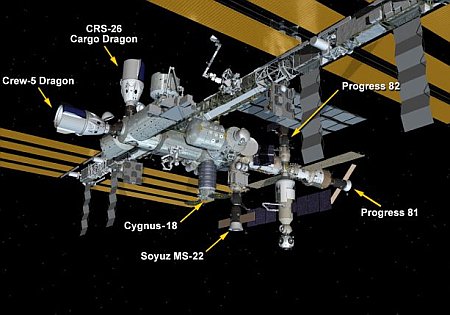
ISS as of February 11, 2023

To clarify the situation, the image to the right shows all the spacecraft presently docked to ISS. Progress 82 is the spacecraft that experienced a leak in its coolant system on February 11th. Soyuz-MS22 experienced a leak in its coolant system in December. At the moment the only safe vehicle for returning the seven astronauts on ISS is Crew-5 Dragon, SpaceX’s Endurance spacecraft. Should a major catastrophe occur requiring an immediate evacuation of the station, the plan right now is for five astronauts to come home on Endurance, and two Russians to come home on the damaged Soyuz. (The thinking is that having only two men on board will prevent too much of a temperature rise during the return to Earth because of the lack of its coolant system.)

With the delay in the launch of the replacement Soyuz lifeboat, this emergency plan will be in place for at least three weeks longer.

15 comments

Russians successfully test replacement Soyuz capsule for leaks

The next Soyuz capsule to launch to ISS has now been passed its leak tests on the ground as it is being prepared for a February 20th launch.

“At the Baikonur cosmodrome, leak tests of the Soyuz MS-23 transport crewed spacecraft have been completed,” the [Roscosmos press release] said. In the coming days, checks of the propulsion system’s automation equipment, onboard digital computerized system and radio engineering systems will follow. Also, the thermal control system is to be filled with a coolant.

The launch has been moved up one month in order to speed the replacement of the leaking Soyuz presently on ISS.

2 comments

Astronauts complete Soyuz seat liner installation inside Endurance

Astronauts today completed the installation of Frank Rubio’s Soyuz seat liner inside the Dragon capsule Endurance so that he can return to Earth should an emergency requiring evacuation occur on ISS.

On Jan. 17, NASA Flight Engineer Josh Cassada, with assistance from NASA Flight Engineer Nicole Mann, worked inside the SpaceX Dragon Endurance crew ship collecting tools and readying the spacecraft for a seat liner move. The seat liner move, completed today, Jan. 18, ensures NASA Flight Engineer Frank Rubio will be able to return to Earth in the unlikely event of an emergency evacuation from the International Space Station. Rubio originally launched to the station with cosmonauts Sergey Prokopyev and Dmitri Petelin aboard the Soyuz MS-22 crew ship on Sept. 21, 2022. The change allows for increased crew protection by reducing the heat load inside the MS-22 spacecraft for Prokopyev and Petelin in case of an emergency return to Earth.

It would be fascinating to get more details about the work that was done to install this Soyuz seat liner in Endurance. Clearly some improvisation was required.

Regardless, this work is only temporary, since Rubio’s seat liner will be shifted again into the replacement Soyuz scheduled to arrive in mid-February.

3 comments

American astronaut seat liner shifted to Dragon temporarily

Though NASA has not issued an update, the Soyuz seat liner used by American astronaut Frank Rubio was supposed to be shifted from the leaking Soyuz capsule to Endurance today, just in case that Soyuz needs to be used as a lifeboat. From the January 13th ISS update:

On Thursday, Jan. 12, the International Space Station mission management team polled “go” to move NASA astronaut Frank Rubio’s Soyuz seat liner from the Soyuz MS-22 spacecraft to Dragon Endurance to provide lifeboat capabilities in the event Rubio would need to return to Earth because of an emergency evacuation from the space station. The seat liner move is scheduled to begin Tuesday, Jan. 17, with installation and configuration continuing through most of the day Wednesday, Jan. 18. The change allows for increased crew protection by reducing the heat load inside the MS-22 spacecraft for cosmonauts Prokopyev and Petelin in the event of an emergency return to Earth.

Once the replacement Soyuz MS-23 arrives at the space station on Feb. 22, Rubio’s seat liner will be transferred to the new Soyuz and the seat liners for Prokopyev and Petelin will be moved from MS-22 to MS-23 ahead of their return in the Soyuz.

I expect that once this work is completed tomorrow NASA will issue an update.

10 comments

Russia and Europe negotiating return of rockets and satellites

Russia and Europe have begun negotiations concerning the return of the various rockets and satellites that were left stranded in both countries when Russia invaded the Ukraine and all cooperative international agreements between the two entities broke off.

[I]n January 2023, an industry source told RussianSpaceWeb.com that Arianespace representatives were exploring a potential deal with Roskosmos on the exchange of Soyuz rocket components stranded in French Guiana for a group of 36 OneWeb satellites stuck in Baikonur Cosmodrome in Kazakhstan after the aborted 14th launch for the Internet constellation. The satellites were held at the Russian-controlled facility in Kazakhstan per the order by Rogozin, but the newly appointed head of the Roskosmos State Corporation Yuri Borisov was reportedly opened to negotiations on their fate.

There are many obstacles blocking this deal, the biggest being the on going war itself. It will be necessary to engineers to both places to facilitate the return, and the war right now makes that difficult if not impossible.

Ironically, Russia is likely in more need of this deal than Europe. OneWeb of course wants its satellites back, but it can replace them. Russia it appears is having trouble building complex things like rockets, and needs these rockets and components to replace components it no longer can get in the west.

1 comment

Leaking Soyuz to return empty; Unmanned Soyuz to be launched to replace it

The Russians announced today the plan to deal with the leaking Soyuz capsule on ISS as well as provide transportation back to Earth for its three astronauts.

First, the damaged Soyuz will return empty to Earth. Second, the next Soyuz will be launched in February unmanned so that it can bring back all three astronauts. Their mission however will likely be extended. Instead of returning in March as planned, they will stay in orbit until September, when that capsule was originally going to return to Earth. If this happens, it means their flight will end up being about a full year long. For the American in that crew, Frank Rubio, this could mean he will set a new American record for the longest spaceflight.

The Russians also added these details about the puncture in the Soyuz, which is believed to have been caused by a meteor:

According to calculations, a hole in the instrument compartment of the spacecraft, observed with a camera of the American ISS Segment, could be caused by a one-millimeter particle striking the vehicle with a speed of around 7,000 meters per second. Borisov also said that a possibility of a manufacturing defect in the radiator system of Soyuz MS-22 had also been evaluated but had not been confirmed.

4 comments

Decision on leaking Soyuz and its replacement to be made by Russia on January 11th

According to Russian space reporter Anthony Zak, Russia now says it will make its final decision on replacing the leaking manned Soyuz capsule on ISS January 11. Zak added this:

According to unofficial reports, the damaged spacecraft would return to Earth without crew, while the Soyuz MS-23 spacecraft would be launched in February 2023 piloted by a single cosmonaut Oleg Kononenko. His crew mates Nikolai Chub and Andrei Fedyaev would remain on the ground to free return seats for the two Russian members of the stranded Soyuz MS-22 crew. NASA astronaut Frank Rubio, who also traveled to the ISS on Soyuz MS-22, would return to Earth aboard a US Dragon vehicle, according to that scenario. On Jan. 9, 2023, Roskosmos denied that such a plan had been approved.

I have strong doubts about these “unofficial reports.” First, there would be no reason to fly the Soyuz manned, as it can do everything automatically, just like a Progress freighter. Second, there are serious safety issues about flying Rubio home as an extra passenger on Dragon. More likely someone in Russia wants to tweak some noses by suggesting Russia considers its own astronauts more valuable than the American.

Expect Russia to announce that the new Soyuz will arrive unmanned in February, and bring all three men home.

14 comments

Russian investigators conclude leak on Soyuz caused by external impact

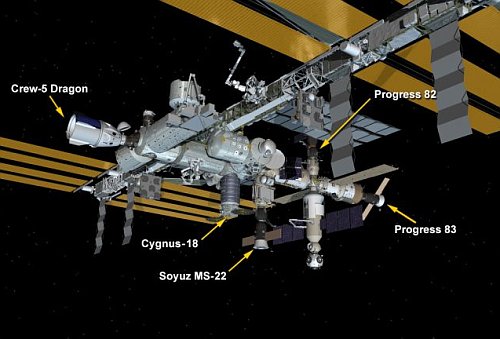
ISS as of November 28, 2022
ISS after November 28, 2022 docking of unmanned Dragon freighter.
MS-22 is the Soyuz capsule that is leaking.

The Russian investigators yesterday concluded that the coolant leak on the Soyuz capsule docked to ISS was caused by an external impact, either by a meteroid or a small piece of space junk.

A decision on whether this capsule is still usable for manned flight will be made sometime in January. If not, Russia will move up the launch of the next Soyuz to ISS one month from March to February, but launch it empty. If so, managers will leave the schedule as is.

If the engineers determine the capsule is not flightworthy, it will mean however that until February, ISS is short one lifeboat. At present there are two Dragon capsules docked to ISS, one manned and one cargo. Both return to Earth with a habitable interior, but the cargo capsule is not intended for manned flight. In an emergency however it might be possible to use it.

This situation suggests that NASA should pay to get SpaceX to upgrade the cargo Dragons so that they could always be used as an emergency lifeboat.

9 comments

Soyuz hole not caused by a Geminid meteor

According to an analysis by both NASA and Russian engineers, the 0.8 mm hole in the coolant system on the Soyuz docked to ISS was not caused by an object from the Geminid meteor shower that had occurred about the time the leak appeared.

The Soyuz vehicle, known as MS-22, sprayed its coolant into space on Dec. 14, the same day that the annual Geminid meteor shower peaked. But there’s no causal connection, NASA and Russian space officials said. “We did look at the meteor showers that were occurring,” Joel Montalbano, NASA’s International Space Station program manager, said during a press briefing on Thursday (Dec. 22). “Both the trajectory team in Houston and the trajectory team in Moscow confirmed it was not from the meteor showers; it was in the wrong direction.”

The engineers claim the hole could still have been caused by an impact, just not from these meteors.

0 comments

Russians preparing replacement Soyuz for launch to ISS

ISS as of November 28, 2022
ISS after November 28, 2022 docking of unmanned Dragon freighter.
MS-22 is the Soyuz capsule that is leaking.

Though a final decision will not be made until the completion on December 27, 2022 of their investigation into the leak in the coolant system of the Soyuz capsule docked to ISS, the Russians have begun preparing a replacement Soyuz for launch.

A backup spacecraft to bring cosmonauts aboard the International Space Station (ISS) back to Earth will be prepared by February 19 and the spaceship is currently undergoing tests at the Baikonur spaceport, Roscosmos Chief Yury Borisov said on Monday.

That replacement Soyuz was supposed to launch in March, which means they can only accelerate its preparation by about a month. Assuming it is determined that the leaking capsule cannot be used safely as a lifeboat, this means that until February the station does not have its standard complement of lifeboats.

Should something happen that requires an immediate evacuation before February, it might be possible to get an extra three people into the two Dragon capsules presently docked to ISS, since each was designed to carry a maximum of six passengers, though generally four is considered their maximum capacity.

4 comments

Temperature in leaking Soyuz capsule drops

According to Russia’s state-run press TASS, the temperature in its leaking Soyuz capsule on ISS has now dropped to between 50 to 54 degrees Fahrenheit.

The language of the report suggests this temperature drop was the result of actions by Russia’s mission control, but that is decidedly unclear. With the thermal control system now depressurized, the capsule’s temperature could fluctuate a lot, depending on whether it is in shadow or sunlight, a condition dependent on the overall orientation of ISS itself.

A second TASS report today said that two Russian working groups are reviewing the data, and will decide around December 27th what the next step will be, including the possibility of launching a Soyuz capsule unmanned to replace this capsule.

“I believe that at the end of December, somewhere on the 27th [of December], specialists – and now two working groups have been set up – will decide on how we will resolve this situation,” [Yuri Borisov] the Roscosmos head, said in an interview with the daily Izvestia.

There is plenty of time for making decisions and “there is no hurry,” Borisov stressed.

What Borisov was really saying is that there is no reason to panic, but action must be taken without unnecessary delay.

5 comments

Russians test thrusters on leaking Soyuz

In the continuing investigation into the leak of coolant from a Soyuz capsule docked to ISS, Russian engineers yesterday tested the capsule’s thrusters, finding they functioned as normal.

As part of the ongoing evaluation and investigation, Roscosmos flight controllers conducted a successful test of the Soyuz MS-22 thrusters at 3:08 a.m. EST Friday, Dec. 16. The systems that were tested were nominal, and Roscosmos assessments of additional Soyuz systems continue. Temperatures and humidity within the Soyuz spacecraft, which remains docked to the Rassvet module, are within acceptable limits.

The highlighted words have been the Russians’ way of downplaying a serious concern. According to their own data, the temperatures in the capsule have now risen to 86 degrees Fahrenheit, which though entirely safe is higher than normal for within habitable spacecraft. Should those temperatures continue to rise, it will start to become a problem.

One solution would be circulate cooler air from the rest of the station. I suspect this is possible with equipment on board, but do not know for sure.

Right now however it surely appears that it would likely not be wise to return its crew to Earth in this capsule, and that a replacement will be required.

3 comments

Russian official: Soyuz leak possibly caused by micrometeorite hit

According to Sergei Krikalev, who heads Roscosmos’ manned program, the leak of coolant from the Soyuz capsule docked at ISS could have been caused by a micrometeorite hit.

Sergei Krikalev, a veteran cosmonaut who serves as the director of crewed space flight programs at Roscosmos, said a meteorite striking one of external radiators of the Soyuz MS-22 capsule could have caused the coolant to escape.

The malfunction could affect the performance of the capsule’s coolant system and the temperature in the equipment section of the capsule but doesn’t endanger the crew, Krikalev said in a statement.

Krikalev said Russian flight controllers were assessing the situation and following temperature indicators on the Soyuz. “There have been no other changes in parameters on the Soyuz spacecraft and the station, so there is no threat for the crew,” he said.

The “equipment section of the capsule” is its service module, not its habitable orbital module or descent module.

Krikalev, the first Russian to fly on the space shuttle and occupy ISS, is a generally very reliable source. He is speculating, but not wildly but based on what is so far known. The upcoming inspection of the Soyuz using an ISS robot arm will soon tell us whether he is right or not. Krikalev also said that the inspection will tell them whether this capsule can be used to return its astronauts to Earth.

9 comments

December 15, 2022 Quick space links

Courtesy of Jay, BtB’s stringer. All the links today have to do with the Soyuz capsule that is leaking on ISS.


  • Details about the leaking coolant are described here and here.
  • The second link provides a description of the cooling system that is leaking. It appears the leaking material could be water, or “Isooctan LZ-TK-2”.


1 comment

Soyuz manned capsule docked to ISS is apparently leaking something

A spacewalk today was cancelled when it was suddenly noticed that some unknown substance was leaking from one of the Soyuz manned capsules docked to ISS.

During preparations for this evening’s planned spacewalk by Roscosmos cosmonauts Sergey Prokopyev and Dmitri Petelin, ground teams noticed significant leaking of an unknown substance from the aft portion of the Soyuz MS-22 spacecraft docked to the Rassvet module on the International Space Station. The spacewalk has been canceled, and ground teams in Moscow are evaluating the nature of the fluid and potential impacts to the integrity of the Soyuz spacecraft, which carried Prokopyev, Petelin, and NASA astronaut Frank Rubio into space after launching from the Baikonur Cosmodrome in Kazakhstan on Sept. 21.

The big question is whether this leak will impact the capsule’s function as a lifeboat or a return vehicle for the three astronauts it brought into space. If so, then an empty manned capsule needs to be launched, either by the Russians or SpaceX, though if the latter someone would have to pay the cost.

6 comments

Russia launches three astronauts to ISS; China launches Earth observation satellite

Russia today successfully used its Soyuz-2 rocket to launch three astronauts to ISS, two Russians and an American flying as part of the NASA-Roscosmos barter deal whereby each agency flies an astronaut from the other in order to make sure everyone knows how to use each other’s equipment.

China in turn today used its Long March 2D rocket to launch an Earth observations satellite into orbit.

The leaders in the 2022 launch race:

42 SpaceX
38 China
12 Russia
7 Rocket Lab
5 ULA

American private enterprise still leads China 58 to 38 in the national rankings, and is now tied with the entire world combined at 58.

0 comments

September 8, 2022 Quick space links

Courtesy of string Jay:

2 comments
1 2 3 4 15