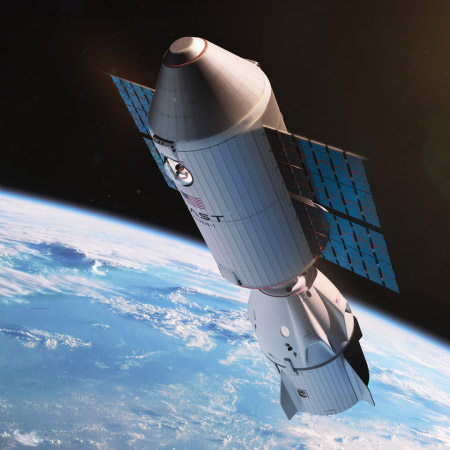
NASA abandons core module idea for its commercial space station program
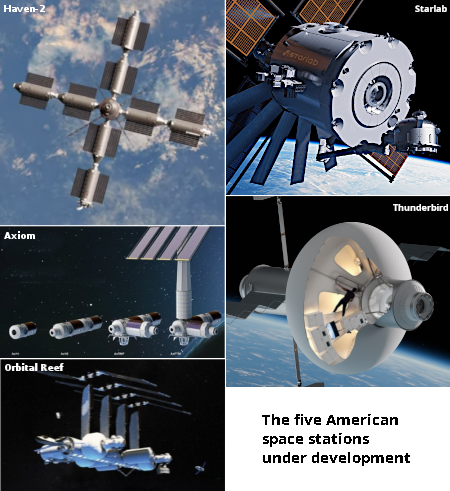
The American space stations under development

Bowing to the unanimous opposition by the three most advanced commercial space station startups, NASA official Bethany Stevens yesterday announced that it is abandoning its proposed core module space station concept and returning its commercial space station program to its original plan, whereby the private stations all compete independently.

Industry has provided extensive feedback making the case for a sustainable commercial market in which NASA is one customer among many, along with assurances regarding available transportation capabilities. The industry position will now shape the path forward as NASA proceeds with the original commercial strategy.

Over the coming weeks, NASA will work with stakeholders and industry to refine flexible requirements and acquisition plans, with a draft RFP expected later this month.

The original plan was for the private sector to compete for one or two major construction contracts from NASA. The core module approach, put forth under NASA administrator Jared Isaacman’s leadership in March, instead made them all part of a government space station, like ISS, at least initially. Under that plan the new commercial space stations would attach their first modules to a government-built core module that NASA would first build and own. Isaacman proposed this because he and NASA believed it didn’t have the budget to finance more than one commercial station, and that the agency didn’t think there was sufficient market to make up the difference.

Officials from Vast, Starlab, Axiom and elsewhere all expressed opposition to the core module plan, insisting there was sufficient market to finance their stations, even without NASA. They also opposed the core module plan because it would require major changes in their present designs, and they had great doubt NASA could build that core module quickly enough for their financial purposes.

Isaacman and NASA apparently listened to these objections, and were convinced their idea was a mistake and the industry was right. It is now reviewing its budget and will decide whether it can do what it originally hoped, award two stations a major contract.

Either way, the recent news from all these three stations suggests they are increasingly in a strong position, whether or not they win that NASA contract.

6 comments

Vast opens Japanese office

As part of its recent push to establish links with as many foreign governments as possible, Vast announced earlier this week the opening of a new Japanese office, to be headed by a retired Japanese astronaut.

In November Vast announced preliminary agreements with Uzbekistan, the Maldives, and Columbia. This new office in Japan continues that trend. The company is clearly marketing its demonstration single module space station Haven-1 to these international customers. None have yet committed to a flight, but expect a lot of action once Haven-1 launches in the spring and is proven operational. The company wants to fly four 30-day manned missions to the module during its three year mission, and if launched successfully these international customers are likely to sign on for flights.

0 comments

Starlab picks Leidos to assemble, integrate, and test its space station prior to launch

Starlab design in 2025
The Starlab design in 2025. Click
for original image.

The consortium building the large single-module Starlab space station (intended to launch on Starship) yesterday picked the American company Leidos to assemble, integrate, and test its station prior to launch.

Leidos will assemble and integrate the components of Starlab’s space station into a complete system, supporting compatibility and verifying performance through environmental, functional and performance testing in Alabama. Additional responsibilities under the agreement include safety and mission assurance and systems engineering.

Since the consortium’s lead company, Voyager Space, raised nearly $400 million in its first public stock offering in June, Starlab has been signing up a lot of new partners, many of which like Leidos are aimed at building the station itself. First it signed the company Journey to design the station’s interior. Then it signed the Louisiana space hardware company Vivace to build Starlab’s primary structure. Next, a Belgium software company specializing in payload integration joined the consortium. Finally Voyager last week acquired the satellite electric propulsion company Exoterra. Initially I thought this last acquisition was aimed at increasing Voyager’s ability to win military contracts, but it also could provide the station itself with a system for orientation and propulsion.

All in all, this activity continues to strengthen Starlab’s position in the competition to win major contracts and customers leading to the construction of the station itself. Below is my updated rankings of the four commercial stations under development:
» Read more

18 comments

Axiom hires Redwire to build the solar panels for its first station module

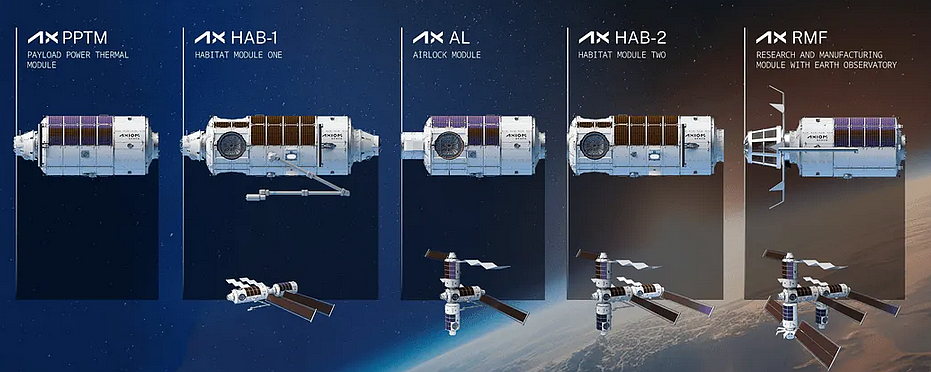
Axiom's new module assembly sequence
Axiom’s assembly sequence for its planned station, initially attached to ISS but subsequently detached

The space station startup Axiom today announced that it has signed an agreement with the space hardware company Redwire to build the solar panels for its first station module, now under construction.

The companies announced Sept. 25 that Redwire will provide a version of its Roll-Out Solar Array, or ROSA, to Axiom for use on Axiom Station’s Payload Power Thermal Module, known as AxPPTM. AxPPTM is the first module Axiom plans to launch for its commercial station. Under a revised assembly schedule announced last December, AxPPTM will berth with one of two ports on the International Space Station used by Cygnus cargo spacecraft.

It would remain there until Axiom launches a second module, called Hab1. At that point, AxPPTM would unberth from the ISS and dock with Hab1, forming the initial station that can support four-person crews. Axiom would later add more modules.

At present Axiom is targeting a 2026 launch of the AxPPTM module. The hull, built by Thales Alenia, is presently being tested in Europe, and is expected to shipped to Houston for integration later this year.

The four commercial stations under development, ranked by me based on their present level of progress:
» Read more

12 comments

Voyager Technologies raises nearly $400 million in first public stock offering

Starlab design in 2025
The Starlab design in 2025. Click
for original image.

The space station startup Voyager Technologies has now raised $383 million during its first public stock offering this week, with the possibility of more investment capital to come.

The six-year-old provider of mission-critical space and defense technology solutions sold 12.35 million shares at $31 each, pricing above the $26–$29 range it marketed last week. The Denver-based company had initially planned to offer 11 million shares.

Underwriters also have a 30-day option to purchase up to 1.85 million additional shares of the company’s Class A common stock, up from 1.65 million, trading under the ticker symbol VOYG.

Of the four private commercial space stations under development, Voyager is the only one to have so far built nothing. Its station, dubbed Starlab, is conceived as a single large module launched on SpaceX’s Starship/Superheavy rocket. Though the company has obtained a $217.5 million development grant from NASA, and is partnering with Airbus, Northrop Grumman, and the European Space Agency, it has focused so far all of its work on design.

We must assume the company intends to use this additional public capital to begin some construction. It likely needs to if it is to have any chance of winning NASA’s major contract for building the station itself, since all of its other competitors are doing so. My present rankings for these four projects:

  • Haven-1, being built by Vast, with no NASA funds. The company is moving fast, with Haven-1 to launch and be occupied in 2026 for an estimated 30 days total. It hopes this actual hardware and manned mission will put it in the lead to win NASA’s phase 2 contract, from which it will build its much larger mult-module Haven-2 station..
  • Axiom, being built by Axiom, has launched three tourist flights to ISS, with a fourth to launch momentarily, carrying passengers from India, Hungary, and Poland. Though there have been rumors it has cash flow issues, development of its first module has been proceeding more or less as planned.
  • Orbital Reef, being built by a consortium led by Blue Origin and Sierra Space. Overall, Blue Origin has built almost nothing, while Sierra Space has successfully tested its inflatable modules, including a full scale version, and appears ready to start building its module for launch.
  • Starlab, being built by a consortium led by Voyager Space, Airbus, and Northrop Grumman, with an extensive partnership agreement with the European Space Agency. It recently had its station design approved by NASA, but it has built nothing. The company however has now raised $383 million in a public stock offering, which in addition to the $217.5 million provided by NASA gives it the capital to begin some construction.
5 comments

Vast delays launch of Haven-1 space module to May 2026

Haven-1 with docked Dragon capsule

The space station startup Vast yesterday announced that it had revised its overall schedule, delaying the launch of its Haven-1 space module from August 2025 to May 2026.

Based on their testing program this delay had become increasingly expected. They have only now begu testing of the primary structure qualification article of this module, with it passing its first pressure tests. Vibration testing is still to come. This makes the August 2025 target date impossible.

The plan now is to begin construction of the actual module as soon as this testing is complete in about a month, with the primary structure ready in July. Integration and testing will then follow to be completed by March 2026.

The launch of Haven-1 on a Falcon 9 rocket is now targeting May 2026, with its 30-day four-person crewed mission to launch no earlier than the end of June 2026.

As the company notes,

Vast was founded in 2021. At the time, NASA had already launched the CLD program and awarded funding to [three] other [space station] companies. Recognizing the need for a leapfrog strategy, we developed Haven-1 to set us apart. When NASA selects its partner(s) to carry forward its low-Earth orbit (LEO) legacy, we will be the only company operating a crewed space station—one we designed, built, tested, and verified for safety entirely in-house.

…Every lesson learned from Haven-1 will be applied to our CLD Phase II proposal—Haven-2. No team will have more operational experience than Vast. No design will carry as much flight heritage. No company will be better positioned to deliver for NASA as fast—thanks to our work and over $1 billion investment in Haven-1 ahead of CLD Phase II.

This strategy all depends of course on getting Haven-1 launched as planned. Based on the company’s operations so far, the odds appear high that it will meet this new schedule. There are no guarantees however.

5 comments

Northrop Grumman abandons its own proposed space station; partners with Voyager’s Starlab

Northrop Grumman today officially confirmed rumors from earlier this week: It is abandoning construction of its own proposed space station and will instead join Voyager Space’s Starlab station project, using an upgraded version of its Cygnus freighter to be the station’s cargo ferry.

As part of this new partnership, Northrop will provide cargo services to Starlab for up to five years. The upgrades will allow Cygnus to dock directly to a station port, rather than rendezvous and get berthed using a robot arm. This upgrade will also make Cygnus a more saleable product for providing cargo to other stations as well, as they come on line.

Northrop Grumman was one of four proposed private space stations projects that won NASA contracts, Axiom in 2020 and the other three in December 2021, with its award fixed at $125.6 million, of which $36.6 million has been paid to the company for meeting specific development milestones. NASA is now going to distribute the rest of that award among the remaining projects after some renegotiations.

0 comments

Space station builder Voyager raises $80 million in private investment capital

Capitalism in space: Voyager Space, one of three companies that NASA has provided funds to build a private space station, has now raised $80 million in private investment capital.

The funding includes participation from NewSpace Capital, Midway Venture Partners and Industrious Ventures, according to U.S. Securities and Exchange Commission filings and other documents viewed by TechCrunch. Seraphim Space also participated, TechCrunch has confirmed. The funding was filed with the SEC on January 27.

The company is building Starlab in partnership with Nanoracks (which is the majority owner of Voyager) and Lockheed Martin, which has already received $160 million from NASA.

1 comment

NASA again approves design concept for Orbital Reef commercial space station

Proposed Orbital Reef space station

Capitalism in space: Sierra Space announced today that NASA has completed, apparently for the second time, the design review for the Orbital Reef space station that the company wants to build in partnership with Blue Origin and others, thus allowing the actual design of the station to begin.

This press release announcement, on August 22, 2022, is a bit puzzling, as Sierra Space made almost the exact same announcement in April 2022. What, did NASA have to do this twice? Did issues come up after the first approval? Was the agency reviewing different things?

Regardless, NASA as usual is slowing things down considerably. Sierra Space and Blue Origin, the primary partners in this private space station project, first announced it in October 2021. It took the government almost a year to simply approve the basic concept so that the design phase could finally begin. At this pace it will be 2090 before the station is launched.

13 comments

NASA’s safety panel questions NASA commitment to commercial space stations

We’re here to help you! Not surprisingly, members of NASA’s safety panel have once again expressed doubts about NASA’s ongoing effort to encourage a thriving private, competitive, and efficient commercial space industry, this time questioning the transition from NASA’s government-built space station, ISS, to privately-built and owned space stations, four of which are presently under development.

At a July 21 meeting of the Aerospace Safety Advisory Panel, members said they were concerned that commercial stations whose development is being supported by NASA were unlikely to be ready in time before the ISS is retired at the end of the decade, and that those efforts suffered from insufficient budgets.

Those plans, called Commercial Leo Earth Orbit (LEO) Destinations by NASA, “are on a precarious trajectory to realization on a schedule and within the projected resources needed to maintain a NASA LEO presence,” said Patricia Sanders, chair of the panel. “This is an area of concern for us.”

The panelists also questioned how quickly the stations would be man-rated (claiming NASA was not allocating enough time to do so) as well as whether NASA had enough work for four stations.

For the past decade this safety panel has consistently shown itself to be hostile to the new commercial space companies. It has never seen any safety issues or scheduling problems with NASA’s big SLS rocket. Nor did it notice Boeing’s significant software and valve problems on Starliner. Yet somehow, the work of SpaceX was dangerous (when it was not), and now these new stations, most of which are being built by new space companies, are equally unfit for use.

It is time to shut down this panel. Or at a minimum fire its present members and bring in new blood more willing to look at the entire space industry with a more objective eye.

9 comments

SpaceX’s failure to win space station NASA contract reveals where the company is weak

Jeff Foust of Space News today has a detailed article detailing NASA’s decision-making process that led to its awarding Blue Origin, Northrop Grummann, and Nanoracks development contracts for their proposed commercial and private space station.

The article not only describes NASA’s analysis of each winning bid, it also describes the analysis of some of the eight bids that lost. Most interesting were the strengths and weaknesses NASA saw from SpaceX’s bid.

The company won strengths based on its technical maturity linked to HLS proposal (the Starship lunar lander) and a “strong approach” to communications that appeared to be associated with SpaceX’s Starlink constellation. However, NASA assessed several weaknesses because of a lack of details about its concept, including how it will accommodate payloads and scale up an environmental control system for long-duration missions. [emphasis mine]

While SpaceX so far has proven itself to be a brilliant rocket and engineering company — achieving things that everyone else said couldn’t be done and doing so so quickly it takes your breath away — the company has so far appeared to have little understanding or knowledge about the complexities of building an interplanetary manned vessel. This NASA analysis, as noted by the highlighted phrases in the quote above, underlines that impression.

None of this precludes SpaceX from gaining that knowledge and applying it to the engineering of future Starship designs. This information however shows that the company still lacks this knowledge. It apparently has still not tackled the job of designing the insides of Starship, only its rocketry for getting into orbit.

10 comments

NASA awards contracts to three private space station projects

Capitalism in space: NASA today announced development contract awards to three different private space station projects.

  • Nanoracks Starlab concept won $160 million. Partners include Voyager Space and Lockheed Martin.
  • Blue Origin’s Orbital Reef project was awarded $130 million, partnering with Sierra Space, Boeing, and Redwire.
  • Northrop Grumman won $125.6 million on a concept based on upgrades to its Cygnus freighter.

All three contracts are Space Act agreements, designed by NASA to jumpstart the companies and their design efforts. All three are in addition to the effort by Axiom to build its own ISS modules that will eventually detach to form its own independent station.

That’s four private American space stations now in the works. All are aiming to launch before this decade is out.

7 comments

Crew on China’s space station complete first spacewalk

The crew on China’s Tianhe space station have successfully completed their first spacewalk, with two astronauts spending 6.5 hours on the exterior of the station, testing their new spacesuits, the station’s robot arm, and the overall equipment used during such outside activities.

Zhai Zhigang was doing his second spacewalk, the first in thirteen years. Wang Yaping was doing her first, which made her the first Chinese woman to walk in space. This was her second space mission, the first in 2013 when she was the second Chinese woman fly in space.

The third crew member, Ye Guangfu, stayed on aboard the station to coordinate activities with the crew outside.

The crew is expected to do one to two more spacewalks during the rest of their six month mission. During that time two more large modules will be launched to the station.

0 comments

China’s space station

The new colonial movement: China’s propaganda news services today released an article outlining in a somewhat superficial manner the overall design and program of its first full-sized space station, Tiangong-3.

The article does not really provide any new information that was not already reported back in 2016, except for this intriguing detail:

The Long March-2F carrier rocket and Shenzhou manned spacecraft will be used to transport crew and some materials between Earth and the space station. The Shenzhou can carry three astronauts and be used as a rescue spacecraft in emergency.

Earlier reports had suggested they would be using their as-yet unnamed second generation manned capsule and the Long March 5B for these functions. It now appears that they are planning to use both manned ships, probably beginning with the Shenzhou and transitioning to the new manned capsule over time.

The article also describes again their plan to launch and fly in formation with the station a two-meter optical telescope, maintaining it in orbit during the 10-year life of the station using crew from the station. This concept was one that NASA actually considered when it was first conceiving Hubble, but put aside when it was realized that the U.S. station would not launch in time.

Note also that this Chinese space telescope is only slightly smaller than Hubble, its mirror 2 meters across compared to Hubble’s 2.4 meter diameter. It will thus be the second largest optical telescope ever launched, and if it works will allow for astronomical research that will dwarf all the giant ground-based telescopes western astronomers have spent all their time and millions building in the past two decades, rather than launch several Hubble twins.

1 comment

India to build its own space station

The new colonial movement: India announced yesterday that it is beginning design work on its own space station, with a plan to begin construction and launch following its first manned mission, dubbed Gaganyaan, in 2022.

Giving out broad contours of the planned space station, Dr. Sivan [head of India’s space agency ISRO] said it has been envisaged to weigh 20 tonnes and will be placed in an orbit of 400 kms above earth where astronauts can stay for 15-20 days. The time frame is 5-7 years after Gaganyaan, he stated.

The announcement came out of the first meeting of what ISRO calls its Gaganyaan National Advisory Council, designed to bring together people from India’s space industry to prepare for that first manned flight in 2022.

0 comments

China offers its space station to the UN

The United Nations and China have signed an agreement whereby UN member nations can apply to run experiments on China’s space station, due to become operational in the 2020s.

The UN press release states that it is especially interested in applications from developing nations.

This isn’t a surprise. China is following the approach of the Soviet Union under Leonid Brezhnev during the 1970s and 1980s, using its space station program to generate positive international propaganda. This will also give them an opportunity to obtain technology ideas from other nations.

At the same time, this will force China to become more open with other nations, a side effect of Brezhnev’s space station program that was not expected or even wanted by the Russians at the time.

0 comments

Another space station hotel company enters the market

Capitalism in space: A new space station hotel start-up, Orion Span, hopes to launch their first module by 2021, and begin accommodating guests by 2022.

Aurora Station will accommodate four paying guests and two crewmembers; these latter personnel will likely be former astronauts, Bunger said. Most of the guests will probably be private space tourists, at least initially, but Orion Span will be available to a variety of customers, including government space agencies, he added.

And the space hotel will get bigger over time, if everything goes according to plan. As demand grows, Orion Span will launch additional modules to link up with the original core outpost, Bunger said. “Our long-term vision is to sell actual space in those new modules,” he said. “We’re calling that a space condo. So, either for living or subleasing, that’s the future vision here — to create a long-term, sustainable human habitation in LEO [low Earth orbit].”

This makes three companies vying to build the first private space stations, with Bigelow and Axiom Space already in the game.

3 comments

China to ramp up manned missions to build space station

In order to build its space station, beginning in 2019, China will increase its manned mission rate, completing four missions in five years.

This is still a somewhat glacial pace, compared to other nations. It will seem even slower based on what I expect will start happening once a number of competitive private American rockets begin hauling tourists into space.

The article notes one additional tidbit about China’s station. They plan to run 3 to 6 month long missions there.

5 comments
1 2 3 4