Academia makes its first comprehensive attempt to plan science missions to Mars using Starship

Figure 2-2 from the NAS report
Figure 2-2 from the National Academies
of Science report

A new report released today by the National Academies of Science, entitled “Highest Priority Science for the First Human Missions to Mars,” is essentially the first attempt by the planetary science community to plan its future science missions to Mars using the gigantic capabilities that SpaceX’s Starship is expected to provide them.

You can download the report here.

Even though the report made the search for life on Mars its big priority — a bugaboo that NASA and the science community trots out repeatedly to garner clicks from the ignorant propaganda press — this report is radically different then all previous similar NASA studies proposing future Mars exploration, as indicated by the graphics from figure 2-2 of the report to the right. Unlike those past studies, which were badly limited by the inadequate capabilities of any spacecraft NASA could send to Mars, this new report recognizes how much the game is changed by SpaceX’s Starship.

First, the new panel did not attempt to place any limit on any landing zones. Earlier reports had forbidden landings in the high latitudes or high altitudes because of the risks to NASA’s proposed landers. Starship overcomes much of those risks, giving researchers much greater flexibility.

Second, the focus of the missions will not be solely devoted to scientific or geological research, as had been the case for all previous similar reports by NASA and the academic community. Instead, the proposed research goals includes important engineering and human exploration requirements outside of science, including efforts to use the resources on Mars itself as well as find locations better suited for human habitation. Once again, the vastly greater capabilities of Starship influenced this change.

Even more important, the study doesn’t assume the future missions will be unmanned, as all previous NASA reports have done. In fact, it does the opposite, proposing multiple 30-day manned missions, as shown in the graphic. One set of three missions would go to three different locations, while another set of three missions would focus on one place in particular.

Much of this shift towards manned flight I think stemmed from the presence on the panel of representatives from the private companies SpaceX and The Exploration Company (a French startup), as well as an engineer from the National Academy of Engineering. Previously studies were almost always entirely dominated by planetary scientists, so the goals outlined were always focused on their interests. Now the idea of human exploration has become prevalent.

The panel’s work was clearly also influenced by the realization that SpaceX’s Starship is not only far more capable, its first flights are just around the corner. SpaceX plans sending it numerous times to Mars in the very near future, as shown in the graphic below that Elon Musk released during a presentation in May 2025.
» Read more
SpaceX launches 29 more Starlink satellites, sets new record for Falcon 9 reuse, dominates the world in rocketry

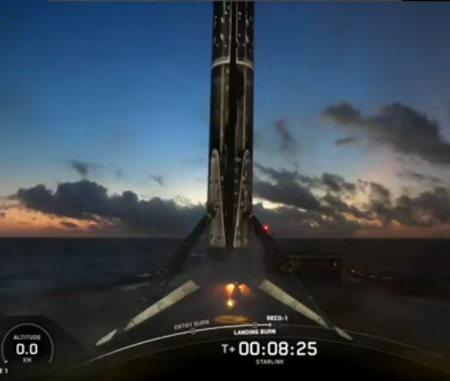
First stage after landing for the 32nd time

SpaceX today launched another 29 Starlink satellites, its Falcon 9 rocket lifting off from the Kennedy Space Center in Florida.

The first stage of its Falcon 9 rocket (B1067) flew for its 32nd time, a new record for a Falcon 9 first stage. As shown in the rankings below of the most reused launch vehicles, this stage is now just one flight from tying the space shuttle Atlantis:

39 Discovery space shuttle
33 Atlantis space shuttle
32 Falcon 9 booster B1067
30 Falcon 9 booster B1071
29 Falcon 9 booster B1063
28 Falcon 9 booster B1069
28 Columbia space shuttle

Sources here and here.

Nor will it be long before SpaceX’s fleet surpasses all the shuttles.

Meanwhile in the 2025 launch race SpaceX’s dominance is overwhelming, as shown by the leader board:
» Read more

SpaceX launches 28 Starlink satellites

SpaceX today successfully launched another 28 Starlink satellites, its Falcon 9 rocket lifting off from Vandenberg Space Force Base in California.

The first stage completed its 12th flight, landing on a drone ship in the Pacific.

The leader board in the 2025 launch race.

160 SpaceX (a new record)
77 China
15 Rocket Lab
15 Russia

SpaceX now leads the rest of the world in successful launches, 160 to 129.

SpaceX to launch another secondary private stock sale, hints at going public

UPDATE: Elon Musk has posted on X that this story is “not accurate.”

According to reports yesterday, SpaceX is about to launch another secondary private stock sale that double the value of the company.

Elon Musk’s SpaceX, is initiating a secondary share sale that would give the company a valuation of up to $800 billion, The Wall Street Journal reported Friday.

SpaceX is also telling some investors it will consider going public possibly around the end of next year, the report said.

At the elevated price, Musk’s aerospace and defense contractor would be valued above ChatGPT maker OpenAI, which wrapped up a share sale at a $500 billion valuation in October.

At $800 billion, SpaceX would be the world’s most valuable private company.

As for going public, nothing is confirmed. Musk has made some comments suggesting he is considering the idea, but at the same time has noted the problems such a act would cause him.

Musk recently discussed whether SpaceX would go public during Tesla’s annual shareholders meeting last month. Musk, who is the CEO of both companies, said he doesn’t love running publicly traded businesses, in part because they draw “spurious lawsuits,” and can “make it very difficult to operate effectively.”

It seems to me it would be a big mistake for Musk to do this. As a public stock-trading company, Musk would lose the freedom he presently has with SpaceX.

Meanwhile, this new private stock offering has done wonders for the value of Echostar’s stock, now that the company’s own stake in SpaceX after selling it some of its FCC licensed spectrum.

SpaceX launches 29 more Starlink satellites

SpaceX today successfully launched another 29 Starlink satellites, its Falcon 9 rocket lifting off from Cape Canaveral in Florida.

The first stage completed its 25th flight, landing on a drone ship in the Atlantic. With this flight, this booster, B1077, has now tied the space shuttle Endeavour in reuses, and is only three behind the Columbia shuttle.

The leaders in the 2025 launch race:

158 SpaceX (a new record)
74 China
15 Rocket Lab
15 Russia

SpaceX now leads the rest of the world in successful launches, 158 to 126.

All eight ports on ISS occupied for the first time; Longest manned mission about to start?

ISS as presently configured
ISS as presently configured. Click for original.

For the first time in its more than quarter century history, all eight docking ports on ISS are occupied, as shown in the graphic to the right.

For the first time in International Space Station history, all eight docking ports aboard the orbital outpost are occupied following the reinstallation of Northrop Grumman’s Cygnus XL cargo spacecraft to the Earth-facing port of the station’s Unity module. The eight spacecraft attached to the complex are: two SpaceX Dragons, Cygnus XL, JAXA’s (Japan Aerospace Exploration Agency) HTV-X1, two Roscosmos Soyuz crew spacecraft, and two Progress cargo ships.

This milestone follows the reattachment of the Cygnus XL spacecraft, supporting the Northrop Grumman-23 commercial resupply services mission for NASA, which was removed last week by the robotics officer at the agency’s Mission Control Center in Houston using the space station’s Canadarm2 robotic arm. The Cygnus XL movement was coordinated between NASA, Northrop Grumman, and Roscosmos to provide appropriate clearance for the arriving crewed Soyuz MS-28 spacecraft on Nov. 27.

Cygnus will remain attached to the orbiting laboratory until no earlier than March 2026, when it is scheduled to safely depart and dispose of up to 11,000 pounds of trash and unneeded cargo when it harmlessly burns up in Earth’s atmosphere.

This situation will not last of course, and in fact it may never happen again before the station is retired around 2030. First, Cygnus will leave in March. Second, one Russian Soyuz capsule will leave shortly, as the presence of two simply indicates a crew rotation is underway.

Third, it is presently unclear when the Russians will be able to launch further Soyuz or Progress capsules. » Read more

SpaceX gets Air Force approval to launch and land Starship/Superheavy at Cape Canaveral

Cape Canaveral

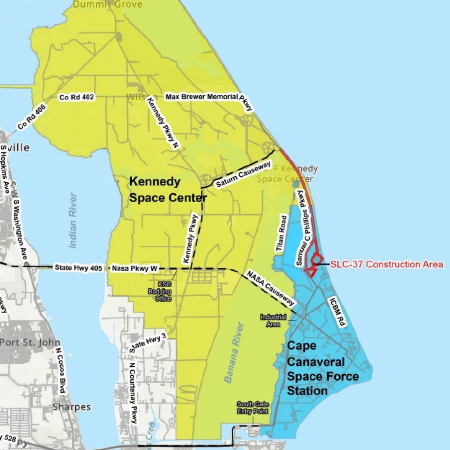
The Air Force announced late yesterday [pdf] that it will now allow SpaceX to launch its Starship/Superheavy rocket at Space Launch Complex 37 (SLC-37) at Cape Canaveral in Florida (as shown on the map to the right) as many as 76 times per year, with twice that number of landings.

The DAF [Department of Air Force] decision authorizes SpaceX to use SLC-37 at CCSFS [Cape Canaveral Space Force Station] to support Starship-Super Heavy launch and landing operations, including the redevelopment of SLC-37 and the other infrastructure improvements required and analyzed in the FEIS [Final Environmental Impact Statement]. Under this ROD [record of decision], upon execution of the real property agreement and associated documentation, and as analyzed in the FEIS while adhering to the mitigation measures specified in Appendix A to this ROD, SpaceX is authorized to: (1) undertake construction activities necessary to re-develop SLC-37 and associated infrastructure for Starship Super Heavy operations; (2) conduct prelaunch operations, including the transportation of launch vehicle components and static fire tests; and (3) conduct up to 76 launches and 152 landings annually once a supplemental analysis of airspace impacts by the Federal Aviation Administration (FAA) is completed. [emphasi mine]

The deal also requires SpaceX to do some road upgrades in order to transport the rocket from its Gigabay to the launch tower. The company immediately announced on X yesterday that it has already begun construction, and expects to have three pads in Florida before all is done.

The final environmental impact statement [pdf] was released on November 20, 2025, and concluded in more than 200 pages that there will be no significant impact from these launch operations, something that should be self-evident after more than three-quarters of century of rocketry at the Cape. The existence of the spaceport acts to protect wildlife, because it limits development across a wide area.

The report suggested that some turtle species and one mouse specie might “affected adversely”, but it it also appears that risk was considered minor and not enough to block development. To deal with this however the impact statement requires SpaceX to do a number of mitigation actions, similar to what it is required to do at Boca Chica.

One fact must be recognized, based on the red tape and delays experienced by SpaceX during the Biden administration. Had Kamala Harris and the cadre that ran the White House under Biden had been in office now, this approval would almost certainly have not happened, or if it did, it would have likely been delayed for a considerable amount of time, into next year at the earliest. It is certain that Trump is clearing the path to prevent red tape and the administrative state from slowing things down unnecessarily.

This announcement also strengthens the likelihood that SpaceX will do at least one launch of Starship/Superheavy from Florida in 2026. And if not then, by 2027 for sure.

Two launches today, by Arianespace and SpaceX

Today there were two launches worldwide, one from South America and the second from the U.S.

First, Arianespace launched a South Korea imaging satellite from French Guiana, using the Vega-C rocket built and owned by the Italian rocket company Avio. Based on the July 2024 agreement, this is the next-to-last Vega-C flight that Arianespace will manage. After the next flight, Avio will take over management of its own rocket, cutting out this government middle man, though that agreement also allowed customers who had previously signed with Arianespace for later flights to stay with it as the managing organization.

Either way, Arianespace’s responsibilities will soon be limited solely to the Ariane-6 rocket, which itself has a limited future, being expendable and too expensive to compete in the present launch market.

Next SpaceX launched another 27 Starlink satellites into orbit, its Falcon 9 lifting off from Vandenberg Space Force Base in California. The first stage completed its 20th flight, landing on a drone ship in the Pacific.

As the Vega-C launch was only the sixth for Europe in 2025, it remains off the leader board for the 2025 launch race:

157 SpaceX (a new record)
74 China
15 Rocket Lab
15 Russia

SpaceX now leads the rest of the world in successful launches, 157 to 126.

Russia still using black market Starlink terminals on its drones

In its war with the Ukraine, it appears Russia is still managing to obtain black market Starlink mini-terminals for use on its drones, despite an effort since 2024 to block access.

According to Defense Express on November 30, imagery has emerged showing what appears to be a Russian “Molniya”-type drone fitted with a mini-Starlink unit, reportedly observed near the Pokrovsk sector in eastern Ukraine. The configuration—an off-the-shelf satellite internet terminal strapped to a drone—suggests improvised but functional integration, consistent with past sightings. The drone’s design and power unit indicate it is of Russian origin, likely a variation of the Molniya unmanned aerial vehicle, which is known for its low-cost, modular construction.

The use of Starlink terminals on Russian drones was first publicly reported in early 2024. Since then, Ukrainian forces have documented multiple instances of their use, including on Shahed-136 drones and larger UAVs such as the RD-8 “mothership” drone, which is reportedly capable of controlling other loitering munitions using satellite connectivity. The main concern raised by Ukrainian defense observers is that Starlink-based control enables extended-range communications, allowing Russian drones to conduct reconnaissance or strike missions far from ground-based operators.

SpaceX has made no comment on this issue. According to the article, the Ukraine is “exploring alternative European satellite providers in response, seeking more secure and controllable communications infrastructure for military operations.” While switching to another satellite provider might allow the Ukraine to shut Starlink down and prevent the Russians from using it within its territory, doing so would likely do more harm to the Ukraine’s military effort than Russia’s. There isn’t really any other service comparable at this time. And when Amazon’s Leo system comes on line it will face the same black market issues. I doubt it will have any more success than SpaceX in preventing Russia from obtaining its terminals.

Overall this issue is probably not a serious one militarily, however. Russia is not likely capable of obtaining enough black market terminals to make any significant difference on the battlefield.

This story however highlights a positive aspect of these new constellations. Just as Russia can’t be prevented from obtaining black market terminals, neither can the oppressed citizens in totalitarian nations like Russia and China be blocked as well. These constellations as designed act to defeat the censorship and information control of such nations, a very good thing.

SpaceX launches another 29 Starlink satellites

SpaceX in the early morning hours today successfully launched 29 more Starlink satellites, its Falcon 9 rocket lifting off from the Kennedy Space Center in Florida.

The first stage completed its fourth flight, landing on a drone ship in the Atlantic.

The leaders in the 2025 launch race:

156 SpaceX (a new record)
74 China
15 Rocket Lab
15 Russia

SpaceX now leads the rest of the world in successful launches, 156 to 125.

SpaceX launches another Transporter mission, including dozens of smallsats

SpaceX today successfully completed its fifteenth Transporter mission of smallsats, its Falcon 9 rocket lifting off from Vandenberg Space Force Base in California.

The two major customers for this mission were Planet Lab, placing 36 satellites for its imagery constellation, and Exolaunch, which acts as a launch manager for smallsat companies. It placed 58 payloads in orbit for many various companies. Another launch manager company, SEOPS, launched 7 payloads, while the European aerospace company OHB launched 8. Among the other payloads was Varda’s fifth re-usable capsule.

The rocket’s two fairings completed their fourth and fifth flights respectively. The first stage (B1071) completed its 30th flight, landing on a drone ship in the Pacific. With this launch this booster become the second SpaceX first stage to achieve at least thirty flights. As the rankings for the most reused launch vehicles below show, SpaceX now has four boosters close to becoming the most reused rockets ever.

39 Discovery space shuttle
33 Atlantis space shuttle
31 Falcon 9 booster B1067
30 Falcon 9 booster B1071
29 Falcon 9 booster B1063
28 Falcon 9 booster B1069
28 Columbia space shuttle

Sources here and here.

The leaders in the 2025 launch race:

155 SpaceX (a new record)
73 China
15 Rocket Lab
15 Russia

SpaceX now leads the rest of the world in successful launches, 155 to 124.

SpaceX launches 28 Starlink satellites; 1st stage flies for first time

UPDATE: When I wrote this post, several sources stated that the first stage was flying for its thirtieth time. I relied on those sources. As it turns out, they were wrong. The first stage on this launch was flying for its first time. The post below has been rewritten to correct this error.

———————–
SpaceX early this morning successfully placed another 28 Starlink satellites into orbit, its Falcon 9 rocket lifting off from Vandenberg Space Force Base in California.

The first stage completed its first flight, landing on a drone ship in the Pacific.

The leaders in the 2025 launch race:

154 SpaceX (a new record)
72 China
15 Rocket Lab
13 Russia

SpaceX now leads the rest of the world in successful launches, 154 to 120.

SpaceX issues 1st statement regarding Superheavy test explosion

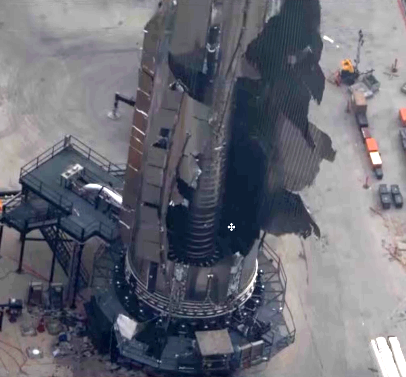
Damaged Superheavy
Click for original image.

SpaceX yesterday issued its first update regarding the explosion in the lower half of the Superheavy booster that it had planned to fly on the next orbital test flight.

Booster 18 suffered an anomaly during gas system pressure testing that we were conducting in advance of structural proof testing. No propellant was on the vehicle, and engines were not yet installed. The teams need time to investigate before we are confident of the cause. No one was injured as we maintain a safe distance for personnel during this type of testing. The site remains clear and we are working plans to safely reenter the site.

That no propellant was involved explains why the booster and test pad experienced relatively little damage. They were likely pumping nitrogen through the system to test it, and while something exploded, the gases were not volatile.

The picture to the right is a screen capture from aerial drone flights performed by RGV Aerial Photography and posted on nasaspaceflight.com. I have enhanced it to bring out the details. Note the lack of damage on all sides of the booster at its base. The explosion was clearly confined to the booster, and appears to have occurred from within.

SpaceX launches 29 more Starlink satellites

SpaceX early this morning successfully launched another 29 Starlink satellites, its Falcon 9 rocket lifting off from Cape Canaveral in Florida.

The first stage completed its 9th flight, landing on a drone ship in the Atlantic.

The leaders in the 2025 launch race:

153 SpaceX (a new record)
72 China
15 Rocket Lab
13 Russia

SpaceX now leads the rest of the world in successful launches, 153 to 120.

Superheavy intended for next test flight damaged during static fire test

Damaged Superheavy
Click for source.

According to video taken by the Labpadre live stream of SpaceX’s operations at Boca Chica, the Superheavy booster that the company was preparing for the next orbital test flight was damaged while it was being fueled for a static fire test.

The video, which I have embedded below, suggests a tank rupture occurred in the booster’s lower section, where its main oxygen tanks are located. Another post-incident image from different source on social media and to the right, shows the hull of that section badly deformed, with the far side not visible apparently blown out. It also appears the test stand experienced no or little damage.

This incident will likely delay the next orbital Starship/Superheavy test flight, but not significantly. SpaceX has more prototype Superheavys in the queue. While it might need to do some quick additional work preparing one, that should’t slow things down by much.

Figuring out what happened to cause this burst tank is more likely to cause a delay. The company needs to identify and fix the issue before it can proceed.
» Read more

SpaceX launches 29 more Starlink satellites

The beat never stops! SpaceX tonight successfully placed another 29 Starlink satellites into orbit, its Falcon 9 rocket lifting off from the Kennedy Space Center in Florida.

The first stage completed its 23rd flight, landing on a drone ship in the Atlantic.

The leaders in the 2025 launch race:

152 SpaceX (a new record)
71 China
15 Rocket Lab
13 Russia

SpaceX now leads the rest of the world in successful launches, 152 to 119.

SpaceX and China complete launches

Two launches on opposites sides of the globe this evening.

First, SpaceX launched another 29 Starlink satellites into orbit, its Falcon 9 rocket lifting off from Cape Canaveral. The first stage completed its 12th flight, landing on a drone ship in the Atlantic.

Next (November 19th local time), China placed three classified satellites into orbit, its Long March 2C rocket lifting off from its Jiuquan spaceport in northwest China. China’s state-run press would only say the satellites were for “space environment exploration and related technology verification,” an utterly meaningless statement. That state-run press also said nothing about where the rocket’s lower stages, using very toxic hypergolic fuels, crashed inside China.

The leaders in the 2025 launch race:

151 SpaceX (a new record)
71 China (a new record)
14 Rocket Lab
13 Russia

SpaceX now leads the rest of the world in successful launches, 151 to 118.

Mexican anti-Musk activists whine about SpaceX’s Boca Chica launch operations

Chicken Little is once again panicking

Mexican anti-Musk activists have now announced new complaints against SpaceX’s Boca Chica launch operations, claiming the soft-splash down of its Superheavy boosters in the Gulf of Mexico is damaging marine life, and the company’s effort to remove its stage and debris is further damaging the ocean floor.

Conibio Global A.C., a marine biodiversity organization in Mexico, launched “Expedition Booster 2025” this summer in partnership with the state of Tamaulipas and the Universidad Autónoma de Tamaulipas. The group is studying how booster landings near Playa Bagdad may be affecting wildlife and nearby communities. “We have 20 kilometers of space debris, which amounts to tons,” said Jesus Elias Ibarra Rodriguez, president of Conibio Global A.C. “If you go right now, you’ll find three or five pieces of plastic or metal or electrical parts from the thruster, even tanks—there is already a lot of debris.”

Researchers report that sea turtles and dolphins often mistake smaller debris for food, which can lead to deadly ingestion. They also documented debris fragments measuring between two and 10 meters long. According to the group, 3-D sonar imaging shows that a platform used in July to remove debris may have caused additional damage to the seafloor. “This platform has three structures that were sunk and anchored to the seafloor,” Rodriguez said. “During the investigation, we realized that it caused damage and holes when its structures were wedged in while removing the engines, and the engines were damaging the seabed and the species that live in the area.”

In other words, SpaceX is evil for dropping Superheavy in the Gulf, and it is also evil for removing it. Or to put this in real terms, these activists simply don’t want SpaceX to do anything. Their goal is to shut the company down entirely.

Moreover, their research is clearly bogus and overwrought. The entire world has been dropping lower stages in the oceans for more than three-quarters of a century, with no documented harm to marine life or the oceans. These faux scientists are simply puffing up their work to use this as a hammer against SpaceX.

Their complaint meanwhile appears somewhat bogus as well. They are “in communication” with Mexican authorities, and only “plan to present [their] findings” to that government eventually. In other words, their complaint hasn’t been filed with the government, but with our compliant propaganda press (in this case a local Texas news outlet), who are always glad to push the leftist agenda, no matter how idiotic.

Hat tip to Robert Pratt of Pratt on Texas.

Echostar subsidiary Hughesnet now sending its customers to Starlink

Following the purchase by SpaceX of much of Echostar’s spectrum, its subsidiary Hughesnet appears to be on the verge of shutting down as it is now referring its present and future customers to Starlink.

Hughesnet is preparing to refer its own customers to rival Starlink after its parent company, EchoStar, reached a deal to sell radio spectrum to SpaceX. The referral program is mentioned in a 10-Q SEC filing that Hughesnet released on Friday. The 66-page document includes a section about the EchoStar-SpaceX deal and what it means for Hughesnet’s business. “The commercial agreements will also provide for a fee-based referral program that lets us refer existing HughesNet customers and new Starlink customers to SpaceX,” the document says, without elaborating.

The article also notes that the company lacks the cash on hand to function over the next 12 months, and has lost more than half its customer base in the past year.

Thailand rejects Starlink

Because of local laws forbidding the operation of any foreign-owned telecommunications company in Thailand, its government has rejected any sale of Starlink terminals inside the country.

The Digital Economy and Society Ministry has rejected a proposal from SpaceX to provide Starlink low-orbit satellite internet services in Thailand through a 100% foreign-owned company, citing national security concerns and legal restrictions. “If the company wants to set up a wholly owned firm, there will be no opportunity … to cooperate, as telecom ownership is directly linked to our digital security system,” minister Chaichanok Chidchob said on Friday.

This is the same problem that SpaceX has faced in a number of other third world countries, such as India and South Africa. In South Africa the government demanded SpaceX give up some or all of its ownership rights as well as impose a variety of racial or employment quotas that SpaceX considers unacceptable. Thus, no Starlink. In the case of India, the government insisted that its own telecom companies get a cut. SpaceX then managed to negotiate deals with each, where those companies market the Starlink terminals for SpaceX.

Apparently, no such deal has yet been worked out in Thailand.

Expect a deal eventually, however. The article notes that Thailand’s neighbor Vietnam has a Starlink deal allowing its citizens to sign up without restrictions. That agreement is going to put great pressure on Thailand

SpaceX launches NASA ocean radar satellite

SpaceX tonight successfully launched Sentinal-6B, a NASA radar satellite designed to measure the global sea level, its Falcon 9 rocket lifting off from Vandenberg Space Force Base.

The first stage completed its 3rd flight, landing back at Vandenberg.

The leaders in the 2025 launch race:

150 SpaceX (a new record)
70 China
14 Rocket Lab
13 Russia

SpaceX now leads the rest of the world in successful launches, 150 to 117.

Note that until SpaceX began to up its launch rate significantly in 2022, the entire global rocket industry — run entirely by governments — never completed more than 135 successful launches in a single year, and usually failed to make 100 launches. SpaceX is now proving that those global numbers over more than a half century were indicative of the failure of those governments. Those governments controlled everything, and so they prevented innovation, competition, and new ideas.

The transition to capitalism and freedom since 2010 has finally begun to open up space for everyone.

Two more SpaceX launches

SpaceX yesterday completed two launches, placing a total of 58 Starlink satellites into orbit.

First, a Falcon 9 lifted off from the Kennedy Space Center in Florida, carrying 29 Starlink satellites. The first stage completed its 8th flight, landing on a drone ship in the Atlantic.

Four hours later, a second Falcon 9 lifted off from Cape Canaveral, carrying another 29 Starlink satellites. Its first stage completed its 24th flight, also landing on a drone ship in the Atlantic.

The leaders in the 2025 launch race:

149 SpaceX
70 China
14 Rocket Lab
13 Russia

SpaceX now leads the rest of the world in successful launches, 149 to 117.

Uzbekistan signs deal to possibly fly astronauts on Vast’s Haven-1 space station

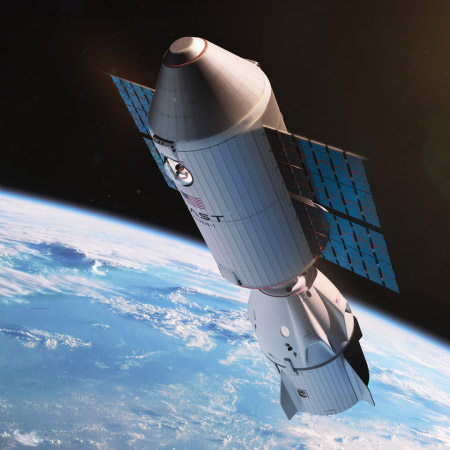
Haven-1 with docked Dragon capsule

According to a press release earlier this week from the Uzbekistan government, it has signed an agreement with the American space station startup Vast to possibly fly its astronauts on Vast’s Haven-1 space station, scheduled for launch early next year for a three year mission that will include four two-week manned occupancies.

The parties discussed prospects for long-term cooperation with Vast, including participation in joint scientific research, personnel exchange programs, and the involvement of Uzbek specialists in upcoming missions following the successful launch of the Haven-1 orbital station.

Discussions also covered the potential involvement of Uzbek scientists and engineers in research on artificial gravity, life support systems, and orbital architecture within the framework of the Haven-2 project, the proposed successor to the International Space Station.

Neither Vast nor Uzbekistan apparently made any firm commitments to fly astronauts to Haven-1, but the agreement clearly laid the groundwork for doing so, if not on Haven-1 then on Vast’s follow-up much larger station, Haven-2. At the moment Vast has not yet announced any of passengers or crew for the four Haven-1 manned missions, so there clearly is room for an astronaut from Uzbekistan, assuming it is able and willing to pay the freight.

Hat tip to BtB’s stringer Jay.

SpaceX signs Starlink deal with major African telecommunication company

In a major deal that will make Starlink available across a wide swath of Africa, SpaceX has now signed an agreement with the African telecommunication company Vodacom, which operates in 47 African countries.

Vodacom will market for SpaceX its Starlink terminals, aimed specifically in rural areas where traditional land lines are not available.

The African company [Vodacom, majority owned by Britain’s Vodafone, has been seeking to ‍close connectivity gaps across the continent through low-earth orbit satellite technology which can help provide internet even in tough terrains. Vodacom will ​integrate Starlink’s satellite technology for data relay into its ‌mobile network and will be authorized to resell equipment and services from the SpaceX-owned firm to customers in Africa, the company said in a statement.

The parent company Vodafone has also signed deals with the satellite constellations being launched by AST SpaceMobile and Amazon, so it is aggressively seeking numerous avenues for getting service to customers in those rural areas.

It appears that Vodafone will have to obtain government permission from each country, but except for South Africa the company does not see this as a serious problem. South Africa however is presently run by communist bigots who are demanding SpaceX impose racial hiring quotas on its operations before approving Starlink, and SpaceX quite rightly is telling it to go pound sand.

Kazakhstan expanding its access to multiple internet satellite constellations

It appears the Kazakhstan government is making multiple internet satellite constellations available to its citizens in an effort to increase competition and lower costs.

Kazakhstan first engaged with Starlink in 2023, following government frustration over the slow pace of domestic telecom expansion. The project initially connected 2,000 rural schools, and by mid-2024 nearly 1,800 had access to satellite internet.

Authorities briefly considered banning satellite internet services operated from abroad late last year, citing national security concerns, but withdrew the proposal after a public backlash.

Meanwhile, competition in the country’s nascent satellite internet market is heating up. In September 2024, Kazakhstan signed an agreement with Amazon to bring its Project Kuiper satellite network to the country, setting up a future rival to Starlink. Prime Minister Olzhas Bektenov said the move would help improve affordability and service quality. Chinese firm Spacesail Kazakhstan, a subsidiary of Spacesail International, has also registered at the Astana International Financial Centre (AIFC) with $17mn in capital, positioning itself as another potential player in the mega-constellation internet sector.

When Kazakhstan opened Starlink to all its citizens in June 2025, I noted how this deal indicated the country’s move away from Russia. Its willingness now to add Kuiper and Spacesail deals accelerates that move, in numerous ways. It not only wants its citizens to have capabilities that Russia cannot control, it wants to encourage competition to lower costs for those citizens. What a concept!

Like the Ukraine, Kazakhstan is working hard to exceed Russia in technology, in order to make it much harder for its big and very power-hungry neighbor to dominate or even invade it.

SpaceX launches 29 more Starlink satellites

Note: My original post mistated the time of launch. Below is a corrected text:

SpaceX tonight at 10:21 pm (Eastern) successfully launched another 29 Starlink satellites, its Falcon 9 rocket lifting off from Cape Canaveral in Florida.

The first stage completed its third flight, landing on a drone ship in the Atlantic.

I specify the launch time because it occurred just outside the FAA’s so-called curfew banning all launches from 6 am to 10 pm local time, due to the government shutdown and a shortage of air traffic controllers to coordinate aviation and rocket launches. Though the Senate today voted to end the shutdown, that shutdown has not yet ended, and won’t until the House passes the Senate budget version and Trump signs it.

Thus, it appears Blue Origin has negotiated an exemption for its now planned launch of New Glenn on November 12, 2025 in the afternoon.

The leaders in the 2025 launch race:

147 SpaceX (a new record)
70 China
14 Rocket Lab
13 Russia

SpaceX now leads the rest of the world in successful launches, 147 to 115.

Note that I had made an error in entering my numbers earlier this week in regards to China, and have now corrected the mistake, thus revising the numbers in the last few launch reports.

Echostar sells more of its licensed spectrum to SpaceX

Echostar announced this week that it has sold additional spectrum that had been licensed to it by the FCC to SpaceX, getting in return about $2.6 billion in SpaceX stock.

EchoStar has entered into an amended definitive agreement with SpaceX to sell the company’s unpaired AWS-3 licenses for approximately $2.6 billion in SpaceX stock valued as of September 2025. This transaction builds on the agreement the companies entered into in September. EchoStar’s unpaired AWS-3 licenses are nationwide and are part of 3GPP Band 70n (1695-1710 MHz uplink). “This transaction with SpaceX, in addition to our previously announced spectrum transactions and commercial agreements, will strengthen EchoStar’s ability to develop new business opportunities and growth in value for our shareholders,” said Hamid Akhavan, CEO, EchoStar Capital. “The combination of AWS-3 uplink, AWS-4 and H-block spectrum from EchoStar with the rocket launch and satellite manufacturing capabilities from SpaceX accelerates the realization of powerful and economical direct-to-cell service offerings for consumers and enterprises worldwide, including our Boost Mobile customers.”

In other words, Echostar was not making any money from this spectrum on its own. By partnering with SpaceX it can do so, because SpaceX has the satellites and rockets capable of making it happen, and a cost that is affordable.

Nor should the companies have much problem getting FCC approval. Echostar had previously been accused of under-utilizing its licensed spectrum. This deal with SpaceX helps solve that issue.

In other Starlink news, SpaceX has begun rolling out Starlink service in India, while also striking a deal with British Airlines to use Starlink on its airplanes.

One launch today by SpaceX, while ULA scrubs for the second time in two days

SpaceX today successfully launched another 28 Starlink satellites, its Falcon 9 rocket lifting off from Vandenberg Space Force Base in California.

The first stage completed its 8th flight, landing on a drone ship in the Atlantic.

ULA for the second day in a row was forced to scrub a launch of a Viasat communications satellite due to “a reoccurrence of the issue with the Atlas V booster liquid oxygen tank vent valve.” No new launch data has as yet been announced.

The contrast between these two rocket companies here is truly striking. In the past two days SpaceX’s reusable Falcon 9 has launched twice, like clockwork, while ULA can’t get off the ground because of a valve issue, the kind of niggling problem that routinely scrubs its launches. It is thus rare that ULA launches on time, on schedule, as planned.

SpaceX’s launch however sets a new record for successfully launches in a single year by the entire world, 257, breaking the record set last year. These numbers are two to five times what the global launch industry managed annually for most of the space age, and signal the renaissance in rocketry brought on by Elon Musk and SpaceX. Nor I think have we reached peak numbers. Not even close.

The leaders in the 2025 launch race:

145 SpaceX (a new record)
67 China
14 Rocket Lab
13 Russia

SpaceX now leads the rest of the world in successful launches, 145 to 112.

SpaceX and Arianespace make launch predictions for ’25 and ’26

In separate announcements this week, officials from Arianespace and SpaceX revealed their launch plans for the rest of this year and next.

First, Arianespace officials revealed yesterday that it is hoping to do six to eight Ariane-6 launches in 2026.

During a post-flight conference following the launch of Sentinel-1D, Arianespace CEO David Cavaillès stated that while the company preferred to wait until next year to reveal details about its 2026 launch manifest, it was aiming to double its launch cadence. He added that a cadence of between six and eight next year “will be great.”

If the company does manage eight Ariane 6 flights in 2026, it will already be close to reaching the stated maximum launch cadence of between nine and ten flights per year. When asked if this cadence could be increased, Cavaillès explained that the decision would be driven by customer demand.

Since customer demand for Ariane-6 has been quite low, because of its high cost, don’t expect this launch rate to rise much higher. Arianespace’s only big contract is 18 launches for Amazon’s Kuiper constellation. Once that is completed it is not clear where much future business will be coming from, even with some bureaucrats lobbying the European Space Agency to require its members to use it. There are too many cheaper options available now, with many more coming on line, both in America and Europe.

Next, a SpaceX official noted at a conference this week that the company hopes to complete another 25 to 30 Falcon 9 launches before the end of the year.

“We’re aiming for around 170 — between 165 and 170 — which means 25 to 30 more launches to go,” Kiko Dontchev, the company’s vice president of launch, said during a Wednesday session at the Space Economy Summit 2025.

…All together, “we’ll get to 2,400, 2,200 [metric tons launched] or something like that, which is absurd in the grand scheme of where things have been,” he added. Historically, that is close to the global record for metric tons launched to space by all companies and nations — about 2,500 metric tons in 2024, according to Jonathan’s Space Report, compiled by astronomer Jonathan McDowell.

In other words, SpaceX hopes its Falcon 9 rocket will this year alone place in orbit almost the same tonnage launched previously by everyone in the three-quarters of a century since Sputnik.

Cavaillès’ forecast means the company is likely to get very close to its prediction for launches at the beginning of the year, 180, that also included its Superheavy/Starship test launches. Quite an amazing achievement.

And as Al Jolson once said, “You ain’t seen nothin’ yet!”

1 2 3 4 5 6 92