Voyager to make “a multi-million-dollar strategic investment” in Max Space’s inflatable habitats
Click for original image.
In an expansion of a partnership announced last month, Voyager Technologies — the lead company in the consortium building the Starlab space station — today announced it is now making “a multi-million-dollar strategic investment” in Max Space’s inflatable habitats, aiming at winning contracts both for NASA’s proposed Moon base as well as any other “future deep space missions.”
The actual dollar amount has not yet been released, but my sources say it is in “the low eight figures,” or more than $10 million but probably less than $25 million.
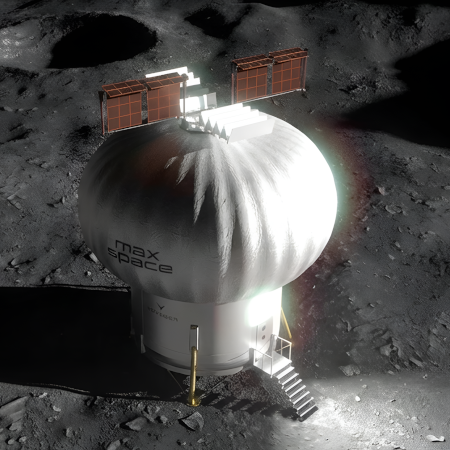
This partnership appears aimed not at NASA’s space station program nor enhancing Starlab. Instead, it is focused on providing NASA (and other commercial operations) inflatable habitats that can be launched and quickly established on the Moon and elsewhere, as shown by the artist’s rendering to the right. It appears Voyager will build the foundation, base, and airlock, while Max will provide the inflatable module above. From the press release:
This initiative directly supports NASA’s historical Artemis Program and aligns precisely with Administrator Isaacman’s announcement to be on the Moon to stay by 2028. Max Space delivers critical enabling infrastructure, maximizing livable volume, enhancing crew safety, and reducing the cost and complexity of surface deployment. It complements Voyager’s broader lunar roadmap, including cislunar mission management, surface logistics, propulsion, power systems, and future surface infrastructure, reinforcing a shared vision of the Moon as an operational domain, not a temporary destination.
In other words, the two companies are aiming to become major suppliers for NASA’s Artemis lunar base, and to do that by offering a way to get it quickly built and operational, at a reasonable cost.
I suspect it will be a few years before NASA issues any such contracts. It will first want to see both companies demonstrate success, both with Voyager’s Starlab and Max Space’s own demo station module scheduled for launch in ’27. Nonetheless, this announcement puts them on the map in the race to get those contracts, and begins to put some commercial reality to the American colonization of the solar system.
Click for original image.
In an expansion of a partnership announced last month, Voyager Technologies — the lead company in the consortium building the Starlab space station — today announced it is now making “a multi-million-dollar strategic investment” in Max Space’s inflatable habitats, aiming at winning contracts both for NASA’s proposed Moon base as well as any other “future deep space missions.”
The actual dollar amount has not yet been released, but my sources say it is in “the low eight figures,” or more than $10 million but probably less than $25 million.
This partnership appears aimed not at NASA’s space station program nor enhancing Starlab. Instead, it is focused on providing NASA (and other commercial operations) inflatable habitats that can be launched and quickly established on the Moon and elsewhere, as shown by the artist’s rendering to the right. It appears Voyager will build the foundation, base, and airlock, while Max will provide the inflatable module above. From the press release:
This initiative directly supports NASA’s historical Artemis Program and aligns precisely with Administrator Isaacman’s announcement to be on the Moon to stay by 2028. Max Space delivers critical enabling infrastructure, maximizing livable volume, enhancing crew safety, and reducing the cost and complexity of surface deployment. It complements Voyager’s broader lunar roadmap, including cislunar mission management, surface logistics, propulsion, power systems, and future surface infrastructure, reinforcing a shared vision of the Moon as an operational domain, not a temporary destination.
In other words, the two companies are aiming to become major suppliers for NASA’s Artemis lunar base, and to do that by offering a way to get it quickly built and operational, at a reasonable cost.
I suspect it will be a few years before NASA issues any such contracts. It will first want to see both companies demonstrate success, both with Voyager’s Starlab and Max Space’s own demo station module scheduled for launch in ’27. Nonetheless, this announcement puts them on the map in the race to get those contracts, and begins to put some commercial reality to the American colonization of the solar system.