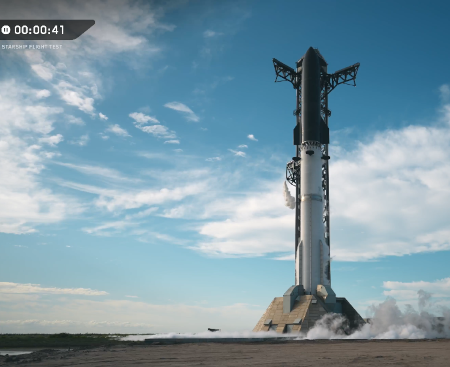
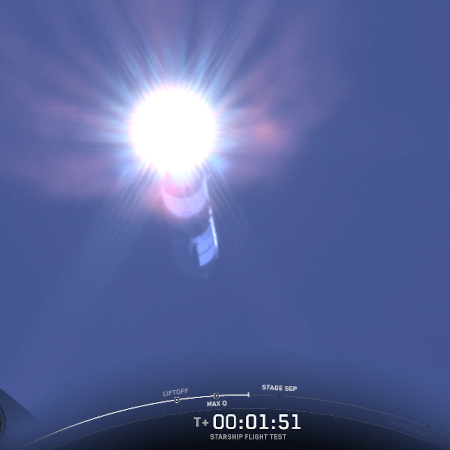
Based on a tweet posted by Elon Musk on March 7, 2026, SpaceX now targeting early April for next and 12th Starship/Superheavy test orbital flight.
According to this update at nasaspaceflight.com, the Superheavy booster, the 19th prototype and the first version 3 booster, is now on the launchpad for final checks.
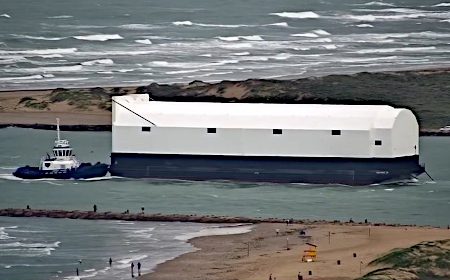
On March 8, Booster 19 left Mega Bay 1 and rolled down Highway 4 towards the launch site and Pad 2. This is the start of pad commissioning and booster engine testing for Block 3.
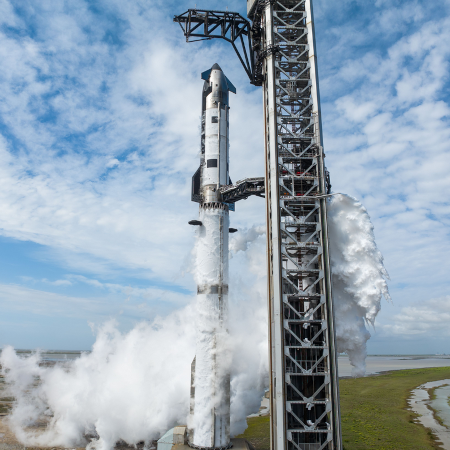
Booster 19 is mounted on Pad 2 to conduct multiple tests over the coming days. This will likely include ambient pressure testing, tanking tests with Liquid Oxygen (LOX) and Liquid Methane (LCH4), spin primes, and eventually a static fire, maybe even a couple of static fires. These tests are not only to help test the booster but also to test all of the pad systems.
While crews have run operations with the Pad 2 tank farm many times, they have never loaded an actual booster with propellant. With a booster finally on the pad, this will help in the final commissioning process.
For these initial pad and booster check-outs, #19 does not have all 33 engines installed. It appears the company wants to test the launchpad fueling system first, with the minimum number of engines needed.
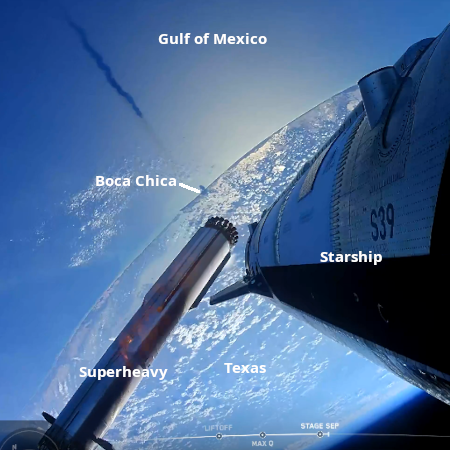
Meanwhile, the Starship prototype that will fly, #39 in the series, is in the assembly building after completing its own series of tanking and launchpad tests.
I want to highlight two numbers — 19 and 39 — in order to illustrate how SpaceX does things versus NASA. Not only has SpaceX already completed eleven test flights of Starship/Superheavy, it has tested or flown 19 and 39 prototypes of each, in one manner or another. The company has a very rich history of hardware and testing as it ramps up towards operational flights. This practically guarantees that those operational flights will not only occur relatively soon, they will be relatively safe and robust.
This was all done in less than a decade, though most of the testing of those prototypes has occurred in the last six years.
NASA meanwhile began work on SLS about fifteen years ago, and has built two rockets total, and so far flown only one. Though the agency did a lot of tests of pieces of the rocket, it flew only one test launch, in 2022. SLS’s design is so cumbersome and expensive, the agency could not afford to fly it multiple times. Thus, much of its testing was done on computer screens, in simulations.
Which rocket would you want to fly on when both are operational?