Saturn’s rings with two of its moons perfectly aligned
Click for original image.
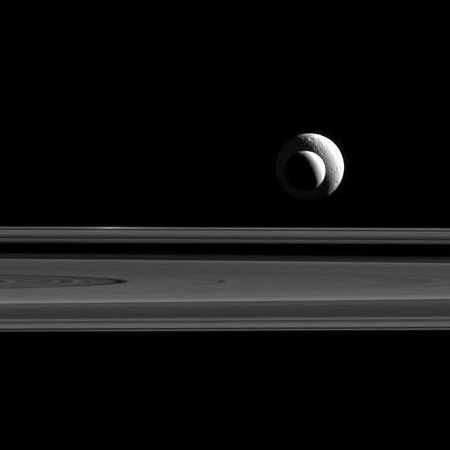
Cool image time! Rather than posting another Mars orbital image, I decided today to delve into the archive of pictures taken by the Cassini orbiter during the thirteen years it circled Saturn, from 2004 until 2017. The picture to the right, cropped to post here, was released on December 14, 2015, and is just one example of the many breath-taking photographs that the Cassini science team took during that mission. From the caption:
Like a cosmic bull’s-eye, Enceladus and Tethys line up almost perfectly for Cassini’s cameras. Since the two moons are not only aligned, but also at relatively similar distances from Cassini, the apparent sizes in this image are a good approximation of the relative sizes of Enceladus (313 miles across) and Tethys (660 miles across).
This view looks toward the un-illuminated side of the rings from 0.34 degrees below the ring plane. The image was taken in red light with the Cassini spacecraft narrow-angle camera on Sept. 24, 2015.
The image was obtained at a distance of approximately 1.3 million miles from Enceladus. Image scale on Enceladus is 7 miles per pixel. Tethys was at a distance of 1.6 million miles with a pixel scale of 10 miles per pixel.
Enceladus is in the foreground, and is the planet that has what scientists have labeled tiger stripe fractures that vent water and other material, including carbon molecules.

Click for original image.
Cool image time! Rather than posting another Mars orbital image, I decided today to delve into the archive of pictures taken by the Cassini orbiter during the thirteen years it circled Saturn, from 2004 until 2017. The picture to the right, cropped to post here, was released on December 14, 2015, and is just one example of the many breath-taking photographs that the Cassini science team took during that mission. From the caption:
Like a cosmic bull’s-eye, Enceladus and Tethys line up almost perfectly for Cassini’s cameras. Since the two moons are not only aligned, but also at relatively similar distances from Cassini, the apparent sizes in this image are a good approximation of the relative sizes of Enceladus (313 miles across) and Tethys (660 miles across).
This view looks toward the un-illuminated side of the rings from 0.34 degrees below the ring plane. The image was taken in red light with the Cassini spacecraft narrow-angle camera on Sept. 24, 2015.
The image was obtained at a distance of approximately 1.3 million miles from Enceladus. Image scale on Enceladus is 7 miles per pixel. Tethys was at a distance of 1.6 million miles with a pixel scale of 10 miles per pixel.
Enceladus is in the foreground, and is the planet that has what scientists have labeled tiger stripe fractures that vent water and other material, including carbon molecules.