Thank you all for your support!

Scroll down for the most recent stories.

My February birthday fund-raising campaign for Behind the Black is now over. Thank you to everyone that so generously donated. You don’t have to give anything to read my work, and yet so many of you donate or subscribe. I can’t express what that support means to me.

This thank you will remain at the top of the page for the next few days so that as many can see it as possible.

Genesis cover

On Christmas Eve 1968 three Americans became the first humans to visit another world. What they did to celebrate was unexpected and profound, and will be remembered throughout all human history. Genesis: the Story of Apollo 8, Robert Zimmerman's classic history of humanity's first journey to another world, tells that story, and it is now available as both an ebook and an audiobook, both with a foreword by Valerie Anders and a new introduction by Robert Zimmerman.


The print edition can be purchased at Amazon or any other book seller. If you want an autographed copy the price is $60 for the hardback and $45 for the paperback, plus $8 shipping for each. Go here for purchasing details. The ebook is available everywhere for $5.99 (before discount) at amazon, or direct from my ebook publisher, ebookit you don't support the big tech companies and the author gets a bigger cut much sooner.


The audiobook is also available at all these vendors, and is also free with a 30-day trial membership to Audible.
 

"Not simply about one mission, [Genesis] is also the history of America's quest for the moon... Zimmerman has done a masterful job of tying disparate events together into a solid account of one of America's greatest human triumphs."--San Antonio Express-News

Dart changed the orbit of the Didymos/Dimorphos binary asteroids around the Sun

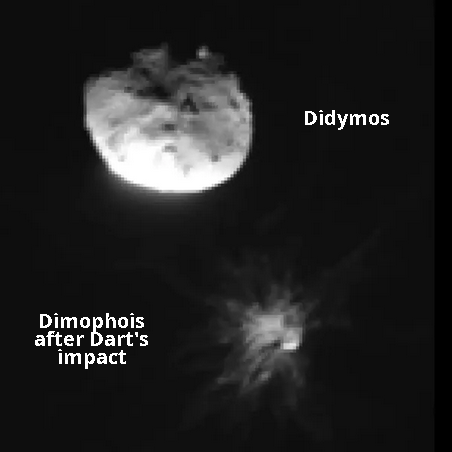
Dimorphos just after impact

When the Dart spacecraft impacted the asteroid Dimorphos in September 2022, it not only shortened Dimophos’ orbit around its companion asteroid Didymos by about 33 minutes while reshaping the asteroid, a new study has found that it also changed very slightly the orbit of both asteroids around the Sun.

The image to the right, annotated to post here, was taken by the Italian LICIACube spacecraft moments after the September 26, 2022 impact.

The research paper describing this research can be found here. From the press release:

The new study shows the impact ejected so much material from the binary system that it also changed the binary’s orbital period around the Sun by 0.15 seconds. “The change in the binary system’s orbital speed was about 11.7 microns per second, or 1.7 inches per hour,” said Rahil Makadia, the study’s lead author at the University of Illinois Urbana-Champaign. “Over time, such a small change in an asteroid’s motion can make the difference between a hazardous object hitting or missing our planet.”

To be precise, the orbital speed was slowed 1.7 inches per hour, which while tiny would mean its solar orbit is now slightly lengthened.

The result proves that a similar impact could be used on some asteroids to deflect them from hitting the Earth, though we would need to know a lot about that asteroid prior to launching the mission to accurately predict the orbital change. Otherwise, any impact could be a dangerous crap shoot that could do more harm than good.

Conscious Choice cover

Now available in hardback and paperback as well as ebook!


From the press release: In this ground-breaking new history of early America, historian Robert Zimmerman not only exposes the lie behind The New York Times 1619 Project that falsely claims slavery is central to the history of the United States, he also provides profound lessons about the nature of human societies, lessons important for Americans today as well as for all future settlers on Mars and elsewhere in space.

 
Conscious Choice: The origins of slavery in America and why it matters today and for our future in outer space, is a riveting page-turning story that documents how slavery slowly became pervasive in the southern British colonies of North America, colonies founded by a people and culture that not only did not allow slavery but in every way were hostile to the practice.  
Conscious Choice does more however. In telling the tragic history of the Virginia colony and the rise of slavery there, Zimmerman lays out the proper path for creating healthy societies in places like the Moon and Mars.


“Zimmerman’s ground-breaking history provides every future generation the basic framework for establishing new societies on other worlds. We would be wise to heed what he says.” —Robert Zubrin, founder of the Mars Society.


All editions are available at Amazon, Barnes & Noble, and all book vendors, with the ebook priced at $5.99 before discount. All editions can also be purchased direct from the ebook publisher, ebookit, in which case you don't support the big tech companies and the author gets a bigger cut much sooner.


Autographed printed copies are also available at discount directly from the author (hardback $29.95; paperback $14.95; Shipping cost for either: $6.00). Just send an email to zimmerman @ nasw dot org.

March 6, 2026 Quick space links

As BtB’s stringer Jay is on vacation, here are two links I spotted that don’t deserve full posts. This post is also an open thread. I welcome my readers to post any comments or additional links relating to any space issues, even if unrelated to the links below.

Curiosity looks uphill at its upcoming travels

Panorama looking up Mount Sharp
Click for original.

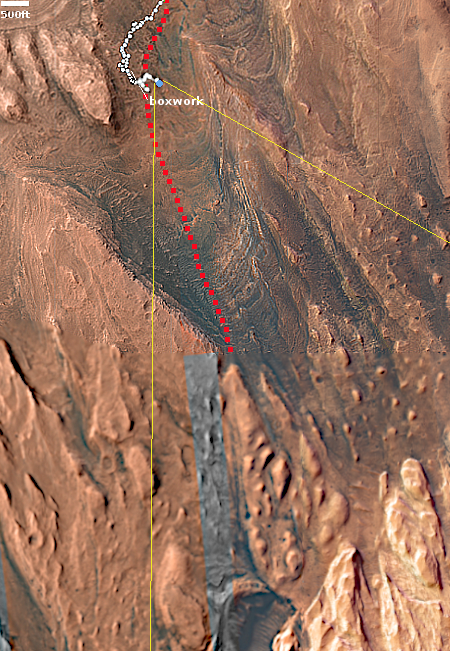
Overview map
Click for interactive map.

Cool image time! Since May 2025 Curiosity has been exploring in great detail the boxwork formations located on the lower slopes of Mount Sharp. It is now about to complete those investigations, with the Curiosity science team beginning their planning for moving onward and upward.

The panorama above, enhanced to post here, was taken on March 2, 2026 by the rover’s right navigation camera. It looks uphill along the valley that Curiosity is in toward the mountainous region the rover is targeting. Note that the peak of Mount Sharp is not visible, being more than 25 miles away beyond the horizon and about 15,000 feet higher up.

The blue dot on the overview map to the right mark Curiosity’s present position. The yellow lines indicate roughly the area this panorama covers. The red dotted line marks the rover’s approximate planned route, while the white dotted line indicates Curiosity’s actually travels.

Right now Curiosity is traveling through a geological layer the scientists have dubbed the sulfate unit. The lighter colored hills seen on the horizon have also been identified as sulfate, but believed to be much more pure. The geology there should be very different. Instead of rough and rocky it could be like traveling over soft porous sand. This however is merely a guess on my part, based on imagery of those light-colored hills.

The actual route through those hills however remains unknown. Either the science team has not yet released it, or is still trying to figure out the best way through.

Leaving Earth cover

Leaving Earth: Space Stations, Rival Superpowers, and the Quest for Interplanetary Travel, can be purchased as an ebook everywhere for only $3.99 (before discount) at amazon, Barnes & Noble, all ebook vendors, or direct from my ebook publisher, ebookit.


If you buy it from ebookit you don't support the big oppressive tech companies and I get a bigger cut much sooner.


Winner of the 2003 Eugene M. Emme Award of the American Astronautical Society.

 
"Leaving Earth is one of the best and certainly the most comprehensive summary of our drive into space that I have ever read. It will be invaluable to future scholars because it will tell them how the next chapter of human history opened." -- Arthur C. Clarke

South Korean rocket startup Perigee signs deal to launch from the Philippines

The Philippines

The South Korean rocket startup Perigee yesterday signed an agreement with the government of the Philippines, allowing it to launch its proposed suborbital and orbital Blue Whale rockets from a sea platform within that country’s territorial waters.

The Philippine Space Agency (PhilSA), together with the Department of Information and Communications Technology (DICT), Cagayan Economic Zone Authority (CEZA), Ascend International Gateway, Inc., and … Perigee Aerospace, Inc. signed a Memorandum of Understanding … to collaborate on a framework for rocket development training and experimental rocket launches in the Philippines. These initiatives will demonstrate the viability of the establishment and operation of a Philippine spaceport, with the goal of positioning the country as a gateway to space in the region.

…The agreement builds on the rocket technology know-how transfer and training program undertaken by PhilSA engineers in the Republic of Korea from October to November 2025, in collaboration with Perigee Aerospace. The program equipped the engineers with foundational and applied knowledge in launch vehicle systems through lectures and hands-on experience in rocket assembly and testing. These initiatives lay the groundwork for future activities, including possible localized assembly, testing, and launch operations in the Philippines.

The first four entities listed above are all government agencies in the Philippines. Apparently Perigee is providing training and aid to the Philippines in exchange for the right to launch from within that country. It website states the suborbital version of Blue Whale will launch from a sea platform, but the launch site for the orbital version is unclear.

This deal however sets the stage for possibly developing a land-based spaceport in the Philippines. As shown by the map to the right, the country is well situated for such purposes, with a lot of eastern coastline facing the vast Pacific ocean. A spaceport located on its southernmost island of Mindanao would be especially well placed.

ESA loses contact with the coronagraph satellite of its duel-satellite Proba-3 mission

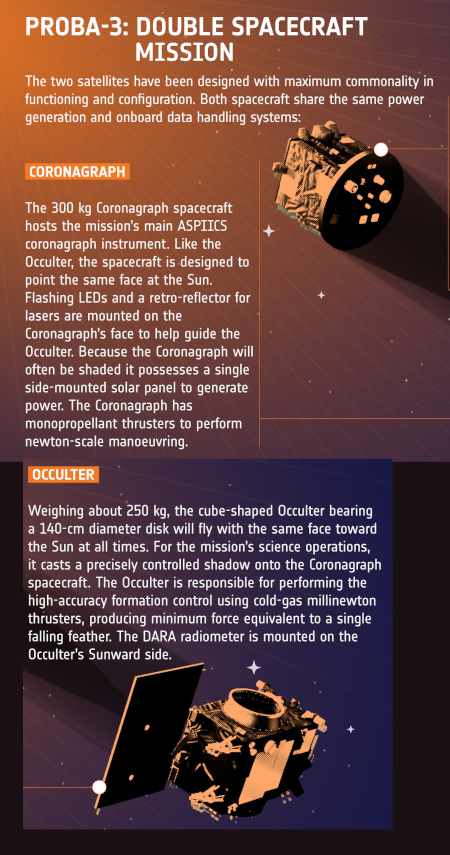
The Proba-3 mission
The Proba-3 mission. Click for original.

The European Space Agency (ESA) today announced that engineers have lost contact with the Coronagraph satellite of its duel-satellite Proba-3 mission, and are working now to recover contact.

During the weekend of 14–15 February 2026, an anomaly onboard Proba-3’s Coronagraph spacecraft triggered a chain reaction that led to the progressive loss of attitude (spacecraft orientation) and prevented the entry into safe mode.

Because the spacecraft’s solar panel was no longer facing the Sun, the onboard battery started to discharge quickly. This caused the spacecraft to enter survival mode, when minimum electronics are active and data transmission to the ground is interrupted.

The exact root cause of the anomaly is under investigation, and mission teams and operators have joined forces to attempt to re-establish contact with the spacecraft to recover the situation.

The Coronograph satellite is the heart of this mission. It records the data, available because the Occulter blocks the Sun from view so that the corona, the Sun’s atmosphere, can be seen. Based on this report, it does not look good that the spacecraft can be recovered.

At the same time, the mission has apparently achieved all of its initial goals, and was now on an extended mission.

Sierra Space raises $550 million in private investment capital

Due to its aggressive shift in the past year away from NASA-based civilian contracts to defense work, Sierra Space announced yesterday that it has successfully raised another $550 million in private investment capital.

That shift occurred because of its failure to deliver its Dream Chaser vehicle to NASA as planned, as well as the apparently lack of progress in its partnership with Blue Origin on the Orbital Reef space station. From the press release:

Sierra Space Corporation, an industry-leading defense-tech space company delivering solutions for the nation’s critical missions, announced today a $550 million equity investment led by LuminArx Capital Management (“LuminArx Capital”), a global alternative investment manager, with participation from existing investors. The financing values the company at $8 billion post-money.

With this new capital, Sierra Space will be able to further focus on its national security space efforts through ongoing expansion of production capacity and continued development of differentiated solutions for its customers. The investment better positions Sierra Space to secure additional contracts, leverage existing technologies, and pursue growth opportunities beyond its current satellite and spacecraft mission programs.

Artist rendering of Orbital Reef design, as of April 2025
Artist rendering of Orbital Reef design, as of April 2025,
the best we can likely ever expect from this dead project.
Click for original image.

The release also mentioned General Atlantic, Coatue, Moore Strategic Ventures, and Andalusian Private Capital as investors.

Though this money should help fuel its work on Dream Chaser and Orbital Reef, I suspect little will go to those two projects. The company is now clearly targeting military and national security work as its prime source of income. There are also indications that there are some technical issues with Dream Chaser that Sierra has not yet revealed.

Meanwhile, the lack of effort from Blue Origin on Orbital Reef likely convinced Sierra it was better to turn its eyes elsewhere. While Sierra spent considerable effort testing its LIFE inflatable module, Blue Origin did practically nothing, and continues to do little. It is unlikely this partnership will win any funding from NASA when the agency awards new space station contracts, expected sometime in six months.

Rocket Lab completes another launch yesterday

Rocket Lab yesterday successfully placed a satellite into orbit, its Electron rocket lifting off from one of its two launchpads in New Zealand.

The company did not reveal the name of its customer, though according to this source the satellite was a Blacksky Earth imaging satellite, the fourth launch of a four-launch contract with that satellite company.

The 2026 launch race:

28 SpaceX
8 China
3 Rocket Lab
2 Russia
1 ULA
1 Europe (Arianespace)

Not only is SpaceX this year leading the entire world combined in total launches — as it did in both ’24 and ’25 — at the moment its pace is about twice as much as the rest of the globe.

March 5, 2026 Quick space links

As BtB’s stringer Jay is on vacation, there wasn’t going to be a quick links today. Then Robert Pratt of Pratt on Texas sent me the two links below. Thank you Robert!

This post is also an open thread. I welcome my readers to post any comments or additional links relating to any space issues, even if unrelated to the links below.

New Webb data says asteroid 2024 YR4 will miss the Moon in 2032

Asteroid 2024 YR4 as seen by Webb in the mid-infrared
Asteroid 2024 YR4 as seen by Webb in the
mid-infrared in April 2025. Click for original image.

New Webb data collected in February has now eliminated any chance the potentially dangerous asteroid 2024 YR4 will hit either the Earth or the Moon when it makes its next close pass on December 22, 2032.

Using data from NASA’s James Webb Space Telescope observations collected on Feb. 18 and 26, experts from NASA’s Center for Near-Earth Object Studies at the agency’s Jet Propulsion Laboratory in Southern California have refined near-Earth asteroid 2024 YR4’s orbit and are ruling out a chance of lunar impact on Dec. 22, 2032. With the new data, 2024 YR4 is expected to pass by the lunar surface at a distance of 13,200 miles (21,200 km).

Earlier less precise data had suggested 2024 YR4 had a 4.3% chance of hitting the Moon in 2032. That chance is now zero. This result is actually disappointing, in that an impact of this asteroid, estimated to be about 200 feet in diameter, would have not only been spectacular, but would have been scientifically useful. We would have been able to observe it closely with many ground- and space-based telescopes, and garnered a lot of useful information about the asteroid, the Moon, and the very nature of impacts.

The impact would have also eliminated the chance this asteroid might hit the Earth in the future. 2024 YR4 orbits the Sun about every four years. Previous calculations suggested another potentially dangerous fly-by of Earth in 2047, but these numbers are unreliable because the orbit will be changed by the 2032 fly-by in ways that cannot be predicted as yet.

Vast raises $500 million in new private investment capital

Haven-2
Vast’s full Haven-2 station once completed

The space station startup Vast today announced it has raised another $500 million in new private investment capital, bringing the total so far invested in the company’s space station project to more than one billion.

The financing round was led by Balerion Space Ventures with participation from IQT, Qatar Investment Authority (QIA), Mitsui & Co., Ltd, MUFG, Nikon Corporation (Nikon), Stellar Ventures, Space Capital, and Earthrise Ventures. Jed McCaleb, founder and first investor, also participated in the round. As part of the transaction, Balerion Advisor A.C. Charania, former Chief Technologist for NASA, will join the Vast board.

…To date, more than $1 billion has been invested in Vast’s space stations technologies and facilities—resources that NASA and government partners can leverage to ensure readiness to replace the ISS in 2030. The latest financing includes $300 million in Series A equity and $200 million in debt to support the continued development of Vast’s Haven space stations. The funds will be used to expand facilities, grow the team, and advance the company’s proposed successor to the ISS, Haven-2, designed to ensure continuous human presence in low-Earth orbit for the United States and its allies.

Hat tip to reader Richard M for letting me know about this announcement.

In my rankings below of the five American commercial space stations presently in development, I rank Vast #1. This new investment helps solidify its first place standing.
» Read more

The American Revolution, as seen from across the Atlantic

The First Salute by Barbara Tuchman

As this year is the 250th anniversary of the signing of the Declaration of Independence, it seems fitting to review a history about the Revolutionary War. In fact, I intend to do a few more such reviews in the coming months.

Let’s start however with a book that looks at that Revolution from a very different perspective.

Historian Barbara Tuchman is most well known for her early classic, The Guns of August, a book that was made famous when John Kennedy repeatedly referred to it during the Cuban missile crisis. Kennedy’s recommendation not only brought the book to the attention of the general public, it made Tuchman’s career. From that day forth, her work has always been received with accolades and enthusiasm and uncritical respect.

I am here however to break that bubble, though only partly. I just finished reading The First Salute, Tuchman’s 1988 history of the Revolutionary War. Rather than tell the tale from the point of view of the Americans, as done by most historians, Tuchman’s work looks at the war from the point of view of Europe, and thus gives us a much larger and very worthwhile context.

For this I compliment Tuchman highly. Though it is well known that the arrival of the French fleet off the coast of Virginia was crucial in forcing the British army to surrender to Washington at Yorktown, the background behind that arrival has generally been given short shrift by historians. Tuchman does not, describing in detail the political maneuvering necessary between the American envoys in France and France’s government to make that fleet happen. She also describes the attitudes of the Dutch and Spain to the war, and how and why they eventually moved to support America, even though there were many reasons for them to stay out.

Her book also gives us the British perspective, revealing the amazing and continuous failures of its government and generals to wage the war with any enthusiasm or skill. It appears almost from the start that the British had no great desire to win, and that malaise and overconfidence more than anything resulted in their eventual defeat.

For example, the British never took Washington or his army seriously. » Read more

The auroras of Jupiter and Ganymede

According to two different university press releases in the past month, new details have been discovered about the auroras found on Jupiter as well as its largest moon, Ganymede, caused by the interaction of Jupiter’s powerful magnetic field not only with Ganymede’s weak one but with the motion of all four Galilean moons as they orbit the gas giant.

The first study used data from Juno when it made a close fly-by of Ganymede in 2021. It not only showed how the aurora was caused by interaction between the magnetic fields of Jupiter and Ganymede, it found that Ganymede’s auroras were similar to those on Earth.

Similar structures, known as ‘beads’, have been observed in the auroras of Earth and Jupiter, where they are linked to sub-storms and dawn storms, large-scale rearrangements of the magnetosphere that release enormous amounts of energy and produce intense auroral activity,” explains Alessandro Moirano, post-doctoral researcher at LPAP.

Ganymede interacts with Jupiter’s space environment in a similar way to how Earth interacts with the solar wind; therefore, the discovery of auroral patches on Ganymede similar to those on Earth suggests that the fundamental physical process(es) could be generally induced in the coupling between any celestial body, its magnetosphere, and external forces.

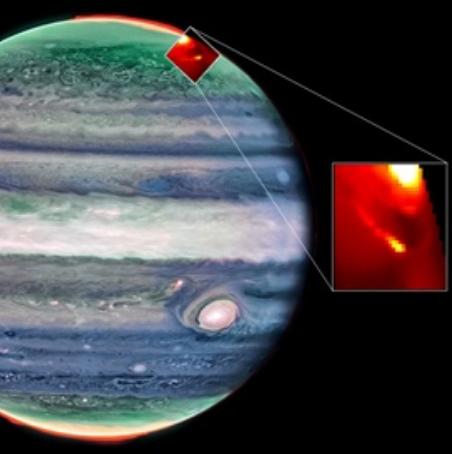
The aurora's on Jupiter
The auroral footprints of Io and Europa
on Jupiter

The second study, released yesterday, used the Webb Space Telescope to a get a more detailed look at Jupiter’s auroras, caused as the four Galilean moons — Io, Europa, Ganymede, and Callisto — travel through Jupiter’s powerful magnetic field, causing energetic particles to following Jupiter’s magnetic field lines down to its poles, there creating the auroras.

Webb’s data found that the auroral footprints on Jupiter caused by each moon were different from Jupiter’s own aurora.

However, the footprints created by Io and Europa, did not have the characteristics expected from Jupiter’s main aurora, which contains a lot of hot material. Instead, in one snapshot, they discovered a cold spot within Io’s auroral footprint that registered temperatures much lower than expected, with extraordinarily high densities.

As the data was limited to a single 22-hour window, the results are very uncertain. More observations are planned, covering a longer time period, to see if this phenomenon can be captured again.

All of these results are very tantalizing, but to really get a handle on what is going on will require continuous observations over years, from many spacecraft devoted exclusively to Jupiter. And that isn’t going to happen for quite some time.

The United Kingdom’s Labor government to spend £500 million on space

The UK Space Agency, gone but not forgotten

My heart be still! The United Kingdom’s present Labor government yesterday announced it has allocated an additional £500 million ($665 million) on a wide range of space projects, all of which are either new government programs or facilities or direct subsidies to its failing space businesses.

Nowhere in this announcement did government officials address the choking regulations and burdensome licensing requirements that have essentially driven away all space business while bankrupting two different rocket startups, Virgin Orbit and Orbex.

In addition to the £1.7 billion committed to European Space Agency (ESA) programmes in November 2025, the government is allocating more than £500 million to national space programmes:

  • £105 million to develop civil capabilities for in-orbit servicing and manufacturing (ISAM) – an emerging market where the UK has a strong competitive edge and opportunities to deliver significant commercial returns and strengthen national resilience
  • £85 million to develop the National Space Operations Centre, including £40 million to build a new ground‑based sensing network, supporting the 24/7 requirement to protect satellites and manage an increasingly crowded space environment
  • £80 million to deliver the Connectivity in Low Earth Orbit (C-LEO) programme, including for a new £30m funding call opened today to support UK businesses developing smarter satellites, advanced hardware and AI‑enabled data delivery
  • £65 million for the National Space Innovation Programme to accelerate breakthrough technologies and boost commercialisation
  • £40 million for the Unlocking Space Programme to drive market demand for space technology, develop national security capabilities and attract private investment to support the scale up of UK firms
  • £37 million to develop space clusters, building on local strengths and ensuring the benefits of space reach every corner of the UK
  • £20 million to accelerate spaceport infrastructure development in Scotland

The announcement was made in connection with the decision by this Labor government to eliminate the UK Space Agency as a separate bureaucracy, consolidating it into the Department for Science, Innovation and Technology (DSIT). The consolidation was intended to save money and make the government more efficient, but this announcement suggests it is being used to funnel more cash into DSIT’s bureaucracy, simply under a different name.

None of this is going to do much to promote an independent space industry in Great Britain. As long as it continues to take years to get launch licenses, rocket companies are not going to launch from its spaceports. And without those launches, its space industry is going to be seriously handicapped. And dumping cash into these various government programs won’t do much either to promote competition or innovation. All the UK will get is more bureaucracy and government control.

Does weightlessness cause blood clots?

The uncertainty of science: A new study on Earth using an “dry immersion tank” now suggests that weightlessness could increase the chances that female astronauts could get blood clots during long space missions.

First reported in 2020, an International Space Station mission detected an unexpected blood clot in a female astronaut’s jugular vein. To date, space-health research has had more male participants but with the number of female astronauts on the rise, a new SFU–European Space Agency study examined how microgravity affects blood clotting specifically in women. Key findings

  • 18 female participants experienced five days of continuous simulated microgravity in a European Space Agency (ESA)-sponsored VIVALDI I dry immersion study.
  • Coagulation time (the time it took for blood clots to start forming) was longer.
  • Once started, clots formed faster.
  • Once formed, the strength and stability of the clots was greater

The dry immersion tank is “a specially designed water bath with a waterproof sheet to keep participants dry while floating, and simulating weightlessness.”

The researchers admit these results are very uncertain. For one, none of the clots that occurred during the study were “clinically concerning,” which means they were the kind of clots that the body deals with normally without threat. The researchers also noted in their paper’s abstract that “current published research on this topic is male-centered,” which explains the female focus of this particular research.

This research suggests that blood clots could be an issue on long missions in weightlessness, but the data is sparse and very incomplete. Moreover, based on more than a quarter century of missions longer than six months in space, it appears the one blood clot cited above might have been the only incident so far recorded. And any results using immersion tanks on Earth is questionable, as they are a poor substitute for actual weightlessness in space.

Nonetheless, these results add weight to the need for developing interplanetary spaceships with some sort of artificial gravity. Without it, the health of any passengers going on long missions to other planets like Mars is certainly at risk, not simply from blood clots but from bone loss, vision damage, spinal deformities, and overall loss of cardio-vascular and muscular strength, all issues that have been documented well in space.

Third launch attempt by Japanese rocket startup Space One fails

Kairos rocket just after failure

In another attempt to do the maiden launch its orbital Kairos rocket today, the Japanese rocket startup Space One experienced its third launch failure, with the rocket breaking up about a minute after launch.

The screen capture to the right shows the rocket just after failure. The cloud arc in the upper left is the moment some burst occurred. Within seconds it was clear that the rocket was now in several pieces.

The launch attempt, which took place from the company’s own spaceport, Spaceport Kii, on the southern coast of the main island of Japan, was the third failure in a row, all involving failures of the first stage. The first launch in March 2024 blew up mere seconds after launch. The second attempt in December 2024 failed about 90 seconds after launch when the rocket began to spiral out of control.

This third launch appeared more controlled, but it also occurred only a minute after launch.

Whether the company can survive a third straight failure, none of which got even close to main engine cutoff and stage separation, is unknown. The company has some major investors, including Canon, several major Japanese banks, and the government-owned Development Bank of Japan. While they might stick with the company, it would not be surprising if there was a major shake-up in management.

Japan at the moment has no operational launch capability. Space One is its only private rocket startup, while the two rockets belonging to its space agency JAXA, H3 and Epsilon, are both grounded due to launch failures.

NASA initiates new program to grab talent from the private sector

Where new talent will now go to wither
Where new talent will now go to wither.

As part of NASA administrator’s effort to remake NASA into a cutting edge agency, “the global leader in space,” the agency in partnership with the federal Office of Personnel Management (OPM) has initiated a new program, dubbed NASA Force, to recruit talent from the private sector for two-year terms, after which they can then try to get a full time job either with NASA or a private aerospace company.

NASA Force will identify and place high-impact technical talent into mission-critical roles supporting NASA’s exploration, research, and advanced technology priorities, ensuring the agency has the cutting-edge expertise needed to maintain U.S. leadership in space.

Tech Force, led by OPM, was established to recruit elite technical professionals into federal service, embed them at partner agencies to modernize systems, accelerate innovation, and strengthen mission delivery. NASA Force represents a focused expansion of that effort, tailored to the unique technical demands of space exploration and aerospace research.

“America’s leadership in space depends on extraordinary talent,” said NASA Administrator Jared Isaacman. “NASA Force will help us attract the next generation of innovators and technical experts who are ready to solve the toughest challenges in exploration, science, and aerospace technology. This partnership strengthens our workforce and helps ensure the United States remains the global leader in space.”

This program however has things entirely backwards. The last thing any engineer who has just graduated college should do is get a short two-year job at NASA. He or she will learn all the wrong lessons, working for a government agency not interested in efficiency or profit.

Instead, it is essential the first job new engineers get is in the private sector, to learn how to do things fast and efficiently. It Isaacman had the right priorities, he would use this money to fund these jobs in the private sector, so that new graduates will get the right training. Unfortunately, that is not Isaacman’s priority. He wants the government to lead.

Moreover, NASA’s job was never intended to be “the global leader in space.” Its job was to formulate the federal government’s needs in space, and then ask the private sector — the American people — to get the job done. Isaacman instead wants to have NASA do the job, as it did for a half century after Apollo, quite poorly. Only after the agency began relying on private enterprise beginning in 2008, the capitalism model, did things finally start happening again.

The worst aspect of this program is that it will take talent away from the private sector. A lot of good and talented young engineers will gravitate to these NASA positions for the high pay, relatively easy good hours, and prestige. They won’t accomplish much there, and their training will be wrong-headed. Meanwhile, the private sector will lose that talent and have to find it elsewhere, assuming it is available at all.


March 4, 2026 Quick space links

As BtB’s stringer Jay is on vacation, here are a few links I spotted that don’t deserve full posts. This post is also an open thread. I welcome my readers to post any comments or additional links relating to any space issues, even if unrelated to the links below.

The mysterious spokes in Saturn’s rings

A bent spoke in Saturn's rings
Click for original.

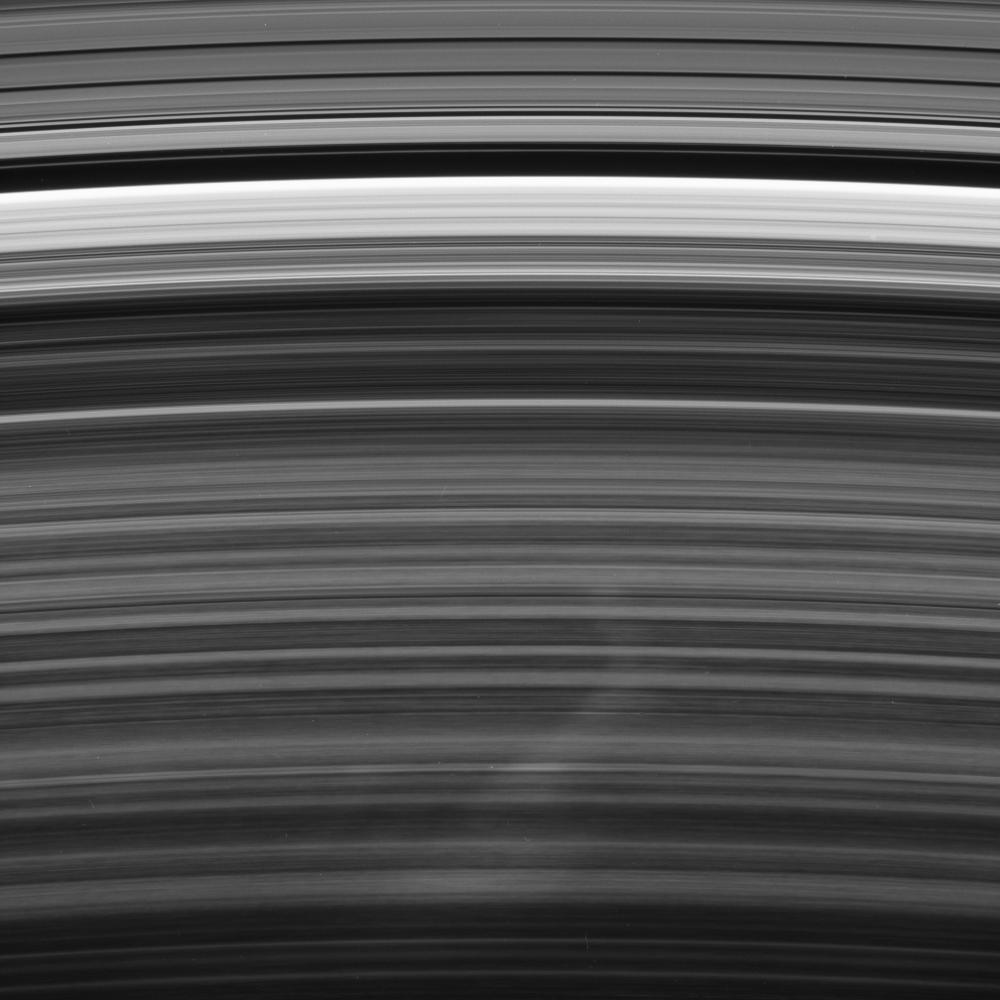
Cool image time! When Voyager-1 did its fly-by of Saturn in December 1980, its cameras captured something in the gas giant’s rings that no one had predicted or expected, spokes of brightness pointing outward along the surface of the rings at right angles to the planet. Even more puzzling, these spokes actually appeared to rotate around Saturn, always pointing away from it.

The picture to the right, cropped, reduced, and enhanced to post here, was taken on March 7, 2007 by the Saturn orbiter Cassini. It shows a close-up of one such spoke, though in this case it is bent. From the press release:

A bright spoke extends across the unilluminated side of Saturn’s B ring about the same distance as that from London to Cairo. The background ring material displays some azimuthal (i.e., left to right) asymmetry. The radial (outward from Saturn) direction is up in this view. A noticeable kink in the spoke occurs very close to the radius where ring particles orbit the planet at the speed of Saturn’s magnetic field. Such a connection is most intriguing to scientists studying these ghostly ring phenomena.

If gravity alone were affecting the spoke material, there would be no kink and the entire spoke would be angled toward right, like the bottom portion. That it bends to the left above the kink indicates that some other force, possibly related to the magnetic field, is acting on the spoke material. The shape might also indicate that the spoke did not form in a radial orientation, thus challenging scientists’ assumptions about these features.

In other words, the spokes exist because of multiple factors, some still unknown, that cause these streaks of brightness in the rings. For some reason, the millions of tiny ice particles that comprise the rings are brightened along these spokes, and it isn’t just gravity that is causing it.

South Korean rocket startup Innospace signs another spaceport launch deal

Proposed Canadian spaceports

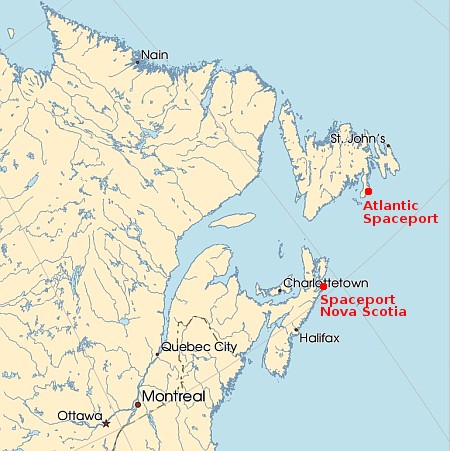
The South Korean rocket startup Innospace, which has attempted one launch of its Hanbit-Nano rocket (a failure), has now signed a launch deal with the proposed Spaceport Nova Scotia, run by Maritime Launch Services.

Maritime Launch Services announced a strategic partnership with South Korean rocket developer Innospace. Under a new Letter of Intent (LOI), the two companies will evaluate hosting the HANBIT launch system at Spaceport Nova Scotia, potentially transforming the Atlantic coast into a primary North American hub for the South Korean firm.

Innospace’s first launch was from Brazil’s long unused Alcantera spaceport on its northeast coast. The company has also signed deals with Portugal’s proposed Santa Maria spaceport, two spaceports in Australia (Southern Launch and Equatorial Launch), and Norway’s Andoya spaceport.

This new deal in Nova Scotia is still preliminary, with the two companies having until the end of the year to finalize the specifics. For Innospace, it appears the company its trying to give itself as many spaceport options as possible. It can also launch from the government spaceport in South Korea, but that provides much more limited orbital flight paths, and presents scheduling difficulties.

For Maritime, this deal might finally get this spaceport off the ground. It was first proposed in 2016, offering satellite companies both a launch site and a Ukrainian-built rocket. That plan fell through when Russia invaded the Ukraine and the rocket became unavailable. Since then Maritime has struggled to convince rocket companies to use the spaceport, all to no avail. It signed some deals, but none has gone anywhere. This deal is its first with a rocket startup that has actually attempted a launch, though that launch was a failure.

The first orbiting private space telescope releases “first light” image

Mauve's first light image and data
Click for original image.

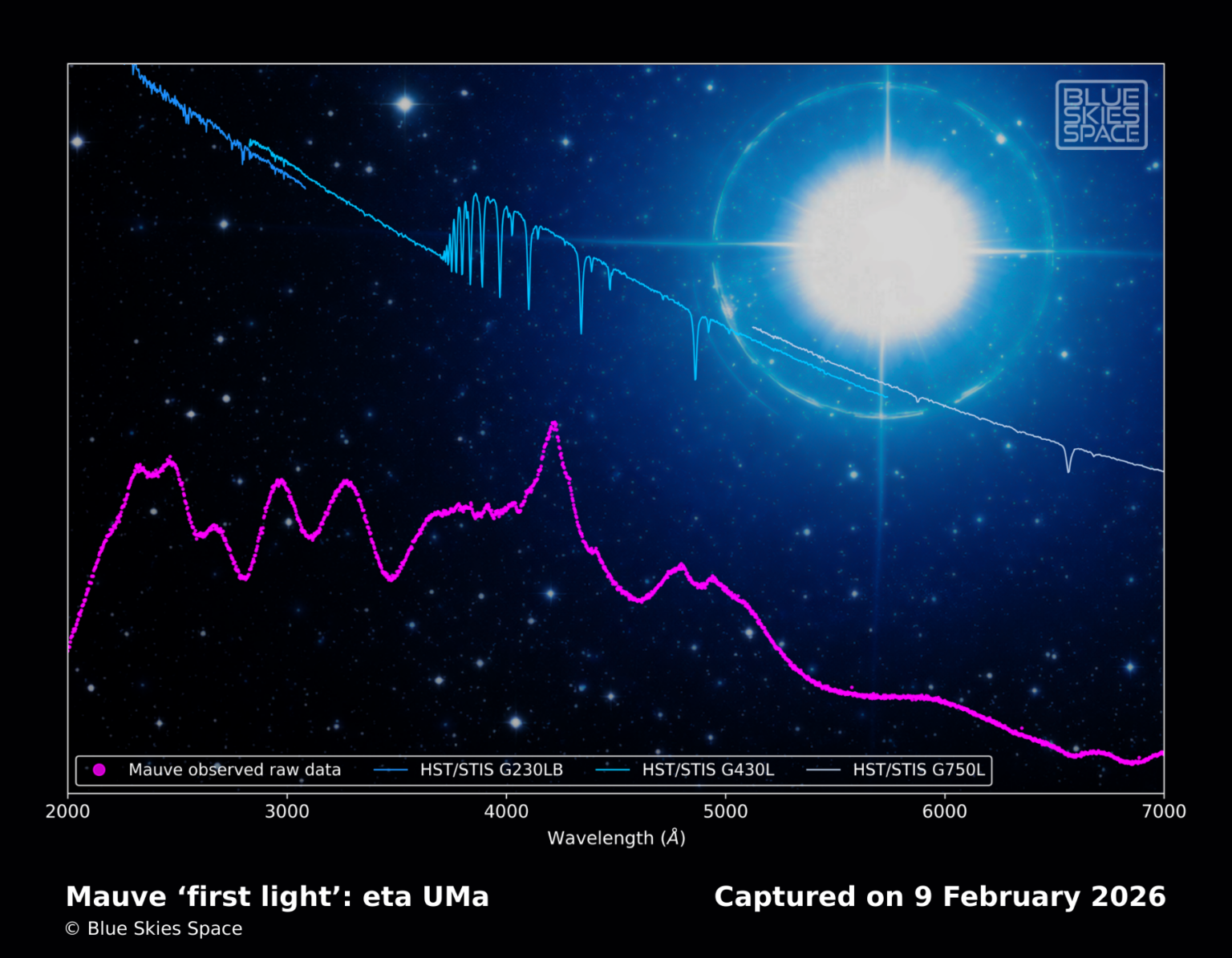
The first orbiting private space telescope, owned by Blue Skies Space and dubbed Mauve, has successfully taken its first image and data, a 5 second long exposure of a single star.

That image is to the right, with the spectroscopic data shown by the magenta line. The Hubble Space Telescope’s spectroscopic data is shown in blue and while for comparison.

As part of early commissioning, Mauve was pointed at its first calibration target, eta Ursae Majoris (eta UMa), a bright star in the constellation Ursa Major, approximately 104 light-years from Earth, for a 5-second observation. Eta UMa is a hot, blue-white star, much hotter than our Sun. Eta UMa shines brightly in ultraviolet light, making it an ideal calibration target for a UV observatory like Mauve.

The telescope has a 5-inch mirror, so its resolution is far lower than Hubble’s 94-inch mirror, but because it is above the atmosphere its view is far better than larger ground-based telescopes. Mauve is intended as a three-year-long demonstration project, during which it will study flares from nearby stars that are thought to have exoplanets, as well as binary star systems and variable stars. It is also making this data available to scientists, for a subscription fee. It already has almost a dozen universities signed up.

Blue Skies hopes Mauve’s success will help it raise the capital to build Twinkle, a space telescope with an 18-inch primary mirror. If that succeeds, the company plans to scale up to even bigger orbiting telescopes.

This private sector astronomy model is how the U.S. did things routinely prior to World War II. Then, for many reasons, the government took over for the next three-quarters of a century. It now appears the pendulum is shifting back to the private sector.

ESA asks for proposals on building its own space station

ESA logo

The European Space Agency (ESA) last week issued an open call for proposals outlining the construction of its own space station, independent of the five American stations presently in development to replace ISS.

On 27 February, ESA published an intended call for tenders for two Pre-Phase A studies under Scenario 3. According to the call, the studies will consolidate the “feasibility, architecture, utilisation, and technology requirements of a European-led LEO outpost” and propose cooperation with the Canadian Space Agency, Japan’s national space agency JAXA, and “additional partners.” The results of the two parallel studies will be used to enable ESA decision-making for its post-ISS transition by the end of 2026.

Do not expect these “studies” to produce a European-led space station any time soon. It is the ESA way to do lots of studies, and then after reading these to do more detailed follow-up studies outlining what they will do. Then, after years of review, it might finally get started on construction, which always proceeds somewhat slowly.

In the meantime, ESA has signed agreements with three of the five American space station projects (Axiom, Starlab, Vast), with its deal with the Starlab station the most extensive. All three deals leave open the possibility that Europe will rent time at each station to fly experiments and astronauts there.

Spanish rocket startup PLD raises $209 million in new investment capital

The Spanish rocket startup PLD, which hopes to launch its orbital Miura-5 rocket this year, has now raised an additional $209 million in new investment capital, bringing the total capital it has raised to more than $400 million.

PLD Space, an international space transportation company, has closed a €180 million Series C equity funding round led by the renowned Japanese manufacturer Mitsubishi Electric Corporation, alongside with other investors.

The Spanish Ministry of Science, Innovation and Universities, through the Centre for the Development of Technology and Innovation (CDTI) and its INNVIERTE fund, and the Spanish public funds management company COFIDES, through its FOCO investment fund, have co-invested in this round. Ultimately, the European renowned Spanish fund Nazca Capital, via Nazca Aeroespacial y Defensa INNIVERTE I FCR Fund, close the round.

The company hopes to ramp up its launch pace to as many as 30 launches per year by 2030, though these numbers are clearly aspirational. It has already won two launch contracts, and it is building its own launchpad in French Guiana, where that first launch will take place, and has also signed a deal with Oman to launch from its proposed spaceport in Duqm. PLD has also said it is in negotiations for a third launch site, not yet named.

Varda rents new 200K-square-foot facility in California

Varda's W-5 capsule after landing today
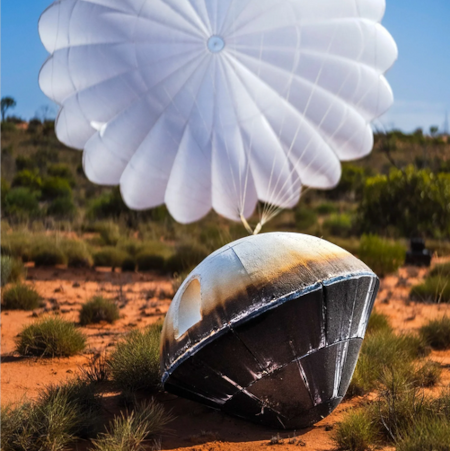
Varda’s fifth capsule after landing on January 29, 2026

The startup Varda, which launches returnable capsules for manufacturing products in space, has now rented a large building in California to build those capsules.

In an expansion of its business of processing pharmaceuticals in Earth’s orbit, Varda Space Industries is renting a large El Segundo plant where toy manufacturer Mattel used to design Hot Wheels and Barbie dolls. The plant in El Segundo’s aerospace corridor will be an extension of Varda Space Industries’ headquarters in a much smaller building on nearby Aviation Boulevard.

Varda will occupy a 205,443-square-foot industrial and office campus at 2031 E. Mariposa Ave., which will give it additional capacity to manufacture spacecraft at scale, the company said

The company will take control of the building in December, and will then need another four to eight months to install its production facilities.

Varda has launched and recovered five capsules so far. Some produced pharmaceuticals for sale on Earth, others other products, while two did hypersonic tests for the Pentagon during re-entry. It has a deal in Australia to land as many as 20 more capsules, and presently has ten more missions scheduled on SpaceX’s Falcon 9 rocket.

SpaceX launches 29 more Starlink satellites

SpaceX early this morning successfully placed another 29 Starlink satellites in orbit, its Falcon 9 rocket lifting off from Cape Canaveral Space Force Station in Florida.

The first stage completed its 25th flight, landing on a drone ship in the Atlantic.

The 2026 launch race:

28 SpaceX
8 China
2 Rocket Lab
2 Russia
1 ULA
1 Europe (Arianespace)

Not only is SpaceX this year leading the entire world combined in total launches — as it did in both ’24 and ’25 — at the moment it has launched twice as much as the rest of the globe.

Engineers locate helium flow issue on SLS upper stage

NASA last evening posted an update on the status of its SLS rocket, noting that engineers had located the seal that had caused the helium flow issue in the upper stage during unfueling after the wet dress rehearsal two weeks ago.

Engineers determined a seal in the quick disconnect, through which helium flows from the ground systems to the rocket, was obstructing the pathway. The team removed the quick disconnect, reassembled the system, and began validating the repairs to the upper stage by running a reduced flow rate of helium through the mechanism to ensure the issue was resolved. Engineers are assessing what allowed the seal to become dislodged to prevent the issue from recurring.

Though this information is somewhat vague, it strongly suggests the seal with the problem was in the upper stage, not the umbilical line that is part of the ground systems.

Before they can return the rocket to the launchpad, they need to make sure they identified the exact issue that caused the seal to not work properly. They also are replacing the batteries in the rocket’s self-destruct system as well as flight batteries in the upper stage, core stage, and two strap-on solid-fueled boosters. It also appears they are replacing another seal the oxygen feed line for the core stage.

Once this work is finished and confirmed, they will still need to roll SLS back to the launchpad and likely do another wet dress rehearsal countdown, though that rehearsal might be condensed to focus on these issues specifically.

The present launch window closes on April 6th, so the timeline is very tight. NASA management is reviewing later windows in late April as well as May and June.

Despite the major reshaping of the later missions in the Artemis program that NASA administrator Jared Isaacman announced last week, this upcoming Artemis-2 mission remains the same, a ten-mission carrying four astronauts around the Moon using an Orion capsule with a questionable heat shield and an untested life support system.

1 2 3 1,155