Firefly launches its Alpha rocket, almost a year after previous launch failure

Firefly today successfully launched its Alpha rocket, almost a year after a launch failure in April 2025.

This launch, from Firefly’s launchpad at Vandenberg Space Force Base in California, was the last for this version of Alpha, and was designed as a test flight, both to check out the fixes to correct last year’s failure as well as to prove out some of the technology that will be used on the upgraded Alpha to be used on all future flights.

The 2026 launch race:

30 SpaceX
8 China
3 Rocket Lab
2 Russia
1 ULA
1 Europe (Arianespace)
1 Firefly

SpaceX continues to lead the entire world combined in total launches — as it did in both ’24 and ’25 — and is doing almost twice as many launches as everyone else.


Genesis cover

On Christmas Eve 1968 three Americans became the first humans to visit another world. What they did to celebrate was unexpected and profound, and will be remembered throughout all human history. Genesis: the Story of Apollo 8, Robert Zimmerman's classic history of humanity's first journey to another world, tells that story, and it is now available as both an ebook and an audiobook, both with a foreword by Valerie Anders and a new introduction by Robert Zimmerman.


The print edition can be purchased at Amazon or any other book seller. If you want an autographed copy the price is $60 for the hardback and $45 for the paperback, plus $8 shipping for each. Go here for purchasing details. The ebook is available everywhere for $5.99 (before discount) at amazon, or direct from my ebook publisher, ebookit you don't support the big tech companies and the author gets a bigger cut much sooner.


The audiobook is also available at all these vendors, and is also free with a 30-day trial membership to Audible.
 

"Not simply about one mission, [Genesis] is also the history of America's quest for the moon... Zimmerman has done a masterful job of tying disparate events together into a solid account of one of America's greatest human triumphs."--San Antonio Express-News

Conscious Choice cover

Now available in hardback and paperback as well as ebook!


From the press release: In this ground-breaking new history of early America, historian Robert Zimmerman not only exposes the lie behind The New York Times 1619 Project that falsely claims slavery is central to the history of the United States, he also provides profound lessons about the nature of human societies, lessons important for Americans today as well as for all future settlers on Mars and elsewhere in space.

 
Conscious Choice: The origins of slavery in America and why it matters today and for our future in outer space, is a riveting page-turning story that documents how slavery slowly became pervasive in the southern British colonies of North America, colonies founded by a people and culture that not only did not allow slavery but in every way were hostile to the practice.  
Conscious Choice does more however. In telling the tragic history of the Virginia colony and the rise of slavery there, Zimmerman lays out the proper path for creating healthy societies in places like the Moon and Mars.


“Zimmerman’s ground-breaking history provides every future generation the basic framework for establishing new societies on other worlds. We would be wise to heed what he says.” —Robert Zubrin, founder of the Mars Society.


All editions are available at Amazon, Barnes & Noble, and all book vendors, with the ebook priced at $5.99 before discount. All editions can also be purchased direct from the ebook publisher, ebookit, in which case you don't support the big tech companies and the author gets a bigger cut much sooner.


Autographed printed copies are also available at discount directly from the author (hardback $29.95; paperback $14.95; Shipping cost for either: $6.00). Just send an email to zimmerman @ nasw dot org.

Iapetus: Saturn’s ying-yang moon

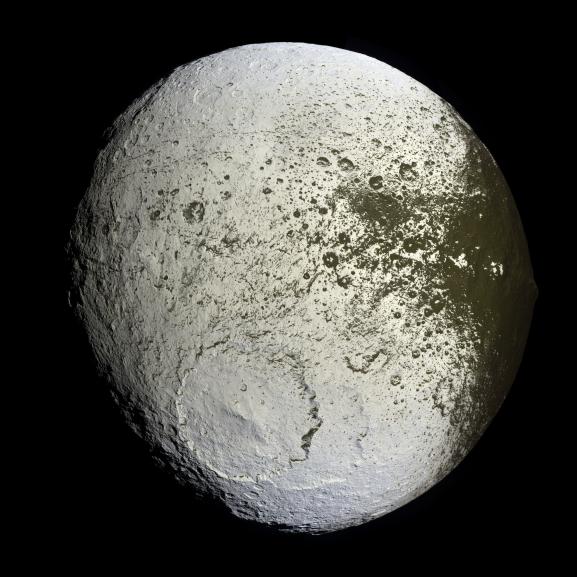
Iapetus as seen by Cassini in 2007
Click for original image.

Cool image time! The image to the right, reduced and sharpened to post here, was taken on September 10, 2007 by the Saturn orbiter Cassini as it made its first close fly-by of the moon Iapetus, from a distance of about 45,000 miles.

Iapetus, about 912 miles in diameter, is one of the strangest objects in the solar system. As it orbits Saturn, its leading hemisphere is very dark, covered with almost pitch black material, while its trailing hemisphere is very bright. This picture captures a bit of both, with the dark leading hemisphere visible along the right edge.

In many places, the dark material–thought to be composed of nitrogen-bearing organic compounds called cyanides, hydrated minerals and other carbonaceous minerals–appears to coat equator-facing slopes and crater floors. The distribution of this material and variations in the color of the bright material across the trailing hemisphere will be crucial clues to understanding the origin of Iapetus’ peculiar bright-dark dual personality.

There are several theories to explain the planet’s strange ying-yang two-tone coloration. One suggests it is material thrown off by other Saturn moons that Iapetus sweeps up. Other theories suggest the planet’s orbit itself causes the two hemispheres to have different temperatures, allowing material to sublimate off the dark side and to the bright side.

No theory is presently accepted. Nor does any explain the data fully.

Tomorrow I’ll post a most intriguing close-up of Iapetus taken by Cassini during that 2007 fly-by.

Interstellar comet 3I/Atlas is unusually enriched with windshield wiper fluid

New Hubble image of 3I/Atlas
Comet 3I/Atlas as seen by Hubble
in November 2025. Click for original.

While interstellar comet 3I/Atlas is remarkably like most comets from our own solar system, scientists have now found new evidence that it spalled off unusual amounts of methanol (CH3OH) — material normally used as windshield washer fluid, carburetor fluid, and cooking fuel — when it made its close fly-by of the Sun in the fall of 2025.

You can read the paper here [pdf] . The research also detected large amounts of prussic acid (HCN). As the comet made its closest pass to the Sun, the numbers increased. From the paper’s abstract:

The CH3OH production rate increased sharply from August through October, including an uptick near the inner edge of the H2 O sublimation zone at r H = 2 au. Compared to comets measured to date at radio wavelengths, the derived CH3 OH/HCN ratios in 3I/ATLAS of 124+30 −34 and 79−14 +11 on September 12 and 15, respectively, are among the most enriched values measured in any comet, surpassed only by anomalous solar system comet C/2016 R2 (PanSTARRS).

Though the numbers are high, they aren’t outside the range of what has been found in comets from our own solar system. Instead, this data suggests — as has all data so far — that Comet 3I/Atlas is a normal comet, but unique in its own way, as are all comets and in fact every object in space.

Leaving Earth cover

Leaving Earth: Space Stations, Rival Superpowers, and the Quest for Interplanetary Travel, can be purchased as an ebook everywhere for only $3.99 (before discount) at amazon, Barnes & Noble, all ebook vendors, or direct from my ebook publisher, ebookit.


If you buy it from ebookit you don't support the big oppressive tech companies and I get a bigger cut much sooner.


Winner of the 2003 Eugene M. Emme Award of the American Astronautical Society.

 
"Leaving Earth is one of the best and certainly the most comprehensive summary of our drive into space that I have ever read. It will be invaluable to future scholars because it will tell them how the next chapter of human history opened." -- Arthur C. Clarke

Fourteen-year-old NASA satellite about to burn up uncontrolled in the atmosphere

Chicken LIttle rules again.

Chicken Little rules again! After fourteen years, the orbit of one of NASA’s two Van Allen Probe satellites is about to decay, causing the 1,323 pound satellite to burn up uncontrolled in the atmosphere.

As of March 9, 2026, the U.S. Space Force predicted that the roughly 1,323-pound spacecraft will re-enter the atmosphere at approximately 7:45 p.m. EDT on March 10, 2026, with an uncertainty of +/- 24 hours. NASA expects most of the spacecraft to burn up as it travels through the atmosphere, but some components are expected to survive re-entry. The risk of harm coming to anyone on Earth is low — approximately 1 in 4,200.

As today is a very slow news day in space news, a lot of the mainstream press is highlighting this story, with the usual fear-mongering about how it could hit the Earth and cause terrible damage. And while it is certainly true that this satellite appears large enough for some pieces to reach the ground, the chances of those pieces causing any real harm is quite slim. In fact, I think NASA’s estimate of 1 in 4,200 to be far too high.

Mission engineers had initially estimated the orbit would decay in the 2030s, but that estimate was based on a prediction of a weak solar maximum. The Sun however was more active than predicted in the past decade, and that activity caused the Earth’s atmosphere to puff up, which in turn acted to accelerate the satellite’s orbital decay.

This incident once again shows us that there is money to be made in removing defunct satellites from orbit. NASA and ESA have both made it clear each would pay a company to do it. So have some private companies. Some of the orbital tug and robotic servicing companies have here an opportunity they need to grab.

A nearby red dwarf star has a solar system of four planets, one in the habitable zone

According to a new analysis of new data, astronomers now think the nearby red dwarf star GJ 887, only about 11 light years away, not only has a solar system of four planets, one of those planets is is a super-Earth orbiting the star in the habitable zone.

From the abstract:

With the Bayesian analysis, we confirmed a four-planet model, including the two previously known planets at periods of 9.2619 ± 0.0005 d and 21.784 ± 0.004 d, as well as two newly confirmed exoplanets: an Earth-mass planet, with a 4.42490 ± 0.00014 d period and a sub-meter-per-second amplitude, and a super-Earth with a 50.77 ± 0.05 d period located in the habitable zone (HZ). This super-Earth is the second closest planet in the HZ, after Proxima Cen b.

The super-Earth has a mass estimated to be anywhere from two to ten times that of Earth, so if any life could exist on it that life would have to be adapted for an extremely strong gravitational field. The star itself appears to be relatively benign for an M dwarf, having a “low level of magnetic activity”, though it does exhibit some flaring that could pose a threat to the development of life on the planet.

Unfortunately, this system is not aligned in a way to allow transits of these planets across the face of the star, so these conclusions are based on gravitational wobbles of the star analyzed by computer modeling. Lots of uncertainty. The scientists hope that direct observations of the planet by future space telescopes will reduce these uncertainties. At the moment, the proposed privately-funded Lazuli optical orbiting telescope has the best chance of doing this work, but it isn’t expected to launch before the end of the decade. It will have a 3.1 meter primary mirror, larger than Hubble’s 2.4 meter mirror.

It is a so far very slow news day in space.

Jefferson Starship – Jane

An evening pause: Performed live 1981.

Hat tip Gene Shipp.

March 10, 2026 Quick space links

As BtB’s stringer Jay is on vacation, here are a few links I spotted that don’t deserve full posts. This post is also an open thread. I welcome my readers to post any comments or additional links relating to any space issues, even if unrelated to the links below.

  • The Paso Robles city council approves plan to make its airport a spaceport
    Don’t bet on any orbital launches from this California city, for years if ever. There are no horizontal rockets presently operational, few are in development, and launching from California’s burdensome regulatory and anti-business government will discourage any that eventually start flying to come here. There are too many far better choices.
  • NASA inspector general generally approves its commercial manned lunar lander program
    You can read the report here [pdf]. While it identifies a number of relatively minor management issues, it admits that relying on private companies to build the lunar lander has controlled cost, kept it low, and is proceeding at reasonable speed. It whines about whether either SpaceX or Blue Origin will be ready for a 2028 manned landing, but recognizes that both are proceeding with all due speed. Note too that this report is out-of-date, as it does not include the recent reshaping of the entire Artemis program.

Who fired “the shot heard round the world”?

Paul Revere's Ride

In just a few months we will be celebrating the 250th anniversary of the signing of the Declaration of Independence. That signing occurred because a little over a year previously a troop of British soldiers went into the heart of Massachusetts to seize weapons and ammunition that the British government did not want Americans to possess, and ended up getting involved in a firefight with the local militia in the town of Lexington, what became known as “the shot heard round the world. That shot started the American Revolution, and eventually forced the members of the Continental Congress to declare their independence from that British government.

As with all history, though that firefight sparked vast changes in politics, history, and culture across the globe and across centuries, the event itself was the act of just one or a few individuals, in a specific moment and place, under very specific circumstances created by those greater movements of politics, history, and culture.

One man fired the gun. A few others fired back. And then a war started.

But who was that man?

In one of the best histories I have ever read, historian David Hackett Fischer attempts to answer this question. His 1994 book, Paul Revere’s Ride, centers the story on Paul Revere and that man’s actions to warn the citizens throughout Concord and Lexington of the British invasion, so that they could be prepared to fight, if necessary.
» Read more

Pluto’s cratered glacial terrain

Panorama of Pluto's eastern limb
Click for full resolution. For original images go here, here, here, and here.

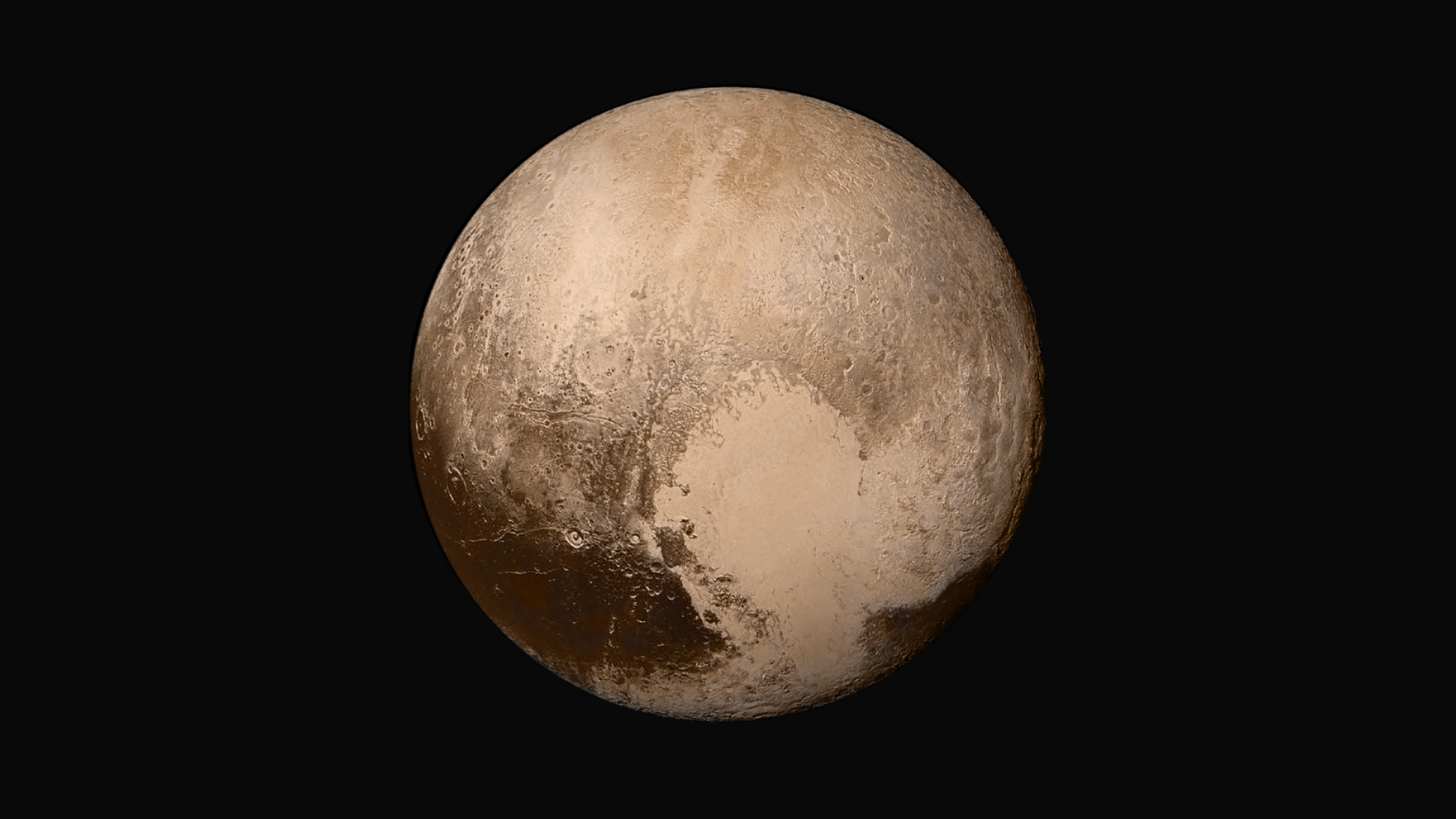
Pluto in true color
Click for original image.

Cool image time! The panorama above, created from four New Horizons’ images that were cropped and enhanced to post here, was taken by New Horizons on July 14, 2015 (here, here, here, and here), about 30 minutes before its closest approach of 7,800 miles above Pluto.

I have searched the New Horizons’ press release archive, and as far as I can tell, this sequence of images and the terrain it shows was never highlighted publicly by the science team. For that reason, I am not sure exactly where to place it on the global true-color image of Pluto to the right, released by the science team shortly after that fly-by. I suspect the panorama covers a strip on the eastern limb of the globe, in the darker crater region to the east of Pluto’s giant frozen nitrogen sea. It is also possible this is actually covering the north pole regions, with the raw images as released oriented with north to the right.

Other than these guesses I cannot tell. If anyone has better information please provide it in the comments.

What the panorama does show us is cracked and pitted terrain, thought to be mostly made up of frozen ice mixed with dust and debris with some nitrogen and other materials thrown in. Though in many ways it resembles the Moon, that similarity is only very superficial. For example, the polygon shapes near the picture’s center suggest ice floes or glaciers, though there is no underground liquid ocean on which they could float.

This is a very alien world. And it is likely even more alien than the few pictures obtained during that New Horizons’ fly-by have suggested. After all, we only saw in high resolution one hemisphere. Who knows what’s really on the planet’s other side?

SpaceX now targeting early April for next Starship/Superheavy test flight

Based on a tweet posted by Elon Musk on March 7, 2026, SpaceX now targeting early April for next and 12th Starship/Superheavy test orbital flight.

According to this update at nasaspaceflight.com, the Superheavy booster, the 19th prototype and the first version 3 booster, is now on the launchpad for final checks.

On March 8, Booster 19 left Mega Bay 1 and rolled down Highway 4 towards the launch site and Pad 2. This is the start of pad commissioning and booster engine testing for Block 3.

Booster 19 is mounted on Pad 2 to conduct multiple tests over the coming days. This will likely include ambient pressure testing, tanking tests with Liquid Oxygen (LOX) and Liquid Methane (LCH4), spin primes, and eventually a static fire, maybe even a couple of static fires. These tests are not only to help test the booster but also to test all of the pad systems.

While crews have run operations with the Pad 2 tank farm many times, they have never loaded an actual booster with propellant. With a booster finally on the pad, this will help in the final commissioning process.

For these initial pad and booster check-outs, #19 does not have all 33 engines installed. It appears the company wants to test the launchpad fueling system first, with the minimum number of engines needed.

Meanwhile, the Starship prototype that will fly, #39 in the series, is in the assembly building after completing its own series of tanking and launchpad tests.

I want to highlight two numbers — 19 and 39 — in order to illustrate how SpaceX does things versus NASA. Not only has SpaceX already completed eleven test flights of Starship/Superheavy, it has tested or flown 19 and 39 prototypes of each, in one manner or another. The company has a very rich history of hardware and testing as it ramps up towards operational flights. This practically guarantees that those operational flights will not only occur relatively soon, they will be relatively safe and robust.

This was all done in less than a decade, though most of the testing of those prototypes has occurred in the last six years.

NASA meanwhile began work on SLS about fifteen years ago, and has built two rockets total, and so far flown only one. Though the agency did a lot of tests of pieces of the rocket, it flew only one test launch, in 2022. SLS’s design is so cumbersome and expensive, the agency could not afford to fly it multiple times. Thus, much of its testing was done on computer screens, in simulations.

Which rocket would you want to fly on when both are operational?

Chinese scientists pinpoint a prime landing site for its manned lunar mission

Potential landing site for China's manned lunar landing

Though no final decision has apparently been made, a just published research paper suggests that China is considering a location almost dead center on the Moon’s near side, on the edge of a mare region dubbed Sinus Aestruum, for its first manned lunar landing, presently targeting a 2030 launch date. From the abstract:

We propose four prospective landing sites in the traversable areas, which provide a range of diverse geological samples, including volcanic debris, mare basalts, Copernicus crater ejecta and high-Th materials. Such a collection may provide insights into the geological evolution of the region and enhance our understanding of the lunar mantle composition and volcanic processes.

The red star on global lunar map to the right, taken from figure 1 of the paper, shows the location of this region. The lower map zooms into the region, with the four stars indicating the four prospective landing sites. The region has several rilles, long meandering channels thought to have formed from lava flow, that could be reached during an EVA.

Though it appears the scientists of this paper are lobbying for this landing region and no final decision has been reached, its location and wide variety of geology strongly suggests this will be the final choice. If so, of the four landing sites outlined two are in the smoother mare regions, and two are off the edge, in rougher terrain. For safety considerations, it is likely the final landing site will be in one of the former.

SpaceX launches EchoStar communications satellite

SpaceX early this morning successfully launched an EchoStar communications satellite, its Falcon 9 rocket lifting off from Cape Canaveral in Florida.

The first stage completed its 14th flight, landing on a drone ship in the Atlantic. The rocket’s two fairings completed their 8th and 27th flights respectively.

The 2026 launch race:

30 SpaceX
8 China
3 Rocket Lab
2 Russia
1 ULA
1 Europe (Arianespace)

Not only is SpaceX this year leading the entire world combined in total launches — as it did in both ’24 and ’25 — at the moment its pace is twice that as the rest of the globe.

Voyager to make “a multi-million-dollar strategic investment” in Max Space’s inflatable habitats

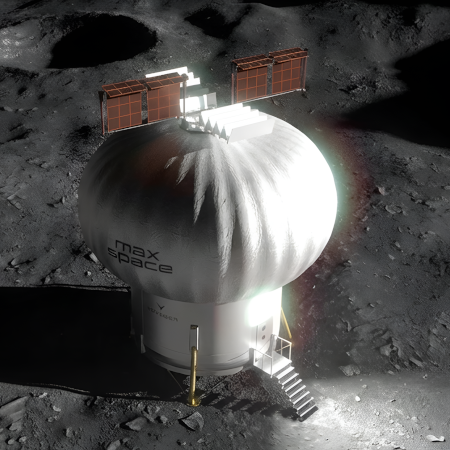
Voyager-Max lunar habitat
Click for original image.

In an expansion of a partnership announced last month, Voyager Technologies — the lead company in the consortium building the Starlab space station — today announced it is now making “a multi-million-dollar strategic investment” in Max Space’s inflatable habitats, aiming at winning contracts both for NASA’s proposed Moon base as well as any other “future deep space missions.”

The actual dollar amount has not yet been released, but my sources say it is in “the low eight figures,” or more than $10 million but probably less than $25 million.

This partnership appears aimed not at NASA’s space station program nor enhancing Starlab. Instead, it is focused on providing NASA (and other commercial operations) inflatable habitats that can be launched and quickly established on the Moon and elsewhere, as shown by the artist’s rendering to the right. It appears Voyager will build the foundation, base, and airlock, while Max will provide the inflatable module above. From the press release:

This initiative directly supports NASA’s historical Artemis Program and aligns precisely with Administrator Isaacman’s announcement to be on the Moon to stay by 2028. Max Space delivers critical enabling infrastructure, maximizing livable volume, enhancing crew safety, and reducing the cost and complexity of surface deployment. It complements Voyager’s broader lunar roadmap, including cislunar mission management, surface logistics, propulsion, power systems, and future surface infrastructure, reinforcing a shared vision of the Moon as an operational domain, not a temporary destination.

In other words, the two companies are aiming to become major suppliers for NASA’s Artemis lunar base, and to do that by offering a way to get it quickly built and operational, at a reasonable cost.

I suspect it will be a few years before NASA issues any such contracts. It will first want to see both companies demonstrate success, both with Voyager’s Starlab and Max Space’s own demo station module scheduled for launch in ’27. Nonetheless, this announcement puts them on the map in the race to get those contracts, and begins to put some commercial reality to the American colonization of the solar system.

Webb takes a look at a strange planetary nebula

Nebula PMR-1
Click for original image.

Cool image time! The two false-color pictures to the right, reduced to post here, were taken by two different infrared cameras on the Webb Space Telescope.

The object, PMR-1, is about 5,000 light years away and has apparently not been studied very much in the past. In 2013 astronomers used the Spitzer Space Telescope to get a first look in the infrared, at a much lower resolution. They also gave this object a nickname, the “Exposed Cranium” nebula. From the Webb press release:

The nebula appears to have distinct regions that capture different phases of its evolution — an outer shell of gas that was blown off first and consists mostly of hydrogen, and an inner cloud with more structure that contains a mix of different gases. Both Webb’s NIRCam (Near-Infrared Camera) and MIRI (Mid-Infrared Instrument) show a distinctive dark lane running vertically through the middle of the nebula that defines its brain-like look of left and right hemispheres. Webb’s resolution shows that this lane could be related to an outburst or outflow from the central star, which typically occurs as twin jets burst out in opposite directions. Evidence for this is particularly notable at the top of the nebula in Webb’s MIRI image, where it looks like the inner gas is being ejected outward.

While there is still much to be understood about this nebula, it’s clear that it is being created by a star near the end of its fuel-burning “life.” In their end stages, stars expel their outer layers. It’s a dynamic and fairly fast process, in cosmic terms. Webb has captured a moment in this star’s decline. What ultimately happens will depend on the mass of the star, which is yet to be determined. If it’s massive enough, it will explode in a supernova. A less massive Sun-like star will continue to shed layers until only its core remains as a dense white dwarf, which will cool off over eons.

The dark lane suggests we are looking at the star’s equator, with the two lobes on either side the material being flung out ward from the poles. It is also possible this is wrong, because the lobes on either side do not have a clear distinct jet-like appearance.

Italian rocket company Avio wins $65 million War department contract

The Italian rocket company Avio announced last week that it has won a $65 million contract to build a solid-fueled motor for the U.S. Department of War.

Defense Systems and Solutions (DSS), a joint venture between Yulista Integrated Solutions, LLC (YIS) and Science and Engineering Services, LLC (SES), acting as a prime contractor for the US Department of War, selects Avio Group for the development, qualification and initial production of a solid rocket motor for air defense applications.

The contract, amounting approximately to $65 million and covering a three-year period, paves the way for a broader cooperation between the Parties, to exploit respective competences to provide US Government and NATO Allies with critical Defense Systems.

This contract award is significant in several ways. First, it signals the success of Avio’s policy in the past two years to establish itself as a U.S. military contractor, despite being a long-time Italian company. To do this it created a U.S. division, begun construction of a U.S-based manufacturing facility, and committed $500 million to its construction.

Second, Avio’s quick success also illustrates a general weakness in the American solid-rocket industry. It appears the American company that previously dominated this field of military solid-fueled rockets is Northrop Grumman, and its work in recent years has been problematic. Others might also do this work, but it appears no U.S. company has been doing it well enough to satisfy the War Department. The result has been an opportunity for Avio, and it appears it is taking advantage of it.

Finally, this success proves the rightness of the capitalism model. For almost two decades Avio built solid-fueled rockets for the European Space Agency’s commercial division, Arianespace, which controlled the marketing and sale of the rockets. That government control not only created a government middle-man that eat into the profits, it discouraged competition and innovation. Last year ESA completed transfer back to Avio, and the result has been new contracts from many new sources for the company.

The Senate cries “Uncle!” on SLS and big goverment with its latest NASA authorization bill

I usually pay relatively little attention to the NASA authorization bills that Congress passes periodically, because these bills are generally nothing more than opportunities for the loudmouths in Congress to use them as a bullhorn to puff themselves up to the public and press. Almost never do such bills really have any real impact on the future, or if they do, that impact is often unintended and negative, as Congress is by and large ignorant about these matters and has priorities counter-productive to getting anything substantive accomplished.

I pay even less attention to authorization bills that have only been approved by a committee, and have not yet been voted on by either house. Such bills are ephemeral and the stuff of fantasy. It is nice to know what’s in them, but until such bills are actually approved by both houses of Congress and signed by the president, their language is even more unworthy of serious attention.

Have the pigs in the Senate learned to stop gorging themselves?

Nonetheless, the NASA authorization bill that was just approved by the Senate Commerce committee is worth reviewing, but not for the reasons that has interested the rest of the mainstream and even the aerospace press.

True, the bill extends ISS until 2032. True, it fully supports the commercial private space stations being built to replace it. True, it endorses NASA administrator Jared Isaacman’s restructuring of the Artemis program. True, it rejects all of Trump’s proposed cuts to NASA’s science programs. And true, it strongly endorses a Moon base as a first step to colonizing Mars.

All of these facts are significant, but to focus on each specifically — as it appears the entire press has done — is to miss the forest for the trees.
» Read more

SpaceX launches 25 more Starlink satellites

SpaceX early today successfully placed another 25 Starlink satellites into orbit, its Falcon 9 rocket lifting off from Vandenberg Space Force Base in California.

The first stage completed its 7th flight, landing on a drone ship in the Pacific.

The 2026 launch race:

29 SpaceX
8 China
3 Rocket Lab
2 Russia
1 ULA
1 Europe (Arianespace)

Not only is SpaceX this year leading the entire world combined in total launches — as it did in both ’24 and ’25 — at the moment its pace is about twice that as the rest of the globe.

NASA awards ULA’s Centaur-5 upper stage for future SLS launches

NASA yesterday awarded ULA the contract for providing SLS its upper stage after the Artemis-3 mission using the Centaur-5 upper stage that was developed for the company’s Vulcan rocket.

In its procurement statement, NASA said its intention is to issue a sole source contract to ULA, meaning it’s the only upper stage being considered for this new iteration of the SLS rocket. An eight-page supporting document from NASA’s Marshall Space Flight Center (MSFC) in Huntsville, Alabama, was published to document the reasoning for its decision.

Among the stated reasons are the decades-long heritage of the RL10 engine, which has matured over time; the ability of the Centaur 5 to use the interfaces available on the Mobile Launcher 1 (ML1) along with the propulsion commodities of liquid oxygen and liquid hydrogen; and the experience of ULA’s teams working with NASA’s Exploration Ground Systems (EGS) at the Kennedy Space Center and elsewhere in the country.

They also noted that with the Centaur 3 upper stage achieving certification to launch humans as part of the Commercial Crew Program, there are a lot of common features with the Centaur 5.

The decision relieves NASA from wasting more money on the Mobile Launcher-2, which has been a disaster. The contractor Bechtel has gone over budget — from $383 million to $2.7 billion — and is so behind schedule it is still unclear now whether it will be ready by 2029, a decade after the contract was awarded.

It also relieves NASA of spending more money on its own upper stage, which has been as much a disaster, from Boeing.

Instead, this deal is an example of Isaacman doing the right thing. Rather than have NASA design and build its own upper stage, he is buying the product — almost literally off-the-shelf — from a commercial rocket company. He should expand this effort, and consider other private rockets, such as Falcon Heavy, to replace SLS itself.

Now Isaacman should consider suing Bechtel for fraud and incompetence, to try to get back some of the money it wasted.

Dart changed the orbit of the Didymos/Dimorphos binary asteroids around the Sun

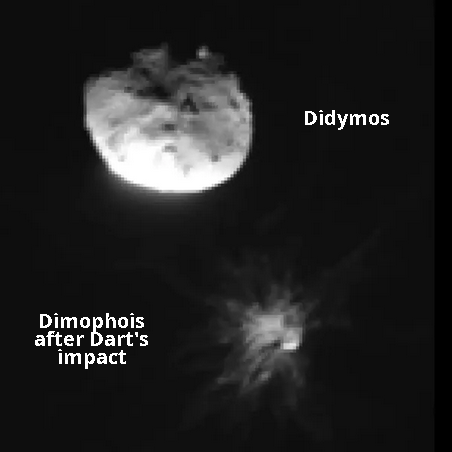
Dimorphos just after impact

When the Dart spacecraft impacted the asteroid Dimorphos in September 2022, it not only shortened Dimophos’ orbit around its companion asteroid Didymos by about 33 minutes while reshaping the asteroid, a new study has found that it also changed very slightly the orbit of both asteroids around the Sun.

The image to the right, annotated to post here, was taken by the Italian LICIACube spacecraft moments after the September 26, 2022 impact.

The research paper describing this research can be found here. From the press release:

The new study shows the impact ejected so much material from the binary system that it also changed the binary’s orbital period around the Sun by 0.15 seconds. “The change in the binary system’s orbital speed was about 11.7 microns per second, or 1.7 inches per hour,” said Rahil Makadia, the study’s lead author at the University of Illinois Urbana-Champaign. “Over time, such a small change in an asteroid’s motion can make the difference between a hazardous object hitting or missing our planet.”

To be precise, the orbital speed was slowed 1.7 inches per hour, which while tiny would mean its solar orbit is now slightly shortened.

The result proves that a similar impact could be used on some asteroids to deflect them from hitting the Earth, though we would need to know a lot about that asteroid prior to launching the mission to accurately predict the orbital change. Otherwise, any impact could be a dangerous crap shoot that could do more harm than good.

March 6, 2026 Quick space links

As BtB’s stringer Jay is on vacation, here are two links I spotted that don’t deserve full posts. This post is also an open thread. I welcome my readers to post any comments or additional links relating to any space issues, even if unrelated to the links below.

Curiosity looks uphill at its upcoming travels

Panorama looking up Mount Sharp
Click for original.

Overview map
Click for interactive map.

Cool image time! Since May 2025 Curiosity has been exploring in great detail the boxwork formations located on the lower slopes of Mount Sharp. It is now about to complete those investigations, with the Curiosity science team beginning their planning for moving onward and upward.

The panorama above, enhanced to post here, was taken on March 2, 2026 by the rover’s right navigation camera. It looks uphill along the valley that Curiosity is in toward the mountainous region the rover is targeting. Note that the peak of Mount Sharp is not visible, being more than 25 miles away beyond the horizon and about 15,000 feet higher up.

The blue dot on the overview map to the right mark Curiosity’s present position. The yellow lines indicate roughly the area this panorama covers. The red dotted line marks the rover’s approximate planned route, while the white dotted line indicates Curiosity’s actual travels.

Right now Curiosity is traveling through a geological layer the scientists have dubbed the sulfate unit. The lighter colored hills seen on the horizon have also been identified as sulfate, but believed to be much more pure. The geology there should be very different. Instead of rough and rocky it could be like traveling over soft porous sand. This however is merely a guess on my part, based on imagery of those light-colored hills.

The actual route through those hills however remains unknown. Either the science team has not yet released it, or is still trying to figure out the best way through.

South Korean rocket startup Perigee signs deal to launch from the Philippines

The Philippines

The South Korean rocket startup Perigee yesterday signed an agreement with the government of the Philippines, allowing it to launch its proposed suborbital and orbital Blue Whale rockets from a sea platform within that country’s territorial waters.

The Philippine Space Agency (PhilSA), together with the Department of Information and Communications Technology (DICT), Cagayan Economic Zone Authority (CEZA), Ascend International Gateway, Inc., and … Perigee Aerospace, Inc. signed a Memorandum of Understanding … to collaborate on a framework for rocket development training and experimental rocket launches in the Philippines. These initiatives will demonstrate the viability of the establishment and operation of a Philippine spaceport, with the goal of positioning the country as a gateway to space in the region.

…The agreement builds on the rocket technology know-how transfer and training program undertaken by PhilSA engineers in the Republic of Korea from October to November 2025, in collaboration with Perigee Aerospace. The program equipped the engineers with foundational and applied knowledge in launch vehicle systems through lectures and hands-on experience in rocket assembly and testing. These initiatives lay the groundwork for future activities, including possible localized assembly, testing, and launch operations in the Philippines.

The first four entities listed above are all government agencies in the Philippines. Apparently Perigee is providing training and aid to the Philippines in exchange for the right to launch from within that country. It website states the suborbital version of Blue Whale will launch from a sea platform, but the launch site for the orbital version is unclear.

This deal however sets the stage for possibly developing a land-based spaceport in the Philippines. As shown by the map to the right, the country is well situated for such purposes, with a lot of eastern coastline facing the vast Pacific ocean. A spaceport located on its southernmost island of Mindanao would be especially well placed.

1 2 3 1,156