
December 12, 2025 Zimmerman/Batchelor podcast
Embedded below the fold in two parts.
To listen to all of John Batchelor’s podcasts, go here.
» Read more
Embedded below the fold in two parts.
To listen to all of John Batchelor’s podcasts, go here.
» Read more
An evening pause: The official name is the Niland Geyser.
Hat tip Wayne DeVette.
Courtesy of BtB’s stringer Jay. This post is also an open thread. I welcome my readers to post any comments or additional links relating to any space issues, even if unrelated to the links below.
The leftist anti-Musk activists groups have now appealed the dismissal of their lawsuit against the law allowing more frequent beach closures at Boca Chica for Starship/Superheavy launches.
The lawsuit was filed by Save the Rio Grande Valley (SaveRGV), the Sierra Club, and the Carrizo/Comecrudo Nation of Texas against Cameron County, the Texas General Land Office, Texas Land Commissioner Dawn Buckingham, and the Texas attorney general. When the case was reviewed by the lower court in Cameron county, it dismissed it entirely, saying the activist groups had no standing and had failed to show any harm from the law.
The activists then appealed to a higher court.
The Thirteenth Court of Appeals found the Plaintiffs have standing and that immunity had been waived for each Defendant. The case was remanded to the trial court to proceed on the merits, but Defendants appealed the Thirteenth Court’s ruling to the Supreme Court of Texas.
Oral arguments before the Supreme Court of Texas will occur on January 13, 2026. In the more rational world of America until two decades ago, the case would be thrown out again, since the law that initially limited these beach closures was legally revised by the state legislature.launches. Just because these leftists don’t like it doesn’t mean they and the courts have the right to cancel legal legislation.
We no longer live in that more rational American world, however. Politics now rule, and it is leftist politics that most often win, regardless of the law or rationality.
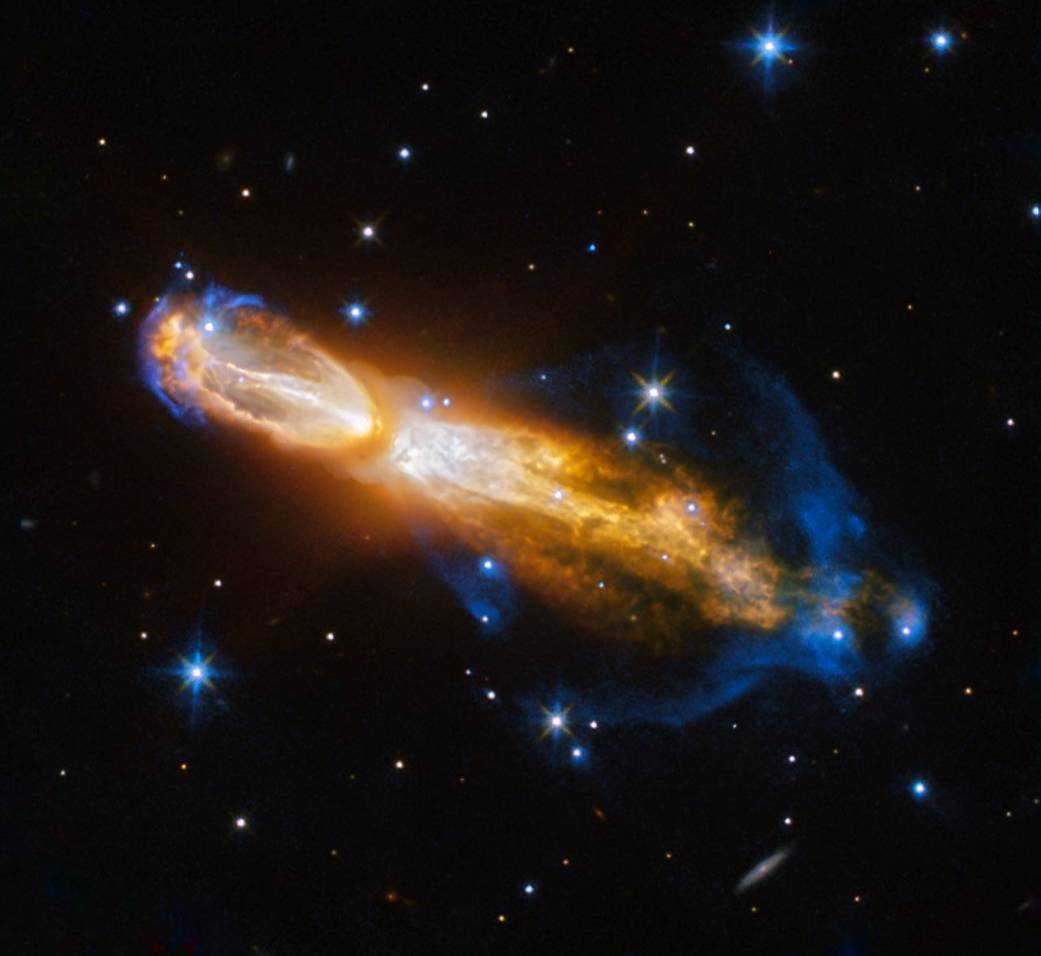
Click for original image.
Cool image time! The picture to the right, reduced and sharpened to post here, was taken by the Hubble Space Telescope back in 2017 but released this week by NASA’s PR department. It shows what astronomers have nicknamed the Calabash Nebula. From the Wikipedia page:
The Calabash Nebula, also known as the Rotten Egg Nebula or by its technical name OH 231.84 +4.22, is a protoplanetary nebula (PPN) 1.4 light years (13 Pm) long and located some 5,000 light years (47 Em) from Earth in the constellation Puppis. The name “Calabash Nebula” was first proposed in 1989 in an early paper on its expected nebular dynamics, based on the nebula’s appearance.[5] The Calabash is almost certainly a member of the open cluster Messier 46, as it has the same distance, radial velocity, and proper motion.[6] The central star is QX Puppis, a binary composed of a very cool Mira variable and an A-type main-sequence star.
The star in the center is an ancient red giant that is in the initial stages of dying. As it does so it periodically erupts, sending out jets of material from its poles. The result is this elongated shape. According to the release, “the gas shown in yellow is moving close to a million kilometers an hour.”
Over the next few thousand years these eruptions will shape the planetary nebula. Since the central star is actually a binary, those two stars will likely act like the blades in a mixer, adding more interesting forms to the material as it is shot out to form this nebula.
Though this is hardly the most important story of the day, the head of the Space Force yesterday announced that the agency has now established a new naming system for its in-space satellites and weapons.
The result is a taxonomy of seven categories tied to seven mission areas. Orbital warfare systems will take their names from the Norse pantheon. Cyber warfare tools from mythological creatures. Electromagnetic warfare systems from serpents. Navigation warfare tools from sharks. Missile warning assets from sentinels. Space domain awareness systems from ghosts. And satellite communications systems from constellations.
The service is also taking care to avoid copyright issues, Saltzman said: “We had to find categories that you could use, like ghosts or constellations or things that nobody could claim ownership of.”
This naming system will allow one to immediately identify the general purpose of the satellite or payload, though of course more specific details will be classified.
The system will however also include a less informative numbering system:
Alongside the thematic nicknames, the Space Force is also adopting a new alphanumeric satellite designation scheme. Each spacecraft will receive a two-letter prefix indicating mission type followed by a number. For example, the next generation of geostationary reconnaissance satellites will carry the RG-XX designator, adding a layer of standardized classification to complement the symbolic names attached to operational systems.
It was not made clear whether this naming system will be applied to previously launched spacecraft.
Meetings this week between SpaceX officials and the Iraqi government appear to have finalized an agreement that would allow Starlink to be marketed inside Iraq.
The meeting on Thursday concluded with discussions on “the final procedures related to granting satellite internet licenses, including the license designated for SpaceX, as well as avenues for strengthening cooperation in the telecommunications sector, the services provided by the company, and its prospective coverage areas,” the statement added.
It is not clear if the deal has been signed, or is simply written and still needs review. Based on the little information provided, it sounds as if SpaceX will be marketing its terminals directly to Iraqi citizens. I suspect however that some Iraqi government entity will demand a cut, and might even demand the right to do the marketing itself, as a number of other nations have done.
Regardless, Starlink continues to expand worldwide, and in doing so makes censorship increasingly difficult for the petty power-hungry thugs that run many of these third world nations. And when Amazon Leo begins operations, that censorship will become even more difficult.
The Italian rocket company Avio has selected Virginia as the location where it will build a $500 million solid-fueled rocket facility as part of establishing its American-based division.
Italian rocket builder Avio has announced that it has selected the state of Virginia to build its planned US-based production facility. The $500 million project forms part of the company’s expansion of its defence business.
Avio founded its wholly owned US subsidiary, Avio USA, in 2022 to capitalise on a market opportunity created by constrained solid rocket motor production capacity relative to surging demand for tactical propulsion solutions. Since then, the company has signed contracts with the US Armed Forces, Raytheon, and Lockheed Martin.
Avio presently builds the Vega-C solid-fueled rocket, which until this year was managed and controlled by the European Space Agency’s (ESA) commercial division, Arianespace. That arrangement however is ending. Beginning next year, Arianespace will be out of the picture. Avio is already marketing its own rocket, as indicated above, and as part of that process the company has been expanding operations, such as creating this U.S. division.
And for Avio this situation presents a great opportunity. The only company producing solid-fueled rockets and missiles in the U.S. appears to be Northrop Grumman, and the lack of competition has made its rockets expensive. There is room for competition. Moreover, the decisions of the Biden administration to provide the Ukraine a very large percentage of the Pentagon’s missile stock means there is a big need to replenish those stocks.

According to statements by one Turkish official this week, his nation has begun building its own spaceport on the southeast coast of Somalia at a location not yet specified.
Türkiye has begun construction of a space launch facility in Somalia, marking the country’s entry into an exclusive group of nations with oceanside spaceports, Board Chairman of Baykar Selcuk Bayraktar announced on Thursday. “Türkiye now has a space launch station. Normally, you need to be by the ocean. Türkiye has a 30 kilometer by 30 kilometer area in Somalia,” Bayraktar said during a panel at Take Off İstanbul 2025. “When you have oceanside access, you can deploy launch vehicles, meaning you have a spaceport. There are 12 such places in the world. Because Somalia is part of our heartland geography, there will be a space station there,” he noted.
This plan has been in the works since earlier this year, though few real details (such as its specific location) have not been released. It appears however that Turkey wants to use it to test both ballistic missiles and eventually launch orbital rockets. The location on the coast will permit test flights of bigger missiles that Turkey cannot do from its present test sites inside Turkey.
China today successfully launched another nine internet-of-things satellites for the Guowang (or SatNet) constellation, its Long March 12 rocket lifting off from its coastal Wenchang spaceport.
China’s state-run press did not reveal the number of satellites, but the previous three Long March 12 launches that carried Guowang satellites all launched nine, so I think it is safe to assume nine launched today as well. This was the sixteenth launch for this constellation, which now has about 119 satellites in orbit, with a planned 13,000 once complete.
The Long March 12 is expendable. Though the launch proceeded over the ocean, one drop zone for the rocket’s lower stages was in the Philippines, where authorities warned its citizens to avoid those zones and to exercise caution if they see any likely rocket debris.
An upgraded version, the Long March 12A, with a first stage designed to land vertically and be reused, is scheduled to launch sometime in the next two weeks.
The leaders in the 2025 launch race:
164 SpaceX
82 China (a new record)
15 Rocket Lab
15 Russia
SpaceX still leads the rest of the world in successful launches, 164 to 134.
An evening pause: Performed live 2010.
Hat tip John Jossy.
The beat goes on! SpaceX today continued its torrid launch pace, launching another 29 Starlink satellites, its Falcon 9 rocket lifting off from Cape Canaveral in Florida.
The first stage completed its 16th flight, landing on a drone ship in the Atlantic.
The leaders in the 2025 launch race:
164 SpaceX (a new record)
81 China
15 Rocket Lab
15 Russia
SpaceX now leads the rest of the world in successful launches, 164 to 133.
Courtesy of BtB’s stringer Jay. This post is also an open thread. I welcome my readers to post any comments or additional links relating to any space issues, even if unrelated to the links below.
Astronomers reviewing data collected by the Chandra X-ray Observatory have found that 70% of smaller galaxies don’t appear to have supermassive black holes at their center.
A team of astronomers used data from over 1,600 galaxies collected in more than two decades of the Chandra mission. The researchers looked at galaxies ranging in heft from over ten times the mass of the Milky Way down to dwarf galaxies, which have stellar masses less than a few percent of that of our home galaxy. … The team has reported that only about 30% of dwarf galaxies likely contain supermassive black holes.
You can read the paper here [pdf].
This conclusion not only impacts the theories on the formation of supermassive black holes in the center of galaxies, it influences the present theories on the formation of galaxies themselves.
Scientists doing new computer modeling of the known data now posit that Neptune and Uranus might not be as icy as previously believed and instead could be more like the inner terrestrial planets like Earth, much rockier in their interior.
According to the work carried by the UZH scientific team, Uranus and Neptune might actually be more rocky than icy. The new study does not claim the two blue planets to be one or the other type, water- or rock- rich, it rather challenges that ice-rich is the only possibility. This interpretation is also consistent with the discovery that the dwarf planet Pluto is rock-dominated in composition.
…With their new agnostic, and yet fully physical model, the University of Zurich team found the potential internal composition of the “ice giants” of our Solar system, is not limited at all to only ice (typically represented by water). “It is something that we first suggested nearly 15 years ago, and now we have the numerical framework to demonstrate it,” reveals Ravit Helled, a professor at the University of Zurich and initiator of the project. The new range of internal composition shows that both planets can either be water-rich or rock-rich.
This new hypothesis might also help explain the multi-polar magnetic fields of both planets.
All is uncertain of course, as this is just a computer model based on limited data. Nor is it a surprise that an alternative conclusion appears to work. We know so little about these distant worlds that it is likely that multiple theories could fit the data, and all could be wrong when we finally learn more.
The French startup The Exploration Company, which has been developing an unmanned cargo spacecraft called Nyx to supply the commercial space stations under development, has now also gotten funds from the European Space Agency (ESA) to build an in-orbit spacecraft designed to provide refueling and servicing capabilities as well.
More information here.
In a 25 November update on its progress with an ESA-funded project, the company revealed that it is also working on a spacecraft called Oura, designed to refuel satellites in orbit, thereby extending their operational lifespan.
…As part of the 25 November update, the company announced that it had been awarded a Phase B2 contract for the InSPoC-1 programme. The Phase B2 development of the project will include activities up to Technology Readiness Level 6, which represents the development of a prototype and its demonstration in a relevant environment.
Once again, this contract from ESA is radically different than its past policy of building and owning everything itself. Instead, it is hiring this French company to develop this capability, which this French company will then own and be able to sell for profits to others.
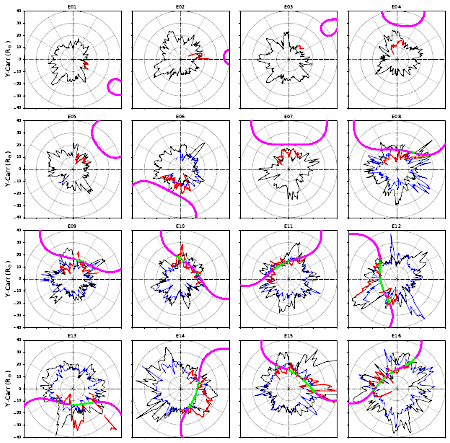
Using multiple solar observatories in space, scientists have now been able to map the approximate location of the outside edge of the Sun’s atmosphere, the point “where the speed of the outward solar wind becomes faster than the speed of magnetic waves.”
The panels to the right are a sampling of that mapping, and is figure 3 of the peer-reviewed paper [pdf]. The bulk of the data (black) comes from five spacecraft observing the Sun from the L1 point a million miles from Earth. The blue line is data from Solar Orbiter, while the red line is data from the Parker Solar Probe. From the press release:
Astronomers have produced the first continuous, two-dimensional maps of the outer edge of the Sun’s atmosphere, a shifting, frothy boundary that marks where solar winds escape the Sun’s magnetic grasp. By combining the maps and close-up measurements, scientists from the Center for Astrophysics | Harvard & Smithsonian (CfA) showed that the boundary grows larger, rougher and spikier as the Sun becomes more active.
…The boundary in the Sun’s atmosphere where the solar wind’s outward speed becomes faster than the speed of magnetic waves, known as the Alfvén surface, is the “point of no return” for material that escapes the Sun and enters interplanetary space; once material travels beyond this point, it cannot travel back to the Sun. This surface is the effective “edge” of the Sun’s atmosphere, and provides scientists with an active laboratory for studying and understanding how solar activity impacts the rest of the solar system, including life and technology on and around Earth.
This new data further refines the nature of the boundary, as earlier probes had already given scientists a rough idea of its size and nature.
The outage earlier today unfortunately toasted everything I did yesterday. That also appears to include the comments people left as well.
I will attempt to recreate those posts later today and over the weekend. Sorry however about the comments. I don’t think I can recover them.
UPDATE: I think I have recreated all the posts from yesterday. I was also able to repost the lost comments from the National Academies of Science story because commenter Edward had them still and sent them to me.
If I have missed anything, please comment below.
Pentagon officials yesterday announced that before it will certify Blue Origin’s New Glenn rocket for commercial military payloads, it must complete two more successful orbital launches, for a total of four flights.
Blue Origin’s New Glenn rocket will have to complete four successful orbital flights as its pathway to certification under the U.S. Space Force’s National Security Space Launch (NSSL) program, Lt. Gen. Philip Garrant said Dec. 10 at the Spacepower conference. Garrant, who leads the Space Systems Command, said Blue Origin selected the four-flight benchmark and the government agreed. “The government is supporting a four-flight certification for New Glenn,” he told reporters. The rocket has logged two successful missions so far, and Garrant said a third launch is expected “earlier in the new year than later.” If upcoming flights stay on track, he added, “I think they’re going to be in a fantastic place to become our third certified provider and compete for missions.”
If certified, Blue Origin would join SpaceX and United Launch Alliance as the Space Force’s third heavy-lift launch provider.
It is surprising that the military is requiring four successful flights from Blue Origin, but required only two from ULA’s new Vulcan rocket, and certified that even though there were problems on Vulcan’s second flight.
These extra flights should not cause a significant delay, since Blue Origin is expecting to complete a number of launches in 2026 to meet its obligations under its Amazon Leo contract
Embedded below the fold in two parts.
To listen to all of John Batchelor’s podcasts, go here.
» Read more