Biden to unveil first Webb science image today

This should be entertaining: NASA today announced that the unveiling of the first science image from the James Webb Space Telescope has been moved up to later today, so that President Joe Biden can do the unveiling from the White House. From the NASA tweet:

We can’t contain the excitement for @NASAWebb’s first full-color images!

On Monday, July 11 at 5pm ET (21:00 UTC), President Biden will unveil one of the space telescope’s first images of deep space as a preview of what’s ahead.

It appears that the picture Biden will use in this photo op will be the only deep field cosmological picture scheduled for release:

SMACS 0723: Massive foreground galaxy clusters magnify and distort the light of objects behind them, permitting a deep field view into both the extremely distant and intrinsically faint galaxy populations.

The remaining four images will still be released on July 12, 2022, as originally planned.

The live stream of this event will be broadcast on NASA TV.

8 comments

SpaceX launches another 46 Starlink satellites

Capitalism in space: Using its Falcon 9 rocket, SpaceX today successfully launched another 46 Starlink satellites from Vandenberg Space Force Base in California.

The first stage completed its sixth flight, landing on the drone ship in the Pacific.

A minor note: SpaceX has clearly decided to simplify these broadcasts. Each is now starting much closer to launch, and the announcers have reduced their narration to the absolute minimum. Overall, this seems a wise policy, because though these live streams are good advertising, most of the people listening at this point do not need detailed explanations of everything. If anything, too much chatter is annoying, and as always less is more.

The leaders in the 2022 launch race:

29 SpaceX
21 China
9 Russia
4 Rocket Lab
4 ULA

The U.S. now leads China 41 to 21 in the national rankings, and the entire world combined 41 to 36. The forty-one launches in just over half of ’22 beats the U.S.’s total for the whole year just two years ago.

1 comment

Elon Musk gives a tutorial on the Raptor-2 engine

Tim Dodd of Everyday Astronaut on Friday released another video from his most recent tour of Starbase at Boca Chica with Elon Musk. I have embedded it below.

Essentially, this 41 minute video is Elon Musk giving us a tutorial on how SpaceX simplified and improved its Raptor engines from its first iteration to the present Raptor-2. He does this while standing in front of a long row of finished Raptor-2s, all meant for installation in the seventh prototype of Superheavy, the booster now on the launchpad with those engines installed and being prepared for its first static fire test prior to the orbital flight.

Musk revealed two interesting factoids during this video. First SpaceX blew up approximately 20 to 30 Raptor engines during the development phase, and melted the chambers on another 50. All of this was perfectly acceptable, because they designed engine manufacture so that a high production rate was built in. As Musk noted, “A high production rate solves many ills.” Losing engines during testing and development was no big deal because they were able to quickly replace them, with revisions and upgrades.

Secondly, Musk claimed that the Raptor-2 engine has a 99% efficiency, a level of efficiency that is unheard of in any engine for any purpose ever. I wonder if that claim will hold up as new companies and engineers work to beat SpaceX in the coming centuries.

» Read more

13 comments

A galaxy with swirling arms

A galaxy with swirling arms
Click for full image.

Cool image time! The picture to the right, cropped and reduced to post here, was released yesterday by the science team that operates the Hubble Space Telescope. It captures a galaxy about 520 million light years away that appears to have been reshaped due to a galaxy merger.

That merger somehow distorted the disk of the inner galaxy, the brightest area, while also producing two sweeping spiral streams in the surrounding periphery.

Despite its unusual shape, astronomers did not choose to study this galaxy. From the caption:

This observation is a gem from the Galaxy Zoo project, a citizen science project involving hundreds of thousands of volunteers from around the world who classified galaxies to help scientists solve a problem of astronomical proportions: how to sort through the vast amounts of data generated by telescopes. A public vote selected the most astronomically intriguing objects for follow-up observations with Hubble. CGCG 396-2 is one such object, imaged here by Hubble’s Advanced Camera for Surveys.

7 comments

The colorful layers of the Martian north pole icecap

Colorful layers in the Martian north pole ice cap
Click for full image.

Wider view
Click for full image.

Today’s cool image above, rotated, reduced, and annotated to post here, comes from today’s picture of the day for the high resolution camera on Mars Reconnaissance Orbiter (MRO), which in turn is a retrospective of a captioned image first taken in 2010. The photo to the right, rotated, cropped, and reduced to post here, shows a larger area to provide some context. For this image north is towards the top. The rectangle indicates the area covered by the picture above.

The ice cap at the north pole is about 600 miles across and a little less than 7,000 feet deep, made up of many layers that are a mixture of water ice and cemented dust and sand. From the picture’s caption:

In many locations erosion has created scarps and troughs that expose this layering. The tan colored layers are the dusty water ice of the polar layered deposits; however a section of bluish layers is visible below them. These bluish layers contain sand-sized rock fragments that likely formed a large polar dunefield before the overlying dusty ice was deposited.

The lack of a polar ice cap in this past epoch attests to the variability of the Martian climate, which undergoes larger changes over time than that of the Earth.

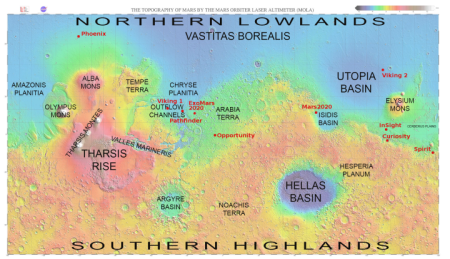
The overview map below provides some further context.
» Read more

1 comment

Blacklisted Americans fight back

And clowns should not be running the schools
And the clowns must be fired, now!

Today’s blacklist column will be a surprisingly optimistic one (though I fully admit that I might be fooling myself), based on two stories that appeared in the press yesterday.

First, there was this story out of Virginia, where a new Christian private school with an initial capacity for 500 students received in less than a week more than 2,500 applications from parents.

Loudoun County has been the subject of so much controversy, that Pastor Gary knew there would be a demand locally. What he didn’t expect is to hear from parents in at least 27 states eager for their children to attend.

Cornerstone has been inundated with inquiries, and not just from parents. Teachers want out of public schools too. “By the end of the week, we had over 2,500 students pre-registered. I got over 450 emails from teachers wanting employment.” [emphasis mine]

The school, Cornerstone Christian Academy, is in Loudoun County, where the local government school board has been aggressively promoting the queer and Marxist agendas while enforcing irrational mask policies on little kids.

The enthusiastic response from both parents and teachers strongly indicates that the public has finally become conscious of the leftist and queer policies of too many local school boards, and will no longer tolerate it. It also suggests that there is not only sufficient demand for the establishment of many more private schools, both religious and secular, there will be plenty of qualified teachers available to run them.

Nor is this private religious school the only one that has opened in Loudoun County. One year ago a Christian high school, dubbed Evergreen Christian School, opened in Leesburg. Though small, with only 50 students initially, it expects to grow quickly.

This movement to private schools will likely accelerate nationwide, not just because of the intransigence of leftist-dominated government school boards and the growing demand from parents for sane alternatives. It appears that state legislatures are beginning to take action to encourage it. In Arizona for example, the governor signed into law last week a bill that expands school choice to all parents, with full subsidies from the state. According to this article,
» Read more

25 comments

NASA announces the targets picked for Webb’s first science images

NASA today announced the astronomical targets scientists have chosen for the first infrared science images taken by the James Webb Space Telescope which will be unveiled on July 12, 2022.

  • Carina Nebula. The Carina Nebula is one of the largest and brightest nebulae in the sky, located approximately 7,600 light-years away in the southern constellation Carina. Nebulae are stellar nurseries where stars form. The Carina Nebula is home to many massive stars, several times larger than the Sun.
  • WASP-96 b (spectrum). WASP-96 b is a giant planet outside our solar system, composed mainly of gas. The planet, located nearly 1,150 light-years from Earth, orbits its star every 3.4 days. It has about half the mass of Jupiter, and its discovery was announced in 2014.
  • Southern Ring Nebula. The Southern Ring, or “Eight-Burst” nebula, is a planetary nebula – an expanding cloud of gas, surrounding a dying star. It is nearly half a light-year in diameter and is located approximately 2,000 light years away from Earth.
  • Stephan’s Quintet: About 290 million light-years away, Stephan’s Quintet is located in the constellation Pegasus. It is notable for being the first compact galaxy group ever discovered in 1877. Four of the five galaxies within the quintet are locked in a cosmic dance of repeated close encounters.
  • SMACS 0723: Massive foreground galaxy clusters magnify and distort the light of objects behind them, permitting a deep field view into both the extremely distant and intrinsically faint galaxy populations.

That only the last image is focused on distant deep space cosmology, the scientific research that Webb’s infrared instruments are optimized for suggests that NASA wishes to highlight the telescope’s other observational possibilities.

The images will be released one by one during a press conference beginning at 10:30 am (Eastern) on July 12th. It is once again important to note that though the images are likely to be spectacular, they will be false color infrared images measuring the heat produced by the objects, not optical images that we could see with our eyes.

1 comment

OSIRIS-REx’s sample grab at Bennu in 2020 proved the rubble-pile asteroid has far less cohesion than predicted

The post touchdown crater on Bennu

The OSIRIS-REx science team, using data gathered during the spacecraft’s sample grab at Bennu in 2020, has determined that the rubble-pile asteroid has far less cohesion than predicted, with its rubble behaving less like a solid object and more like the playground ball-pits found in amusement parks.

After analyzing data gathered when NASA’s OSIRIS-REx spacecraft collected a sample from asteroid Bennu in October 2020, scientists have learned something astonishing: The spacecraft would have sunk into Bennu had it not fired its thrusters to back away immediately after it grabbed dust and rock from the asteroid’s surface.

It turns out that the particles making up Bennu’s exterior are so loosely packed and lightly bound to each other that if a person were to step onto Bennu they would feel very little resistance, as if stepping into a pit of plastic balls that are popular play areas for kids.

The image above shows what the touch down crater looked like after the sample grab, taken from the video that was part of the press release. The false colors indicate the depth changes produced by the touch down. The final crater was 26 feet across and more than two feet in depth, far larger than expected. Moreover, the energy from the spacecraft’s thrusters as it lifted off had increased the size of that crater further, by about 40%.

These results about the asteroid’s lack of cohesion match the earlier results studying a different impact crater on Bennu.

3 comments

Dish Network condemns Starlink and SpaceX study

Constellation wars! In an apparent response to the FCC’s decision last week to reject the Dish network’s request that the agency block Starlink from using the 12GHz frequency band so that Dish could use it, Dish (as part of a coalition) now claims that SpaceX’s study on the use of that band is “scientifically and logically flawed” and used “cherry-picked” data.

While the FCC had rejected Dish’s blocking request, it also said it was still studying whether Starlink’s orbital system and Dish’s ground-based system could both use the frequency at the same time. Today’s statement is obviously Dish’s effort to influence that FCC study.

The coalition’s full statement also said this about the request by Starlink to its customers to send their own comments to the FCC:

In addition to this manipulated filing, Starlink has initiated a public misinformation campaign by falsely telling customers and the public that coexistence is not possible in the band among Starlink and 5G services – despite nationwide data proving otherwise. This tactic, which is commonly used by Elon Musk, is not only disingenuous, but it promulgates an anti-5G narrative that is harmful to American consumers who deserve greater competition, connectivity options and innovation. It also stands to threaten America’s global leadership in the 5G and technology sector as other countries outpace the nation in delivering next-generation services.

This constellation war has hardly begun. Expect politicians to soon get involved, both pro and con, prompted by campaign contributions from the commercial players (which when paid to ordinary we call it “bribes”).

Meanwhile, SpaceX announced yesterday that Starlink is now offering its service to boat owners, though the service is hardly cheap.

Starlink Maritime costs $5,000 per month, plus an initial $10,000 fee that covers two high-performance satellite dishes. It promises to deliver download speeds of 350 Mbps. Regular Starlink internet costs $110 per month, along with $599 for the necessary hardware.

3 comments

X-37B sets new in-orbit record

The Space Force’s X-37B reusable mini-shuttle that is presently in orbit has now set a new mission record, spending more than 781 days in orbit.

As of today (July 7), the X-37B has been in Earth orbit for 781 days, breaking its previous record of 780. The reusable vehicle designed and built by Boeing is currently flying on its sixth mission, known as Orbital Test Vehicle-6 or OTV-6, which launched on May 17, 2020.

During this long flight one of the spacecraft’s few unclassified experiments successfully tested the conversion of solar power into beamed microwave energy.

The second X-37B in the fleet remains on the ground, having completed its 780 day mission in October 2019. We also do not know when the military will order the return of the X-37B in orbit. Only then will the mission really be a success.

3 comments
1 738 739 740 741 742 2,928