Kristin Diable & the City – I’ll Make Time for You
A evening pause: Hat tip Dan Morris.

Oakton Community College: dedicated to segregation!
“Segregation today, segregation tomorrow, segregation forever!” Oakton Community College, a small college in the Chicago area, has now established a special academy for black men only, dubbed the Emory Williams Academy for Black Men.
As a member of the Academy, you will join a community designed for Black male-identifying students who are on a journey to advance their education and achieve their goals. Whether you want to earn your associate degree and transfer to a four-year school or kick-start a career with training, the Academy will meet you where you are and help you thrive.
The Academy is led by dedicated Black faculty and staff. You’ll be supported every day by a group of committed professors and student-success coaches—and your fellow scholars. [emphasis mine]
That website also describes its values like so:
» Read more
In a paper published earlier this month, scientists have proposed a new theory to explain the the origin of slope streaks on Mars, a unique Martian geological feature that at first glance look like a stainlike avalanches which also appear to do nothing to change the surface topography. (See earlier posts here and here for a description of this strange Martian phenomenon.)
Essentially, data from the orbiters suggests that carbon dioxide frost develops just under the surface during the night. In equatorial regions this frost mixes with dust (allowing it to exist even in these warmer climates). When the morning light hits the frost it causes it to sublimate away, which in turn causes the appearance of slope streaks as the dust is released from the frost.
At sunrise, sublimation-driven winds within the regolith are occasionally strong enough to displace individual dust grains, initiating and sustaining dust avalanches on steep slopes, forming ground features known as slope streaks. This model suggests that the CO2 frost cycle is an active geomorphological agent at all latitudes and not just at high or polar latitudes, and possibly a key factor maintaining mobile dust reservoirs at the surface.
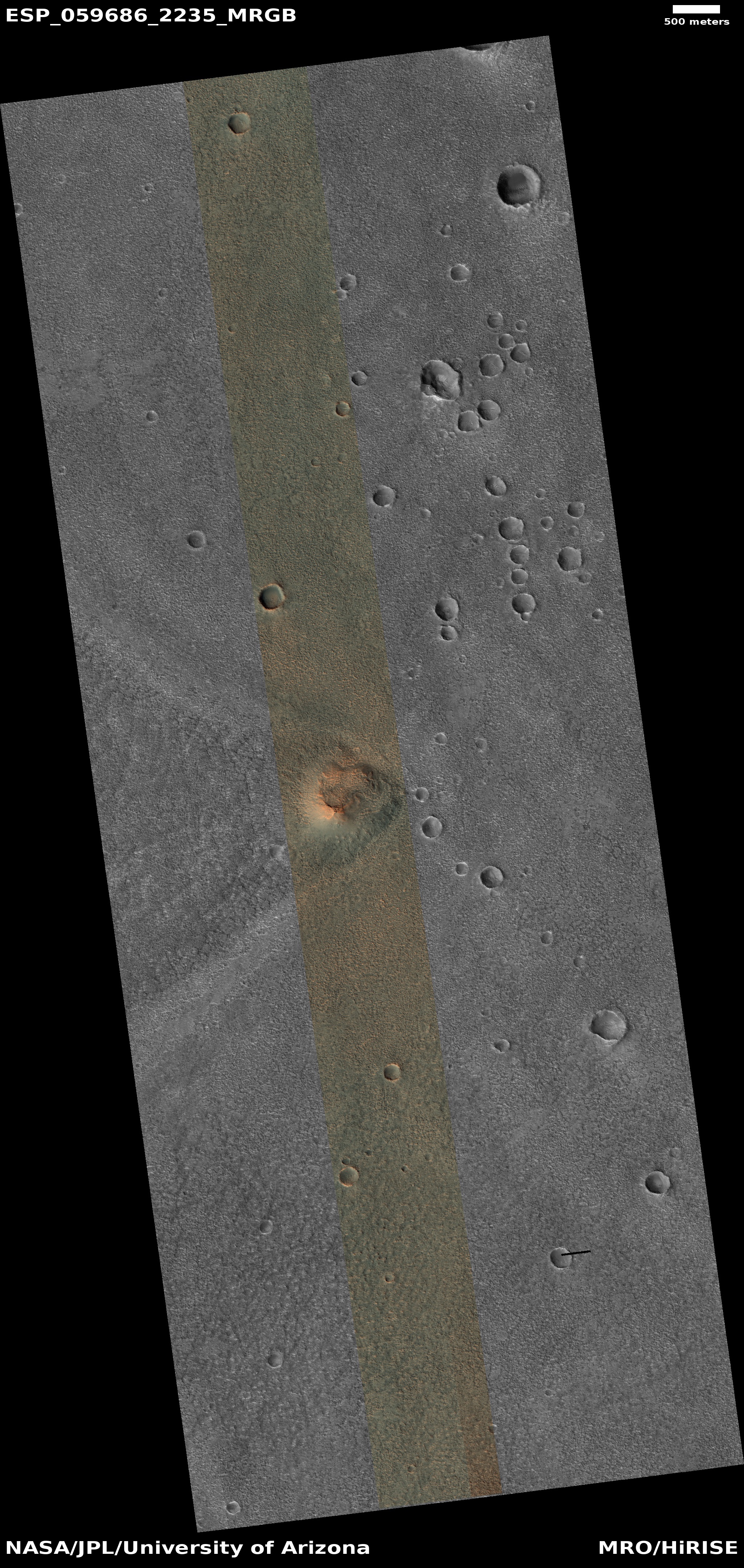
The cool image above, cropped and reduced to post here, was taken on October 28, 2020 by the high resolution camera on Mars Reconnaissance Orbiter (MRO) and shows an excellent example of two very spectacular large slope streaks, one long and narrow and another short and wide. Located at 23 degrees, this is an area where no ice has yet been found near the surface.
This new theory joins two other popular theories attempting to explain slope streaks. The others postulate that the streaks are either dust avalanches of a different type or the percolation of a brine of chloride and/or perchlorate in a thin layer several inches thick close to the surface.
None have been proven. None likely fit all the known data at this point.
Capitalism in space: Terran Orbital has completed construction of the CAPSTONE Moon smallsat and has now had it shipped to New Zealand for its launch on a Rocket Lab Electron rocket no earlier than May 27th.
Tyvak Nano-Satellite Systems, a Terran Orbital Corporation, built the spacecraft for the Cislunar Autonomous Positioning System Technology Operations and Navigation Experiment, otherwise known as CAPSTONE. The 12U CubeSat includes a radio tower on top that extends its size from a traditional 12U form factor.
CAPSTONE will not go directly to the Moon but instead, follow a “ballistic lunar transfer” that will take it out as far as 1.5 million kilometers before returning into lunar orbit. That transfer, which will take about four months to complete, is designed to save propellant, making the mission feasible for such a small spacecraft. The CAPSTONE payload and its software are owned and operated by Advanced Space for NASA.
CAPSTONE will use Rocket Lab’s Proton upper stage to get it to the Moon. It will then test maneuvering as well as communicating in the lunar halo orbit that NASA wants to use with its Lunar Gateway space station. It will also be proving out the use of this kind of smallsat for future interplanetary missions.
Capitalism in space: Blue Origin yesterday announced the six people who will fly on its next suborbital New Shepard flight.
The company did not reveal the flight date. Nor did it say who is paying for their ticket and how much. In fact, Blue Origin has still not revealed what it is charging per ticket. It is appears however that at least one or more passengers are not paying, and were chosen instead for their PR value, including the apparent “woke” desire of Jeff Bezos to achieve as many ethnic “firsts” as possible.
It is nice that Blue Origin appears to be making money from its suborbital division. It would be much much better however if the company was be making orbital launches with its New Glenn rocket, which were originally supposed to begin in ’20 and now likely won’t start happening until ’23, at the very earliest.
The seismometer deployed by the Martian lander InSight has now detected its largest quake yet on Mars, with an estimated magnitude of 5.
NASA’s InSight Mars lander has detected the largest quake ever observed on another planet: an estimated magnitude 5 temblor that occurred on May 4, 2022, the 1,222nd Martian day, or sol, of the mission. This adds to the catalog of more than 1,313 quakes InSight has detected since landing on Mars in November 2018. The largest previously recorded quake was an estimated magnitude 4.2 detected Aug. 25, 2021.
The timing was very fortunate. Only three days later the power being generated by InSight’s dust-covered solar panels dropped too low, and the lander went into safe mode. Though its mission has been extended through the end of this year, the inability of the solar panels to produce energy because of dust has been predicted to shut down operations sooner. While it might be possible to restart science operations, this most recent safe mode situation could very well be that moment.
Meanwhile, scientists will analyze the data of this most recent large quake to attempt to pinpoint its location. They will also study it to gain a better understanding of the interior structure of Mars.
Capitalism in space: After a year delay due to government security concerns, Momentus has finally gotten all the launch permits required for a launch later this month on a Falcon 9 of its space tug, Vigoride, on its first orbital test flight.
In late April Momentus had gotten FCC approval. Now it has gotten clearance from the FAA. The FAA had blocked last year’s launch because of security concerns related to the foreign connections of several of the company’s founders/investors. Those individuals have now left the company, clearing the way for license approval.
The delay however caused Momentus to lose several customers while allowing another space tug competitor, Launcher, to catch up.
The new president of South Korea, Yoon Suk-yeol, has made it clear that when he takes office today his policy will be to expand that nation’s space effort while tying that effort more closely with NASA and the U.S. military.
[His goals] include establishing an independent aerospace agency offering integrated management of civil and military space programs in Sacheon, South Gyeongsang Province, home to nearly 100 aerospace companies, and developing a high-power rocket for independent satellite launches in the near term and lunar and Mars exploration in the long-run.
…Yoon has also promised to facilitate the public-to-private transfer of space technologies, reform regulations and launch a space industry cluster to grow the country’s nascent domestic space industry. In line with this, the science ministry recently selected five universities that will be subsidized $4 million each over the next five years in return for running education programs designed to nurture skilled space engineers.
“Countries jockey for position in the space industry to secure a competitive edge in national security and future competitiveness,” Yoon wrote in his election manifesto, pledging to make South Korea “one of seven most advanced space powers in the world by 2035.”
However, the first space-related task of Yoon’s adminstration, which merely accelerates what the previous South Korean government had been doing, will likely be to replace the Russian rockets that South Korea presently has contracts with to launch several satellites.
Capitalism in space: Astra today announced an agreement with the SaxaVord Spaceport in the Shetland Islands to begin launches from that United Kingdom location, beginning in 2023.
These launches will be the first by Astra outside the U.S. It is the second American company to sign on with SaxaVord, with Lockheed Martin’s ABL rocket company smallsat startup planning its own first launch there later this year. SavaVord also has a launch deal with a French company, Venture Orbital Systems, which hopes to launch later this decade.
None of these however could be the first launch from the United Kingdom since the 1960s. Virgin Orbit has a deal to launch from a runway from a Cornwall airport later this year. Furthermore, the rocket company Orbex is planning to launch its Prime rocket from a differenct spaceport in Sutherland, Scotland.
In yesterday’s non-news Dmitry Rogozin, the head of Roscosmos which runs Russia’s entire aerospace industry, issued a threat against Elon Musk for supplying the Ukraine Starlink service in its war against the Russian invasion, and Musk responded with an almost cheerful quip.
On Sunday (May 8), Musk posted on Twitter a note that he said Rogozin, the head of Russia’s federal space agency Roscosmos, had sent out to Russian media. The note claimed that equipment for SpaceX’s Starlink satellite-internet system had been delivered to Ukrainian marines and “militants of the Nazi Azov battalion” by the U.S. military. “Elon Musk, thus, is involved in supplying the fascist forces in Ukraine with military communication equipment,” Rogozin wrote, according to an English translation that Musk posted. (He also tweeted out a Russian version.) “And for this, Elon, you will be held accountable like an adult — no matter how much you’ll play the fool.”
This sounds very much like a threat, as Musk acknowledged in a follow-up tweet on Sunday. “If I die under mysterious circumstances, it’s been nice knowin ya,” he wrote. Musk’s mom, Maye, didn’t appreciate that glib response, tweeting, “That’s not funny” along with two angry-face emojis. The billionaire entrepreneur responded, “Sorry! I will do my best to stay alive.” (It was Mother’s Day, after all.)
Musk’s light-hearted response only stands to reason, considering Rogozin’s loud-mouthed track record. Nothing he says really matters, so why should Musk care that much. Musk probably posted Rogozin’s comments out of amusement more than anything else..
An evening pause: We’ve seen her before in an evening pause, but this time she plays solo, covering the bass part in this Rush recording.
Hat tip Cotour.
The new colonial movement: China today successfully used its Long March 7 rocket to launch a new Tianzhou unmanned cargo freighter to its Tiangong space station.
The cargo is for the station’s next crew, scheduled to launch in June for a six month mission, during which two new large modules will be added to the station.
The launch took place at China’s sea coast Wenchang spaceport, so its expendable lower stages all fell harmlessly in the ocean.
The leaders in the 2022 launch race:
18 SpaceX
15 China
6 Russia
3 Rocket Lab
2 ULA
U.S. private enterprise still leads China 26 to 15 in the national rankings, as well as the entire world combined 26 to 24.