
Lunar Gateway dead as NASA announces major changes to its future space station, lunar, and Mars plans
Capitalism in space As part of the reshaping of NASA being pushed by NASA administrator Jared Isaacman, the agency today announced major changes to its future programs in low Earth orbit, on the Moon, and in exploring Mars. Video of these changes can be viewed here and here.
The Moon
NASA will now focus all work in its lunar program on getting to the surface of the Moon. Lunar Gateway is “paused,” though the language of NASA’s press release suggests more strongly that it is dead, with the agency already trying to figure out ways to “repurpose” its already built components. NASA will instead ask for proposals from private industry and its international Artemis partners to ramp up as soon as possible a phased program to establish the infrastructure on the Moon needed for the lunar base. This new focus begins with “up to 30 robotic landings in three years, starting in 2027,” and at least two manned landings per year beginning in 2028.
The graph below, presented during today’s announcement, shows the basic plan for the next few Artemis missions, which will act as the manned foundation for this entire surface-focused program. The overall program will build out the lunar base in three phases, first to test some basic infrastructure using these smaller lunar landers, second to begin establishing the base’s foundational components with intermittent manned missions, and third to begin long-term human occupancy.
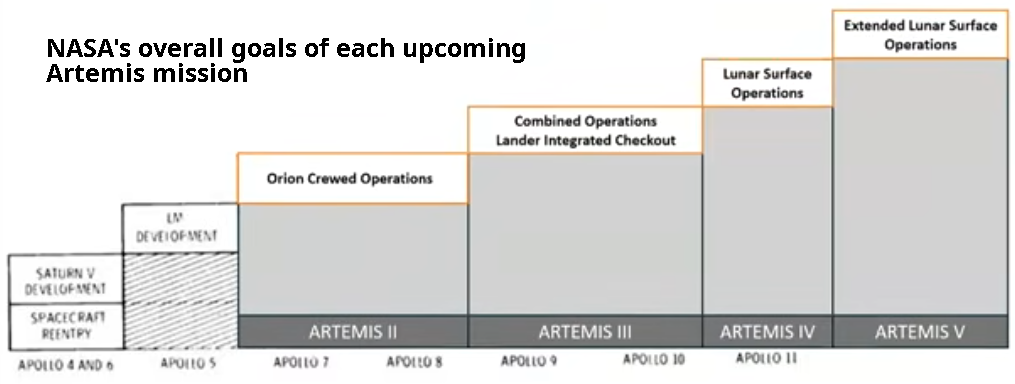
The manned missions above are scheduled through ’28. For the three-phase program to build that lunar base the agency hopes to reach its third phase by 2033. And while it states it wants to work with its international partners in doing this work, it will mostly depend on the American private sector to come up with ways to achieve it.
In many ways the timeline for this program resembles an Elon Musk timeline. The overall plan makes great sense, but it will likely take longer than anticipated to achieve. Its greatest virtue however is that it is properly focused on the Moon. Gone is NASA’s ridiculous Lunar Gateway, that only served to slow development on the Moon as well as making it harder to get there. It also appears the plan is designed to phase out SLS as soon as possible, shifting to relying on privately-owned rockets instead.
Most important, the program is structured logically, building upward from small first efforts to increasingly greater challenges, something that NASA management before Isaacman did not do.
Building a replacement for ISS
The program to replace ISS is being restructured for two reasons. 1. NASA doesn’t have the funds to fund two private stations in a manner the agency considers sufficient or safe. It says its present budget is about $250 million per year. The agency also does not think there is enough commercial market to make up the difference.
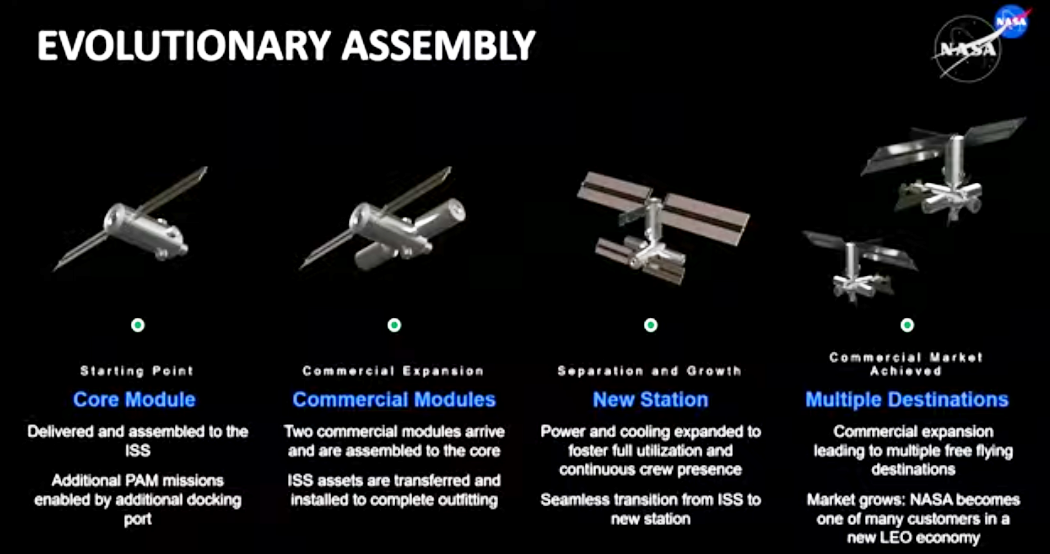
To overcome this shortfall as well as fuel a private space station industry, the agency is considering a different approach. Rather than award a single insufficient contract to a private company to build a new station, it is proposing launching what it calls a new government-owned “core module” to attach initially to ISS, and later become the hub for multiple private modules. It would have six docking ports to allow more commercial tourist missions to the station as well as the later attachment of new commercial modules. Once this core module has grown enough, it would later separate from ISS when the station is retired, and serve as a core to help generate the development of one or multiple commercial separate stations.
The graphic below, from today’s presentation, shows this step-by-step process.
In many ways, it appears NASA is copying Axiom’s plan for its space station. Whether this supplants or supplements Axiom remains unknown. It is also very likely Axiom could quickly revise its station design to grab the contract for this core stage, as proposed.
The basic concept, however, is to provide a more cost effective way for NASA to build a foundational hub to help multiple private space station companies develop and build their own stations, with NASA as a major customer to all. And once again, this approach is aimed at encouraging a private sector, not building a giant NASA project. In this more than anything else the plan appears to be good news for the future of the American space industry.
Mars
NASA is proposing a new Mars mission, dubbed Space Reactor-1 Freedom, using nuclear propulsion to carry a fleet of Ingenuity-class helicopters to the Red Planet, with the goal of launching this mission by the end of 2028.
Of all the proposals announced today, this one project appears the least connected to the private sector. The nuclear engine is being built by a partnership of NASA and the Energy Department. The helicopter fleet appears to be basically Ingenuity multiplied, something that NASA can do on its own.
Only the ship itself, carrying the engine and the helicopters, could come from the private sector, with SpaceX’s Starship the prime candidate.
Thus, as a mostly government run project, I believe it will be the least likely to happen, as promised. That Isaacman seems personally committed to it, however, says my pessimistic prediction will be wrong.
Final thoughts
Overall, these program changes appear sensible and more realistic than any major NASA manned program in decades. Though it does appear to want to elevate NASA’s status across the entire landscape of American space exploration, it also does so by relying mostly on the private sector to get the job done. And it lays out a rational manned program for both low Earth orbit as well as the Moon.
There is one dangerous caveat to this logical program. NASA is still going to send four astronauts on a ten-day around the Moon in just a few weeks, using a Orion capsule with a questionable heat shield and a untested life support system. That mission remains irrational and out of place, an apparently leftover from NASA’s previous management that planned nothing in a sensible way.
If it fails and those astronauts die, it is very unclear what impact that will have Isaascman’s entire program as announced today.

On Christmas Eve 1968 three Americans became the first humans to visit another world. What they did to celebrate was unexpected and profound, and will be remembered throughout all human history. Genesis: the Story of Apollo 8, Robert Zimmerman's classic history of humanity's first journey to another world, tells that story, and it is now available as both an ebook and an audiobook, both with a foreword by Valerie Anders and a new introduction by Robert Zimmerman.
The print edition can be purchased at Amazon or from any other book seller. If you want an autographed copy the price is $60 for the hardback and $45 for the paperback, plus $8 shipping for each. Go here for purchasing details. The ebook is available everywhere for $5.99 (before discount) at amazon, or direct from my ebook publisher, ebookit. If you buy it from ebookit you don't support the big tech companies and the author gets a bigger cut much sooner.
The audiobook is also available at all these vendors, and is also free with a 30-day trial membership to Audible.
"Not simply about one mission, [Genesis] is also the history of America's quest for the moon... Zimmerman has done a masterful job of tying disparate events together into a solid account of one of America's greatest human triumphs."--San Antonio Express-News
I knew that if I read long enough, I would find the word “seamless”!