
Only the power-hungry truly lust for war
Today is “President’s Day”, a meaningless holiday created by our stupid lords in Congress in order to denigrate George Washington by devaluing the holiday celebrating his birth, February 22nd, by applying that holiday to all presidents, from great to the trashy. This fake holiday also acted to devalue any remembrance of Abraham Lincoln’s birthday on February 12th, as it forced many states that used to celebrate that holiday separately to fold that celebration into today as well.
I don’t accept Congress’s stupid holiday. Instead, I separately try each year to honor both Washington and Lincoln on their actual birthdays, because without these great men the nation of my birth would never have become the great and free and prosperous place it became.
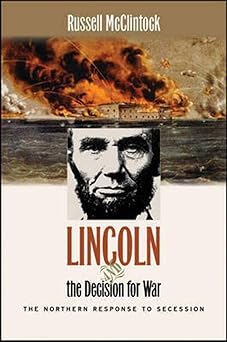
In honor of Lincoln today, I thought I’d post a short review of Russell McClintock’s fine 2008 history, Lincoln and the Decision for War. McClintock took a decidedly different look at the Civil War by focusing not on larger events, but specifically at the time period between the election of Lincoln on November 6, 1860 and the beginning of the Civil War in April 1861.
What many forget with the passage of time is that the Civil War did not start instantly with Lincoln’s victory. For six months furious negotiations took place between politicians from the North and South, with Northern politicians desperately trying to somehow convince the southern states not to secede from the Union. McClintock details those negotiations, including Lincoln’s own efforts in numerous ways to placate the most radical southern states.
You see, as much as Lincoln opposed slavery — and he truly did — he was far more committed to the American Constitution and the nation it had created. If he had to let the issue of slavery take a back burner to saving the Union, he was quite content to do so. More important, as McClintock shows, if the southern states hadn’t seceded and had stayed part of the Union, their power bloc in Congress would have been strong enough to block any anti-slavery action by Lincoln anyway. He really didn’t have sufficient political power in Congress to change anything.
For the South, none of these actual facts about Lincoln mattered. The South had developed Lincoln Derangement Syndrome, and was not going to allow itself to be ruled by Lincoln no matter what, even if that rule was weak and ineffectual. As noted by the Ohio’s radical anti-slavery senator Ben Wade in a speech on the Senate floor on December 17, 1860:
You [the South] intend either to rule or ruin this government. That is what your complaint comes to; nothing else.
As Wade noted, Lincoln had been fairly elected, by law, and this is what the South did not like. It was demanding some compromises of power to hold them within the Union, even though it had lost the election.
Sir, it would be humiliating and dishonorable to us if were to listen to a compromise by which he who has the verdict of the people in his pocket.
McClintock’s book makes very clear who wanted war, and who didn’t. The South lusted for it, led by its most radical state of South Carolina where Fort Sumter was located. The Northern states wanted to limit slavery, but were not initially willing to go to war to do so.
Even in 1860, few Northerners proposed to interfere with slavery in the Southern states. The chief reason for this was the same imperative that dictated their political response to apparent Southern aggression: their firm commitment to the system of government created by the Founders. To them, as we shall see, that system was institutionalized by the Constitution and embodied in the Union. Specifically, the Constitution permitted neither the general government nor the free states to interfere in the domestic affairs of the slave states, and even those who felt an ethical or moral aversion to slavery believed the Union would be threatened by antislavery agitation.
So for six months the two sides negotiated, to no end. The South simply was not going to accept the legal results of the 1860 election. South Carolina declared its secession in December and placed Fort Sumter in Charleston harbor under siege. When Lincoln finally attempted to resupply the fort in April, after months of dithering and fruitless negotiations, South Carolina forces fired on the fort and the supply ships, capturing it.
Lincoln at this time wasn’t trying to stop South Carolina from seceding. He merely was acting to protect what was clearly federal property, the fort itself that the federal troops stationed there.
The attack however galvanized the North, as Lincoln knew it would. While beforehand the public had been reluctant to fight, the attack convinced them that to save the Union and the Constitution and its grand experiment in self-government, they were now forced to fight. And so the war started.
The bottom line remains however: The South wanted to keep slavery, an institution that allowed some men to own others. For those who lust power, such an institution is addictive in the extreme. For the South, the addiction was so strong they were glad to go to war to keep that addiction supplied.
The North was for freedom and the rule of law. The Constitution as they understood it allowed the South to keep its slaves, but it also allowed them the right to resist the spread of that peculiar institution. If the South wanted to keep its slaves the North was willing to tolerate that, even if it hated the idea. “Let’s find a way to live together, without fighting!”
When the South would not obey the law, however, and committed violence against the legal election results, then the North finally rose up to fight. It did so reluctantly, but when it finally did it did so with righteous anger.
My readers will of course notice some interesting parallels to our own time. The Democratic Party and its supporters today cannot accept the fact that they lost the last election. Donald Trump and the Republicans won, and Trump did so under a platform to end illegal immigration and to deport the millions of illegals who were allowed to come here during Biden’s administration. His platform also included promises to shrink the federal workforce, reduce regulation, and to eliminate raced-based hiring.
Trump is doing exactly what he promised during his 2024 campaign. The country apparently approved, because they voted for these promises quite handily.
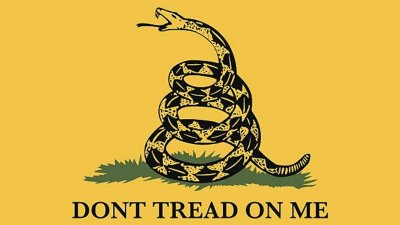
Gadsden Flag – a symbol of unbowing defiance to oppression
And the Democrats today are acting exactly as the southern Democrats did in 1860s, refusing to accept their defeat, Trump’s victory, and more important, the will of the people. To the Democrats, maintaining their grip on power is all that matters, and if it requires them to throw out the Constitution and the rule of law to keep it, so be it.
As always, it is the power-hungry who lust for war. And the civilized struggle to avoid it, if at all possible, and only as a last resort finally rise up for battle.
We can only pray that the civilized today will have the same will to fight as freedom-loving Americans in the North did in 1860. Because I think it will be required of them.

On Christmas Eve 1968 three Americans became the first humans to visit another world. What they did to celebrate was unexpected and profound, and will be remembered throughout all human history. Genesis: the Story of Apollo 8, Robert Zimmerman's classic history of humanity's first journey to another world, tells that story, and it is now available as both an ebook and an audiobook, both with a foreword by Valerie Anders and a new introduction by Robert Zimmerman.
The print edition can be purchased at Amazon or from any other book seller. If you want an autographed copy the price is $60 for the hardback and $45 for the paperback, plus $8 shipping for each. Go here for purchasing details. The ebook is available everywhere for $5.99 (before discount) at amazon, or direct from my ebook publisher, ebookit. If you buy it from ebookit you don't support the big tech companies and the author gets a bigger cut much sooner.
The audiobook is also available at all these vendors, and is also free with a 30-day trial membership to Audible.
"Not simply about one mission, [Genesis] is also the history of America's quest for the moon... Zimmerman has done a masterful job of tying disparate events together into a solid account of one of America's greatest human triumphs."--San Antonio Express-News
So true.
The Democrats intend to either rule or ruin, but this sentiment applies to both the government AND individual citizens. There can be nothing short of full acceptance of their tyranny. They will lie to get their way. They will cheat to get their way. They will steal to get their way. They will incite hatred to get their way.
I don’t like how only managers have labor day off, so it’s a wash
The origin of President’s Day was a Faustian bargain between the Dems, who wanted a national holiday for Martin Luther King,and the RINOs who were willing to throw both Washington and Lincoln under the bus in order to keep the total number of federal holidays constant and keep the public employee unions from getting an extra taxpayer-funded day off work.
The North invaded the South, not the other way around. Several of the Confederate states did not secede until Lincoln called for volunteer troops to do just that. Every country in Europe and the Americas abolished slavery but only the US had a war about it. And we didn’t really abolish it but replaced it with a type of serfdom that lasted for another century.
Richard, firing on federal property and demanding its surrender is an invasion. Don’t try to whitewash who started the war.
I often wonder what the course of our history would have become if instead of firing on Ft. Sumpter, South Caolina had led a petition of several of the southern states on the Constitutionality of secession? First, what would the Court have determined? Second, would either North or South abided by the decision?
Where reasoning ends, the only alternative to it manifest. We may again face such a situation. So too might Alberta.
Lincoln saved the Union at the expense of the Republic. Here is what the Civil War was about: Once you join this Club, you can’t quit. Slavery was proximate–but in elemental ways, it was incidental. We are arguably in the early stages of a second civil war right now, and slavery is not a factor at all.
I don’t believe the South had the political power you say they did. The South was outnumbered in the House by about 2-1. Not just a few seats like today. You also fail to mention the Morrill act. This act was what many considered to be the last straw
Richard, you might ask why the US suffered through a civil war when all the countries in Europe abolished slavery without one. There were many incidents of insurrection before Lincoln was inaugurated. To wit:
Georgia militia seized Fort Pulaski, Jan. 3, 1861.
Alabama militia seized the arsenal at Mount Vernon, Jan. 4, and Forts Morgan and Gaines, Jan. 5.
Louisiana seized 3 forts and an arsenal between Jan. 10 and 14.
Florida militia seized Fort Marion and an arsenal, Jan. 7.
These events all happened before the States in question “seceded.” Lincoln, in his first inaugural address (March 4), apparently was willing to overlook these seizures, stating only that the Federal government would “hold, occupy, and possess the property and places belonging to the government.” Fort Sumter was the last straw.
Lincoln really needed Davis to fire the first shot. Fortunately for him, Davis obliged.
The Democrats in the South started the war. It matters not which side actually fired first. The North’s actions were in effort to prevent secession, and were fully justified.
Who knew that voluntarily joining the Union meant that once done you could never get out. If that had been part of the proposal, no one would have joined. Lincoln was a tyrant. Shakespeare was right, we should kill all the lawyers.
Dick–
Glad you brought that up; I recall in Elementary school we specifically celebrated both of the Washington and Lincoln Holidays. Separate bulletin board for each, for the month.
——————————————————
I’m going to drop this in here, slightly tangential but serves to help clarify early divisions in America, geographically & culturally:
“Are You Irish or Scots Irish (Ulster Scots)?”
The lost tribe: Why 35 million American’s misunderstand their roots”
https://youtu.be/g-UrV_aWQ94
16:42
“If your family came from Ireland to the United States before the Civil War, settled in the South, the Midwest, or the Appalachian Mountains, and were Protestant, you probably aren’t “Irish.” Not the way you think you might be. ”
“There were 2 distinct waves of “Irish” immigration, the beginning and middle-end of the 1800’s.
->The first wave: Your ancestors were from Ireland, but they weren’t culturally “Irish.”
They didn’t belong to the 1850’s 2nd-wave potato famine Irish, the slums of New York or Boston, and weren’t Catholic. They were Scots Irish.
They weren’t the ones being oppressed or starving in Ireland, they were the ones oppressing the Catholic Irish, on behalf of the King of England, who eventually turned on them, and they emigrated / fled to the United States.”
“Every wonder why the South is obsessed with “honor,” why more Southerners serve in the Military, why they have an instinctual distrust of authority and state-sponsored religions, and just want to be left alone? They are descendants of the Protestant Scots Irish. The King of England manipulated them to oppress the Catholic Irish and then inevitably turned on them. Those divisions carried over to the United States, this first-wave eventually occupied the frontier between “civilization” and “Indian territory,” and were uniquely adapted to the South because the geography was very similar to Ireland. “
Also, with the current definition, it is impossible for “Presidents’ Day” to fall on Washington’s (or Lincoln’s, for that matter) actual birthday.
Minor edit in fifth paragraph: “power bloc in Congress”
Andi: Typo fixed. Thank you.
To those who complain that secession should be legal, consider the words of Thomas Jefferson:
“The right of the people of a single State to absolve themselves at will, and without the consent of the other States, from their most solemn obligations, and hazard the liberties and happiness of the millions composing this Union, cannot be acknowledged. Such authority is believed to be utterly repugnant, both to the principles upon which the General Government is constituted, and to the objects which it was expressly formed to attain.”
Or James Madison (referring to a “partial ratification” of the Constitution by New York, wherein they reserved the right to withdraw from the Union):
“My opinion is that a reservation of a right to withdraw if amendments be not decided on under the form of the Constitution within a certain time, is a conditional ratification; that it does not make New York a member of the new Union, and consequently that she could not be received on that plan. Compacts must be reciprocal: this principle would not, in such a case, be preserved. The Constitution requires an adoption in toto, and forever. In short, any condition whatever must vitiate the ratification. The idea of reserving a right to withdraw was started at Richmond, and considered as a conditional ratification, which was itself abandoned as worse than a rejection.”
Dan Niemeyer: Thank you for digging up these quotes. Anyone who had researched this knows secession was never considered a valid option. And it was especially considered invalid as a response to an election result someone didn’t like.
The South didn’t like Lincoln. However, he was legally elected. If you are going to accept the idea of rule through elections, then you don’t have the right to reject his victory.
Which means the South didn’t really believe in the rule of law and elections. Just like the Democrats today.
“I don’t accept Congress’s stupid holiday. Instead, I separately try each year to honor both Washington and Lincoln on their actual birthdays, because without these great men the nation of my birth would never have become the great and free and prosperous place it became.”
Has anyone else noticed that the greatness and liberty of this nation have diminished ever since Congress diminished the celebration of these two great presidents? We are no longer taught why these two presidents were so instrumental to the greatnesses of our country. Among the many trials and tribulations faced by each, they both were tasked with demonstrating to the world that a nation can be successfully run by its own population and did not require divinely chosen rulers to lead. Proving to the world that self-rule was possible is why “Northern politicians desperately try[ed] to somehow convince the southern states not to secede from the Union.”
Self-rule was such an important issue that the North was prepared to create the Thirteenth Amendment as an acknowledgement of slavery in the U.S. rather than an abolishment. This amendment had been written and was seriously considered, but it stopped making headway with the Southern secession. Self-rule was more important than freedom, at that time. Fortunately, slavery has been abolished, and in success of self-rule, our priorities as a nation have improved.
Washington set up the methods of self rule, and they have lasted successfully for a quarter millennium. Good for him.
Lincoln came at a time when the great experiment was at its most critical challenge. Can a nation survive such a fundamental difference of opinion? The carefully held balance between these two opinions began to fall apart when California insisted upon being a free state, despite its relation to the Mason-Dixon line. It seems that one part of the population, the selfish part, is in need of being raised by the other side, the mature part.
Not only were we able to run our own country without specialized policymakers, we were able to do so more prosperously than any nation has ever done.
Recently, we have seen that the policymakers who have not come from among the civilian population are too far removed from the operation of the country (not the operation of the government, which is a completely different entity) too make policies that are good for We the People. It is why We were intended to make some time away from our industrious duties to perform governmental duties for a few years, then to return to our industrious duties. We have shown that to successfully rule ourselves, we have to be mature, to hold the selfish, childish portion to the standards that make for successful self-rule.
Sanity has recently waned, where many of our leaders insist that a man can be a woman and vice versa, and many can no longer define what a woman is. In an Orwellian way, “follow the science” actually means “ignore the science, obey the politicians.”
The challenge, these days, is to convince those those whose experiments fail that they have failed. Marxism is a classic example of a failed theory, but many people, rather than accept defeat, believe that the failed theories must be applied more vigorously, which is how we got Obama’s Great Recession, attempting to apply more Keynesian Economics rather than accept that it had been proven a failure on many previous occasions. Too many people — including trained scientists themselves — love their own theories too much to acknowledge their failures, for the love of theory is the root of all kinds of evil.
A quarter millennium later, the experiment continues. Having various states allows for smaller experiments to show what adjustments work well and which ones fail. Because Democrats have rigged the vote, these days, people have begun to vote with their feet, moving from states whose experiments in self-rule and prosperity are failing to states that are succeeding.
wayne
Thanks for bringing up the Scots Irish influence on the Southern states.
I read someplace a time ago that because of this influence the Southern Generals had a small problem with their solders. They would go into battle at the drop of a hat. It was honor. But they would not fall back when it was smart to do so or when ordered.
Its estimated that large numbers of solders died needlessly because of this. Even when they knew the south was solder short.
It was expected that only the good generals were the ones willing to attack, attack and win. The solders would get frustrated if they were not thrown into battle as soon as possible.
By the end of the war those southern boys changed their mind.
Absolute hogwash. Southerners realized radicals in the North had created “bleeding Kansas” and then financed John Brown’s attempt at a race war. And the North made Brown a martyr. In return for the Missouri compromise the Congress wrote the fugitive slave laws which the North ignored, further demonstrating Republicans and the North would not honor their words. Sound familiar? Decades of demonstrating bad faith was strengthened by huge increases in tariffs, paid for by the South and favoring the North. Faith in democracy working with the North? These bad faith moves were worsened by a doubling in tariffs before Lincoln’s election. Being able to block the North’s agenda? If you couldn’t block massive taxes increases how do you justify the assertions of the author? More ridiculous is the positing that slavery was the central issue of the War of the Northern Aggression. 5% of the south had a stake in slavery, 95% of the population is unlikely to fight the interests of the 5%. But they had seen the North exploit the South, push rebellion among slaves, and push an agenda that would have made the South politically impotent.
Lincoln choose war. He killed a million Americans. The final payment to veterans and their dependents was made in the 1960s. Lincoln destroyed the richest part of the nation for 80 years. No other nation waged war to end slavery. No other leader killed so many of his own people rather than seek compromise.
Finally, and try to disprove this. Three states demanded the right to leave the Union at any time, for any reason to approve the Constitution. For their votes all states had to recognize these demands. And so the Constitution was approved. Yet Lincoln waged an illegal and amoral war. How illegal. If secession was illegal why did he allow West Virginia to leave Virginia with his blessing? This is why not one official of the Confederacy was charged with treason. I hate the white washing of history.
The author and I probably would not agree on much –but I would say a great must-read is:
The Problem With Lincoln
Only 5% had slaves why would 95% be willing to fight?
Could be the first and best cases of political propaganda foisted on the Southern people.
Play to their pride and honor counting on their lack of education and ingrained bigotry.
Sounds like the Democrats are still playing by that same playbook.
pzatchok:
Arguably the three greatest frauds perpetrated on The People:
Climate
Democrats as ‘Champions of The People’
COVID
”More ridiculous is the positing that slavery was the central issue of the War of the Northern Aggression.
I suppose you think you’re being cute with your pet name for the Civil War. No matter. You don’t have to take our word for the cause of it. You can look it up yourself..
Much as the United States did in the Declaration of Independence when it seceded from Britain, South Carolina issued a Declaration when it seceded from the United States in 1860. Contrary to what Confederate apologists tell everyone today, it made no mention of taxes, tariffs, or any other issue. It was all about slavery.
Called the ”Declaration of the Immediate Causes Which Induce and Justify the Secession of South Carolina from the Federal Union” it laid out the primary reason behind South Carolina’s decision to secede from the US as ”the increasing hostility on the part of the non-slaveholding States to the Institution of Slavery.”
It went on to state “A geographical line has been drawn across the Union, and all the States north of that line have united in the election of a man to the high office of President of the United States, whose opinions and purposes are hostile to slavery.”
Georgia, Mississippi, and Texas issued similar documents. Support for the Confederacy was and still is support for slavery.
As for an attempt to deal with secession with methods short of war, all of that went out the window when South Carolina fired on the federal troops at Fort Sumter. I guess firing on federal troops is what counts as “Northern Aggression.”
Murray Rothbard
The American Economy and the End of Laisse Faire 1870 to WW2
Chapter 1: “The Civil War and Its Legacy”
https://youtu.be/Db4ohWQHVvY
1:55:23
The only states right the south wanted was the keeping of slaves.
You know the people who harvested their crops.
Today they opened the boarder and use the harvesting of our crops as the excuse to keep the underpaid people. The new slaves.
They have never claimed to want to pay those “new slaves” illegal immigrants a fair wage,
A fair wage is the wage it would take to get an American to do the job.
Instead they let them take the union jobs from their own trained and certified union workers. Like truck drivers.
They gave them driver licenses with automatic Motor Voter registration.
They gave them non resident working numbers instead of SSN’s. This counts as a SS account until they are granted full citizenship. That number gives them more rights than our real SSN give real citizens.
When they leave the US for any reason they can ask for all the money they put into it back. Try to get all of your SS payments back. Never going to happen.
The South has risen again.
Bob’s blog attracts people from the right side of the American political spectrum (as we all know!) and it’s interesting to see how this thread has brought out one of the long-standing cleavages in that eco-system. Talking about Lincoln always seems to do that!
Myself, I am a Yankee, and my family has always been Yankees; some were even abolitionists, and I like to think I take a certain pride in that. All of my ancestors who fought in the war wore blue. Some of the ones who couldn’t fight, built gunboats for James Eads. As such, I second Ulysses Grant’s assessment of the Southern cause as “one of the worst for which a people ever fought, and one for which there was the least excuse.” And like Grant, I am certainly happy that it ended up losing. That said, I suppose it must be conceded that a right to secede from a polity is only as legitimate as you can manage to make it *effective*. The thirteen colonies had no explicit legal right to secede from the British Empire, and yet, they somehow did it anyway. Had the South somehow, improbably, managed to win the war and its independence, that would have required the U.S. government to recognize that independence, and that would have forced some awkward rewriting of American constitutional law. Which, I’m afraid, would have made a mockery of the prudent observations of Thomas Jefferson and James Madison.
In all fairness, I always thought that Shelby Foote (who grew up in Mississippi knowing a lot of elderly Confederate veterans) gave a pretty good sense of the answer to that, both in his Civil War trilogy, and even more directly in his comments in Ken Burns’ Civil War documentary, which is, alas, in bad odor for many in these Woke days. In Foote’s telling, the motivations were often pretty visceral. At one point in the Burns series, he brought up the anecdote of a poor, barefoot Southern soldier taken captive. He was clearly too poor to own slaves; a Union officer asked him point blank, why was he bothering to fight for such a cause. The soldier replied, “I’m fighting because you’re down here,” which, Foote reflected, “was a pretty satisfactory answer.”
Foote offered other, similarly visceral motivations, too: Young Southern men dreaded being thought cowards by Southern women; hardly any were willing to risk their contempt even if they couldn’t muster any other motivation. That’s undoubtedly the sort of thing that has gotten more than a few young men to sign up for bloody wars through the ages, I expect.
And Union soldiers did a lot of the dirty work against indians–who actually got along with Confederates for the most part–some even owned slaves, which Buffalo Soldiers knew…blood guilt is a circular firing squad, after all.
Kaitlin Collins at CNN is from South Alabama….she looks to have that thicc raven hair from the Poarch band.
The old adage “…if the Creeks don’t rise” had nothing to do with watershed. Oh, sewage in D.C.? What else is nee
Talk radio host Matt Murphy of 99.7 in Tennessee came from South Alabama.
P.S. It occurs to me that I probably ought to add a qualifier to my last post to head off any incoming accusations of Neo-Confederate apologetics on my part:
Shelby Foote was a man of post-bellum Mississippi, and as such he’s drawn his share of criticism in recent years for painting too irenic a picture of Southern motivations, and that maybe Ken Burns was too seduced by his charm and beautiful liquid Mississippi drawl to balance those off properly in his series. I’ve never really been bothered by that, but I readily concede that surely it is true that there were also some less admirable visceral motivations in the mix for those yeomen farmers, as pzatchok suggests — fear that those Yankee bluebellies marching down their way would upset the local social order by freeing those slaves and giving ’em the vote (and maybe other things, too). No doubt that kind of thing was in play for some, too.
But my point, if I had one, was just to distinguish between the kinds of motives that caused a lot of those young men to go off to fight, and the factor that actually caused the war itself. I think it can be simultaneously true that Slavery, with a capital “S”, was the necessary and ultimate cause of the Civil War, and also true that it may not have figured so prominently as an immediate reason for a lot of young men, North or South, to actually enlist and go fight in it.
This is one of the key reasons why Andrew Rakich of the Youtube channel Atun-Shei Films singles out Clint Eastwood’s 1976 film THE OUTLAW JOSEY WALES as the best movie from a pro-Confederate viewpoint — and maybe the *only* good movie from a pro-Confederate viewpoint. Because the Indians are mainly (accurately) depicted as being pretty pro-Confederate — or certainly pretty anti-Unionist, at any rate. In a key scene Eastwood’s Josey Wales famously goes out to negotiate with the Indian chief Ten Bears, who upon realizing who Josey is, says: “You are the grey rider, who would not make peace with the blue coats. *You* may go in peace.”
But that shouldn’t be a surprise to anyone who knows anything about the history of Oklahoma up through the 1860’s. The Confederate Cause may have been bad, but the denizens of Indian Territory had their own causes, which tracked sufficiently well enough with the Confederates’ cause to, well, make common cause.
”It occurs to me that I probably ought to add a qualifier to my last post to head off any incoming accusations of Neo-Confederate apologetics on my part…”
You’ll get no such accusations from me. I think the text you quoted here is accurate:
”The soldier replied, ‘I’m fighting because you’re down here.’”
It also jives with the opening scene of one of my favorite John Wayne movies, ”The Undefeated.”. Perhaps Wayne can dig up the clip.
”Only 5% had slaves why would 95% be willing to fight?”
The key to understanding this is noting that the South in the 1850s wasn’t industrializing like the Northeast was and wasn’t built almost entirely around the family farm like the Midwest was. It was built mainly around the large plantations and was semi-feudal in nature. Even those not working directly on the plantations mostly worked for entities supporting the plantations or for entities supporting those entities.
Think of a mining town supporting the mine or a company town in the early 20th century supporting the plant. They were right in that freeing the slaves *would* upend the whole social and economic structure of the South. It needed to be done, but it wasn’t without consequences.
You can have sympathy for the South while still hating the Confederacy. In fact, I recommend it.
mkent wrote correctly, “The key to understanding this is noting that the South in the 1850s wasn’t industrializing like the Northeast was and wasn’t built almost entirely around the family farm like the Midwest was. It was built mainly around the large plantations and was semi-feudal in nature. Even those not working directly on the plantations mostly worked for entities supporting the plantations or for entities supporting those entities.”
To understand how the South got that way, I once again beg my readers to buy and read my book Conscious Choice: The origins of slavery in America and why it matters today and for our future in outer space. It describes in detail the origins of this failed social order, in the context of the British effort to establish a new society in a New World.
For anyone interested in doing the same on Mars, the Moon, or anywhere in the solar system, it is imperative they understand the mistakes the British made in Virginia (that were eventually repeated through all the southern colonies). These are human mistakes, related to basic human behavior, and could have been avoided.
We really have a choice, of either building a society to guide human behavior in good directions (as was done by the Pilgrims, Puritans, and Quakers in the North), or of being lazy, not thinking about it much, and ending up creating societies that encourage bad human behavior (such as slavery with much poverty and poor family life in the South).
My history describes what happened in the South and why it failed. It’s a dramatic story, easy to read, but it tragic in many ways, especially because it shows how it is always possible to make good choices. We just have to be willing to do it.
General Lee did not want to fight the Gettysburg battle.
He was drawn into it by his own solders pride. His forward scouts encountered northern solders and pursued them to the city. As more solders heard of the fighting more joined until Lee had to send in his whole army to try to extract the ones fighting.
He wanted to take Washington and was only a day away from doing that.
During the battle he kept looking for his cavalry unit so he could have adequate scouts and high speed communication.
They instead were fighting the last cavalry vs cavalry fight of the war for the whole time just 3 miles away. They could even hear the sounds of the main battle in town.
Pride kept them from breaking it off and joining the main fight.
TJ Thomas,
Excellent revisionist history, blaming the Republican Party, which was formed in the 1850s, for Missouri Compromise violations, the Compromise having been created in 1820, a third of a century before the Republican Party. I know you are just trolling us, because we haven’t heard much from you before, and you stopped being part of the discussion, but you have helped us all with our history of the Civil War. Thank you for that.
The Democratic Party was founded in 1828 explicitly to defend the institution of slavery from the growing movement, in the North, to end that institution. Slavery was acceptable worldwide in 1750, but by the mid 1760s the Northern colonies found the Southern colonies’ slavery repulsive. This revulsion quickly spread to other areas of the world, in the next few decades, but the South tenaciously held their institution.
The Southern states seceded explicitly because they feared Lincoln would end slavery, which made slavery the central issue of the civil war. As has already been established in this thread, the Southern states were the aggressors, having taken over several U.S. forts and other military facilities. With slavery as a major factor in the South’s economy (or at least seen as a major factor), most of the other 95% had an interest in defending the institution of slavery, if only to protect the region’s economy. You noted, yourself, how the South was afraid that their economy was suffering already, even before Lincoln. As noted by others: The fear was that an abolition of slavery would devastate the Southern economy, thus the Lincoln Derangement Syndrome.
However, if you doubt that those Southerners who did not own slaves had no reason to fight the North, then why do you suppose Northerners were willing to fight when they had absolutely no personal stake in whether or not slavery existed?
pzatchok,
I am not sure how Gettysburg came up here, and it seems off-topic from Bob’s essay, but…
This gets us back into the weeds of common myths and misunderstandings of the Gettysburg Campaign. The availability of Lee’s cavalry is one of those misunderstandings.
Lee actually had seven (7) brigades of cavalry in the Army of Northern Virginia, and he took them all north with him on the Gettysburg Campaign. Only three of these brigades (Hampton, Fitzhugh Lee, and WHF Lee/Chambliss) went off with Stuart on his jolly ride, though! The other four did not. Lee declined to use these to do much at all in the way of scouting, a decision which even now begs more attention. The reason why he declined to give them to Stuart, or use them for independent scouting, seems to be that he did not trust the commanders of two of the brigades, and the other two were considered “irregular,” and therefore, it seems, less reliable in themselves — at least, in Lee’s mind. Instead, Lee mainly used them on the march north to guard his supply train or other rear area duties.
But that was almost certainly a costly decision by Lee. While it was not unreasonable to take special precautions to guard his supply train while marching deep into enemy country, the guard he used really seems excessive, and it had a terrible opportunity cost. Had he been using some of these brigades to scout aggressively to the east, it seems hard to believe he would have had to learn that Meade’s army had moved north of the Potomac and was only a few hours march away from Longstreet’s paid spy on June 30. These failures cannot be pinned on just Jeb Stuart.
Add this to the ambiguous orders Lee gave to Stuart, and his tardiness in trying to recall him, and it’s more bits of evidence coloring that week as not among Lee’s better weeks as a commanding general. Contrary to a lot of present-day revisionist figures, Lee *was* a good general, one of the best in the Civil War; but he made some significant mistakes occasionally, and a few times, it cost him dearly. Unfortunately for the South, Gettysburg was one of those times.
I agree Lee was a great general. he did the best with what he had and what he did was great.
The problem is every mistake he made was amplified because he didn’t have enough men and materials to recover fast and well.
Once Sherman was let loose on the south Lee had one chance and he lost it by not taking Washington and forcing a northern armistice. After that the south spent all of Lees possible replacement forces chasing Sherman.
But this is all way off topic.