
The space station part of Isaacman’s new program is facing push back, from industry and Congress
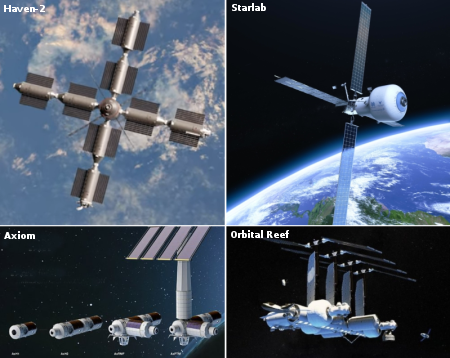
Four of the American space stations under development.
The fifth, Max Space, is a late comer and not shown.
At a hearing yesterday before the space subcommittee of the House Science, Space, and Technology Committee, both the trade organization representing the five commercial space station projects as well as some members of Congress expressed strong reservations about NASA’s new plan to build a core module as a basis for helping these companies develop their space stations.
Dave Cavossa, President of the Commercial Space Federation (CSF) that represents these companies, outlined in his statement [pdf] to the committee the industry’s dissatisfaction, not so much because of the specifics of NASA’s plan but because it follows other sudden changes last year by the previous NASA administrator Sean Duffy, and is still uncertain in its outline.
Given the delays and possible shifts in strategy, industry has been left to continue spending resources to develop private space stations without a full understanding of what NASA will require from a private station, how the agency will structure the rest of the procurement and program, and when industry may see a return on investment. This uncertainty challenges the public-private partnership business model and puts the agency at risk of deorbiting ISS before private stations are operational.
The trade group proposed that NASA stick with its previous plan to fund two or more station projects, dropping Isaacman’s core module proposal. It also wanted Congress give the agency the funds to do so.
Cavossa also strongly disputed NASA’s claim that the market at present doesn’t support these commercial stations.
Cavassa said today that “industry has raised over a billion dollars in private capital” in the last six months and “several billions of dollars over the last several years.” Some of his member companies have said they’ve already sold out the available rack space on their space stations. NASA’s rationales are “flawed” and the repeated changes are “sowing confusion” in the industry reminiscent of Lucy and the Football.
Nor is Cavassa’s claim about private capital wrong. Of the five space stations under development, most have obtained investment capital exceeding several hundred million dollars, with two raising more than half a billion dollars. NASA might think the market isn’t there, but Wall Street sure seems enthused.
Of those five projects, Vast has expressed support for NASA’s new approach, while the Starlab consortium issued a press release that wholly supported NASA’s new Moon program but seemed to be less enthused about its station proposals. Another news report yesterday further suggests Axiom and Starlab are skeptical.
Two of the station builders, Axiom Space of Texas and Colorado-based Starlab Space, told me by email they are still reviewing NASA’s request for input about the alternative strategy, which was released Wednesday morning.
During the hearing at least one congressman, George Whitesides (D-California) expressed doubt about NASA’s new space station plan.
My experience with new pieces of the ISS is that it takes 10 years to build. I don’t get how, where, we’re going to get this new thing. And doesn’t that [timeframe] go beyond the lifetime of the ISS? … I just don’t see how it’s fiscally possible for NASA to afford the development and launch of a custom-built government core module, while maintaining ISS, while claiming at the same time it can’t afford to be a customer on a commercial station that is being privately financed. I just don’t understand it.
When NASA announced its new proposals last week, agency officials made it clear their core module proposal was preliminary, and that they welcomed input from the space station companies. It now appears the political winds might be moving against that core module proposal.

On Christmas Eve 1968 three Americans became the first humans to visit another world. What they did to celebrate was unexpected and profound, and will be remembered throughout all human history. Genesis: the Story of Apollo 8, Robert Zimmerman's classic history of humanity's first journey to another world, tells that story, and it is now available as both an ebook and an audiobook, both with a foreword by Valerie Anders and a new introduction by Robert Zimmerman.
The print edition can be purchased at Amazon or from any other book seller. If you want an autographed copy the price is $60 for the hardback and $45 for the paperback, plus $8 shipping for each. Go here for purchasing details. The ebook is available everywhere for $5.99 (before discount) at amazon, or direct from my ebook publisher, ebookit. If you buy it from ebookit you don't support the big tech companies and the author gets a bigger cut much sooner.
The audiobook is also available at all these vendors, and is also free with a 30-day trial membership to Audible.
"Not simply about one mission, [Genesis] is also the history of America's quest for the moon... Zimmerman has done a masterful job of tying disparate events together into a solid account of one of America's greatest human triumphs."--San Antonio Express-News
I’m confused, as it appears the proposed core module is equivalent to Axiom’s initial module, design (possibly construction?) of which is already underway with serious funding. Perhaps I’m misinformed.
Hi Bob,
You’re right here, of course; but I think we have to be careful not to over-read what I *think* Cavassa is saying in this letter here. The commercial space station developers all still maintain that, fundraising successes notwithstanding, they still need a NASA CLD contract in the range that’s been discussed in order to close their business cases. A half billion bucks in venture capital and deposits does a lot here — it can get them to a Critical Design Review (CDR), set up a lot of what’s needed for actual fabrication, and it is certainly a vote of confidence in these stations — but it’s not enough to build and deploy a space station, or certainly not the ones we are talking about.
I think the frustration is with the prospect of yet *another* major change in the commercial space station program just eight months after the *last* major change, and the uncertainty it injects into the whole thing. They really seem to want to stick to the new plan announced last July, a plan which (I think it important to note) was enthusiastically endorsed by Phil McAlister, who is arguably the guy who better understood the commercial space sector than any senior NAA manager who has ever worked at the agency. (Naturally, of course, he was more or less eased out by the last administration.)
The difficulty seems to be Jared Isaacman’s assertion that he doesn’t think they have the money to fund two stations through the initial phase of operation, and NASA doesn’t like the risk involved in downselecting to just one, and that’s why they seem to have cooked up this new proposed scheme. Which, I suppose, is not unreasonable. But maybe that’s a discussion that really has to happen with congressional leadership.
Richard M: My instincts, which are usually pretty good, are telling me that if any of these private stations can get up and running in orbit, they will soon discover more profit centers than they can handle, more than enough to survive and prosper. Those instincts are also telling me this is why there is so much investment capital being committed to them: The investment community is aware of these possibilities, and so is willing to commit.
This ties in with the flood of investment capital to the slew of orbital capsule companies that have appeared since Varda completed its first successful flight. The investment community is committing money to these capsules because it knows there is real profit to be made there, and it also knows this profit has the potential to grow exponentially on the larger stations.
At least, this is what instincts say. That I tend to be an optimist means I take your reservations very seriously. Nonetheless, that my instincts are so often right in these matters — when people are willing to take risks — makes me confident of their value.
It sounds like there was some good immediate feedback. The Ignition presentation announced some goals that were not fully thought out. They emphasized that their ideas were in need of much work, which explains their requests for information. It seems that they were looking at goals, presented ideas for achieving those goals, and asked for feedback on those ideas and how to either make the ideas work or to come up with better ideas.
I am under the impression that Isaacman looked at his favorite government agency and found it wanting. He has suggested ways to make it great again. The Ignition presentation announced one of those ways, spread out among several projects.
I find it a little ironic that Isaacman wants to stabilize the SLS design and avoid the future changes that are presenting NASA with many challenges, costs, and delays, but he is also proposing plan changes for other projects and creating some challenges, probable costs, and possible delays. Fortunately, since he is getting his supply chain involved in these discussions so that a more realistic plan can come out of this process of his.
Discussions are underway as to how to make the future come true. We are starting to live in the world that science fiction predicted. We just have to guide it to the stories with the happy endings, not the bad ones.
Patrick Underwood,
The proposed Core Module is apparently supposed to be capable of providing ISS re-boost among its other functions. None of the Axiom modules are capable of doing that and modifications to accommodate such a function would be major and lengthy because Axiom doesn’t build most of its hardware but contracts that out to Thales Alenia in Italy.
Richard M & Robert Zimmerman,
I think Vast’s relative enthusiasm for the Core Module proposal is entirely a matter of it being the only LEO space station contender which can build its own major structures in-house and with reasonable dispatch. If there is to be a Core Module, Vast seems the only player with a prayer of being able to design and build it on the sort of schedule that would be required. So I think Vast sees itself as a winner regardless of how the whole Commercial Lunar Destinations (CLD) program plays out.
If no additional NASA funding for CLD is likely to materialize, then the only thing that will render even one, never mind multiple, stations feasible is more private capital. This could be forthcoming if the operational economics of post-ISS LEO stations could be significantly improved. Fortunately, that is possible.
Administrator Isaacman stated, during the Ignition presentations, that crew rotation and cargo resupply account for more than half of what NASA spends annually to sustain ISS. It is these costs that can be radically reduced if a suitably fitted out Starship is used to support, say, quarterly runs of a crew rotation and cargo resupply service analogous to a combination of city transit bus service and Fed Ex delivery to all post-ISS US LEO crewed space stations and, potentially, those of any friendly nation – say India. The more of these stations there are, the better the economics of this shared logistics infrastructure get, especially if all such stations fly in a common orbit – the ISS orbit being the de facto standard.
It has recently been revealed that Starlab’s deployment contract with SpaceX for a Starship mission is priced at $90 million. If a quarterly $90 million Starship mission took, say, two fresh crew and a standardized cargo module with up to 5 metric tonnes of supplies to ISS orbit for each of five LEO stations (Vast, Axiom, Starlab, Orbital Reef and a draft pick to be named later) and returned with five such modules containing a mix of useful downmass and trash, plus two crew from each station who have reached the ends of their on-orbit “shifts,” that would cost each station operator $18 million per quarter – $72 million/yr. – to operate his station. As future LEO stations will vary in size and crew complement, Starship could certainly carry more than a pair of rotating crew and more than a single cargo module for larger stations such as Vast’s Haven 2 and its follow-ons. This would lower the costs per module and per seat still further. But even if there are only two post-ISS LEO stations initially, a single Starship could provide crew rotation and cargo delivery/pickup for $45 million per combined mission – roughly a quarter of what a Crew Dragon and Cargo Dragon mission pair would cost. And it is, of course, problematical how much longer Crew and Cargo Dragon service will remain available.
The argument will, inevitably, be made that SpaceX would monopolize LEO station logistics if such a system is put in place. That would almost certainly be true – initially. But Blue Origin – if it ever does get around to building Orbital Reef – would not likely be happy being beholden to SpaceX for logistics and would likely build something at least potentially price-competitive that could fly, reusably, atop one or the other variants of New Glenn. NASA could even encourage this evolution with a modest bit of financial encouragement.
The needed “gap-filler” capital will flow from the private sector if pro forma balance sheets show vastly smaller logistics costs. The owners of all currently planned post-ISS LEO space stations should form a logistics consortium and work out a deal with SpaceX. They can do the same later with any other logistics provider that shows up with a comparable or better deal – should that eventuate.
Hello Bob,
In the *long-term*, of course, I am quite optimistic about the commercial prospects of space stations! I suppose it is just a question of how quickly we can realize the *long-term.*
The most common factor that seems to show up in critical analyses of commercial space stations is the one factor that commercial space station developers have no control over: the cost of transportation to and from earth orbit. Crew Dragon might be cheaper than anything else we’ve ever flown people on, but it’s still pretty pricey. SpaceX has some room to cut that price point (mostly via the healthy profit margin they have on Falcon 9 launches) but zero incentive to do so because there is simply no competition to force them to do so. The only other crew vehicles with any prospect of becoming operational in the next few years are Starliner and ISRO’s Gaganyaan. I can’t see either exercising any downward pressure on crew transport costs. Blue Origin or Rocket Lab might choose to develop their own crew vehicles, as they have hinted at previously, but we have to assume that any new crew vehicle will take 7-8 years, minimum, to become operational. And to be honest, it is hard to see any of these vehicles making *really* major cuts in the price point of crew transport to orbit: seats seem likely to remain well into 8 figures for the foreseeable future.
If and when Starship gets into the crew transport business, the same problem will still be present: there needs to be competition to push prices down. In the meantime, I guess the station developers can try to sell as many slots for remotely operated payloads. But that will only go so far.
Hello Dick,
I actually expect there’s a good chance something like that *will* happen. But even if they fired the starting gun *today*, a reasonable expectation is that you are not going to see that crew vehicle until 2035, at least. This is Blue Origin we are talking about, after all.
For the time being, SpaceX is all we’ve got.
Some are complaining about Starship being overkill for a single commercial station resupply.
The solution is simple, keep as many stations as possible in the same orbit at the same altitude and have one starship service multiple stations.
This was the plan with the Industrial Space Facility plans of the late 80s to mid-90s. One orbiter would service multiple ISFs arrayed in one orbit like a string of pearls.
So Eric Berger has an article up on this flap today, and it sounds like everyone he has talked to in the industry just hates this idea. “In my discussions with private industry leaders, almost none of them like NASA’s new plan.” Whether that includes people at Vast is not clear.
Berger also talked to Phil McAlister, who I mentioned up above, and it seems he hates the idea, too: “I don’t see how this new plan benefits industry at all,” he told Ars. “This new plan destroys the development work the companies have accomplished over the last several years, and it ensures NASA and the nation will see no benefit from the hundreds of millions of dollars that NASA has spent on CLD designs that are now obsolete.” It also means that these station developers would now have to go through the ultra-rigorous and expensive certification process that docking a module with the ISS in any form requires. And yeah, I don’t think any of us like the sound of that.
https://arstechnica.com/space/2026/03/what-happens-next-with-nasas-plan-to-replace-the-iss-source-it-could-get-ugly/
Also, Berger drops a real jawdropper of an aside about habitation modules for the now “paused” Lunar Gateway station: “Despite billions of dollars and efforts by NASA and the European Space Agency to build new deep space station modules—the HALO and iHAB elements of the now-shelved Lunar Gateway—have both faced significant delays. There are rumors that both modules are actually corroded, perhaps beyond repair.”
Whoa. “Corroded, perhaps beyond repair?” Seriously? This is the first I haver heard of this!
Richard M,
I agree with pretty much every objection Berger heard from his sources. I don’t think Core Module is a good idea either. It strikes me as being the space station equivalent of what was said, back in my motorcycling days, of “universal” accessories – they fit nothing.
As I noted above, SpaceX can cut the cost of LEO space station crew rotation and cargo resupply a lot by just ginning up a Transporter-esque logistics rideshare service based on Starship. And it can do this without compromising its Starship operating margins at all.
Sure, it would initially be a monopoly, but SpaceX is already a de facto near-monopoly at everything it does because no other entity is structured to match SpaceX’s ability to operate at scale and because it moves so fast it enjoys first-mover advantage in pretty much everything it turns its hand to. So long as said monopoly results in major reductions in logistics expense for LEO space stations, no one would be harmed by said monopoly. Certainly not its notional customers – the provision of such a service would close their currently iffy business cases.
Back in my Libertarian days, such a prospect would have had me clutching my Freidman-esque pearls. I have since come to see that maximizing economic efficiency can sometimes occur because of a monopoly, not in spite of it.
Anyone else would, of course, be free to gin up an even better system and take a run at SpaceX’s monopoly, but that has proven to be quite a pile of rocks to get over for a number of players in a number of fields and LEO space station logistics is, in all likelihood, just going to be one more. I entirely agree that Blue is unlikely to be a player in this notional space until at least the mid-2030s whereas SpaceX could have a service ready to go by the time there are any post-ISS LEO space stations that could use it.
Anent allegedly corroded Gateway modules, I would not be much surprised to find that this is true. I worked in Western Europe for a couple of years starting nearly a half century ago. Many of the countries there have climates that average being pretty cloudy and damp. And rust, as we all know, never sleeps. If true, this also makes it a lot less politically fraught to just cancel Gateway outright rather than “pausing” it – nudge-nudge, wink-wink.
M Puckett,
Yeah, a shared logistics service would be all kinds of good for every LEO station operator that used it. And the more – literally – the merrier.
P.S. Eric tells me he’s getting thrashed by the usual suspects over this claim about the Gateway modules: “Don’t worry, according to the Artemis discord server I’m making all of this up.”
Hello Dick,
What were you thinking of here? That a crewed Starship launches with astronauts for a couple stations, does a rendezvous with Station A and deposits that batch of astronauts, then undocks and travels to Station B, docks and unloads its batch of astronauts?
Side note, from my libertarian perspective (I swear there are as many perspectives as there are libertarians), the real damage with monopolies are ones that are enforced. If SpaceX is neither favored by governments, and not allowed to sabotage competitors then it will work out. The struggle is as they grow they tend to first covertly and then overtly collude to maintain their monopoly by force and subtrifuge.
So far Musk seems more fascinated by the extreme growth opportunities of space, making it not worth worrying about competitors. But if growth stagnates, I believe we have a lot to fear.
Patrick Underwood,
“I’m confused, as it appears the proposed core module is equivalent to Axiom’s initial module, design (possibly construction?) of which is already underway with serious funding. Perhaps I’m misinformed.”
We may all be confused. One of my many takeaways from the Ignition presentation is that the things they were announcing were notional as opposed to thought out. They were requesting information in order to figure out how to accomplish their goals. I didn’t get a sense that they had yet set in stone any real requirements for the core module.
_________
M Puckett,
“The solution is simple, keep as many stations as possible in the same orbit at the same altitude and have one starship service multiple stations.”
That would be nice, but different orbital planes have different advantages, and it would be a shame to limit commercial space to one plane.
__________
Richard M wrote: “So Eric Berger has an article up on this flap today, and it sounds like everyone he has talked to in the industry just hates this idea.”
Well, it is like changing horses mid stream. The current horse is struggling, and it looks like they are trying to find a good horse to jump onto. NASA seems to have chosen the wrong horse in the first place, and now is looking for one to finish the job. It would help if Congress were cooperative. As Richard M’s linked article emphasizes, the space station companies need requirements to work toward. I really don’t understand why NASA does not yet know what they want from the commercial space stations. No wonder no one thinks that they can satisfy NASA four years from now.
“There are rumors that both modules are actually corroded, perhaps beyond repair.”
That is difficult to believe, and shocking if true. What did they do to allow corrosion? How did they design them to allow corrosion? The space industry works very hard to avoid corrosion, so it builds and stores its flight hardware indoors in climate-controlled cleanrooms. It is one of the reasons why I was so shocked that SpaceX was storing flight materials and hardware outdoors at Boca Chica (now Starbase). Storing it in those open tents was not much better.
From Richard M’s linked article:
Did his team inherit it or was his team among the ones that created the mess over the past decade? As with any cleaning project, when you start with a mess, you have to make a bigger mess for a while until you can get the cleaning job done.
“What were you thinking of here? That a crewed Starship launches with astronauts for a couple stations, does a rendezvous with Station A and deposits that batch of astronauts, then undocks and travels to Station B, docks and unloads its batch of astronauts?”
Not a bad plan, IF there are lifeboats at each station in case of emergency. If not, then it is a bad plan. Of course, it reduces the mission flexibility for each of the concurrently serviced space stations.
If a Starship is dedicated to a Haven II space station, it could bring a large number of workers and plenty of supplies, but it would have to stay with the space station for the duration of the mission, again in case of emergency.
Richard M,
Yeah, that’s exactly what I was thinking of here.
Bill Buhler,
My suggested logistics solution is entirely private sector – no government involvement equals no coercion. The only potential government involvements would be future excessive regulatory buttinskyism and/or an attempt by a would-be competitor to get the government to pay for/mandate its proposed competitive system. SpaceX is a big boy. It can look out for its own interests against either type of potential future threat.
With whom would SpaceX notionally “collude” to protect its de facto LEO space station logistics monopoly? Perhaps the same non-existent entity with which it currently “colludes” to dominate the space launch business? Or the LEO broadband business? SpaceX dominance of those markets it dominates is entirely due to moving first, moving fast and moving at scale. Any potential competitor not able to do all three at once will, inevitably, wind up with a view of SpaceX’s tail lights dwindling in the distance until they go around a corner and are lost to sight – likely for good.
SpaceX has actually launched all or part of several notionally competitive satellite constellations. Perhaps it is “colluding” somehow even with its competitors?
Musk, I suspect, worries little about competition because he – correctly – realizes that there are no limits to the – as you quite correctly put it – “extreme growth opportunities of space.”
Perhaps you would care to spitball a potential future circumstance that might result in stagnation of growth in space-based and space-related enterprise? Short of another world war, I can’t think of one – and I’m not even 100% convinced that another world war would do it.
Edward,
What certain old-guard folks at NASA pretty clearly want is for ISS to continue indefinitely – and they have some political backing. This whole Core Module idea seems both a bid to keep ISS flying indefinitely and perhaps also a way to put NASA’s thumb on the scale to favor Axiom. Axiom doesn’t have any single module that could do what Core Module is supposed to do, but the two modules it actually has under construction seem capable, in combination, of doing what Core Module is supposed to do.
Orbital planes different from that of ISS may have modest advantages for certain use cases. But I can’t think of any advantages that would come close to counterbalancing a major cut in logistical expense. Perhaps you can think of one.
I think the current “lifeboat” function of crew logistics vehicles is going to have to go away. It’s economically inefficient and won’t be practical anyway for stations appreciably larger than ISS – too many people will be too far from the single docking port in the event of any genuinely dire emergency that forces a complete evacuation. And if said docking port is as dinky and cramped as those currently in use on ISS, good luck getting even a few possibly panicky people through one of those in single-file. I think LEO space stations need to address the “escape pod” issue fairly soon. Such pods should be numerous and evenly distributed across occupied sections of a space station.
I disagree that my suggested logistical solution would reduce station mission flexibility. Quite the contrary I should think. It would allow both more frequent and vastly cheaper logistics than at present. I fail to see how either of those things would serve to reduce “mission flexibility” over the much less flexible and very expensive arrangements now standard for ISS. Sure, Star Trek-ish transporters would be still better. Call me when those become a catalog item.
Bill Buhler,
“The struggle is as they [monopolies] grow they tend to first covertly and then overtly collude to maintain their monopoly by force and subtrifuge. So far Musk seems more fascinated by the extreme growth opportunities of space, making it not worth worrying about competitors. But if growth stagnates, I believe we have a lot to fear.”
I think that the prices that SpaceX charges is already close to the maximum possible. If the company charged more for launch or transportation services then there would be fewer customers. That was the problem before SpaceX provided low cost launches, the customers could not make their business cases work, so there were not as many operators in space. The low launch prices has produced the current customer base.
The prices may be higher than they would be if there were more launch companies competing for the business, because all the launch vehicles worldwide are close to their maximum cadences and maximum capacities. There are not enough launchers, yet, for more space operator customers, so the price is currently keeping the demand in check. As more launch vehicles become operational and increase their launch cadences, then the increased supply will allow more space operators to demand launches, and the price of a launch can decrease in order to attract additional customers.
The additional launch vehicles should also reduce the near-monopoly that SpaceX enjoys, right now, but my point is that if growth stagnates then even the SpaceX near-monopoly would not be able to charge more for a launch, because the customers would not be there to pay the additional price.
Musk seems much more interested in colonizing Mars than in obtaining wealth. The wealth is just a byproduct of the success. The near-monopoly is a byproduct of the success and of the lack of others to adapt quickly to the changing methods of accessing space. Reusable rockets allow for lower cost launches and for more availability of launch vehicles, and other companies are only just now bringing their reusable launch vehicles online. The competition is increasing and the near-monopoly decreasing.
The space economy is a free market, and supply/demand/price pressures are driving the market. One company is leading the way in methodology, but many of the other companies are finally adapting, so the pressures should change soon and the market will adapt to the new conditions.
If the growth stagnates, it is not the monopoly that we should fear, it is the failure of the space economy that we should fear.
_________
Dick Eagleson,
“Orbital planes different from that of ISS may have modest advantages for certain use cases. But I can’t think of any advantages that would come close to counterbalancing a major cut in logistical expense. Perhaps you can think of one.”
Oh, I don’t know. NASA was not eager to put their Freedom space station into such a highly inclined orbit until the Russians got involved, so that orbit clearly is not so very desirable that NASA thought of it themselves.
“I think the current ‘lifeboat’ function of crew logistics vehicles is going to have to go away.”
In January, NASA had a need for a return lifeboat, and that did not involve a panic. Not all lifeboat situations are like the Mir fire or the Mir collision, and even then neither of those involved a panicky scramble for the lifeboat. I do not think that the idea of the lifeboat-less space station is ready for prime time.
Passenger planes do not have provision for lifeboats, so their safety had to be dramatically increased. Passenger ships do have provisions for lifeboats, so they have a seat for every passenger and crew member. I do not think that the public is yet ready for us to put space stations in low Earth orbit without providing for an escape from an emergency situation. They aren’t ready for a government space station to do that, and they most certainly would not allow a commercial space station to forego safety for mere profit.
“I disagree that my suggested logistical solution would reduce station mission flexibility.”
Your proposal would mean that station A’s missions would be the same length as station B’s missions. The missions necessarily must be no less in length than the frequencies of the Starship visits. No mission flexibilities there.
Edward,
The ISS orbit may have been chosen to accommodate the Russians but it has turned out to be a good pick. Future stations could certainly do worse. Future stations oriented mainly or exclusively to tourism, in particular, should find the ISS orbit a good one as it allows all potential tourists but a few Aleuts, Inuits and Tierra del Fuegans to look straight down at their homes from orbit. NASA’s Core Module notion, should it come to pass, would result in the ISS orbit remaining the orbit for human-crewed LEO stations. If not, Axiom still intends to use it and there is no terribly compelling reason for other station builders to put their destinations elsewhere and many reasons not to – the realistic ability to render mutual aid in emergencies being a big one. Another, as I have proposed here, is to avail themselves of a low-cost shared logistics capability.
I did not, in any way, propose that LEO space stations should lack emergency escape capabilities. I simply suggested that leaving crew transport vessels docked to space stations for months on end is not the optimal way to accomplish this. It is indeed true that large ships carry lifeboats enough for all passengers and crew, but the crew and passengers do not first ride said lifeboats out to the ship. The lifeboats are already on the ship when it enters service and stay there unless needed. It is certainly quite possible to design one- or two-place “escape pods” that can be quickly boarded and jettisoned in an emergency. These units, especially in the early going of post-ISS LEO stations, should be constructed and equipped to de-orbit and do Earth entry, descent and landing (EDL) on their own. Later, when there are more stations in a common orbit, it might make more sense for these pods to omit the de-orbit and EDL capabilities in favor of just having enough maneuvering capability to reach another station in the same orbit. That would make them less expensive per unit and make it possible to build larger stations less expensively.
The logistics arrangement I have spitballed here doesn’t really cramp anyone’s style very much from the standpoint of mission length. “Working” space stations will have crew on fairly lengthy “shifts” as ISS does now. Having a “bus” that runs its route every quarter, say, would allow “shifts” of 3, 6, 9 or even 12 months straightforwardly. Strictly tourist destinations, when they appear, might well exchange sizable loads of tourists, say, every other week. In this case, it would make sense for the departing guests to take the same ship back to Earth that brought up their successor sightseers. Short tourist jaunts could also be accommodated on the quarterly logistics runs as these would take at least a few days to complete and the ability to visit multiple stations, at least briefly, while staying based on the logistics ship would likely be quite attractive to many.
Dick Eagleson,
We are thinking two different things. You are thinking future tourism space stations and I am thinking of our current space stations.
I can see the “cruise ship” model of space tourism, where the passengers are taken from port to port and they get off at each port for a day of tourism and get back onto the ship at the end of the day to sleep while the ship sails to the next port.
If we want to think into the future, then we are merely speculating. Two years ago, how many of us would have guessed that space companies would want to put AI data centers in orbit? How many reading Behind The Black currently think it is not a good idea? Ten years ago Iridium was considered a big constellation, then five years ago we thought fifteen thousand was big, and now there is a proposed million-satellite constellation.
We are currently seeing that it is difficult to predict the future in space. Conditions change in unpredictable ways and there are many other people who have ideas that we are not in a position to think of.