
The American Revolution, as seen from across the Atlantic
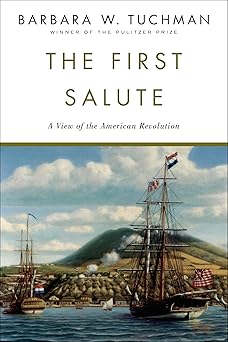
As this year is the 250th anniversary of the signing of the Declaration of Independence, it seems fitting to review a history about the Revolutionary War. In fact, I intend to do a few more such reviews in the coming months.
Let’s start however with a book that looks at that Revolution from a very different perspective.
Historian Barbara Tuchman is most well known for her early classic, The Guns of August, a book that was made famous when John Kennedy repeatedly referred to it during the Cuban missile crisis. Kennedy’s recommendation not only brought the book to the attention of the general public, it made Tuchman’s career. From that day forth, her work has always been received with accolades and enthusiasm and uncritical respect.
I am here however to break that bubble, though only partly. I just finished reading The First Salute, Tuchman’s 1988 history of the Revolutionary War. Rather than tell the tale from the point of view of the Americans, as done by most historians, Tuchman’s work looks at the war from the point of view of Europe, and thus gives us a much larger and very worthwhile context.
For this I compliment Tuchman highly. Though it is well known that the arrival of the French fleet off the coast of Virginia was crucial in forcing the British army to surrender to Washington at Yorktown, the background behind that arrival has generally been given short shrift by historians. Tuchman does not, describing in detail the political maneuvering necessary between the American envoys in France and France’s government to make that fleet happen. She also describes the attitudes of the Dutch and Spain to the war, and how and why they eventually moved to support America, even though there were many reasons for them to stay out.
Her book also gives us the British perspective, revealing the amazing and continuous failures of its government and generals to wage the war with any enthusiasm or skill. It appears almost from the start that the British had no great desire to win, and that malaise and overconfidence more than anything resulted in their eventual defeat.
For example, the British never took Washington or his army seriously. When Cornwallis learned that he was about to be surrounded and trapped in Yorktown, he had time to leave. He instead sat on his hands and did nothing.
This British contempt for America was also illustrated in how it treated America politically. For example, one of the main American complaints was it was not allowed its own representatives in the British parliament, a decision I had always believed Britain applied to all its colonies. Tuchman shows this assumption was false. While it denied the North American colonies representation, its plantations in the West Indies were given from twelve to fifteen seats. The British government considered these colonies far more important, gave them respect, and thus did not lose them. To the thirteen North American colonies it instead thumbed its nose.
Great Britain’s overconfidence was also made evident by how it viewed its European counterparts. It never considered the French a serious or grave threat, and took little action to prevent its fleet from arriving in America. And it was so overconfident of victory that it was not only willing to fight the Americans on a different continent across a vast ocean, but to also at the same time declare war on France, Spain, and the Dutch, despite having limited resources not equal to the task.
Thus, Tuchman’s wider perspective of the war is very enlightening. The nature of colonies and its frontier culture always made it unlikely that Britain could have ever defeated it, but Tuchman shows us that Britain itself earned that defeat, by its own incompetence, ignorance, and overall contempt for its opponent.
Tuchman’s book however has some serious flaws, not in her facts or analysis but in her writing. First, her chronology of events in the first half of the book is often confusing, jumping forward and back sometimes in the most jumbled manner. I often had to struggle to figure out how different events fit together, as she often mixed up the time table quite unnecessarily.
Second, while her analysis of events is cogent and almost always correct, she inserts this analysis over and over again in practically every paragraph. Since her conclusions are almost always the same, she ends up repeating herself incessantly. A good editor should have cut much of this dissection, but I suspect Tuchman’s reputation and fame made it difficult to challenge her.
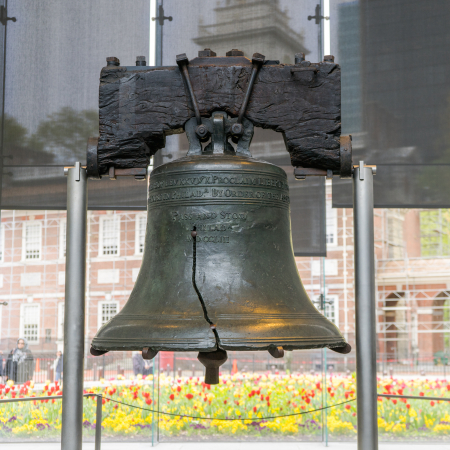
“Proclaim liberty throughout all the land unto all
the inhabitants thereof.” Photo credit: William Zhang
Thus, if you are an aficionado of the Revolutionary War and wish to learn all you can about it, I would recommend this book highly, because it provides a perspective not seen in many other histories of that time.
If however you want to sit down and read a well-written and enjoyable history of that war, this is not the book to read. You will have to struggle through the first half before it begins to pick up speed and become more coherent chronologically in the second half.
Above all, however, this history does illustrate what Washington himself believed, that God himself was on his side, that “the same bountiful Providence, which has relieved us in a variety of difficulties before, will enable us to emerge from them ultimately and crown our struggles with success.”
Tuchman illustrates the almost miraculous confluence of events that made that success possible. And in looking at those facts, it sure looks like God was playing favorites in making the birth of the United States possible.

On Christmas Eve 1968 three Americans became the first humans to visit another world. What they did to celebrate was unexpected and profound, and will be remembered throughout all human history. Genesis: the Story of Apollo 8, Robert Zimmerman's classic history of humanity's first journey to another world, tells that story, and it is now available as both an ebook and an audiobook, both with a foreword by Valerie Anders and a new introduction by Robert Zimmerman.
The print edition can be purchased at Amazon or from any other book seller. If you want an autographed copy the price is $60 for the hardback and $45 for the paperback, plus $8 shipping for each. Go here for purchasing details. The ebook is available everywhere for $5.99 (before discount) at amazon, or direct from my ebook publisher, ebookit. If you buy it from ebookit you don't support the big tech companies and the author gets a bigger cut much sooner.
The audiobook is also available at all these vendors, and is also free with a 30-day trial membership to Audible.
"Not simply about one mission, [Genesis] is also the history of America's quest for the moon... Zimmerman has done a masterful job of tying disparate events together into a solid account of one of America's greatest human triumphs."--San Antonio Express-News
I purchased, and read, THE FIRST SALUTE when it first came out, and I’ve re-read parts of it in recent years. And I have to say that on the whole, it holds up pretty well, certainly better than better known Tuchman works like THE GUNS OF AUGUST, or THE MARCH OF FOLLY.
One thing I thought it really brought home was just how *good* George Washington was as a leader and strategist — to the point where you really come away appreciating that he was, more than any other Founding Father, the *necessary* man that brought America into existence: a Tier 1 case for the Great Man theory of history. If someone like Gates or Lee had been put in charge of the Continental Army instead, history would look very, very different.
I concur with Richard M. George Washington was by far the greatest president. Considering that he had no model to follow, he created the presidency out of “thin air”. After retiring from public office, came back to raise and lead the force the quelled the Whiskey (Tax) Rebellion that could have torn the young nation apart while Anthony Wayne and the army were busy defeating the Indians at the Battle of the Fallen Timbers. Two big mistakes by the British in history were cheating George Washington, the planter, and embarrassing the diplomat, Benjamin Franklin.
My mother of all people, recommended First Salute to me years ago.
I have been blogging on the Revolution ‘as it happened’; writing up each military action as the anniversary comes up. With the War not even a year old in early 1776, the Rebels had secured the Hudson Valley/Lake Champlain supply route, were pushing the British out of Boston, thwarted Crown activity in the South, and utterly failed to capture Quebec. 1776 was the year the British decided to get serious about quashing the Rebellion, and would operate mostly around the lower Hudson valley and southern New England. It’s important to remember that communications and movement of troops and material took weeks and months; not the minutes and hours we are accustomed to. It took time to bring resources to bear.
As Robert notes, the British did not display much sense of urgency at this time, and despite major losses at Breed’s (Bunker) Hill, and a disastrous Southern campaign, they did indeed fail to grasp the level of organization of the Patriots. Rather than move troops to the Carolinas to support efforts in late 1775, LTG William Howe elected to overwinter in Boston, while MG John Burgoyne went back to England for the season. While it was common at the time for militaries to suspend operations in Winter, it wasn’t common for high-level officers to leave the scene for months at a time.
Parliament was planning on a limited response in 1776, believing that isolating New England would end the rebellion. The Loyal Opposition pooh-poohed the idea, arguing that the situation was too far gone for half-measures.
Blair Ivey: Please post the link or url to your site so people can read what you’ve been doing.
The criticism of repeating her analysis reminded me of a similar challenge in reading Atlas Shrugged. Rand reinforced her point often, making it a trial to read on at times. But, AS was worth reading in spite of that. And, I am willing to face down Tuchman’s repetition too, the benefits seem to outweigh that inconvenient style.
As a companion piece, allow me to recommend “The Men Who Lost America” by Andrew Jackson O’Shaughnnessy. (available through Amazon and on Kindle). It looks at the Revolutionary War from the point of view of the English political and military command, and goes into detail about each of the English field commanders. It brings out a number of issues I’ve rarely or never seen discussed in other books about the Revolution.
The three things to watch out for are the King’s Privy Council turning pacifist Quaker Benjamin Franklin into a proponent of revolution; how warfare in the Caribbean drastically altered England’s strategic options in the Colonies by siphoning off a massive amount of men, ships, and supplest; and the disastrous Nicaragua campaign.
Mr. Zimmerman, it’s “compliment,” not “complement.” Small point, I know, but one of your criticisms of Tuchman’s book is poor editing.
D Schrader: Typo fixed. Thank you!
This British contempt for America was also illustrated in how it treated America politically. … The British government considered these [Caribbean] colonies far more important, gave them respect, and thus did not lose them. To the thirteen North American colonies it instead thumbed its nose.
It appears this was not a new attitude, nor just by the British. Many remember today that the Dutch founded New York city and state—as “New Amsterdam”—during the early 1600’s, then decades later (a century before the Revolution) it was seized from them by the English, renaming both to New York. But few remember now that the Dutch came back later in that war and reconquered the colony. However, during the subsequent peace conference, the Dutch gave up New York in lieu of… Surinam (Dutch Guiana). The latter was regarded as being much more valuable to them—and the rest is history.
“its plantations in the West Indies were given from twelve to fifteen seats. “. This is simply false. The West Indian lobby was strong and garnered influence by winning Rotten Borough seats in the UK but outside of Calais in the 16th century there has never been a sitting MP who represented, in the de jure sense, anywhere outside of Great Britain and Ireland.
May I ask whether you were oversimplifying or whether this is actually stated in the book?
Blair has good stuff!
Just click his name….
https://bkivey.wordpress.com/
cjaz99: This was was stated unequivocally in the book, and it surprised me when I read it. From page 134:
Maybe I misunderstood this sentence. These planters got elected to Parliament based on their Great Britain status representing districts in Great Britain, but since they owned large plantations in the West Indies they used that status to represent the islands.
I read the book just after it came out, and a couple of times since. My big takeaway from it was that the Revolutionary War was Great Britain’s Vietnam. It was unpopular among the British citizens, Generals and Admirals disagreed on strategy, and it was micromanaged from London. As Mark Twain said “History does not repeat itself, but it does rhyme.’
I read “The First Salute” last year, then passed it along to my youngest son and daughter. They, like I, enjoy her books immensely. Yesterday, I finished reading Robert Leckie’s “George Washington’s War,” which I feel makes an excellent complement to “The First Salute.”
One of my takeaways from “The First Salute” is that Rodney’s prostate problem may have won the Revolution for the colonies.
its plantations in the West Indies were given from twelve to fifteen seats. “. This is simply false. The West Indian lobby was strong and garnered influence by winning Rotten Borough seats in the UK but outside of Calais in the 16th century there has never been a sitting MP who represented, in the de jure sense, anywhere outside of Great Britain and Ireland.
This point could be underlined, I suppose, by observing that what was really being represented by these men/families holding these Rotten Burrough seats was the pecuniary interests of *these families*, rather than the islands or the populations thereof (free or slave). These things were not the same!
This was much the same rebuttal offered by aggrieved colonists in the 13 Colonies when in the lead up to war, parliamentary leadership tried to argue that the Colonies were effectively represented by certain MPs who happened to have financial or land interests in the Colonies. “They are not representing *us*, they are representing their pocketbooks.”
I encourage everyone to read Tuchman’s A Distant Mirror. Although written about The Calamitous 14th Century, the book’s subtitle, the pages aren’t substantially different than the front pages of today’s front pages.
While you’re at it, her book about the generation leading up to World War One, The Proud Tower, is even more ripped from the headlines.
“One of my takeaways from “The First Salute” is that Rodney’s prostate problem may have won the Revolution for the colonies.”
It certainly *mattered*. One of those “Cleopatra’s Nose” moments in history, you might think….
Tuchman *might* oversell it slightly. The overall logistics and domestic politics of the British strategic position were still ominous, even if they had been somehow able to extract or reinforce Cornwallis in the Virginia Peninsula; Cornwallis’s southern campaign still looks like a resounding strategic failure, just not as catastrophic. The probability still points to American independence at that point, but scenarios building on a healthy and vigorous Rodney more likely just result in a less good deal for that independence in the final settlement. But even that would have big historical knock-on effects: an American Republic which ends up smaller, weaker, and much less consequential on the world stage.
I have collected my War for Independence posts on one Page on my primary blog, which can be accessed, as Wayne noted, by clicking on my name. The posts are in order of occurrence, and later posts will be appended to the end.
Richard M observed: “Cornwallis’s southern campaign still looks like a resounding strategic failure, just not as catastrophic.”
The British continually, and greatly, overestimated Loyalist support in the Southern Colonies. Attempts to raise men fell well short of requirements, and those that did show up, would desert when stuff got real. In contrast to actions earlier in the War, the Rebels would stay and fight, and were learning how to do so effectively. It was evident as early as the winter of ’75 – ’76 that support for the Crown was not widespread in the South, but this was ignored. Whether because British strategy revolved around isolating New England, or because the relatively low population density in the South made it seem a ‘softer’ target, I cannot say.
Blair Ivey: You need to include the link IN your comment. Readers might not realize they can get to these essays by clicking on your name.
Let me help: You can find Blair’s War for Independence posts here.
Blair has some great stuff at his blog!
Longer form, researched, and with visual aids. Cars, history, travel, etc.
This is the kind of detail I like to see:
“1776 was a leap year, giving February 29 days.”
https://bkivey.wordpress.com/the-american-war-for-independence/
The Brits were always better at winning islands while losing continents, all the way up to the Falklands and Dunkirk.
Now, however, they’re about to lose their own ‘sceptered isle of Albion thru suicide via tolerance.
Hello Blair,
“Whether because British strategy revolved around isolating New England, or because the relatively low population density in the South made it seem a ‘softer’ target, I cannot say.”
A lot of things were going on there, but I think one of them was that too many in Westminster counted too much on the Cavalier roots of the southern colonies as a predictor of loyalty.
The large slave populations were also seen as a promising element, not present in New England or the mid-Atlantic colonies.
These were not idiotic impulses! But clearly the British leadership overestimated them. They did not know the colonists as well as they should have.
I think there was a book called “The Fourth Part of the World” to where it was more South America that was the focus of Europeans.
Many in India shamed the Brits into capitulation.
But if you lay that same head down on a train track where a Muslim is involved…he won’t hesitate to run right over a Hindu ascetic where a Brit wouldn’t.
That explains how India went from Gandhi to The Bomb.
Attitudes, cultures are all-important.
Richard M observed: “The large slave populations were also seen as a promising element, not present in New England or the mid-Atlantic colonies.”
Yes, and the Royal Governor of Virginia, 4th Earl of Dunsmore, was the first in the Colonies to offer freedom to slaves that would rally to the King’s flag, effective 7 November 1775. As one might expect, this caused some consternation on the part of slave owners, no matter their allegiance. Although several hundred people would take the Earl up on his offer, there weren’t any large-scale defections.
“They did not know the colonists as well as they should have.”
True, and can probably be blamed in equal measures on complacency, and the communications tech of the day.