The space station part of Isaacman’s new program is facing push back, from industry and Congress
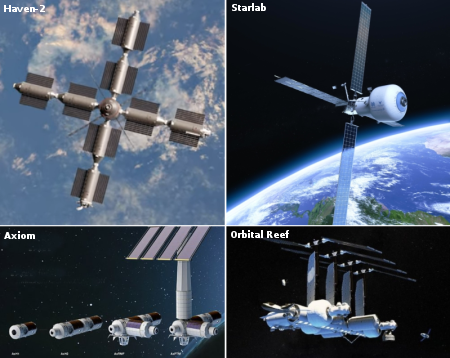
Four of the American space stations under development.
The fifth, Max Space, is a late comer and not shown.
At a hearing yesterday before the space subcommittee of the House Science, Space, and Technology Committee, both the trade organization representing the five commercial space station projects as well as some members of Congress expressed strong reservations about NASA’s new plan to build a core module as a basis for helping these companies develop their space stations.
Dave Cavossa, President of the Commercial Space Federation (CSF) that represents these companies, outlined in his statement [pdf] to the committee the industry’s dissatisfaction, not so much because of the specifics of NASA’s plan but because it follows other sudden changes last year by the previous NASA administrator Sean Duffy, and is still uncertain in its outline.
Given the delays and possible shifts in strategy, industry has been left to continue spending resources to develop private space stations without a full understanding of what NASA will require from a private station, how the agency will structure the rest of the procurement and program, and when industry may see a return on investment. This uncertainty challenges the public-private partnership business model and puts the agency at risk of deorbiting ISS before private stations are operational.
The trade group proposed that NASA stick with its previous plan to fund two or more station projects, dropping Isaacman’s core module proposal. It also wanted Congress give the agency the funds to do so.
Cavossa also strongly disputed NASA’s claim that the market at present doesn’t support these commercial stations.
Cavassa said today that “industry has raised over a billion dollars in private capital” in the last six months and “several billions of dollars over the last several years.” Some of his member companies have said they’ve already sold out the available rack space on their space stations. NASA’s rationales are “flawed” and the repeated changes are “sowing confusion” in the industry reminiscent of Lucy and the Football.
Nor is Cavassa’s claim about private capital wrong. Of the five space stations under development, most have obtained investment capital exceeding several hundred million dollars, with two raising more than half a billion dollars. NASA might think the market isn’t there, but Wall Street sure seems enthused.
Of those five projects, Vast has expressed support for NASA’s new approach, while the Starlab consortium issued a press release that wholly supported NASA’s new Moon program but seemed to be less enthused about its station proposals. Another news report yesterday further suggests Axiom and Starlab are skeptical.
Two of the station builders, Axiom Space of Texas and Colorado-based Starlab Space, told me by email they are still reviewing NASA’s request for input about the alternative strategy, which was released Wednesday morning.
During the hearing at least one congressman, George Whitesides (D-California) expressed doubt about NASA’s new space station plan.
My experience with new pieces of the ISS is that it takes 10 years to build. I don’t get how, where, we’re going to get this new thing. And doesn’t that [timeframe] go beyond the lifetime of the ISS? … I just don’t see how it’s fiscally possible for NASA to afford the development and launch of a custom-built government core module, while maintaining ISS, while claiming at the same time it can’t afford to be a customer on a commercial station that is being privately financed. I just don’t understand it.
When NASA announced its new proposals last week, agency officials made it clear their core module proposal was preliminary, and that they welcomed input from the space station companies. It now appears the political winds might be moving against that core module proposal.

On Christmas Eve 1968 three Americans became the first humans to visit another world. What they did to celebrate was unexpected and profound, and will be remembered throughout all human history. Genesis: the Story of Apollo 8, Robert Zimmerman's classic history of humanity's first journey to another world, tells that story, and it is now available as both an ebook and an audiobook, both with a foreword by Valerie Anders and a new introduction by Robert Zimmerman.
The print edition can be purchased at Amazon or from any other book seller. If you want an autographed copy the price is $60 for the hardback and $45 for the paperback, plus $8 shipping for each. Go here for purchasing details. The ebook is available everywhere for $5.99 (before discount) at amazon, or direct from my ebook publisher, ebookit. If you buy it from ebookit you don't support the big tech companies and the author gets a bigger cut much sooner.
The audiobook is also available at all these vendors, and is also free with a 30-day trial membership to Audible.
"Not simply about one mission, [Genesis] is also the history of America's quest for the moon... Zimmerman has done a masterful job of tying disparate events together into a solid account of one of America's greatest human triumphs."--San Antonio Express-News