
Watching the launch of the Artemis-2 mission
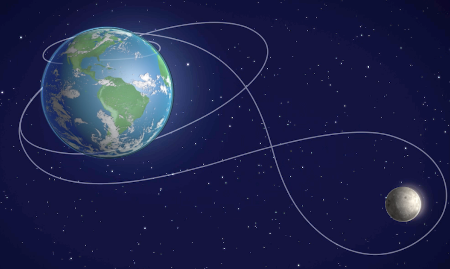
The Artemis-2 flight path. Click for full animation.
The countdown for the launch of the 10-day Artemis-2 manned mission around the Moon continues, with the launch scheduled for 6:24 pm (Eastern) today.
For updates from NASA, go here. So far all is proceeding as planned. A step-by-step outline of the countdown itself can be found here.
A day-by-day detailed description of the planned mission can be found here. For the first day the crew will remain in Earth orbit in order to test the operation of their Orion capsule. To reiterate, the capsule’s life support system has not been flown in space previously, so this first day is critical. If there are any issues, the astronauts are still close to Earth and can return relatively quickly.
If no problems are detected during that first day, on day two the crew will fire the spacecraft’s engines and head to the Moon. At that point everything must function as planned for nine days as they travel out to the Moon, swing around it without going into orbit, and head back to Earth.
The return to Earth remains the most dangerous moment for this flight. During the 2022 unmanned test flight around the Moon, the heat shield design on Orion did not work as planned, with chunks breaking off in a manner that was unexpected and very concerning. NASA spent two years contemplating the issue, and decided to live with the same heat shield design for this mission, since replacing the shield would have delayed the launch at minimum two years. It has adjusted the return flight path in a way it thinks will mitigate the problem. As its engineers are only guessing at what caused the issue and could be wrong — having done no real life tests — we will not know if they are right until Orion splashes down.
We must pray that they are right.
I have embedded NASA’s live stream below.

On Christmas Eve 1968 three Americans became the first humans to visit another world. What they did to celebrate was unexpected and profound, and will be remembered throughout all human history. Genesis: the Story of Apollo 8, Robert Zimmerman's classic history of humanity's first journey to another world, tells that story, and it is now available as both an ebook and an audiobook, both with a foreword by Valerie Anders and a new introduction by Robert Zimmerman.
The print edition can be purchased at Amazon or from any other book seller. If you want an autographed copy the price is $60 for the hardback and $45 for the paperback, plus $8 shipping for each. Go here for purchasing details. The ebook is available everywhere for $5.99 (before discount) at amazon, or direct from my ebook publisher, ebookit. If you buy it from ebookit you don't support the big tech companies and the author gets a bigger cut much sooner.
The audiobook is also available at all these vendors, and is also free with a 30-day trial membership to Audible.
"Not simply about one mission, [Genesis] is also the history of America's quest for the moon... Zimmerman has done a masterful job of tying disparate events together into a solid account of one of America's greatest human triumphs."--San Antonio Express-News
Been watching the NASA YouTube coverage most of the day.
Short of playing out the entire mission with sock puppets, I doubt the coverage could be anymore vapid than NASA has made it.
How “worried” should we be about this?
wayne: I am worried. I also know that even if things go right, things will still be bad, as it will prove NASA is still seeped in the culture that destroyed Challenger and Columbia. Too often the agency lets politics and schedule determine its actions, ignoring engineering.
Let me be more specific. They believe they understand why chunks of the heat shield broke off during the 2022 flight, and have come up with a flight plan they believe will prevent the shield from failing. However, none of these beliefs have truly been tested to confirm whether they are correct or not.
The one test that is most reassuring was a heat test of Orion’s hull, under the assumption the heat shield failed entirely. That test suggested the hull would survive that failure, thus allowing the astronauts to splashdown alive.
All of this is beside the point. Rocket engineering is unforgiving. You don’t fly humans under such uncertain conditions, especially when you know your knowledge is uncertain. For NASA to proceed means it is an agency unqualified to run any manned program.
As it has been for years.
Watching Tim Dodd’s stream.
Watching the NASA feed– worst video coverage of any nasa launch in history.
They faked it! April Fools!
I get nervous watching an orange rocket with an SRB on each side. Glad that part is over. I watched on the NASA youtube until the extension of the solar panels that did not show up on the animation.
GeorgeC,
“I watched on the NASA youtube until the extension of the solar panels that did not show up on the animation.”
Yes, and they couldn’t even keep the coverage going another five minutes to cover the perigee raising burn. What a disappointment. In fact, most of what we saw during the launch was terrible and disappointing. wayne called it right: worst coverage ever.
On the other hand, a couple of hours before launch, one of the hosts, or whoever, gave a rundown of the mission objectives, which was good. We all can check them off as the mission progresses:
Objectives NASA told us during the video:
Overview: Validate systems and human performance
Validation priorities (I assume in the listed order):
a) crew safety and support
b) systems, both ground & flight
c) hardware and data
d) emergency operations, test emergency systems during flight
e) subsystem validation to assure avionics , life support , navigation, etc.
Here’s to praying for a safe return.
I watched the AP stream. Fortunately they had minimal talk-over.
I was quite surprised at the casual radio discipline. At least one astronaut used first names when speaking with the ground. And the female flight director would make Gene Kranz spin in his grave if he heard her.
The ground camera skills were a far cry from NASA’s team from 50 years ago. They entirely missed the solid booster separation when the video shot cut to the crowd watching on the ground.
SpaceX has apparently spoiled us for launch coverage. The NASA youtube feed was astoundingly bad by comparison.
As has already been said, that video stream was astoundingly bad. They didn’t track on the rocket as it left the pad, a pointless view of the crowd at booster sep, no on-vehicle cameras at all..
With the announced changes to the Artemis program, is there actually any purpose to this flight at all, other than “well, it was ready, we hope?” Orion is no longer the vehicle that is going to the moon, so sending one around the moon teaches us…. what?
TL said: “SpaceX has apparently spoiled us for launch coverage. The NASA youtube feed was astoundingly bad by comparison.”
Agreed, good sir!
My wife and I were watching the coverage on TV and on the YouTube channel on my laptop, and I had to comment (more than once), “The SpaceX feeds have ruined me. Everything else seems so amateurish by comparison.”
Can NASA not even get a launch play-by-play right? I watched Apollo 8 and 11 take off live from the Cape, while watching on Dad’s small B&W TV on the trunk of his car. It was far more professional and exciting. What we witnessed today wasn’t even a detergent commercial
Capsule Separation
https://m.youtube.com/watch?v=nnHTcFSvTIY
Interview
https://www.wbrc.com/2026/04/02/artemis-ii-launch-holds-special-meaning-birmingham-native-who-helped-develop-rocket/
James EMP: I’ll note that while we might find it poorly done, I’ve encountered SLS enthusiasts who find SpaceX’s streams mentally taxing, and prefer the approach NASA takes. The sense of élan just isn’t there, because there isn’t the same sense of mission. It’s a job. Pile on top of that the inexperience of NASA’s personnel because the SLS launches so rarely… iterative learning applies to livestreams just as much as it does to rocket development. Though one day I hope a majority of rocket launches aren’t streamed, because it’s become a normal part of the economy. Millions of people don’t watch every jet taking off from SFO. Space needs to become commonplace enough to get to that point.
I hope the names of this crew won’t be carved in marble when they lose their lives because NASA “thought” the heat shield was acceptable.