What life was really like in the American wild west
Though I read a lot of good, detailed, and well-researched histories, I repeatedly find that if I really want to get a sense of the reality of times past, it is necessary to read something that was written by a person who lived at the time, and was an actual witness to great events.
When you do this you instantly cut through the political narratives that color all histories, whether sincere or not. Historians writing generations later bring their own viewpoint to the subject, colored by subsequent history shaped by what the original players did. So, to really understand those original players fairly, you really need to hear their side of the story, from their own lips.
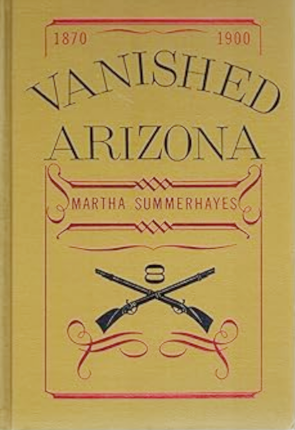
Thus, I was thrilled recently when I came across a used copy of Vanished Arizona: Recollections of the Army life of a New England Woman by Martha Summerhayes. The book covers her memories from 1870 to 1900 as the wife of Jack Summerhayes, an officer in the American military stationed in the western United States, with the bulk of the story centered in Arizona.
This is an amazingly readable book. More important, it tells this story of army life from the perspective of the women who lived it. Most histories cover the battles and important events that Summerhayes’s husband Jack participated in, from defeating the Apaches and Geronimo to establishing the first settlements in early Arizona. Martha Summerhayes instead tells the story from her perspective as a woman living in an isolated fort in the hot desert wilderness of Arizona. The story is riveting, and revealing as well.
In reading her work now, 150 years later during the first half of the 21st century, I noted two important things.
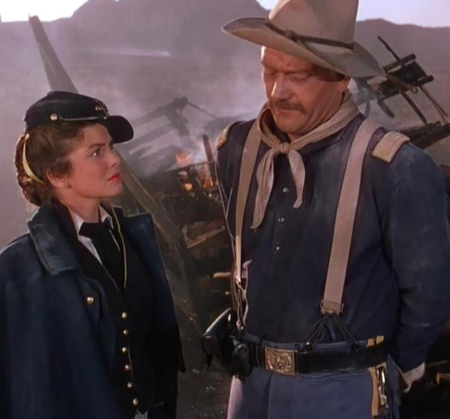
John Wayne and Joanne Dru in John Ford’s
She Wore a Yellow Ribbon
First, the cavalry movies of John Ford from the 1940s were remarkably accurate portrayals of this army life. Movie critics today tend to see these movies as sentimental and self-serving. Summerhayes however proves this wrong. This was really how people behaved in these western forts, with humanity, humility, and amazing wisdom. The goal wasn’t to wipe out the American Indians, but to bring the violent ones either to justice or to heel, so that everyone — whites and Indian alike — could live in peace and prosperity.
And as they did it they tried mightily to recreate the civilized life they had known in the settled east.
I must add that Summerhayes book is not the only original source material on which I base this conclusion. Another great example is Indians, Infants, and Infantry by Merrill J. Mattes, using as his framework the diaries of Elizabeth Burt, the wife of Andrew Bart, who was stationed farther north in the midwest and Rockies at about the same time. She told a very similar tale.
Second, Summerhayes’ story reveals an aspect of the American wild west that is often overlooked. When she first traveled in 1874 to Fort Apache on the eastern end of central Arizona, it took her five months. First she took the Union Pacific railroad from Jack’s previous station, Fort Cheyenne in Wyoming, to San Francisco. Then she boarded a ship that took her down the coast, around the Baja and up the Gulf of California to Yuma. She then changed ships to continue up the Colorado River to Fort Mohave, about halfway up the state on its western border with California.
She had been traveling for 35 days, and had only now landed in Arizona proper. From Fort Mohave she and her husband’s company began a three month journey east, to cross almost the entire state, traveling across the deserts and canyons of Arizona and territories controlled by the hostile Apaches. Summerhayes traveled inside an ambulance, the term then used for what we now call “a covered wagon”.
The main body of the troops marched in advance; then came the ambulances and carriages, followed by the baggage-wagons and a small rear-guard. When the troops were halted once an hour for rest, the officers, who marched with the soldiers, would come to the ambulances and chat awhile, until the bugle call for “Assembly” sounded, when they would join their commands again, the men would fall in, the call “Forward” was sounded, and the small-sized army train moved on.
That was in 1874. When in 1886 Jack Summerhayes was called back to Arizona from a post in Nevada, they traveled entirely by train. The new post was in Tucson, which had been very isolated from the rest of Arizona in the 1870s. For example, in 1877 they had traveled there by wagon from Fort McDowell (east of Phoenix), a journey of about 100 miles that took days, across very rough and poorly marked roads. Now they took “a pullman car” from Nevada to Tucson in about one day. Once there, Martha was astonished by how primitive Tucson had changed in just nine years.
The place seemed unfamiliar. I looked for the old tavern; I saw only a railway restaurant. We went in to take breakfast. … Everything seemed changed. Iced cantaloupe was served by a spick-span waiter; then, quail on toast. “Ice in Arizona?” It was like a dream, and I remarked to Jack, “This isn’t the same Arizona we knew in ’74.” and then, “I don’t believe I like it as well either; all this luxury doesn’t seem to belong to the place.”
In a little over a decade, the American wild west had gone from a remote hard-to-reach place with few basic comforts that only received mail twice a week, to a new community of wealth and prosperity tightly linked to the rest of the nation.
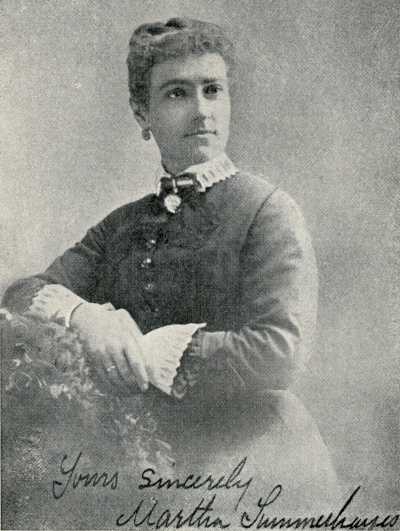
Martha Summerhayes
Summerhayes accepts this breath-taking change in manner so matter-of-factly it’s as if she almost doesn’t notice it. She does of course, but to her and her generation, that change was entirely expected. Americans were building a new nation, and they intended to do it as fast as possible.
All in all, Martha Summerhayes’ story is inspirational in its simple courage faced with endless discomfort and difficulty. Army life in the wilderness was not easy, especially for a woman raising two infants. And yet she persevered, and in the end looked back at those hard times with nostalgia. The memories made her appreciate the luxuries of later life. As she said in her conclusion:
I am glad to have known the army: the soldiers, the line, and the Staff; it is good to think of honor and chivalry, obedience to duty and the pride of arms; to have lived amongst men whose motives were unselfish and whose aims were high; amongst men who served an ideal; who stood ready, at the call of their country, to give their lives for a government which is, to them, the best in the world.
Such people should not be forgotten, especially because they made possible the nation we live in and benefit from.

On Christmas Eve 1968 three Americans became the first humans to visit another world. What they did to celebrate was unexpected and profound, and will be remembered throughout all human history. Genesis: the Story of Apollo 8, Robert Zimmerman's classic history of humanity's first journey to another world, tells that story, and it is now available as both an ebook and an audiobook, both with a foreword by Valerie Anders and a new introduction by Robert Zimmerman.
The print edition can be purchased at Amazon or from any other book seller. If you want an autographed copy the price is $60 for the hardback and $45 for the paperback, plus $8 shipping for each. Go here for purchasing details. The ebook is available everywhere for $5.99 (before discount) at amazon, or direct from my ebook publisher, ebookit. If you buy it from ebookit you don't support the big tech companies and the author gets a bigger cut much sooner.
The audiobook is also available at all these vendors, and is also free with a 30-day trial membership to Audible.
"Not simply about one mission, [Genesis] is also the history of America's quest for the moon... Zimmerman has done a masterful job of tying disparate events together into a solid account of one of America's greatest human triumphs."--San Antonio Express-News
NOTE: Follow the Amazon link to the book Bob provides above. The Kindle edition is available for FREE, if anyone is interested.
For those who do not know, the Kindle edition is an eBook, and can be read in your browser, in a Kindle application, or on a Kindle device.
(I shoulda’ mentioned that in my first post. Sorry!)
Another good book written by a pioneer woman is 4 Wagons West (The story of Seattle) by Roberta Frye Watt.
Also on available on http://www.gutenberg.org/ebooks/search/?query=Vanished+arizona
I think we need a book club section of BtB. Added to the queue, unfortunately it may stay there for a while.
I need to add this to the reading list. My great great uncle was IS Cavalry on the US Mexican border in the same period as this book.
I was given a copy of a privately published book, The Cowboy Preacher, that covers that same time period. It’s the reminiscences of a Lutheran pastor planting churches in Wyoming. Witnessing the arrival of the railroad. Some experiences of ranch life and sod houses on the prairie. And especially the ubiquitous bedbugs.
US Cav, of course ..
I grew up near Tombstone tn the late 60 and 70s. Dad worked rural telephone offices. Actually went to school in the Tombstone Arizona school district, heh, my only claim to fame, couple fights, no shootouts though. Enjoyed your article. I rarely watch westerns, my dad loved them. I can find it painful sometimes, because I was closer to some of the real events, less than than 100 years infact, and things like Hollywood not understanding things like what the climate geography of Arizona actually is like. No, there are no saguaro cactus around Tombstone, too high and cold, actually saw that in a movie once. Clint Eastwood woods famous spaghetti westerns are epic, but as s a kid I was confused by the background in the movie as it didn’t look like the southwest I knew. Only later did learn it was filmed in spain.. anyway, enjoyed the article.
I’ll add to the collection of worthwhile books from that era: On the Border with Crook – General George Crook, the Indian Wars and Life on the American Frontier, by John G, Bourke. Bourke was a Medal of Honor recipient in the Civil War, and aide de camp, to the General. The first half of the book is about life in Arizona, same time period, same Forts. These folks probably crossed paths. Many interesting stories. One of the funniest divorce stories I’ve ever read. The people of that era were serious about life. They knew how to get things done. Top priority.
My family never got that far west; they stopped in western VA (later WV) and in southern PA and OH. That was when OH was the Western Reserve of CT.
There were attacks by the Indians. The survivors of those raids were NOT adopted by the tribe. They were forcibly enslaved hostages. The females – both women and girls – were often raped.
An ancestor of mine – Indian Billy Ice was taken after the adult women were killed. His sister never left, but Billy did, and later joined his family, who had moved further along the frontier.
Sounds awful and more realistic. Indians were not As a whole welcoming to the white settlers
They probably saw us like the horror I looked at the southern border under Biden.
Newspapers from back in the day are helpful too.
I’m still catching up on my local news reading The Alaska Citizen available through the Library of Congress. I’m all the way up to 3 April 1911; https://www.loc.gov/resource/sn96060002/1911-04-03/ed-1/?sp=1&st=image
if you’ve read michener you know. it’s fiction but well researched and much of it based on true events. of course, he starts with plate tectonics, moves on to dinos and eventually spins some gripping yarns. can recommend centennial.
Reminds me of “Mark Twains Roughing it”. He took several weeks by stage coach to get to his brothers sinecure in Nevada. Just a year or so later the railroad had come though to make it several days. I bought
VANISHED ARIZONA Kindle Edition for $.99. Look forward to reading it.
Speaking about that part of the world–it looks like they picked up the Guthrie kidnapper.
The stooped posture and leaves to smear the doorbell camera?
Screams “groundskeeper.”
F—
Referencing Kindle E-Books that are priced at “$0.00,” those are only “free to read,” if you have a paid Kindle Subscription, which allows you to read any of the zero-priced Kindle e-books at Amazon, for no additional cost.
On the flip side, the e-book Author does share in the monthly subscription revenue generated by Kindle, even for e-books priced at “$0.00.”
Subscribers can access them without buying the e-book, and the Author receives a Royalty based on the “Standardized Kindle Pages Read.” It’s a digital book, so Kindle knows which pages were accessed, and that roughly equates to the Royalty split you might earn by selling an e-book itself. (The Author receives a fraction of a cent per “standardized” e-book page read.)
Minor edit in fourth paragraph: “…perspective as a woman…”
Andi: Fixed. Thank you.