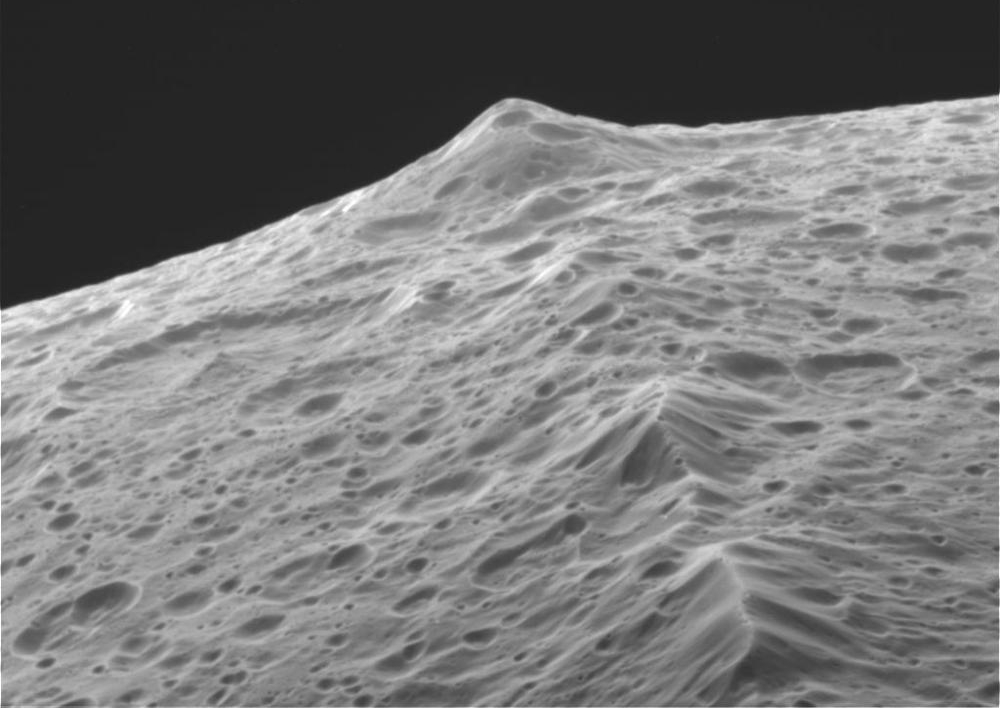
A close-up of the dark side of Saturn’s moon Iapetus
Click for original image.
Click for original image.
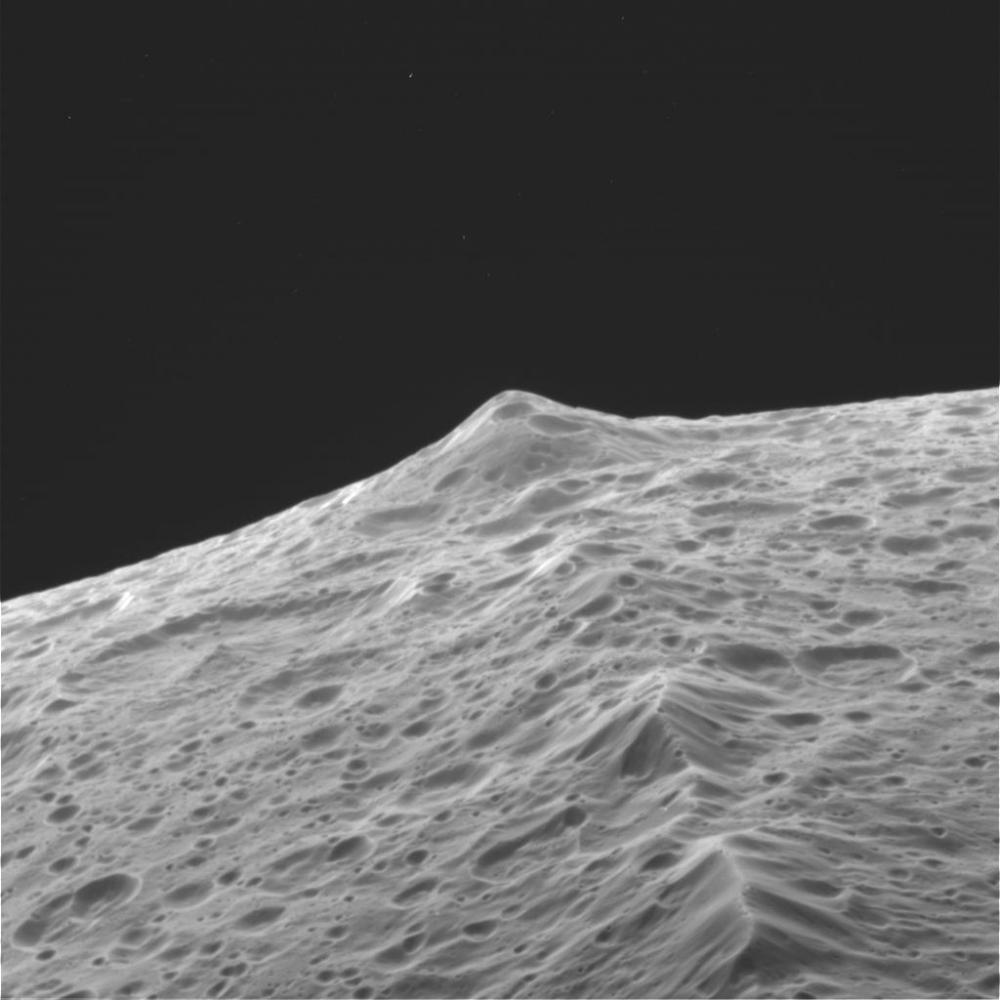
Today’s cool image is a double-header! The picture above, cropped to post here, was taken on September 10, 2007 during Cassini’s fly-by of Saturn’s moon Iapetus, taken from approximately 1,000 miles above the surface. It looks at the dark side of this two-toned planet (see yesterday’s cool image). As the moon’s rotation is tidally locked so that one side always faces Saturn, one hemisphere always leads while the other always trails. For some reason still unexplained, the leading hemisphere is covered with an almost pitch-black material, while the trailing hemisphere is bright and very white, its icy surface quite visible.
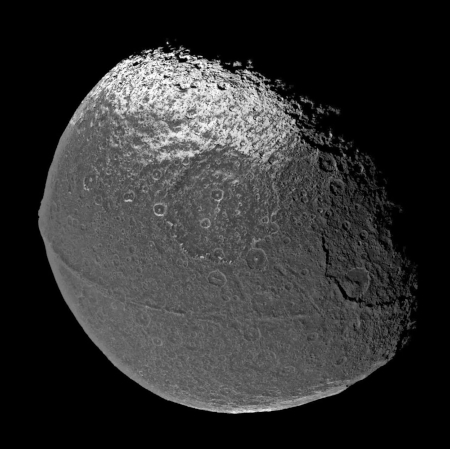
For context, to the right is a global image of that dark side taken during Cassini’s first fly-by of Iapetus on December 31, 2004. This picture highlights the long ridge that runs along the planet’s dark hemisphere’s equator that was the focus of the close-up image above. From the 2005 press release:
The most unique, and perhaps most remarkable feature discovered on Iapetus in Cassini images is a topographic ridge that coincides almost exactly with the geographic equator. The ridge is conspicuous in the picture as an approximately 12 miles band that extends from the western (left) side of the disc almost to the day/night boundary on the right. On the left horizon, the peak of the ridge reaches at least 8 miles above the surrounding terrain. Along the roughly 800-mile-length over which it can be traced in this picture, it remains almost exactly parallel to the equator within a couple of degrees. The physical origin of the ridge has yet to be explained. It is not yet clear whether the ridge is a mountain belt that has folded upward, or an extensional crack in the surface through which material from inside Iapetus erupted onto the surface and accumulated locally, forming the ridge.
Iapetus itself has a diameter of about 900 miles, so this ridge essentially crosses most of the dark hemisphere.
The 2007 press release did not provide enough information to pinpoint exactly where along that ridge the close-up is located, but no matter. Both images make very clear what we are looking at.

On Christmas Eve 1968 three Americans became the first humans to visit another world. What they did to celebrate was unexpected and profound, and will be remembered throughout all human history. Genesis: the Story of Apollo 8, Robert Zimmerman's classic history of humanity's first journey to another world, tells that story, and it is now available as both an ebook and an audiobook, both with a foreword by Valerie Anders and a new introduction by Robert Zimmerman.
The print edition can be purchased at Amazon or from any other book seller. If you want an autographed copy the price is $60 for the hardback and $45 for the paperback, plus $8 shipping for each. Go here for purchasing details. The ebook is available everywhere for $5.99 (before discount) at amazon, or direct from my ebook publisher, ebookit. If you buy it from ebookit you don't support the big tech companies and the author gets a bigger cut much sooner.
The audiobook is also available at all these vendors, and is also free with a 30-day trial membership to Audible.
"Not simply about one mission, [Genesis] is also the history of America's quest for the moon... Zimmerman has done a masterful job of tying disparate events together into a solid account of one of America's greatest human triumphs."--San Antonio Express-News
Click for original image.

Click for original image.
Today’s cool image is a double-header! The picture above, cropped to post here, was taken on September 10, 2007 during Cassini’s fly-by of Saturn’s moon Iapetus, taken from approximately 1,000 miles above the surface. It looks at the dark side of this two-toned planet (see yesterday’s cool image). As the moon’s rotation is tidally locked so that one side always faces Saturn, one hemisphere always leads while the other always trails. For some reason still unexplained, the leading hemisphere is covered with an almost pitch-black material, while the trailing hemisphere is bright and very white, its icy surface quite visible.
For context, to the right is a global image of that dark side taken during Cassini’s first fly-by of Iapetus on December 31, 2004. This picture highlights the long ridge that runs along the planet’s dark hemisphere’s equator that was the focus of the close-up image above. From the 2005 press release:
The most unique, and perhaps most remarkable feature discovered on Iapetus in Cassini images is a topographic ridge that coincides almost exactly with the geographic equator. The ridge is conspicuous in the picture as an approximately 12 miles band that extends from the western (left) side of the disc almost to the day/night boundary on the right. On the left horizon, the peak of the ridge reaches at least 8 miles above the surrounding terrain. Along the roughly 800-mile-length over which it can be traced in this picture, it remains almost exactly parallel to the equator within a couple of degrees. The physical origin of the ridge has yet to be explained. It is not yet clear whether the ridge is a mountain belt that has folded upward, or an extensional crack in the surface through which material from inside Iapetus erupted onto the surface and accumulated locally, forming the ridge.
Iapetus itself has a diameter of about 900 miles, so this ridge essentially crosses most of the dark hemisphere.
The 2007 press release did not provide enough information to pinpoint exactly where along that ridge the close-up is located, but no matter. Both images make very clear what we are looking at.
On Christmas Eve 1968 three Americans became the first humans to visit another world. What they did to celebrate was unexpected and profound, and will be remembered throughout all human history. Genesis: the Story of Apollo 8, Robert Zimmerman's classic history of humanity's first journey to another world, tells that story, and it is now available as both an ebook and an audiobook, both with a foreword by Valerie Anders and a new introduction by Robert Zimmerman.
The print edition can be purchased at Amazon or from any other book seller. If you want an autographed copy the price is $60 for the hardback and $45 for the paperback, plus $8 shipping for each. Go here for purchasing details. The ebook is available everywhere for $5.99 (before discount) at amazon, or direct from my ebook publisher, ebookit. If you buy it from ebookit you don't support the big tech companies and the author gets a bigger cut much sooner.
The audiobook is also available at all these vendors, and is also free with a 30-day trial membership to Audible.
"Not simply about one mission, [Genesis] is also the history of America's quest for the moon... Zimmerman has done a masterful job of tying disparate events together into a solid account of one of America's greatest human triumphs."--San Antonio Express-News
Iapetus has to be one of the most *unusual* moons in the Solar System. How I’d love to see a dedicated mission sent there.
Alas, it’s not even in the top two priority moons of Saturn for NASA and the Decadal right now.
Richard M,
It would be good if both orbiter and lander missions could be undertaken to at least every moon in the solar system that is large enough to have been rendered spherical by its own gravity and to do so within this century. There are apparently 19 such. Our own Moon is one of them and will be getting a lot of fresh attention in the very near future so that will be one box very thoroughly checked. But that leaves 18 other spherical moons orbiting the outer planets. One hopes the massive amount of human activity upcoming on the Moon and Mars will generate infrastructure and capabilities at least a small fraction of which can be diverted to accomplishing such missions and maintaining such presences.
That is not to say that the less regularly-shaped moons shouldn’t also get some love as funds permit. It seems inevitable, for example, that both Phobos and Deimos will be granted such attention well before the more distant spherical moons get their turns.
Looks like a walnut.
Pistachio.
Hmmm… I wonder if there’s a way to build a mass-produced planetary probe out of a Starlink satellite bus. We could seed the Solar System with probes from one Starship flight!
If the equatorial ridge is confined nearly entirely to the leading hemisphere, could the ridge be accumulated swept material? A sphere’s equator is the most forward point on a vector, and it may that the high angle-of-incidence for striking material along the equator may be enough for more of it to accumulate to a greater degree than higher latitudes.
Blair Ivey: Look at the close-up of that ridge. Does it look like an accumulation of material?
Hard to say; it’s been pretty well beaten down by impacts. I do not know what impact speeds are/were, composition of impactors, or what accumulated material might look like, given the conditions and timescale. I suggested the idea as the simplest explanation to fit the observations. This seems like something relatively easy to test. Barring evidence to the contrary; I’ll stick with it.
Blair: Though I don’t think the ridge itself in close-up looks like an accumulation of material, considering what was found with Ryugu and Bennu, a thickened equator, your hypothesis is definitely worth while.
That looks like two bodies slowly(relatively) impacted and squashed out trying to reach a spiracle shape.
Or it was a high speed impact of a smaller body and that’s just a pressure wave frozen in place.
A dark something hit a light something.