A new startup proposes a giant 88,000 satellite data center constellation
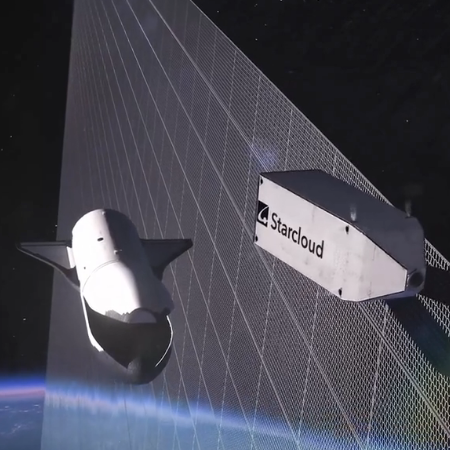
A satellite of the company’s fourth generation Starcloud
constellation being deployed
A new startup dubbed Starcloud has now filed an application with the Federal Communications Commission (FCC) to launch its own giant 88,000 satellite data center constellation.
The FCC accepted for filing March 13 an application by Starcloud, a company based in Redmond, Washington, to operate as many as 88,000 satellites in a range of low Earth orbits to serve as orbital data centers for artificial intelligence and other applications.
“Starcloud is designing its satellite system to accommodate the explosive growth of datacenter demands driven by AI, which is already encountering severe roadblocks to efforts to scale on the ground,” the company wrote in its filing. “By avoiding the constraints of terrestrial deployment, space datacenters will be the most cost-effective and scalable way to deliver compute this decade.”
The company, previously known as Lumen Orbit, has so far only launched one demonstration smallsat, testing the operation of a computer processor in orbit. It plans a second larger demo satellite to launch in ’27 testing a cluster of processors. Based on its own website, it plans to launch the full constellation in four stages, eventually using rockets comparable to Starship, launching many satellites at a time.
The reasoning behind these orbiting data center constellations is that in space there is no real estate to buy or environmental concerns to overcome. You can simply launch the satellites and beam the information to and from Earth. Though it still remains unknown whether this new orbiting data center business model will be profitable, it is definitely becoming a major customer for the new emerging American rocket industry. Even if it fails in the long run, it appears it will fuel the development of a lot of new rockets, all designed to be re-usable, with large capacities, and capable of launching at a fast cadence.
With such a commercial competitive fleet, the entire solar system will be open to the United States and the world.

On Christmas Eve 1968 three Americans became the first humans to visit another world. What they did to celebrate was unexpected and profound, and will be remembered throughout all human history. Genesis: the Story of Apollo 8, Robert Zimmerman's classic history of humanity's first journey to another world, tells that story, and it is now available as both an ebook and an audiobook, both with a foreword by Valerie Anders and a new introduction by Robert Zimmerman.
The print edition can be purchased at Amazon or from any other book seller. If you want an autographed copy the price is $60 for the hardback and $45 for the paperback, plus $8 shipping for each. Go here for purchasing details. The ebook is available everywhere for $5.99 (before discount) at amazon, or direct from my ebook publisher, ebookit. If you buy it from ebookit you don't support the big tech companies and the author gets a bigger cut much sooner.
The audiobook is also available at all these vendors, and is also free with a 30-day trial membership to Audible.
"Not simply about one mission, [Genesis] is also the history of America's quest for the moon... Zimmerman has done a masterful job of tying disparate events together into a solid account of one of America's greatest human triumphs."--San Antonio Express-News
A satellite of the company’s fourth generation Starcloud
constellation being deployed
A new startup dubbed Starcloud has now filed an application with the Federal Communications Commission (FCC) to launch its own giant 88,000 satellite data center constellation.
The FCC accepted for filing March 13 an application by Starcloud, a company based in Redmond, Washington, to operate as many as 88,000 satellites in a range of low Earth orbits to serve as orbital data centers for artificial intelligence and other applications.
“Starcloud is designing its satellite system to accommodate the explosive growth of datacenter demands driven by AI, which is already encountering severe roadblocks to efforts to scale on the ground,” the company wrote in its filing. “By avoiding the constraints of terrestrial deployment, space datacenters will be the most cost-effective and scalable way to deliver compute this decade.”
The company, previously known as Lumen Orbit, has so far only launched one demonstration smallsat, testing the operation of a computer processor in orbit. It plans a second larger demo satellite to launch in ’27 testing a cluster of processors. Based on its own website, it plans to launch the full constellation in four stages, eventually using rockets comparable to Starship, launching many satellites at a time.
The reasoning behind these orbiting data center constellations is that in space there is no real estate to buy or environmental concerns to overcome. You can simply launch the satellites and beam the information to and from Earth. Though it still remains unknown whether this new orbiting data center business model will be profitable, it is definitely becoming a major customer for the new emerging American rocket industry. Even if it fails in the long run, it appears it will fuel the development of a lot of new rockets, all designed to be re-usable, with large capacities, and capable of launching at a fast cadence.
With such a commercial competitive fleet, the entire solar system will be open to the United States and the world.
On Christmas Eve 1968 three Americans became the first humans to visit another world. What they did to celebrate was unexpected and profound, and will be remembered throughout all human history. Genesis: the Story of Apollo 8, Robert Zimmerman's classic history of humanity's first journey to another world, tells that story, and it is now available as both an ebook and an audiobook, both with a foreword by Valerie Anders and a new introduction by Robert Zimmerman.
The print edition can be purchased at Amazon or from any other book seller. If you want an autographed copy the price is $60 for the hardback and $45 for the paperback, plus $8 shipping for each. Go here for purchasing details. The ebook is available everywhere for $5.99 (before discount) at amazon, or direct from my ebook publisher, ebookit. If you buy it from ebookit you don't support the big tech companies and the author gets a bigger cut much sooner.
The audiobook is also available at all these vendors, and is also free with a 30-day trial membership to Audible.
"Not simply about one mission, [Genesis] is also the history of America's quest for the moon... Zimmerman has done a masterful job of tying disparate events together into a solid account of one of America's greatest human triumphs."--San Antonio Express-News
Back in Gerard O’Neill’s day, could anyone have imagined the prime impetus for space development would turn out to be insurmountable masses of red tape?
Starlord, Who?
Guardians of the Galaxy (2014)
https://youtu.be/N-QtJry1yII
(1:15)
The Genesis of Skynet
Terminator 2 (1991)
https://youtu.be/4DQsG3TKQ0I
(1:12)
“… or environmental concerns to overcome.”
This is unduly optimistic. The American Astronomical Society is contemplating lawsuits as we speak.
Call Me Ishmael: You note a amusing aspect of this. On the ground data centers are opposed because of their large real estate footprint, their high energy use, their high water use (for cooling), and their possible environmental impact. In space the astronomers are whining because their ground-based telescopes will not only have to look through a fuzzy atmosphere, they will now have satellites in their images.
The first group has valid concerns. The latter are a bunch of elitists who want to shut down all progress so they won’t be inconvenienced. And meanwhile that latter group has a much better option, putting their telescopes in space where viewing is perfect, but they are too hidebound or stupid to do it.
It’s really cold up there but there is no mass to transfer the heat to. I’ve seen some breakdowns of what it would take to cool a large data center and it appears to me to be insurmountable.
On another note…What will these data centers produce?
What is the maximum number of LEO satellites that the earth can support?
Jerry Greenwood: hmm? Data centers in orbit will have radiators to get rid of the heat. Look up Mach33 for some evaluations on what temperatures hardware will operate at to minimize radiator size. Why does heat transfer seem insurmountable? It’s certainly possible in principle to build solar arrays multiple miles in area, and the necessary radiators will be a fraction of that size.
Anything that data centers do now, though Starcloud’s early efforts revolve around AI.
This may help the powersat cause, in that it really needs to come first.
Solar Thermal powersats needed big radiators…so will this.
How many data centers, each with 10’s of thousands of sats, are actually needed?
We don’t need that many AI data centers in space. And who is going to pay for it and how?
Musk offers internet and phone service with an AI center thrown in free. And can launch his own sats for basically fuel costs.
who is going to pay for it and how?
It’s the 1990s all over again: We lose money on each customer, but we’ll make it up in volume! On the bright side, they laid a lot of fiber that we’re still using.
I find it very strange that people make the same mistakes over and over again – within a single generation. Another example: OMG! Interest rates are going up! Uh, yeah, just as they did in the 1980s – most of the people in charge were alive then.
What is the maximum number of LEO satellites that the earth can support?
Lots and lots. Keep in mind that orbit is three dimensional and vast. “The term LEO region is used for the area of space below an altitude of 2,000 km”. For convenience, let’s put the bottom at 1,000km and round Earth’s diameter to 13,000km. That’s a sphere with 15,000km diameter less a sphere of 13,000km worth of volume (4/3pi(7500^3)-4/3pi(6500^3)). That’s well over 600 billion cubic kilometers.
Granted that everything is moving and you don’t want to pack things too tightly, but 600 billion cubic kilometers a LOT of room.
Patrick Underwood asked: “Back in Gerard O’Neill’s day, could anyone have imagined the prime impetus for space development would turn out to be insurmountable masses of red tape?”
Yes. Red tape is not a new concept or impediment, and the U.S. government had already set in place some discouragements for the use of private commercial rockets and private commercial spacecraft (manned and robotic).
___________
Jerry Greenwood noted: “It’s really cold up there but there is no mass to transfer the heat to. I’ve seen some breakdowns of what it would take to cool a large data center and it appears to me to be insurmountable.”
The way we do radiative cooling now, in orbit, would take quite a bit of area for each square meter of solar cells (AKA photovoltaics). a good indicator is that area of cooling panels used on the ISS vs. the area of the solar arrays. However, some creativity may be able to give us a better ratio.
“On another note…What will these data centers produce?”
They would be doing the AI processing that ground-based data centers do today. There have been previous proposals to place data storage in Earth orbit, especially data that is not referenced often or does not mind a time lag for retrieval. The concept is not new, but the product is.
__________
Kevin asked: “What is the maximum number of LEO satellites that the earth can support?”
Generally, we have been assigning orbital shells to various constellations in circular orbits separated by about 10 km. This gives plenty of space for some error in the actual altitude of each satellite. In theory, we could assign such shells in low Earth orbit from around 200 km, or so, up to the lower boundary of the Van Allen belts, around 2,000 km or so, and we have seen that thousands of satellites can fit nicely within each of these shells. Above that is generally called medium Earth orbit (MEO), and includes the region of the Van Allen belts, where satellites would be subject to high doses of radiation, so flying through these belts is recommended for only a limited time or for a limited number of passes through the region.
Because the Van Allen belts dive down into the atmosphere near the poles (bringing us auroras on nights with high solar activity) additional polar “shells” can reach much higher, even to the altitude that is considered the top of the Van Allen belts, because polar orbits are generally outside of (“above”) these belts.
A hundred or so shells with thousands of satellites means that LEO can support a whole lotta satellites. If we include MEO, then we can put millions upon millions of satellites in orbit until we reach geostationary orbit (GEO). I would skip the next few hundred kilometers, because there is a graveyard orbit (region, really) a couple of hundred km above GEO. Additional shells could be utilized in high Earth orbit (above GEO, but not to be confused with HEO, highly elliptical orbit) going all the way up until reaching orbits a few tens of kilometers from the Moon, whose gravitational pull would ruin the nice pattern of the shells.
Of course, what to do with satellites that high at their end of life is a serious question, but theoretically we can put a bazillion satellites around the Earth. However, navigating through all those shells of satellites from the Earth to the Moon, or beyond, could be challenging.
__________
pzatchok asked: “We don’t need that many AI data centers in space. And who is going to pay for it and how?”
AI is becoming very popular, so we may need — or want — them soon. They would be funded by the companies that think they can make money by selling the AI output, and those companies can find investors that want in on the ground floor. Considering the popularity of earthbound centers, it seems like they may be able to make enough money to more than pay for themselves. This industry has already made several billionaires, and it seems to be similar in potential to the early railroad industry, wildly successful in profits as well as services rendered, expanding humanity in ways not previously imagined. Or it could be the modern Edsel or dot-com boom right before the dot-com bust.*
If you don’t want to support AI, then I recommend not using AI. I am not convinced that it is right for everyone, and I have not yet begun to use it.
___________
* For those not old enough to remember, the dot-com bust didn’t just result in the demise of online retailers but also hurt the manufacturers of internet hardware, who suddenly had too much hardware and not enough customers, and there was too much used hardware for sale at “fire-sale” prices, wreaking havoc across the whole industry. If AI does not prosper as expected, there will be plenty of havoc among internet and computer companies as well as satellite manufacturers and space launch companies.
Nate P
Perhaps insurmountable was the wrong word.
A data center running 100,000 GPUs, each of which is producing 1000 watts produces 100,000,000 watts of heat. 300,000 sq. meters of radiator surface area would be needed to cool a data center of that size based on the current cooling capacity of the ISS (14,000 watts across 42 sq meters.
Deploying 300,000 square meters of radiator to orbit isn’t insurmountable, but it might nearly be. The economics don’t add up.
Better to put them on the floor of the ocean for cooling and power them with a nuclear reactor. Cheaper too.
All in all it doesn’t matter. Nothing will ever come of this.
Jerry Greenwood,
The solar flux at the distance of Earth’ orbit is 1,361 watts/sq. meter. Assuming 20% conversion efficiency for the solar arrays feeding juice to the AI chips – they aren’t exactly “GPUs” anymore – it would take about four sq. meters of solar cells to feed a kilowatt to an AI chip. For a notional 100,000 AI chip data center, that’s 400,000 sq. meters of solar cells. That’s 1/3 more surface area than required for radiators according to your numbers. Just put the radiators on the backs of the solar arrays. The solar arrays would be oriented to receive continuous sunlight so the radiators would be automatically oriented away from the sun and shaded from it.
Whether anything “will ever come of this” very much remains to be seen. The early returns should be in within five years so we won’t have all that long to wait to find out. Personally, I suspect a great deal will come of this.
PVs would be vulnerable to solar flares–as would the servers themselves.
This is why I suggested solar thermal powersat construction in terms of commonality.
A wide solar reflector can still work with meteor holes–PVs cannot. Both servers and powersats need radiators, and there are self-healing materials on the way
Fluidic computers or all-optical computing need looking at in that they should be rather more insensitive to solar activity…indeed light handing may allow these structures to also perhaps beam light to spacecraft like sails.
Instead of different designs for different things–it might be cheaper to design systems with light-handling as the…focus.
Otherwise:
“We celebrate the completion of the first orbital server-”
…screens go black as Carrington II turns everything to junk…
Dick–
What do you think of the contention with AI, that the same $5 billion dollars is just being daisy-chained back and forth between a small universe of companies?
————–
I recently watched someone quiz Grok about distances between cities on Earth, it quickly became obvious that there was no comprehension that the Earth was round. It took a highly detailed question before it inquired which direction you were travelling.
————-
Wrath of Khan (1982)
“His Pattern Indicates 2-Dimensional Thinking”
https://youtu.be/RbTUTNenvCY
(0:40)
Jerry Greenwood: the ISS isn’t really a good example of a spacecraft specifically designed around radiating lots of heat. Keep in mind that large multi-square mile satellites similarly are not the first product on the roadmap-far more modest structures are. Starcloud has already sent a small-scale satellite to orbit, and the next two generations, while rather larger, look to be in the kilowatts and megawatts, rather than gigawatts. High-temperature compute (capable of operating continuously at about 370K) minimizes radiator mass.
It appears what you’re thinking is uneconomical are launch costs for later-generation data centers. To get to that point Starcloud and other data center designers will have to prove smaller-scale satellites are profitable, and SpaceX has to demonstrate that they can fly Starship often and at low cost. Is it economical now? No. What will it be in five or ten years, when something like Starcloud-4 might be built? We cannot say, only make projections.
As for putting data centers at the bottom of the ocean, as I recall Microsoft looked into that and abandoned the idea. Salt water is harsh on our ships; it’s worse if you’re submerging everything; it gets worse if you’re powering it with nuclear energy, given nuclear’s present high costs and slow construction timelines. Plus you’re going to face opposition for releasing so much heat into the ocean. If we insist on using the sea, it seems more sensible to use OTEC to supply cold water and power, and place data centers on structures more akin to oil rigs. You’re still stuck with maintenance costs from the environment, but it’s less drastic than putting your hardware underwater.
Jeff Wright: self-healing silicon solar cells are already under development, and typical solar flares aren’t that dangerous-data centers will have radiation hardening just as Starlink does. A CME is a bigger problem, but it would have to be a massive one to be very harmful, and those are rare. Your suggestions re: computing are impractical and won’t be implemented any time soon. Nor would mirrors be a great idea for data centers that already need to reject plenty of heat.
wayne: data centers and AI aren’t one-to-one, the former support many other functions.
I could see using a heat exchanger under the cold waters of North America. Just two simple water pipes that could run miles inland and miles out to sea.
That way the data center could be hooked to the grid and easily fixed or upgraded.
As for power just build a new Nuclear plant hooked to the grid.
As a recent job move has me right in the middle of the data center universe at its highest level. It takes an almost superhuman effort to build and support a site on terra firma.
I can’t imagine the effort it would take to build and support one in orbit. Let’s not forget if a chunk of space junk collided with it…..catastrophic result.
No NIMBYs up there.
Even in Red States no one wants Big Data for a neighbor. Yet they post pictures of wedding photos on the cloud.
Nate is entirely correct in wanting to keep electronics as far from salt water as possible.
I want optical computing in that radiation will affect it much less.
wayne,
I don’t think much of it. I have no idea how that is even suppose to work, whatever “work” would mean. I suspect those flogging this silly idea could not provide an explanation of how this alleged scam is supposed to work either. Being a conspiracy theorist means never having to show your work.
I do think the demand for conspiracy theories regularly exceeds the supply these days giving rise to a cottage industry that creates new ones on a regular basis. Most of these seem to arise in the fever swamps of the political left. If it is one’s core belief that capitalism is a giant scam run by a handful of “oligarchs,” then the possibilities for invented conspiracies are nearly limitless. The analogy, I guess, would be to the ever-growing number of epicycles Ptolemaic astronomers had to keep adding to maintain the fiction that orbits are all circular. There’s also an analogy to the seemingly never-ending layers of invisible “thetans” that Scientologists keep inventing that adherents of their scam-tastic “religion” are required to pay them to remove.
It’s been at least two generations since the left-dominated US educational establishment quit even pretending to teach critical thinking. Doing so would be directly contrary to their project of indoctrinating the population with leftist ideas – most of which are also, at the end of the day, conspiracy theories that do not withstand even casual scrutiny. Thus we live in a time where far too many people have been trained to believe 12 impossible things before breakfast because it serves the agenda of actual conspiracists. If you believe 12, it’s not much of a stretch to believe 13. Lather, rinse, repeat.
Dark magic is once more loose in the world – or so certain people would have you think anyway.
Mike,
How big a mess a debris strike would cause would depend mainly on how big the piece of debris is. That would appear to provide a considerable incentive to SpaceX, Starcloud and any other company contemplating the placement of giant AI data center satellites in Earth orbit to police up at least the trackable bits of space flotsam, starting with the largest. Strikes by small debris objects should be survivable if the data center sats are suitably designed.
In any case, these sats will be on a regular replacement schedule just as is the case with LEO broadband Internet and mobile device connectivity sats. During a reasonable service life, the amount of “battle damage” sustained should be tolerable. And then a new replacement sat will reset the damage meter to zero.
Jeff Wright,
We seem likely to get optical computing by and by. Microelectronics of the conventional type will do until then.
The potentially catastrophic consequences of another Carrington-class event need to be weighed against the quite infrequent nature of such events – at least along any particular vector. It has, after all, been nearly two centuries since the original Carrington Event. That’s plenty long enough for 10 or more generations of AI data center sats to do their thing untroubled by giant coronal mass ejections.
It’s also worth considering that such sats in Earth orbit will be only a small fraction of the total of such sats in service by mid-century if Elon has his intended way with the Moon. The AI data center sats of lunar origin will be deployed into a considerably more expansive volume of space than that represented by Earth orbit. Thus, even another Carrington Event is unlikely to take out more than a modest fraction of the total population of such sats even as soon as the end of the current century. Carrington Events are not omni-directional.
Dick–
thank you.
Space News is reporting that Blue Origin is getting in on the space server act, and Scott Manley has a video on cooling needs.
The reason I like solar thermal is it’s resilience against many problems….impacts radiation.
The solar powesat part can be separate from the server part, so as to act as a solar thermal tug.
Multi-use infrastructure is to be pushed…and with oil production facilities under the gun–now would be a great time to push for space solar power.
Why?
Because Hormuz is more reachable by Iran than LEO is with their space center gone.
Who would have thought that one of the better loved Republican presidents made a name for himself by wiping out oil infrastructure while killing religious fundamentalists.
You’d think MS Now would be cheering.
Toodles,
Jeff Wright: using solar thermal doesn’t make sense for data centers. You’d end up dumping more off the mass budget for radiators into cooling your power systems versus cooling your compute, which reduces profitability. There’s no reason to separate the power systems from the compute as you suggest, because that adds complexity to the design. There are already companies developing tugs, data center operators, if they need their services, can buy those instead of reinventing the wheel.
Other companies are already developing solar power satellites. The US is independent of foreign oil and natural gas thanks to the fracking boom, and will be so for decades to come, so we have time. Should swarms of data centers in orbit be a viable business, building, maintaining, and upgrading them will result in the development of a wide range of inexpensive fully reusable vehicles, which in turn will enable formerly-marginal use cases to become practical. There is no need for a specific push for space solar.
Jerry Greenwood,
You wrote: “A data center running 100,000 GPUs, each of which is producing 1000 watts produces 100,000,000 watts of heat. 300,000 sq. meters of radiator surface area would be needed to cool a data center of that size based on the current cooling capacity of the ISS (14,000 watts across 42 sq meters. Deploying 300,000 square meters of radiator to orbit isn’t insurmountable, but it might nearly be. The economics don’t add up.”
If you assume a difficult and uneconomical satellite, then you can easily make it sound difficult and uneconomical. Engineers work differently than that. They may prefer a design that is uneconomical, but then they iterate to something that they can make work profitably. The largest trade-offs and compromises happen in this phase.
Every design starts as an ideal dream, but as the reality takes hold, the size, power, weight, materials, interfaces, and many other factors require the engineer to make compromises. “Reality betrays us all.” — Benjamin Hoffman, in the movie Hoffman
Building a 100 megawatt satellite is unlikely, even with Starship’s help. This may be why SpaceX has proposed a million-satellite constellation for its datacenter idea. Instead of putting one earthbound datacenter into a single satellite, it can be spread out among several satellites. Each satellite is more manageable, and the loss of a single satellite does not hurt as much.
I don’t worry about the heat dissipation, much, because we have been keeping high-power communication satellites cool enough for six decades. We know something about how to do it, but we will have to scale up the methods. We may even have to invent better radiators, such that the cooling fluids are at higher temperatures than we use today. That would allow us to reduce the size of the radiators, but it would complicate the method and mechanisms.
A final note on the topic of power and heat management: The size of the solar arrays has a practical upper limit. Too large and they become difficult to handle. Satellites must make occasional station keeping and attitude adjustments, and large solar arrays would flex in ways that would complicate these maneuvers. We may imagine vastly large power collectors, but the reality is that there is an upper limit to the power a given satellite can collect.
“All in all it doesn’t matter. Nothing will ever come of this.”
I’m not so sure. AI may be a fad, as was the dot-com boom, but I’m pretty sure that some form of what we call AI will be around for as long as computers are around. Even though our tools have become very sophisticated, we still use many of the original tools in similar ways as our ancient ancestors.
Edward:
My understanding is that once we can assemble structures on orbit, we can address flexing and forces applied through the design itself, distributing loads, and using either active or passive stabilization as necessary, all the way up to gigawatt scale. Not that flexing can be ignored, but it can at least be handled.
The larger the structure the greater the flexion. The ISS may look nice and solid, but it flexes, even at that small size, relative to the suggested size of the solar arrays. When it comes to vibration, everything is a spring. However, as long as the datacenter, or other large satellite, does not need extremely precise pointing accuracy, unlike the Hubble Space Telescope, then the flexion of solar arrays the size used on the ISS is probably acceptable. Maybe even larger.
To counter vibration and the flexing of large solar arrays, more mass (weight) could have to be added to the system for stiffness, and complicated damping methods may have to be employed, adding even more mass. At some point active or passive stabilization becomes cumbersome and maybe even counterproductive, reaching a point of diminishing returns. Keep in mind that large, tall buildings on Earth flex in the breeze, despite their seemingly rigid structure. Even they are springs.
For large structures, gravity gradients are another factor that causes instability. Or stability; if the spacecraft (satellite, datacenter, whatever) has distributed masses, then those masses would trend toward pointing along the gradient (e.g. toward the Earth). A spherical satellite may help, but keep in mind that even the Moon keeps one face toward the Earth due to the gravity gradient. The Moon is fairly stable, that way.
So, despite Scott Manley making it sound simple ( https://www.youtube.com/watch?v=FlQYU3m1e80 25 minutes), or at least simpler than the reality, we should be able to design a constellation of satellites with fairly large solar arrays. The maximum size before we reach diminishing returns has yet to be determined. Even then, some engineer may continue figuring out ways to make even larger arrays before reaching diminishing returns.
Edward:
Using phased arrays for power beaming (as Starlink does for data) means flexing is of little import. I don’t see any hard obstacles with structures miles in diameter (or on a side); it’s an engineering challenge versus an engineering impossibility. Something like the SPS-ALPHA Mark IV should be able to tolerate tens of yards of flex, versus the typical yard or two the ISS’s solar panels..
How does the cooling system work on space craft and satellites.
pzatchok,
Nice question. Can be a complicated question. (Please note that I will use “satellite” and “spacecraft” interchangeably, although I believe that your use of the word “spacecraft” means a manned vehicle. In my engineering lingo, an unmanned satellite is also a spacecraft.)
As everyone knows, there are three heat transfer methods: 1) conduction, where the heat travels through solid material, 2) convection, where heat transfers to a gas and is drawn away by the flow of the gas, 3) radiation, where energetic electromagnetic waves (e.g. infrared light) carry away the heat, and 4) evaporation.
I don’t know anyone in the thermal world who acknowledges that fourth one, but I do, and I mention it here, because Apollo used it.
I will start with the fourth method, because it is the one most likely to start arguments. Apollo had an evaporator as one of its cooling methods, where excess water (generated from the fuel cells) would evaporate into space, carrying heat away with it. As you may already know from your thermal transfer class in college (yeah, I didn’t stay awake, either), when water evaporates, such as from a pool, lake, ocean or the perspiration on your skin, the water that remains behind cools a bit, because the heat of vaporization (remember than from class? Unfortunately, I do) requires energy to come from somewhere, and that somewhere is the other water molecules, so the water left behind cools down and makes your skin a little cooler as the heat in your skin reheats the perspiration.
The same worked for Apollo. Heat was carried away by the water that evaporated into the dry vacuum of space.
Apollo also had some radiative cooling panels, as do pretty much all spacecraft.
I worked on some geostationary communication satellites that dissipated heat radiatively (no water supply) but some of the heat was transported in an interesting way. These satellites had traveling wave tube amplifiers (TWTA, pronounced “tweeta,” not to be confused with twitter or tweet), which generate a lot of heat. They created a 100 watt (or so) signal to send back to Earth, but their efficiencies were not so good, which meant that hundreds of watts of heat had to be radiated into space. They were mounted to the inside of a radiator panel (north-side panel or south-side panel of the satellite), but since the radiative capacity of the mounting footprint could not handle all the heat, the panels also included heat pipes to transfer heat to other parts of the panel that did not have TWTAs or other electronics. This allowed the whole panel to act as a radiator.
You don’t know about heat pipes? I didn’t, either, until I worked on those satellites. The heat pipe has ammonia inside it, which evaporates at the end with the hot TWTA (there’s that evaporative cooling, again), and the gas spreads throughout the tube and travels to the cooler regions of the pipe where it condenses (anti-evaporative heat transfer) and travels as a liquid, via capillary action, back to the hot end. There are small, thin vanes machined into the pipe’s interior wall to create the capillaries. One of the beauties of this kind of heat transfer is that it is passive, requiring no additional energy inputs, as pumps would do.
Of course, the TWTA transferred heat to the heat pipe via conduction, so there can be some conductive cooling in space, just not conductive cooling into space and away from the spacecraft. TWTAs tend to have their own radiators, too, but they are not large enough to handle all the excess heat that they generate.
The ISS pumps heat-laden fluids through its radiators in order to cool the station. Active cooling systems, like this, need to be well managed to make sure that liquid coolants do not freeze in the pipes, as this can be troublesome to thaw and restart the cooling system.
I hope that was a good start for understanding cooling systems on spacecraft. Thermal control is a complex topic that also involves thermal blankets (also called multi-layer insulation) and surface materials or treatments that are critical for maintaining the proper temperature in space.
One place where I worked received a new part of the spacecraft that had an extension to the bright and shiny radiative surface that was already on the spacecraft, and we noticed that the new “mirror” surface was much shinier and clearer than the current one. We realized that we had a contamination problem and that the old, current surface was fuzzy because of volatile materials condensing onto the surface. They assigned me to write the cleaning procedure for that surface, and what a tedious process it was to slowly clean and verify the surface one small area at a time. There is a lesson here, and I learned the wrong one: It is sometimes better to write the tedious procedure than to execute it. The right lesson was something about keeping your room clean so that it is a quick job weekly rather than a huge job every spring, or maybe it had to do with keeping condensible volatiles out of the cleanroom, or something.
Speaking of thermal control, if you are interested, the Everyday Astronaut once made a deep dive into how they keep booster engines from melting: https://www.youtube.com/watch?v=he_BL6Q5u1Y (½ hour)