A nice summary of all space-based research of reproduction in space
Click for original.
Link here to the press release. The paper itself can be read here.
The paper is an excellent summary of practically all the research that has been done in space and on the ground studying the impact of the harsh environment of space on reproduction. It notes above all that we really know very little despite this research, because the risks to the newborn have precluded direct study. From the paper’s abstract:
Despite over 65 years of human spaceflight activities, little is known of the impact of the space environment on the human reproductive systems during long-duration missions. Extended time in space poses potential hazards to the reproductive function of female and male astronauts, including exposure to cosmic radiation, altered gravity, psychological and physical stress, and disruption to circadian rhythm.
This review encapsulates current understanding of the effects of spaceflight on reproductive physiology, incorporating findings from animal studies, a recent experiment on sperm motility, and omics-based insights from astronaut physiology. Female reproductive systems appear to be especially vulnerable, with implications for oogenesis and embryonic development in microgravity. Male reproductive function reveals compromised DNA integrity, even when motility appears to be preserved. This review examines the limited embryogenesis studies in space, which show frequent abnormal cell division and impaired development in rodents.
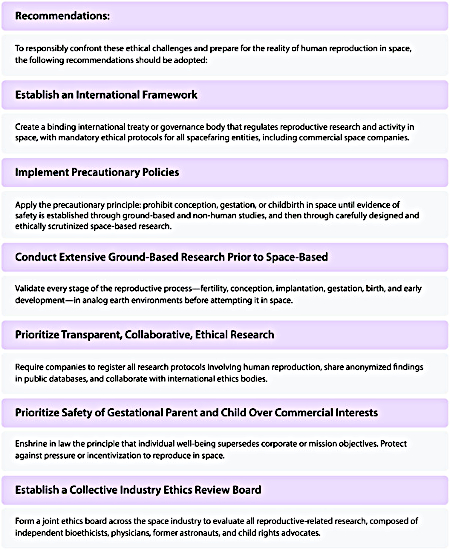
In the paper’s conclusion, these academics sadly revert to type, and propose the establishment of an international regulatory framework for controlling this issue, as shown in the graphic to the right. This is empty foolishness, because such regulations will only do more harm than good, stifling research while failing to accomplish anything.

On Christmas Eve 1968 three Americans became the first humans to visit another world. What they did to celebrate was unexpected and profound, and will be remembered throughout all human history. Genesis: the Story of Apollo 8, Robert Zimmerman's classic history of humanity's first journey to another world, tells that story, and it is now available as both an ebook and an audiobook, both with a foreword by Valerie Anders and a new introduction by Robert Zimmerman.
The print edition can be purchased at Amazon or from any other book seller. If you want an autographed copy the price is $60 for the hardback and $45 for the paperback, plus $8 shipping for each. Go here for purchasing details. The ebook is available everywhere for $5.99 (before discount) at amazon, or direct from my ebook publisher, ebookit. If you buy it from ebookit you don't support the big tech companies and the author gets a bigger cut much sooner.
The audiobook is also available at all these vendors, and is also free with a 30-day trial membership to Audible.
"Not simply about one mission, [Genesis] is also the history of America's quest for the moon... Zimmerman has done a masterful job of tying disparate events together into a solid account of one of America's greatest human triumphs."--San Antonio Express-News

Click for original.
Link here to the press release. The paper itself can be read here.
The paper is an excellent summary of practically all the research that has been done in space and on the ground studying the impact of the harsh environment of space on reproduction. It notes above all that we really know very little despite this research, because the risks to the newborn have precluded direct study. From the paper’s abstract:
Despite over 65 years of human spaceflight activities, little is known of the impact of the space environment on the human reproductive systems during long-duration missions. Extended time in space poses potential hazards to the reproductive function of female and male astronauts, including exposure to cosmic radiation, altered gravity, psychological and physical stress, and disruption to circadian rhythm.
This review encapsulates current understanding of the effects of spaceflight on reproductive physiology, incorporating findings from animal studies, a recent experiment on sperm motility, and omics-based insights from astronaut physiology. Female reproductive systems appear to be especially vulnerable, with implications for oogenesis and embryonic development in microgravity. Male reproductive function reveals compromised DNA integrity, even when motility appears to be preserved. This review examines the limited embryogenesis studies in space, which show frequent abnormal cell division and impaired development in rodents.
In the paper’s conclusion, these academics sadly revert to type, and propose the establishment of an international regulatory framework for controlling this issue, as shown in the graphic to the right. This is empty foolishness, because such regulations will only do more harm than good, stifling research while failing to accomplish anything.
On Christmas Eve 1968 three Americans became the first humans to visit another world. What they did to celebrate was unexpected and profound, and will be remembered throughout all human history. Genesis: the Story of Apollo 8, Robert Zimmerman's classic history of humanity's first journey to another world, tells that story, and it is now available as both an ebook and an audiobook, both with a foreword by Valerie Anders and a new introduction by Robert Zimmerman.
The print edition can be purchased at Amazon or from any other book seller. If you want an autographed copy the price is $60 for the hardback and $45 for the paperback, plus $8 shipping for each. Go here for purchasing details. The ebook is available everywhere for $5.99 (before discount) at amazon, or direct from my ebook publisher, ebookit. If you buy it from ebookit you don't support the big tech companies and the author gets a bigger cut much sooner.
The audiobook is also available at all these vendors, and is also free with a 30-day trial membership to Audible.
"Not simply about one mission, [Genesis] is also the history of America's quest for the moon... Zimmerman has done a masterful job of tying disparate events together into a solid account of one of America's greatest human triumphs."--San Antonio Express-News
Things I note from a brief read through of the paper (Note: I am Not a Doctor nor do I play one on TV)
1) there are several points where they bring up the fact that women (i.e. people with actual functioning uteri and Ovaries for those unclear on the term) are far more likely to be affected and their careers limited by saftey measures. This seems obvious even to a non medical person like myself, as women carry their full egg supply from birth (actually before) making them FAR more prone to teratagenetic damage to the eggs and general damage to their fertility. This is a clear case where the fact that women are not men matters. And yet these authors seem to be vaguely offended by biological reality.
2) The researchers seem put out/offended that COMMERCIAL groups will start accessing space where the people will NOT be as strongly vetted (and observed) as the current Astronaut/Cosmonaut/Taikonaut corps. Were folks worrying about people using aircraft in the 20’s and 30’s this way? OF COURSE more folks will go into space. Are these people so cloistered as to not understand this is the way humanity has acted for the last 50 thousand + years
3) Microgravity has A LOT of likely issues around fertility and conception, and probably fetal development and delivery. This combined with higher than background radiation in LEO (and far higher in travel outside the Van Allen Belts) presents real issues. Limited animal models exist outside the Van Allen. This seems a point where the weird Circum Lunar space station could actually serve a purpose.
4) Pretty much we have NO data on low gravity (i.e. Lunar or Martian levels) as no one was taking mice (or any experimental animals) to the moon. This seems like a likely starting point for lunar bases starting with mice and moving into potential food animals (goats, small sheep?, Cavies and Rabitts?). Beats me how good a model any of those are for human reproduction, but if we can’t raise animals food production just got MUCH more difficult and long term stays become problematic and colonization somewhere between impractical and impossible.
To say their recommendations were timid is an understatement. The authors really don’t understand human nature at all. Their recommendations feel like they’re sticking their fingers in their ears shouting “La La LA, I don’t hear/see you.” If it becomes possible for folks to go somewhere long term (and the Moon and Mars seem at least possible if not probable to fit that bill) they will. Look at Antarctica. The only reason there isn’t motion there is the fact that really there is nothing of commercial value , the Arctic with many valuable resources has been exploited. On top of that one can almost guarantee there are folks trying to get into the above the Karman line club. Probably the only thing that has prevented it is a fair bit of self control combined with the fact that privacy on the ISS/Shuttle/Dragon Capsule/Soyuz is rather limited. I haven’t included Shezhou as I don’t think the Chinese have yet sent mixed sex crews. I think folks were trying to book time on the Virgin Galactic/New Shepard for filming purposes but have so far been turned down (as far as anyone knows).
Where Humans go sex almost inevitably follows; where male/female sex happens, conception sooner or later follows.
Is this related to the pregnancy of the astronaut who returned on January 14th?
wayne: We have no idea whether a pregnancy caused the premature return from ISS. In fact, the facts suggest it wasn’t a pregnancy at all, but a heart issue. The problem arose too suddenly, canceling a spacewalk as they were getting into their spacesuits, to be a pregnancy.
@Tregonsee314,
I find it unlikely that no experimentation has occurred in the decades of healthy people in space. People that really want to will find a way. Not claiming any particular couple, just noticing that with hundreds of opportunities over 40 years or so, there is likely some data we don’t have access to. Not pregnancy, but recreational I would expect.
Now when (as you mention) free people are going without the current restraints, there will be data on the activities not discussed or sanctioned now.
Tregonsee314,
At least a modest degree of megalomania seems near universal among physicians. I’ve had to push back against that on numerous occasions over the years.
As with all previous human exploratory endeavors, interested couples will soon enough conduct their own experiments in applied human biology off-Earth. The majority of such spacefarers over the next few decades are likely to be blue-collar hardhat types and their ladies. Enough said.
We already know zero-G is not a good thing for humans, long-term, so future concentrations of humanity off-Earth will be on planetary surfaces and in rotating habs of steadily increasing size.
The question of food animals will likely be solved mainly with chickens and catfish. Both can be raised in tight quarters and both are already well-optimized for edible yield per pound. Plants of many types, of course, will be comparatively easy to raise and plant material inedible by humans can be ground up, along with inedible parts of the chickens and fish and used as part of the feed for more chickens and fish. The chicken and fish rations can also be extended by tossing in the occasional Norwegian rat – it being an inevitability that these pests will find ways to get themselves off-planet nearly as soon as we do.
Goats, sheep and even rabbits are less efficient converters of feed to food than chickens and fish. Cavies, of course, will be off the menu entirely as they are 40-oz. people. There will be cavies – and cats and small breeds of dog – in space at some point, but as companion animals as they are here on Earth, not as food animals.
While it has been true for eternity in the past, it won’t be true in the future that women (necessarily) come equipped with their full, lifetime complement of eggs at birth (not to speak of the aging process for eggs [and sperm] during their life). The technology of converting normal human body cells into “pluripotent” stem cells and thence into eggs (and sperm), after about a decade, is now well along in research and development.
Not only does this produce new, young (not aged!) eggs and sperm, but the results can be checked prior to conception to ensure that mutations that have occurred in progenitor cells during the host person’s lifetime aren’t carried into the set. (Note that due to genetic limitations in the host’s genome, women would be able to make X eggs, as well as X (and only X) sperm [!], for themselves; whereas men, contrariwise, could produce both X and Y sperm, together with X eggs [Y-only eggs aren’t viable]. Thus, 2 women’s genes could only make a girl baby; whereas 2 men’s genes—in conjunction with an artificial uterus, or implantation in a female—could produce any sex baby.)
Whether this capability be good or bad—no doubt both would be true, as in so many things—I don’t judge; but the technology is soon to be available regardless. No doubt there’s an application for it in the settlement of space.
The advent of “Outercourse” (hat tip to my high school science teacher who coined the term 50 some years ago) is inevitable. Hasn’t someone bred some mice or rats in space yet to at least get some initial data on pregnancy in zero G?
To Mr. Eagleson,
I learned to loathe doctors long before COVID.–which set the cause of patients rights back 50 years.
The day my Dad was put in the ground, one doctor called with MRI results that showed he had tumors in his spine which spread.
He had complained about back pain for years and was ignored.
This is why I think everything should be over-the-counter.
Doctors are ghouls who want people to hurt.
Mr. Eagleson as you note Doctors (even research ones) often have very high opinions of themselves.
And yes Fish (catfish or maybe tilapia) raised in your hydroponics seems like a good idea, chickens also would be good. Not sure if ANY of this works in microgravity, but in Mars/Moon low G it might work (I do wonder about Gill transfer of 02 in low G, probably needs to be tried out)
As for Cavies/Guinea pigs, I think you will need to discuss that with Peruvians. Cuy (aka Cavy) is one of their traditional dishes and is popular in many surrounding countries. Similarly there are folks that use rabbits as food; that is a little more common in the US. Only reason I knew about Cuy was signs at the local 4H display at the Topsfield Fair. I leaned towards Goats and sheep more because perhaps their reproductive process is closer to that of Homo Sapiens, AND they have quick generations and are way easier to handle than say Rhesus or chimps.
Michael McNeil,
Compared to many of the genetic modifications likely to be made to the baseline human genome – both here on Earth and off-world – over the next couple of centuries, the fiddling with human reproductive cell ontology you describe would probably be considered pretty small beer.
Jeff Wright,
I hear ya, bro.
There were at least a half-dozen future doctors in my high-school graduating class and I stood academically above all of them at graduation. That, among other things, has rendered me immune for life to the doctor-as-God delusion too damned many people witlessly entertain.
Of course, I’m also plenty old enough to remember when house calls were still a routine part of medical practice. The only people who get that courtesy these days are the very wealthy who buy expensive concierge medical service. Doctors are now almost entirely assembly line workers and the parts always have to come to the factory. Of course, those “parts” spend entirely too much time rubbing up against one another in waiting rooms with predictable results. Even if you are going in for routine “examination” and not because you have some actual pathology, you are fairly likely to emerge with one anyway. As I sit here writing this I am just past the worst of quite a nasty cold I caught from my wife, who almost certainly picked it up at the office of a doctor we had to visit for a “consultation” about some blood work she recently had done. The whole thing could have been done over the phone but I suspect the practice gets paid a lot more by the insurer for an in-person visit than a phone call – one more way the insurers are also making us sicker.
You are entirely correct that a lot more pharmaceuticals should be over-the-counter. Prescriptions should be reserved only for strongly-habit-forming stuff, stuff that has a more-than-once-in-a-blue-moon likelihood of causing a nasty side effect and any new medication one has never had before. After that, if your drug store sees that you have taken a given thing before, they should just provide it to you on-demand.
And don’t get me started on the crapfest that is anything having to do with management or administration in the “health services” industry. Many of my worst medical experiences involved paperwork and “protocols” more than actual pathology.
Tregonsee314,
I’m quite aware that there are benighted tribalists in South America who eat cavies. I’m also aware that there are other benighted tribalists in other places who eat people. I regard those two transgressions as of roughly equal odiousness. I am definitely not of the stripe who would reflexively defend anything done by another culture so long as its members were not white. Cavie-eaters had better stay in Peru and not cross my path if they know what’s good for them.
I don’t worry too much about lamentable gustatory habits moving off-planet. Hard-core tribal primitivists seem to have little interest in moving beyond their immemorial demesnes right here on Earth, never mind to somewhere in space. The future, as Mark Steyn reminds us, will belong to those who show up for it. I don’t think tribal primitivist lifestyles have much of a future even on this planet.
People’s attitudes toward which animals are edible are strange. Why not eat Cavies (which I had to look up)? I don’t understand not eating cats, dogs, and horses, either. I’ve had horse; loshad stroganinni – probably spelled wrong – at bar in Moscow. I don’t want to eat my pet, but there are plenty of feral dogs and cats out there. I don’t want to be the butcher (killing our “pet” ducks as a child was difficult), but throw it in a stew and I’d be fine with it.
We need a half g space station, either a wheel type or a bar type just for this type of research.
Anything more than half g is a waste of expense and anything less is not definitive enough. Plus if you want to test in lesser g just move the lab closer to the center.
As for food.
I will eat anything or at least try it.
If there was ever a Zombie Apocalypse I would not eat my pets. But there are going to be plenty of the neighbors pets out there running loose.