
A UK law professor and news outlet prove the UK is not the place to launch rockets
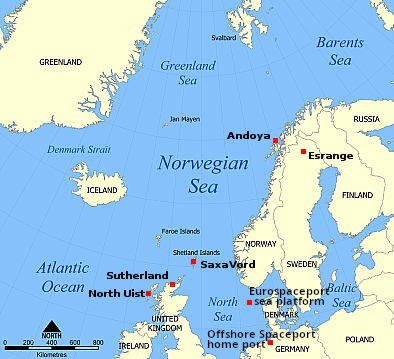
Proposed or active spaceports in North Europe
If I had any remaining hopes that the United Kingdom might finally begin to reform its Byzantine space regulations that bankrupted one rocket company and has blocked any launches from its proposed spaceports for almost a decade — allowing other spaceports in Europe to attract rocket companies and leap ahead — those hopes vanished in reading an article in the Shetland Times today, in which a professor specializing in UK space law described its red tape as “very good,” drawing “on best practice from other industries and jurisdictions.”
Alexander Simmonds of the University of Dundee says a balance should be struck to avoid launch operators being put off by strict regulatory requirements. The lecturer in space law and writer behind The Space Legislation of the United Kingdom says UK regulation of the space industry is “very good” and draws on best practice from other industries and jurisdictions.
Licences are in place for SaxaVord to host the first vertical satelite launch in 2026, and Dr Simmonds says operators have taken responsibilities “very seriously”. But he fears future operators could look elsewhere if compliance becomes too much of a problem and more cost-effective alternatives are available.
“My own view is we’re in a very good place at the moment, as regards to regulation,” Dr Simmonds told The Shetland Times. “I think that the legilsators have been cautious with this and have been very entitled to be, given the nature of what we are dealing with.”
Both this so-called expert and the journalist interviewing him appear entirely ignorant about the history of past decade. While red tape in the UK has blocked or seriously delayed launches, rocket startups have “looked elsewhere,” signing deals and launching from Norway’s long established Andoya spaceport that has now gone commercial with enthusiastic government support. At the same time, new spaceport projects have begun at three other locations, all of which appear to also have support from their local governments in Sweden and Germany. While the UK government has choked off business, the governments at these other spaceports have moved aggressively to ease regulation.
The cluelessness of both Simmonds and the Shetland Times reporter indicates there is absolutely no urgency in the UK to fix things, and in fact it appears they aren’t even aware their emperor is wearing no clothes.

On Christmas Eve 1968 three Americans became the first humans to visit another world. What they did to celebrate was unexpected and profound, and will be remembered throughout all human history. Genesis: the Story of Apollo 8, Robert Zimmerman's classic history of humanity's first journey to another world, tells that story, and it is now available as both an ebook and an audiobook, both with a foreword by Valerie Anders and a new introduction by Robert Zimmerman.
The print edition can be purchased at Amazon or from any other book seller. If you want an autographed copy the price is $60 for the hardback and $45 for the paperback, plus $8 shipping for each. Go here for purchasing details. The ebook is available everywhere for $5.99 (before discount) at amazon, or direct from my ebook publisher, ebookit. If you buy it from ebookit you don't support the big tech companies and the author gets a bigger cut much sooner.
The audiobook is also available at all these vendors, and is also free with a 30-day trial membership to Audible.
"Not simply about one mission, [Genesis] is also the history of America's quest for the moon... Zimmerman has done a masterful job of tying disparate events together into a solid account of one of America's greatest human triumphs."--San Antonio Express-News
Proposed or active spaceports in North Europe
If I had any remaining hopes that the United Kingdom might finally begin to reform its Byzantine space regulations that bankrupted one rocket company and has blocked any launches from its proposed spaceports for almost a decade — allowing other spaceports in Europe to attract rocket companies and leap ahead — those hopes vanished in reading an article in the Shetland Times today, in which a professor specializing in UK space law described its red tape as “very good,” drawing “on best practice from other industries and jurisdictions.”
Alexander Simmonds of the University of Dundee says a balance should be struck to avoid launch operators being put off by strict regulatory requirements. The lecturer in space law and writer behind The Space Legislation of the United Kingdom says UK regulation of the space industry is “very good” and draws on best practice from other industries and jurisdictions.
Licences are in place for SaxaVord to host the first vertical satelite launch in 2026, and Dr Simmonds says operators have taken responsibilities “very seriously”. But he fears future operators could look elsewhere if compliance becomes too much of a problem and more cost-effective alternatives are available.
“My own view is we’re in a very good place at the moment, as regards to regulation,” Dr Simmonds told The Shetland Times. “I think that the legilsators have been cautious with this and have been very entitled to be, given the nature of what we are dealing with.”
Both this so-called expert and the journalist interviewing him appear entirely ignorant about the history of past decade. While red tape in the UK has blocked or seriously delayed launches, rocket startups have “looked elsewhere,” signing deals and launching from Norway’s long established Andoya spaceport that has now gone commercial with enthusiastic government support. At the same time, new spaceport projects have begun at three other locations, all of which appear to also have support from their local governments in Sweden and Germany. While the UK government has choked off business, the governments at these other spaceports have moved aggressively to ease regulation.
The cluelessness of both Simmonds and the Shetland Times reporter indicates there is absolutely no urgency in the UK to fix things, and in fact it appears they aren’t even aware their emperor is wearing no clothes.
On Christmas Eve 1968 three Americans became the first humans to visit another world. What they did to celebrate was unexpected and profound, and will be remembered throughout all human history. Genesis: the Story of Apollo 8, Robert Zimmerman's classic history of humanity's first journey to another world, tells that story, and it is now available as both an ebook and an audiobook, both with a foreword by Valerie Anders and a new introduction by Robert Zimmerman.
The print edition can be purchased at Amazon or from any other book seller. If you want an autographed copy the price is $60 for the hardback and $45 for the paperback, plus $8 shipping for each. Go here for purchasing details. The ebook is available everywhere for $5.99 (before discount) at amazon, or direct from my ebook publisher, ebookit. If you buy it from ebookit you don't support the big tech companies and the author gets a bigger cut much sooner.
The audiobook is also available at all these vendors, and is also free with a 30-day trial membership to Audible.
"Not simply about one mission, [Genesis] is also the history of America's quest for the moon... Zimmerman has done a masterful job of tying disparate events together into a solid account of one of America's greatest human triumphs."--San Antonio Express-News
One of my favorite writers was Lord Dunsany.
That having been said, he and others in the UK seemed to have this guilt over all things industrial, and their words caused great harm.
Neither the US nor the Soviet Union indulged in that guilt. Yes, there was pollution –but both sides knew industry was just as vital as the environment itself.
To be or not to be.
I agree that the UK mainland is not the best place to launch from but….they have remote Islands.
I do feel sorry for the whole of the UK. They have moved away from everything that made them great.
If you think their space sector is bad, try working with them on water issues.
I pity the BIS…no one listens to them inside their own nation. Particle physics guys got more quid’
pzatchok noted ” They have moved away from everything that made them great.”
The Blitz did have the desired effect: it removed the British will to fight. After the War, Britain went full Socialist. To throw in your lot with that philosophy, requires the individual, and the society, to give up all hope of individual achievement. The Self is subjugated to the State. The abdication of any sort of technical ability in aerospace, by a people whom someone described as having “invented everything”, is one of the great tragedies of the 20th Century.
Jeff Wright,
A lot of the post-Industrial Revolution British literary class have been pastoralists. Tolkein certainly was. That’s been true in the US too. A lot of scribblers have been quite taken with the supposed romance of pre-industrial agriculture – which they confuse with gardening.
Old Blighty is looking increasingly bleak in all sorts of ways these days. Almost a decade after Brexit, none of the successive British governments have managed to do much about the main problems that prompted Brexit in the first place – especially the godawful Starmer. Perhaps, with Delta Force now fully spun up in worthless-head-of-state-gathering mode, its next target could maybe be Sir Keir?
Apropos to some of the earlier commentary, whether or not the UK has a functional spaceport is the very least of its problems, and the relevant question — within the not too distant future — will be how such facilities comport with Sharia law and the emerging English Caliphate’s ruthless, anti-Brit DEI initiatives.
While the Untied States literally dogged a bullet and thwarted the hopes of Mr. Soros and the World Economic Forum crowd, the nation that gave us the Magna Carta and English Common Law has now gone full-on 1984, and Mr. Starmer and his cohorts are licking their chops at the prospect of creating a society that is even more cowed, backward, and repressive than Iran.
The tragedy, as Blair Ivey observes, is that the Brits, by and large, seem to have surrendered their will to resist even the most brutal and mean-spirited forms of tyranny*, and they, like many Democrats in our own country, seem to believe that English culture and customs are simply not worth saving.
*The Internet is rife with stories about how everyday Brits are fined and imprisoned for speaking out, or even *thinking* crime-thoughts against their erstwhile country’s rabid, pro-Muslim DEI ideology. Meanwhile, foreign rape gangs wander the countryside, protected by the court system. Orwell, again, on steroids.
The irony, again, is that “while England sleeps” — and the forces of darkness consolidate their hold there — Iran may be on the brink of throwing off its own repressive, backward-looking mullahs. One wonders, however, if anyone in the UK has the same courage or concern for their future. Is the Delta Force, as Dick Eagleson suggests, ready for another mission?
Milt:
A British Citizen (maybe back to Subject, now?) was arrested in England for posing with a firearm in Florida. That would be Florida, America, where you can go to the local pawn shop, and buy a gun. Can’t walk right out the door, but you can three days after purchase.
https://timesofindia.indiatimes.com/world/uk/british-man-arrested-for-posing-with-a-gun-in-us-elon-musk-furious/articleshow/125674330.cms
I linked to that particular source, because it has the Elon Musk angle other sources lack.
” Meanwhile, foreign rape gangs wander the countryside, protected by the court system. Orwell, again, on steroids.”
I believe that would be “A Clockwork Orange”.
“A bit of the ol’ ultra-violence, eh?”
I used to look forward to going to Europe. Now, No Thank You.