China’s government strengthens its commitment to space
Taken from my 2025 year-end report on the state of
global launch industry.
In the Chinese government’s most recently announced five-year plan, it appears it has increased its commitment to its space program and its government-controlled commercial space sector.
Aviation and aerospace was elevated at the Two Sessions [conference earlier this month] to a ‘pillar industry’—a step up from its previous classification as an emerging sector. For the first time, the 15th 5-year plan (2026–30) explicitly sets the goal of building China into a space power by 2030.
The 5-year plan prioritizes reusable launch vehicles, large-scale satellite constellations, and the commercialization of space applications, with cost reduction cast as central to long-term viability. Satellite internet has been earmarked for rapid development as part of broader ambitions around integrated space-air-ground connectivity. A new ‘Space+’ framing suggests that satellite infrastructure is being treated as part of the broader industrial system, with growing interest in on-orbit computing rather than communications alone.
…But the sector still runs on patient state capital—a funding model that has enabled rapid scaling while deferring any serious test of commercial viability. No domestic launch provider has yet turned a profit, and closing the cost gap with SpaceX on reusable rockets remains the industry’s central challenge.
The report at the link is very detailed. Though it comes from a Chinese-based think tank that almost certainly gets funding and supervision from the Chinese communists, it is definitely worth reading. It notes the areas where China is doing well — its Beidou GPS-type constellation and its manned space program — as well as those areas it has come up short — re-usable rockets and its mega-satellite constellations.
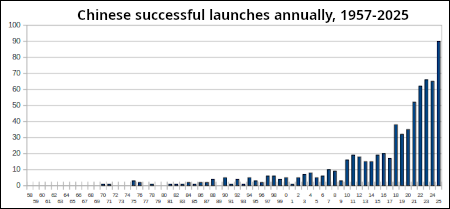
Though the graph to the right illustrates the long-term growth of China as a space power, it has not yet been able to match the U.S. in these two areas, mostly because of SpaceX. Moreover, the inability of China’s pseudo-rocket companies to get its reusable rockets operational is hindering the ability of China’s pseudo-satellite companies to launch their satellites. In both cases this new five-year plan appears to be applying pressure on these pseudo-companies to get moving, or the government will take over.
I must repeat again that the Chinese government’s support for space is deep and widespread, strengthened by that government’s almost two-decade-long policy of using that program as a training ground for its political leaders. Many of its successful space industry managers have been promoted to higher political office, and thus wield great power in deciding policy. Their pro-space roots clearly influence that policy in favor of China’s space effort.

On Christmas Eve 1968 three Americans became the first humans to visit another world. What they did to celebrate was unexpected and profound, and will be remembered throughout all human history. Genesis: the Story of Apollo 8, Robert Zimmerman's classic history of humanity's first journey to another world, tells that story, and it is now available as both an ebook and an audiobook, both with a foreword by Valerie Anders and a new introduction by Robert Zimmerman.
The print edition can be purchased at Amazon or from any other book seller. If you want an autographed copy the price is $60 for the hardback and $45 for the paperback, plus $8 shipping for each. Go here for purchasing details. The ebook is available everywhere for $5.99 (before discount) at amazon, or direct from my ebook publisher, ebookit. If you buy it from ebookit you don't support the big tech companies and the author gets a bigger cut much sooner.
The audiobook is also available at all these vendors, and is also free with a 30-day trial membership to Audible.
"Not simply about one mission, [Genesis] is also the history of America's quest for the moon... Zimmerman has done a masterful job of tying disparate events together into a solid account of one of America's greatest human triumphs."--San Antonio Express-News
Taken from my 2025 year-end report on the state of
global launch industry.
In the Chinese government’s most recently announced five-year plan, it appears it has increased its commitment to its space program and its government-controlled commercial space sector.
Aviation and aerospace was elevated at the Two Sessions [conference earlier this month] to a ‘pillar industry’—a step up from its previous classification as an emerging sector. For the first time, the 15th 5-year plan (2026–30) explicitly sets the goal of building China into a space power by 2030.
The 5-year plan prioritizes reusable launch vehicles, large-scale satellite constellations, and the commercialization of space applications, with cost reduction cast as central to long-term viability. Satellite internet has been earmarked for rapid development as part of broader ambitions around integrated space-air-ground connectivity. A new ‘Space+’ framing suggests that satellite infrastructure is being treated as part of the broader industrial system, with growing interest in on-orbit computing rather than communications alone.
…But the sector still runs on patient state capital—a funding model that has enabled rapid scaling while deferring any serious test of commercial viability. No domestic launch provider has yet turned a profit, and closing the cost gap with SpaceX on reusable rockets remains the industry’s central challenge.
The report at the link is very detailed. Though it comes from a Chinese-based think tank that almost certainly gets funding and supervision from the Chinese communists, it is definitely worth reading. It notes the areas where China is doing well — its Beidou GPS-type constellation and its manned space program — as well as those areas it has come up short — re-usable rockets and its mega-satellite constellations.
Though the graph to the right illustrates the long-term growth of China as a space power, it has not yet been able to match the U.S. in these two areas, mostly because of SpaceX. Moreover, the inability of China’s pseudo-rocket companies to get its reusable rockets operational is hindering the ability of China’s pseudo-satellite companies to launch their satellites. In both cases this new five-year plan appears to be applying pressure on these pseudo-companies to get moving, or the government will take over.
I must repeat again that the Chinese government’s support for space is deep and widespread, strengthened by that government’s almost two-decade-long policy of using that program as a training ground for its political leaders. Many of its successful space industry managers have been promoted to higher political office, and thus wield great power in deciding policy. Their pro-space roots clearly influence that policy in favor of China’s space effort.
On Christmas Eve 1968 three Americans became the first humans to visit another world. What they did to celebrate was unexpected and profound, and will be remembered throughout all human history. Genesis: the Story of Apollo 8, Robert Zimmerman's classic history of humanity's first journey to another world, tells that story, and it is now available as both an ebook and an audiobook, both with a foreword by Valerie Anders and a new introduction by Robert Zimmerman.
The print edition can be purchased at Amazon or from any other book seller. If you want an autographed copy the price is $60 for the hardback and $45 for the paperback, plus $8 shipping for each. Go here for purchasing details. The ebook is available everywhere for $5.99 (before discount) at amazon, or direct from my ebook publisher, ebookit. If you buy it from ebookit you don't support the big tech companies and the author gets a bigger cut much sooner.
The audiobook is also available at all these vendors, and is also free with a 30-day trial membership to Audible.
"Not simply about one mission, [Genesis] is also the history of America's quest for the moon... Zimmerman has done a masterful job of tying disparate events together into a solid account of one of America's greatest human triumphs."--San Antonio Express-News