Cracked bedrock on Mars?
Click for full image.
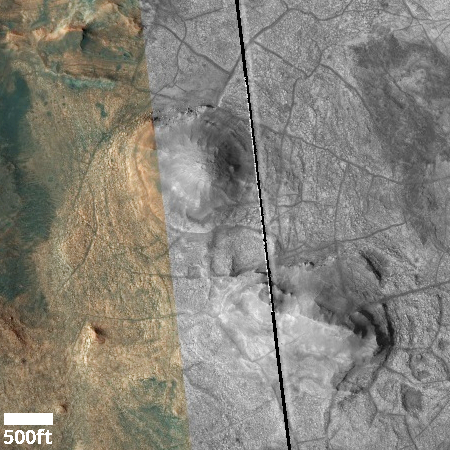
For today’s cool image we return to Mars. The picture to the right, cropped and brightened to post here, was taken on December 3, 2025 by the high resolution camera on Mars Reconnaissance Orbiter (MRO).
The focus of the picture was a strange crater in the floor of Mawrth Vallis, a channel that drains northward from Mars’ cratered southern highlands to its northern lowland plains. You can see the crater in the full image if you click on the picture. It is intriguing because its rim is strangely abrupt and flat on all sides, something that is not seen with impact craters, which have a raised rim of material plowed out by the impact.
In the picture to the right I have however focused on the two small 50-70-foot-high mesas and cracked ground that surrounds them. What struck me was the dry appearance of this landscape. Located at 23 degrees north latitude, it is in the dry tropics of Mars, where little near surface ice is found. The cracks emphasize this conclusion, as they so well resemble the cracks you see in dried mud on Earth.
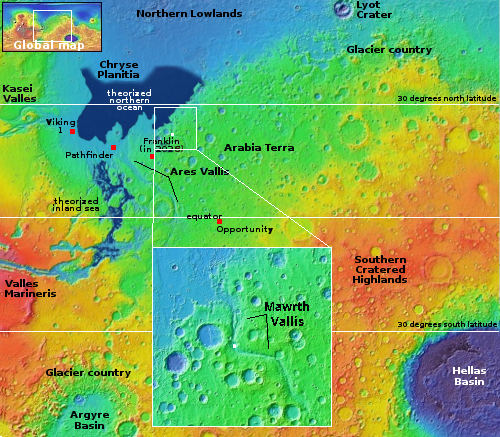
The white dot on the overview map to the right marks the location, inside the Mawrth Vallis, a 400-mile channel that was once considered a candidate landing zone for Europe’s Franklin rover, now targeting a location several hundred miles to the southwest.
The location of Mawrth strongly suggests that it was once a drainage route down from the cratered highlands into that theorized northern ocean. Whether the material draining was glacial ice or liquid water remains unknown, but in either case that’s what is implied by the surface geology, and has resulted in a great deal of research studying this canyon.
Now however that water is long gone, and as a result the surface has instead this dry and cracked appearance. The dark patch on the image’s left edge is a low point, and is likely filled with dust trapped there over eons.
The black line cutting across the image is an artifact of MRO’s camera, which is aging and loses some data in certain wavelengths along its vertical scans.

On Christmas Eve 1968 three Americans became the first humans to visit another world. What they did to celebrate was unexpected and profound, and will be remembered throughout all human history. Genesis: the Story of Apollo 8, Robert Zimmerman's classic history of humanity's first journey to another world, tells that story, and it is now available as both an ebook and an audiobook, both with a foreword by Valerie Anders and a new introduction by Robert Zimmerman.
The print edition can be purchased at Amazon or from any other book seller. If you want an autographed copy the price is $60 for the hardback and $45 for the paperback, plus $8 shipping for each. Go here for purchasing details. The ebook is available everywhere for $5.99 (before discount) at amazon, or direct from my ebook publisher, ebookit. If you buy it from ebookit you don't support the big tech companies and the author gets a bigger cut much sooner.
The audiobook is also available at all these vendors, and is also free with a 30-day trial membership to Audible.
"Not simply about one mission, [Genesis] is also the history of America's quest for the moon... Zimmerman has done a masterful job of tying disparate events together into a solid account of one of America's greatest human triumphs."--San Antonio Express-News

Click for full image.
For today’s cool image we return to Mars. The picture to the right, cropped and brightened to post here, was taken on December 3, 2025 by the high resolution camera on Mars Reconnaissance Orbiter (MRO).
The focus of the picture was a strange crater in the floor of Mawrth Vallis, a channel that drains northward from Mars’ cratered southern highlands to its northern lowland plains. You can see the crater in the full image if you click on the picture. It is intriguing because its rim is strangely abrupt and flat on all sides, something that is not seen with impact craters, which have a raised rim of material plowed out by the impact.
In the picture to the right I have however focused on the two small 50-70-foot-high mesas and cracked ground that surrounds them. What struck me was the dry appearance of this landscape. Located at 23 degrees north latitude, it is in the dry tropics of Mars, where little near surface ice is found. The cracks emphasize this conclusion, as they so well resemble the cracks you see in dried mud on Earth.
The white dot on the overview map to the right marks the location, inside the Mawrth Vallis, a 400-mile channel that was once considered a candidate landing zone for Europe’s Franklin rover, now targeting a location several hundred miles to the southwest.
The location of Mawrth strongly suggests that it was once a drainage route down from the cratered highlands into that theorized northern ocean. Whether the material draining was glacial ice or liquid water remains unknown, but in either case that’s what is implied by the surface geology, and has resulted in a great deal of research studying this canyon.
Now however that water is long gone, and as a result the surface has instead this dry and cracked appearance. The dark patch on the image’s left edge is a low point, and is likely filled with dust trapped there over eons.
The black line cutting across the image is an artifact of MRO’s camera, which is aging and loses some data in certain wavelengths along its vertical scans.
On Christmas Eve 1968 three Americans became the first humans to visit another world. What they did to celebrate was unexpected and profound, and will be remembered throughout all human history. Genesis: the Story of Apollo 8, Robert Zimmerman's classic history of humanity's first journey to another world, tells that story, and it is now available as both an ebook and an audiobook, both with a foreword by Valerie Anders and a new introduction by Robert Zimmerman.
The print edition can be purchased at Amazon or from any other book seller. If you want an autographed copy the price is $60 for the hardback and $45 for the paperback, plus $8 shipping for each. Go here for purchasing details. The ebook is available everywhere for $5.99 (before discount) at amazon, or direct from my ebook publisher, ebookit. If you buy it from ebookit you don't support the big tech companies and the author gets a bigger cut much sooner.
The audiobook is also available at all these vendors, and is also free with a 30-day trial membership to Audible.
"Not simply about one mission, [Genesis] is also the history of America's quest for the moon... Zimmerman has done a masterful job of tying disparate events together into a solid account of one of America's greatest human triumphs."--San Antonio Express-News