
Giant dunes in a dune sea inside a Martian crater

Cool image time! The picture to the right, cropped, reduced, and sharpened to post here, was taken on July 17, 2024 by the high resolution camera on Mars Reconnaissance Orbiter (MRO).
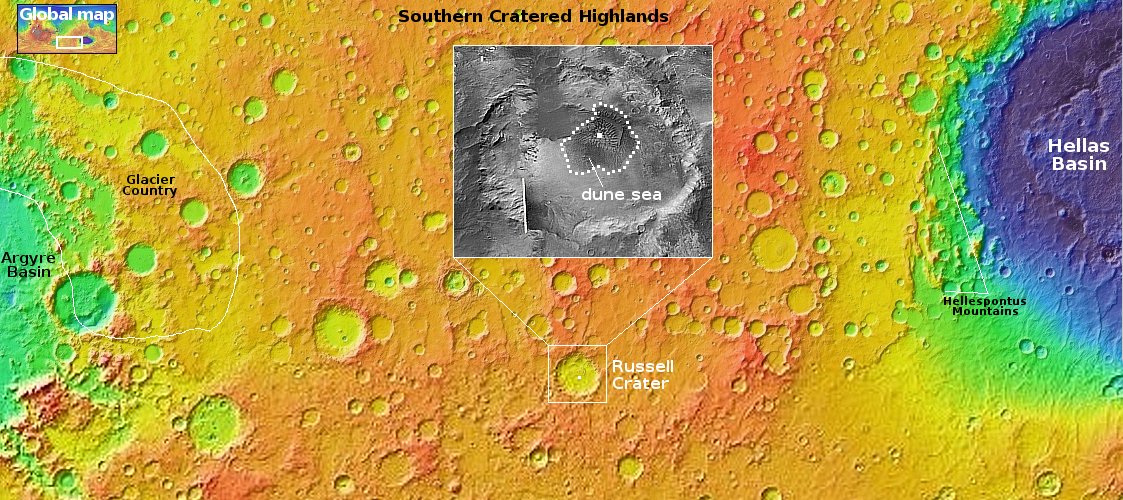
The white dot on the overview map above marks the location, inside a thirty-mile-wide dune sea, or erg, that sits in the center of the floor of 80-mile-wide Russell Crater.
That erg is interesting in that it appears the dunes get larger and larger as you move from the perimeter to its center. Thus, the dunes in the picture are called mega-dunes, about 200-feet-high. They dwarf the smaller dunes at the erg’s edge.
This picture was taken as part of a long term monitoring program to track the coming and going of seasonal dry ice frost on these dunes. It is summer when this picture was taken, so there is relatively little visible frost, though the bright blue areas in the color strip could possibly be the last remnants from winter. In winter, data suggests the entire surface of these dunes is covered by dry ice frost.
As the location is at 54 degrees south latitude, it likely sits at the northernmost edge of the southern dry ice mantle that in winter covers each of the Martian poles, down to about 60 degrees latitude.

On Christmas Eve 1968 three Americans became the first humans to visit another world. What they did to celebrate was unexpected and profound, and will be remembered throughout all human history. Genesis: the Story of Apollo 8, Robert Zimmerman's classic history of humanity's first journey to another world, tells that story, and it is now available as both an ebook and an audiobook, both with a foreword by Valerie Anders and a new introduction by Robert Zimmerman.
The print edition can be purchased at Amazon or from any other book seller. If you want an autographed copy the price is $60 for the hardback and $45 for the paperback, plus $8 shipping for each. Go here for purchasing details. The ebook is available everywhere for $5.99 (before discount) at amazon, or direct from my ebook publisher, ebookit. If you buy it from ebookit you don't support the big tech companies and the author gets a bigger cut much sooner.
The audiobook is also available at all these vendors, and is also free with a 30-day trial membership to Audible.
"Not simply about one mission, [Genesis] is also the history of America's quest for the moon... Zimmerman has done a masterful job of tying disparate events together into a solid account of one of America's greatest human triumphs."--San Antonio Express-News
An excellent location for the 10th remake of DUNE.