
Iapetus: Saturn’s ying-yang moon

Click for original image.
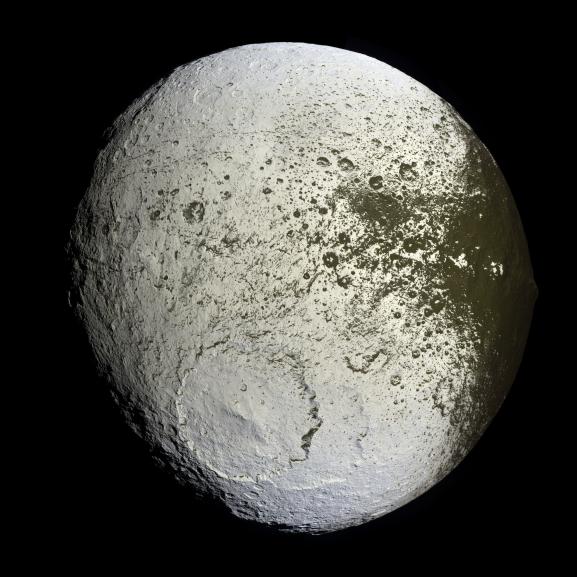
Cool image time! The image to the right, reduced and sharpened to post here, was taken on September 10, 2007 by the Saturn orbiter Cassini as it made its first close fly-by of the moon Iapetus, from a distance of about 45,000 miles.
Iapetus, about 912 miles in diameter, is one of the strangest objects in the solar system. As it orbits Saturn, its leading hemisphere is very dark, covered with almost pitch black material, while its trailing hemisphere is very bright. This picture captures a bit of both, with the dark leading hemisphere visible along the right edge.
In many places, the dark material–thought to be composed of nitrogen-bearing organic compounds called cyanides, hydrated minerals and other carbonaceous minerals–appears to coat equator-facing slopes and crater floors. The distribution of this material and variations in the color of the bright material across the trailing hemisphere will be crucial clues to understanding the origin of Iapetus’ peculiar bright-dark dual personality.
There are several theories to explain the planet’s strange ying-yang two-tone coloration. One suggests it is material thrown off by other Saturn moons that Iapetus sweeps up. Other theories suggest the planet’s orbit itself causes the two hemispheres to have different temperatures, allowing material to sublimate off the dark side and to the bright side.
No theory is presently accepted. Nor does any explain the data fully.
Tomorrow I’ll post a most intriguing close-up of Iapetus taken by Cassini during that 2007 fly-by.

On Christmas Eve 1968 three Americans became the first humans to visit another world. What they did to celebrate was unexpected and profound, and will be remembered throughout all human history. Genesis: the Story of Apollo 8, Robert Zimmerman's classic history of humanity's first journey to another world, tells that story, and it is now available as both an ebook and an audiobook, both with a foreword by Valerie Anders and a new introduction by Robert Zimmerman.
The print edition can be purchased at Amazon or from any other book seller. If you want an autographed copy the price is $60 for the hardback and $45 for the paperback, plus $8 shipping for each. Go here for purchasing details. The ebook is available everywhere for $5.99 (before discount) at amazon, or direct from my ebook publisher, ebookit. If you buy it from ebookit you don't support the big tech companies and the author gets a bigger cut much sooner.
The audiobook is also available at all these vendors, and is also free with a 30-day trial membership to Audible.
"Not simply about one mission, [Genesis] is also the history of America's quest for the moon... Zimmerman has done a masterful job of tying disparate events together into a solid account of one of America's greatest human triumphs."--San Antonio Express-News
Click for original image.
Cool image time! The image to the right, reduced and sharpened to post here, was taken on September 10, 2007 by the Saturn orbiter Cassini as it made its first close fly-by of the moon Iapetus, from a distance of about 45,000 miles.
Iapetus, about 912 miles in diameter, is one of the strangest objects in the solar system. As it orbits Saturn, its leading hemisphere is very dark, covered with almost pitch black material, while its trailing hemisphere is very bright. This picture captures a bit of both, with the dark leading hemisphere visible along the right edge.
In many places, the dark material–thought to be composed of nitrogen-bearing organic compounds called cyanides, hydrated minerals and other carbonaceous minerals–appears to coat equator-facing slopes and crater floors. The distribution of this material and variations in the color of the bright material across the trailing hemisphere will be crucial clues to understanding the origin of Iapetus’ peculiar bright-dark dual personality.
There are several theories to explain the planet’s strange ying-yang two-tone coloration. One suggests it is material thrown off by other Saturn moons that Iapetus sweeps up. Other theories suggest the planet’s orbit itself causes the two hemispheres to have different temperatures, allowing material to sublimate off the dark side and to the bright side.
No theory is presently accepted. Nor does any explain the data fully.
Tomorrow I’ll post a most intriguing close-up of Iapetus taken by Cassini during that 2007 fly-by.
On Christmas Eve 1968 three Americans became the first humans to visit another world. What they did to celebrate was unexpected and profound, and will be remembered throughout all human history. Genesis: the Story of Apollo 8, Robert Zimmerman's classic history of humanity's first journey to another world, tells that story, and it is now available as both an ebook and an audiobook, both with a foreword by Valerie Anders and a new introduction by Robert Zimmerman.
The print edition can be purchased at Amazon or from any other book seller. If you want an autographed copy the price is $60 for the hardback and $45 for the paperback, plus $8 shipping for each. Go here for purchasing details. The ebook is available everywhere for $5.99 (before discount) at amazon, or direct from my ebook publisher, ebookit. If you buy it from ebookit you don't support the big tech companies and the author gets a bigger cut much sooner.
The audiobook is also available at all these vendors, and is also free with a 30-day trial membership to Audible.
"Not simply about one mission, [Genesis] is also the history of America's quest for the moon... Zimmerman has done a masterful job of tying disparate events together into a solid account of one of America's greatest human triumphs."--San Antonio Express-News