Medical company making artificial retinas buys payload slots on Starlab
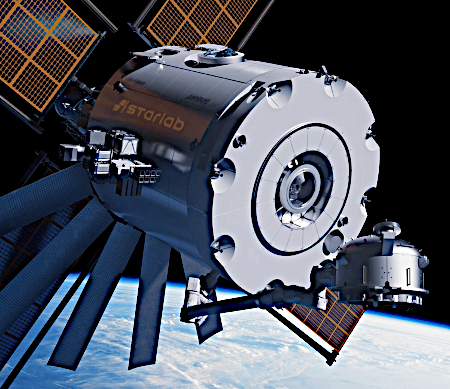
Starlab design as of December 2025
The medical company LambdaVision announced yesterday that has booked payload slots and commercial space on Starlab in order to manufacture “protein-based artificial retinas.”
LambdaVision leverages microgravity to improve the layer-by-layer production process of their artificial retina through alternating layers of the protein bacteriorhodopsin and a polymer, supported by a membrane of a synthetic fiber that has long been used by the medical community. Reduced gravity in an LEO environment improves homogeneity, stability, and performance of thin films like the protein-based artificial retina. By using proteins similar to the visual pigment rhodopsin naturally found in our eyes, LambdaVision’s protein-based artificial retina mimics the light-absorbing properties of human photoreceptors replacing the function of these damaged cells in the retinas of blind patients.
Starlab is the giant single module space station being built by a consortium led by Voyager Technologies that will be placed in orbit by a Superheavy/Starship launch.
While NASA allowed this kind of medical research on ISS, it never allowed the companies to manufacture any products on ISS for later sale on Earth. The new private space stations are decidedly opposed to that government restriction, and thus they are attracting customers like LambdaVision because they will allow it to make money on what it produces. The press release notes that while this first project is aimed at producing artificial retinas to restore vision in patients, the technology will be applicable to “sensitive biosensors, optical systems, tissue engineering, and drug delivery applications.”
In my rankings below of the five commercial American space station projects under development, the first three are basically tied, the fourth is simply late to the game, and the last, Blue Origin’s Orbital Reef, is hardly out of the starting gate.
- Haven-1 and Haven-2, being built by Vast, with no NASA funds. The company plans to launch its single module Haven-1 demo station in 2027 for a three-year period during which it will be occupied by at least four 2-week-long manned missions. It also plans a manned mission to ISS in ’28. The company is already testing an unmanned small demo module in orbit. It has also made preliminary deals with Colombia, Uzbekistan, Japan, and the Maldives for possible astronaut flights to Haven-1.
- Axiom, being built by Axiom, has launched four tourist flights to ISS, with the fourth carrying government passengers from India, Hungary, and Poland. A fifth mission is now planned for ’27. The company has now raised $450 million in private investment capital. The development of its first two modules has been proceeding, though the first module launch is now delayed until 2028. It has also signed Redwire to build that module’s solar panels.
- Starlab, being built by a consortium led by Voyager Space, Airbus, and Northrop Grumman, with extensive partnership agreements with the European Space Agency, Mitsubishi, and others. Though no construction has yet begun on its NASA-approved design, it has raised $383 million in a public stock offering, the $217.5 million provided by NASA, and an unstated amount from private capital. It has also begun signing up station customers, as well as a number of companies to build the station’s hardware.
- Thunderbird, proposed by the startup Max Space. It is building a smaller demo test station to launch in ’27 on a Falcon 9 rocket, and has begun work on its manufacturing facility at Kennedy in Florida. Its management includes one former NASA astronaut and one former member of the Bigelow space station team that built the first private orbiting inflatable modules, Genesis-1, Genesis-2, and BEAM (still operating on ISS).
- Orbital Reef, being built by a consortium led by Blue Origin and Sierra Space. This station looks increasingly dead in the water. Blue Origin has built almost nothing, as seems normal for this company. And while Sierra Space has successfully tested its inflatable modules, including a full scale version, its reputation is soured by its failure in getting its Dream Chaser cargo mini-shuttle launched to ISS.

On Christmas Eve 1968 three Americans became the first humans to visit another world. What they did to celebrate was unexpected and profound, and will be remembered throughout all human history. Genesis: the Story of Apollo 8, Robert Zimmerman's classic history of humanity's first journey to another world, tells that story, and it is now available as both an ebook and an audiobook, both with a foreword by Valerie Anders and a new introduction by Robert Zimmerman.
The print edition can be purchased at Amazon or from any other book seller. If you want an autographed copy the price is $60 for the hardback and $45 for the paperback, plus $8 shipping for each. Go here for purchasing details. The ebook is available everywhere for $5.99 (before discount) at amazon, or direct from my ebook publisher, ebookit. If you buy it from ebookit you don't support the big tech companies and the author gets a bigger cut much sooner.
The audiobook is also available at all these vendors, and is also free with a 30-day trial membership to Audible.
"Not simply about one mission, [Genesis] is also the history of America's quest for the moon... Zimmerman has done a masterful job of tying disparate events together into a solid account of one of America's greatest human triumphs."--San Antonio Express-News
Starlab design as of December 2025
The medical company LambdaVision announced yesterday that has booked payload slots and commercial space on Starlab in order to manufacture “protein-based artificial retinas.”
LambdaVision leverages microgravity to improve the layer-by-layer production process of their artificial retina through alternating layers of the protein bacteriorhodopsin and a polymer, supported by a membrane of a synthetic fiber that has long been used by the medical community. Reduced gravity in an LEO environment improves homogeneity, stability, and performance of thin films like the protein-based artificial retina. By using proteins similar to the visual pigment rhodopsin naturally found in our eyes, LambdaVision’s protein-based artificial retina mimics the light-absorbing properties of human photoreceptors replacing the function of these damaged cells in the retinas of blind patients.
Starlab is the giant single module space station being built by a consortium led by Voyager Technologies that will be placed in orbit by a Superheavy/Starship launch.
While NASA allowed this kind of medical research on ISS, it never allowed the companies to manufacture any products on ISS for later sale on Earth. The new private space stations are decidedly opposed to that government restriction, and thus they are attracting customers like LambdaVision because they will allow it to make money on what it produces. The press release notes that while this first project is aimed at producing artificial retinas to restore vision in patients, the technology will be applicable to “sensitive biosensors, optical systems, tissue engineering, and drug delivery applications.”
In my rankings below of the five commercial American space station projects under development, the first three are basically tied, the fourth is simply late to the game, and the last, Blue Origin’s Orbital Reef, is hardly out of the starting gate.
- Haven-1 and Haven-2, being built by Vast, with no NASA funds. The company plans to launch its single module Haven-1 demo station in 2027 for a three-year period during which it will be occupied by at least four 2-week-long manned missions. It also plans a manned mission to ISS in ’28. The company is already testing an unmanned small demo module in orbit. It has also made preliminary deals with Colombia, Uzbekistan, Japan, and the Maldives for possible astronaut flights to Haven-1.
- Axiom, being built by Axiom, has launched four tourist flights to ISS, with the fourth carrying government passengers from India, Hungary, and Poland. A fifth mission is now planned for ’27. The company has now raised $450 million in private investment capital. The development of its first two modules has been proceeding, though the first module launch is now delayed until 2028. It has also signed Redwire to build that module’s solar panels.
- Starlab, being built by a consortium led by Voyager Space, Airbus, and Northrop Grumman, with extensive partnership agreements with the European Space Agency, Mitsubishi, and others. Though no construction has yet begun on its NASA-approved design, it has raised $383 million in a public stock offering, the $217.5 million provided by NASA, and an unstated amount from private capital. It has also begun signing up station customers, as well as a number of companies to build the station’s hardware.
- Thunderbird, proposed by the startup Max Space. It is building a smaller demo test station to launch in ’27 on a Falcon 9 rocket, and has begun work on its manufacturing facility at Kennedy in Florida. Its management includes one former NASA astronaut and one former member of the Bigelow space station team that built the first private orbiting inflatable modules, Genesis-1, Genesis-2, and BEAM (still operating on ISS).
- Orbital Reef, being built by a consortium led by Blue Origin and Sierra Space. This station looks increasingly dead in the water. Blue Origin has built almost nothing, as seems normal for this company. And while Sierra Space has successfully tested its inflatable modules, including a full scale version, its reputation is soured by its failure in getting its Dream Chaser cargo mini-shuttle launched to ISS.
On Christmas Eve 1968 three Americans became the first humans to visit another world. What they did to celebrate was unexpected and profound, and will be remembered throughout all human history. Genesis: the Story of Apollo 8, Robert Zimmerman's classic history of humanity's first journey to another world, tells that story, and it is now available as both an ebook and an audiobook, both with a foreword by Valerie Anders and a new introduction by Robert Zimmerman.
The print edition can be purchased at Amazon or from any other book seller. If you want an autographed copy the price is $60 for the hardback and $45 for the paperback, plus $8 shipping for each. Go here for purchasing details. The ebook is available everywhere for $5.99 (before discount) at amazon, or direct from my ebook publisher, ebookit. If you buy it from ebookit you don't support the big tech companies and the author gets a bigger cut much sooner.
The audiobook is also available at all these vendors, and is also free with a 30-day trial membership to Audible.
"Not simply about one mission, [Genesis] is also the history of America's quest for the moon... Zimmerman has done a masterful job of tying disparate events together into a solid account of one of America's greatest human triumphs."--San Antonio Express-News
By itself, LambdaVision’s Starlab booking doesn’t close the business case for a commercial space station that no longer has to rely on NASA business.
But it’s an important building block for an eventual future where one *can*.
I reiterate my hope that at least Haven-2, Starlab, and Axiom really can get at least a baseline station into orbit, and operating, so that we at least have a chance to see how that might come about. Right now, all three companies are adamant that they need a NASA Phase 2 award to accomplish that. But perhaps, just perhaps, by some point in the 2030’s, a purely non-sovereign customer, or at least a purely non-NASA, space station business case could become a reality.
Could also potentially be orbited by a New Glenn 9×4
M Puckett,
Could be. I couldn’t find any projected total mass for the Starlab station, but it seems unlikely to exceed the 70 tonne LEO lift capacity posited for New Glenn 9×4. The only sticking point might be whether Starlab would fit in the New Glenn 9×4’s payload fairing. That fairing is depicted as a hammerhead in concept art for the NG 9×4, but it may not be quite hammerheaded enough to handle direct sub-in for a payload designed to maximize use of a Starship’s cargo bay volume. The diameter of the fairing for the NG 9×4 is given, by Wikipedia, as 8.7 meters or 29 ft. Seems a potentially wasted opportunity not to go the full 9 meters to offer at least a volumetric match of Starship. Perhaps that will change by the time an initial flight article of NG 9×4 is ready to fly. In any case the diameter of Starlab is given as 8 meters so even the currently notional design of the NG 9×4 payload fairing might suffice.
will be exciting to see the first space habs of the Starship era
then the real fun starts in a few years when we can lift a Helion 50MWe fusion reactor into space
with fusion ISP there are 10^15 tons of NEOs we can round up and maneuver into HEO
spin up some nice near-gee real estate where people will want to live and we can sell millions of units
TallDave,
Quite right, sir. Starlab will need a Starship or equivalent to deploy. Gravitics has also prototyped a hab module sized for Starship deployment. The central hub module for Vast’s stage 2 version of its Haven-2 station is also being designed for Starship deployment.
Beyond that, things seem likely to get very interesting very fast.
I hope so.
The medical industry has deep pockets.
Jeff Wright observed: “The medical industry has deep pockets.”
They have the most captive audience possible.