Modeling says the Small Magellanic Cloud passed through the Large Magellanic Cloud 200 million years ago
Click for original graphic.
According to new computer modeling, some astronomers now believe that a collision between the Small Magellanic Cloud (SMC) and the Large Magellanic Cloud (LMC) 200 million years ago best explains the chaotic movement of the stars in the former.
The SMC contains more mass in gas than in stars. Gas cools, contracts under gravity and settles into a rotating disk, the same process that shaped the spinning plane of our solar system. But when researchers, including those at University of Arizona, previously measured the motion of the SMC’s stars using the Hubble Space Telescope and the Gaia satellite of the European Space Agency, the SMC’s stars were not orbiting around the galaxy’s center the way stars in most galaxies do.
The possible reason, Rathore said, is a collision. A few hundred million years ago, the SMC crashed directly through the LMC’s disk. The LMC’s gravity disrupted the SMC’s internal structure and sent its stars into random, disordered motion. Also, the LMC’s gas applied a tremendous amount of pressure to the SMC’s gas and destroyed its gas rotation.
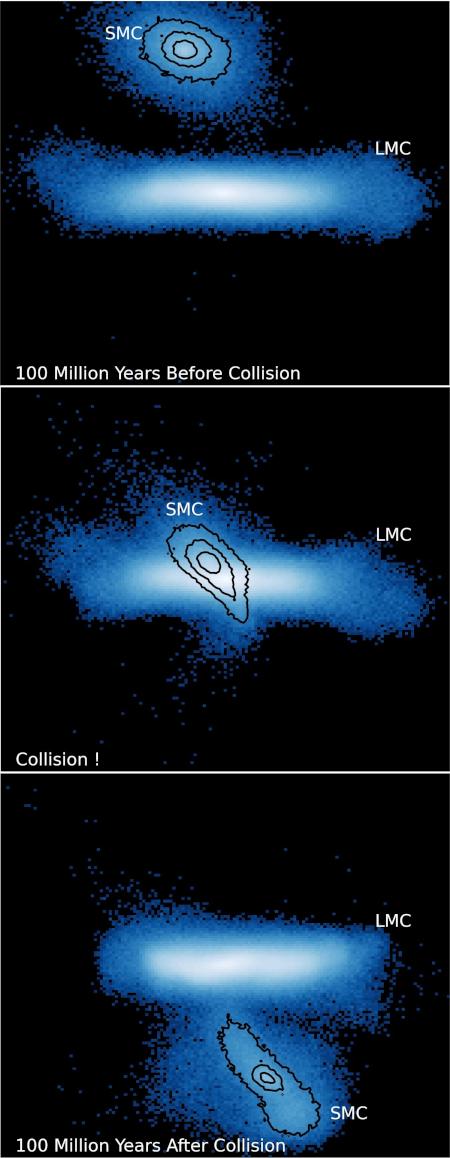
The graphic to the right illustrates that collision, based on the computer modeling. It appears the Small Magellanic Cloud’s passage through the Large Magellanic Cloud acted to shake the smaller cloud apart, spreading its stars and gas across a wider space.
You can read the paper here [pdf]. There is of course a great deal of uncertainty in these results, but they add weight to the general theory that galaxy formation is strongly impacted by such collisions. As the scientists note in the conclusion of their paper, “The SMC gives a front row view of group processes driving dramatic morphological and kinematic transformations.”

On Christmas Eve 1968 three Americans became the first humans to visit another world. What they did to celebrate was unexpected and profound, and will be remembered throughout all human history. Genesis: the Story of Apollo 8, Robert Zimmerman's classic history of humanity's first journey to another world, tells that story, and it is now available as both an ebook and an audiobook, both with a foreword by Valerie Anders and a new introduction by Robert Zimmerman.
The print edition can be purchased at Amazon or from any other book seller. If you want an autographed copy the price is $60 for the hardback and $45 for the paperback, plus $8 shipping for each. Go here for purchasing details. The ebook is available everywhere for $5.99 (before discount) at amazon, or direct from my ebook publisher, ebookit. If you buy it from ebookit you don't support the big tech companies and the author gets a bigger cut much sooner.
The audiobook is also available at all these vendors, and is also free with a 30-day trial membership to Audible.
"Not simply about one mission, [Genesis] is also the history of America's quest for the moon... Zimmerman has done a masterful job of tying disparate events together into a solid account of one of America's greatest human triumphs."--San Antonio Express-News

Click for original graphic.
According to new computer modeling, some astronomers now believe that a collision between the Small Magellanic Cloud (SMC) and the Large Magellanic Cloud (LMC) 200 million years ago best explains the chaotic movement of the stars in the former.
The SMC contains more mass in gas than in stars. Gas cools, contracts under gravity and settles into a rotating disk, the same process that shaped the spinning plane of our solar system. But when researchers, including those at University of Arizona, previously measured the motion of the SMC’s stars using the Hubble Space Telescope and the Gaia satellite of the European Space Agency, the SMC’s stars were not orbiting around the galaxy’s center the way stars in most galaxies do.
The possible reason, Rathore said, is a collision. A few hundred million years ago, the SMC crashed directly through the LMC’s disk. The LMC’s gravity disrupted the SMC’s internal structure and sent its stars into random, disordered motion. Also, the LMC’s gas applied a tremendous amount of pressure to the SMC’s gas and destroyed its gas rotation.
The graphic to the right illustrates that collision, based on the computer modeling. It appears the Small Magellanic Cloud’s passage through the Large Magellanic Cloud acted to shake the smaller cloud apart, spreading its stars and gas across a wider space.
You can read the paper here [pdf]. There is of course a great deal of uncertainty in these results, but they add weight to the general theory that galaxy formation is strongly impacted by such collisions. As the scientists note in the conclusion of their paper, “The SMC gives a front row view of group processes driving dramatic morphological and kinematic transformations.”
On Christmas Eve 1968 three Americans became the first humans to visit another world. What they did to celebrate was unexpected and profound, and will be remembered throughout all human history. Genesis: the Story of Apollo 8, Robert Zimmerman's classic history of humanity's first journey to another world, tells that story, and it is now available as both an ebook and an audiobook, both with a foreword by Valerie Anders and a new introduction by Robert Zimmerman.
The print edition can be purchased at Amazon or from any other book seller. If you want an autographed copy the price is $60 for the hardback and $45 for the paperback, plus $8 shipping for each. Go here for purchasing details. The ebook is available everywhere for $5.99 (before discount) at amazon, or direct from my ebook publisher, ebookit. If you buy it from ebookit you don't support the big tech companies and the author gets a bigger cut much sooner.
The audiobook is also available at all these vendors, and is also free with a 30-day trial membership to Audible.
"Not simply about one mission, [Genesis] is also the history of America's quest for the moon... Zimmerman has done a masterful job of tying disparate events together into a solid account of one of America's greatest human triumphs."--San Antonio Express-News