New images of interstellar Comet 3I/Atlas
Click for original.
Click for original.
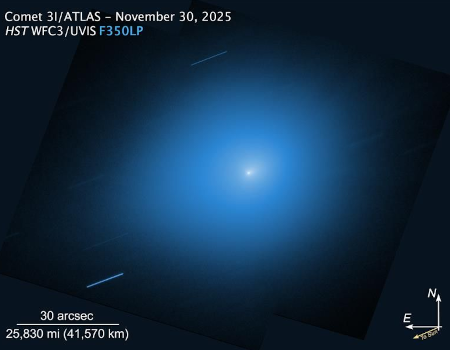
Both NASA and the European Space Agency (ESA) yesterday released new photos of the interstellar comet 3I/Atlas.
First, NASA released the image on the right, taken on November 30, 2025 by the Hubble Space Telescope. At the time the comet was about 178 million miles away. It clearly shows the comet’s coma of material, surrounding a bright nucleus at the center. The streaks are background stars.
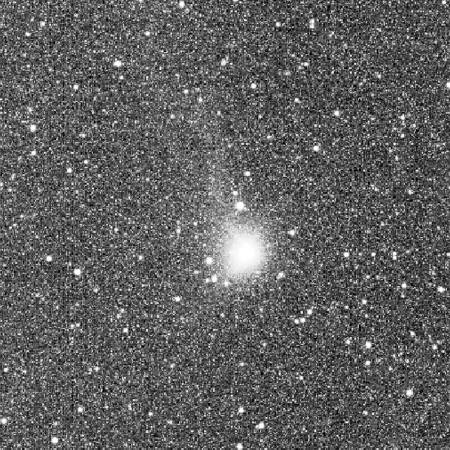
Next, the mission team for Europe’s Juice probe, on its way to Jupiter, released one small portion of a picture taken by its navigation camera. That picture is the second to the right.
During November 2025, ESA’s Jupiter Icy Moons Explorer (Juice) used five of its science instruments to observe 3I/ATLAS. The instruments collected information about how the comet is behaving and what it is made of. In addition, Juice snapped the comet with its onboard Navigation Camera (NavCam), designed not as a high-resolution science camera, but to help Juice navigate Jupiter’s icy moons following arrival in 2031.
Though the data from the science instruments won’t arrive on Earth until February 2026, our Juice team couldn’t wait that long. They decided to try downloading just a quarter of a single NavCam image to see what was in store for them. The very clearly visible comet, surrounded by signs of activity, surprised them.
Not only do we clearly see the glowing halo of gas surrounding the comet known as its coma, we also see a hint of two tails. The comet’s ‘plasma tail’ – made up of electrically charged gas, stretches out towards the top of the frame. We may also be able to see a fainter ‘dust tail’ – made up of tiny solid particles – stretching to the lower left of the frame.
The image was taken on 2 November 2025, during Juice’s first slot for observing 3I/ATLAS. It was two days before Juice’s closest approach to the comet, which occurred on 4 November at a distance of about 66 million km.
Because Juice is presently behind the Sun (as seen from Earth), most of the data it collected during its closest approach won’t be downloaded until February. This one partial image is only a fore taste.

On Christmas Eve 1968 three Americans became the first humans to visit another world. What they did to celebrate was unexpected and profound, and will be remembered throughout all human history. Genesis: the Story of Apollo 8, Robert Zimmerman's classic history of humanity's first journey to another world, tells that story, and it is now available as both an ebook and an audiobook, both with a foreword by Valerie Anders and a new introduction by Robert Zimmerman.
The print edition can be purchased at Amazon or from any other book seller. If you want an autographed copy the price is $60 for the hardback and $45 for the paperback, plus $8 shipping for each. Go here for purchasing details. The ebook is available everywhere for $5.99 (before discount) at amazon, or direct from my ebook publisher, ebookit. If you buy it from ebookit you don't support the big tech companies and the author gets a bigger cut much sooner.
The audiobook is also available at all these vendors, and is also free with a 30-day trial membership to Audible.
"Not simply about one mission, [Genesis] is also the history of America's quest for the moon... Zimmerman has done a masterful job of tying disparate events together into a solid account of one of America's greatest human triumphs."--San Antonio Express-News
Click for original.

Click for original.
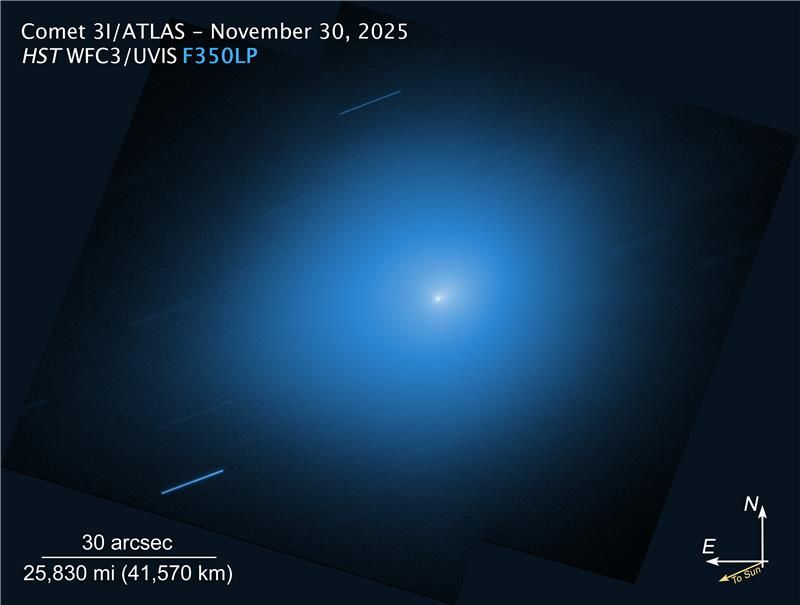
Both NASA and the European Space Agency (ESA) yesterday released new photos of the interstellar comet 3I/Atlas.
First, NASA released the image on the right, taken on November 30, 2025 by the Hubble Space Telescope. At the time the comet was about 178 million miles away. It clearly shows the comet’s coma of material, surrounding a bright nucleus at the center. The streaks are background stars.
Next, the mission team for Europe’s Juice probe, on its way to Jupiter, released one small portion of a picture taken by its navigation camera. That picture is the second to the right.
During November 2025, ESA’s Jupiter Icy Moons Explorer (Juice) used five of its science instruments to observe 3I/ATLAS. The instruments collected information about how the comet is behaving and what it is made of. In addition, Juice snapped the comet with its onboard Navigation Camera (NavCam), designed not as a high-resolution science camera, but to help Juice navigate Jupiter’s icy moons following arrival in 2031.
Though the data from the science instruments won’t arrive on Earth until February 2026, our Juice team couldn’t wait that long. They decided to try downloading just a quarter of a single NavCam image to see what was in store for them. The very clearly visible comet, surrounded by signs of activity, surprised them.
Not only do we clearly see the glowing halo of gas surrounding the comet known as its coma, we also see a hint of two tails. The comet’s ‘plasma tail’ – made up of electrically charged gas, stretches out towards the top of the frame. We may also be able to see a fainter ‘dust tail’ – made up of tiny solid particles – stretching to the lower left of the frame.
The image was taken on 2 November 2025, during Juice’s first slot for observing 3I/ATLAS. It was two days before Juice’s closest approach to the comet, which occurred on 4 November at a distance of about 66 million km.
Because Juice is presently behind the Sun (as seen from Earth), most of the data it collected during its closest approach won’t be downloaded until February. This one partial image is only a fore taste.
On Christmas Eve 1968 three Americans became the first humans to visit another world. What they did to celebrate was unexpected and profound, and will be remembered throughout all human history. Genesis: the Story of Apollo 8, Robert Zimmerman's classic history of humanity's first journey to another world, tells that story, and it is now available as both an ebook and an audiobook, both with a foreword by Valerie Anders and a new introduction by Robert Zimmerman.
The print edition can be purchased at Amazon or from any other book seller. If you want an autographed copy the price is $60 for the hardback and $45 for the paperback, plus $8 shipping for each. Go here for purchasing details. The ebook is available everywhere for $5.99 (before discount) at amazon, or direct from my ebook publisher, ebookit. If you buy it from ebookit you don't support the big tech companies and the author gets a bigger cut much sooner.
The audiobook is also available at all these vendors, and is also free with a 30-day trial membership to Audible.
"Not simply about one mission, [Genesis] is also the history of America's quest for the moon... Zimmerman has done a masterful job of tying disparate events together into a solid account of one of America's greatest human triumphs."--San Antonio Express-News
Will the images show the separation of the first and second stages? ( It’s a bloody long ride back if the alpha centurions are going to reuse the first stage! )
Lee S,
Heh. Good one there.
That would be about par for the course for Londo Mollari operations.