Proteus, Neptune’s second largest moon, discovered by Voyager-2 in 1989
For original images go here and here.
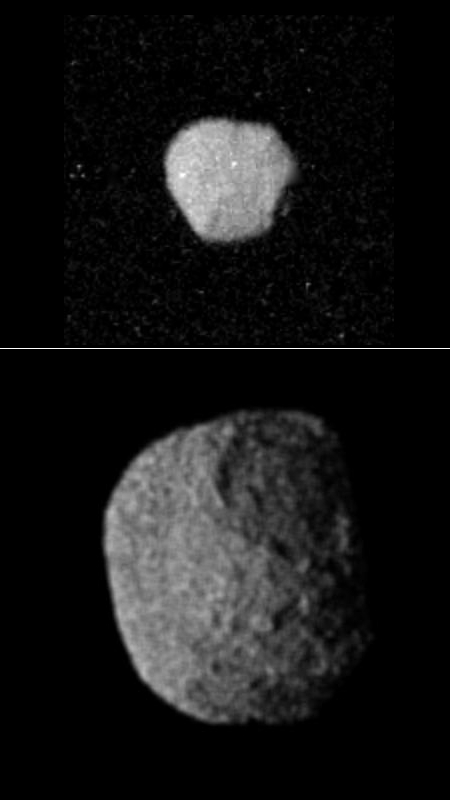
Our tour continues of the only close visit to Neptune on August 25, 1989 by Voyager-2. The two pictures to the right were taken by the spacecraft during that fly-by of Neptune’s second largest moon, dubbed Proteus. Both pictures are shown as Voyager-2 took them.
The top picture was taken from a distance of about 540,000 miles, and has a resolution of about five miles per pixel.
The satellite has an average radius of about 120 miles and is uniformly dark with an albedo of about 6 percent. The irregular shape suggests that 1989N1 has been cold and rigid throughout its history and subject to significant impact cratering.
The bottom picture was taken from a distance of about 91,000 miles, and can resolve objects as small as 1.7 miles in size.
Hints of crater-like forms and groove-like lineations can be discerned. The apparent graininess of the image is caused by the short exposure necessary to avoid significant smear.
Proteus was not known prior to Voyager-2’s fly-by, because it orbits so close to Neptune (about 73,000 miles) that the ground-based telescopes of the time could not see it in the glare of the gas giant. It was discovered in early global pictures of Neptune as Voyager-2 approached.
While planetary scientists have made some educated guesses about the moon’s origin and geology based on these two images, they are simply guesses. These are the only detailed images we have of Proteus, and neither is particularly good.

On Christmas Eve 1968 three Americans became the first humans to visit another world. What they did to celebrate was unexpected and profound, and will be remembered throughout all human history. Genesis: the Story of Apollo 8, Robert Zimmerman's classic history of humanity's first journey to another world, tells that story, and it is now available as both an ebook and an audiobook, both with a foreword by Valerie Anders and a new introduction by Robert Zimmerman.
The print edition can be purchased at Amazon or from any other book seller. If you want an autographed copy the price is $60 for the hardback and $45 for the paperback, plus $8 shipping for each. Go here for purchasing details. The ebook is available everywhere for $5.99 (before discount) at amazon, or direct from my ebook publisher, ebookit. If you buy it from ebookit you don't support the big tech companies and the author gets a bigger cut much sooner.
The audiobook is also available at all these vendors, and is also free with a 30-day trial membership to Audible.
"Not simply about one mission, [Genesis] is also the history of America's quest for the moon... Zimmerman has done a masterful job of tying disparate events together into a solid account of one of America's greatest human triumphs."--San Antonio Express-News
For original images go here and here.
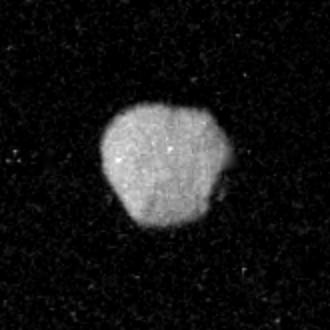
Our tour continues of the only close visit to Neptune on August 25, 1989 by Voyager-2. The two pictures to the right were taken by the spacecraft during that fly-by of Neptune’s second largest moon, dubbed Proteus. Both pictures are shown as Voyager-2 took them.
The top picture was taken from a distance of about 540,000 miles, and has a resolution of about five miles per pixel.
The satellite has an average radius of about 120 miles and is uniformly dark with an albedo of about 6 percent. The irregular shape suggests that 1989N1 has been cold and rigid throughout its history and subject to significant impact cratering.
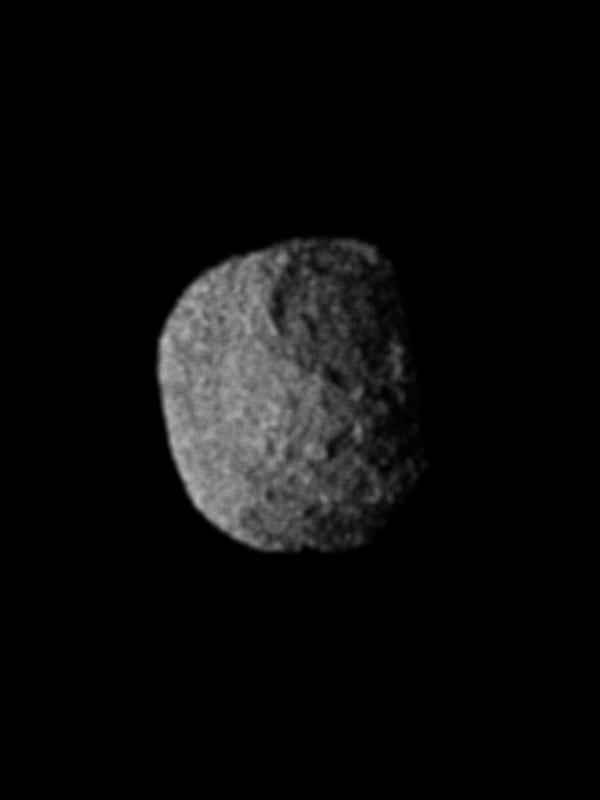
The bottom picture was taken from a distance of about 91,000 miles, and can resolve objects as small as 1.7 miles in size.
Hints of crater-like forms and groove-like lineations can be discerned. The apparent graininess of the image is caused by the short exposure necessary to avoid significant smear.
Proteus was not known prior to Voyager-2’s fly-by, because it orbits so close to Neptune (about 73,000 miles) that the ground-based telescopes of the time could not see it in the glare of the gas giant. It was discovered in early global pictures of Neptune as Voyager-2 approached.
While planetary scientists have made some educated guesses about the moon’s origin and geology based on these two images, they are simply guesses. These are the only detailed images we have of Proteus, and neither is particularly good.
On Christmas Eve 1968 three Americans became the first humans to visit another world. What they did to celebrate was unexpected and profound, and will be remembered throughout all human history. Genesis: the Story of Apollo 8, Robert Zimmerman's classic history of humanity's first journey to another world, tells that story, and it is now available as both an ebook and an audiobook, both with a foreword by Valerie Anders and a new introduction by Robert Zimmerman.
The print edition can be purchased at Amazon or from any other book seller. If you want an autographed copy the price is $60 for the hardback and $45 for the paperback, plus $8 shipping for each. Go here for purchasing details. The ebook is available everywhere for $5.99 (before discount) at amazon, or direct from my ebook publisher, ebookit. If you buy it from ebookit you don't support the big tech companies and the author gets a bigger cut much sooner.
The audiobook is also available at all these vendors, and is also free with a 30-day trial membership to Audible.
"Not simply about one mission, [Genesis] is also the history of America's quest for the moon... Zimmerman has done a masterful job of tying disparate events together into a solid account of one of America's greatest human triumphs."--San Antonio Express-News