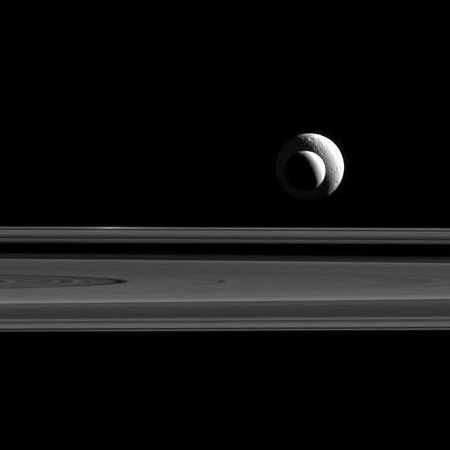
Saturn’s rings with two of its moons perfectly aligned
Click for original image.
Cool image time! Rather than posting another Mars orbital image, I decided today to delve into the archive of pictures taken by the Cassini orbiter during the thirteen years it circled Saturn, from 2004 until 2017. The picture to the right, cropped to post here, was released on December 14, 2015, and is just one example of the many breath-taking photographs that the Cassini science team took during that mission. From the caption:
Like a cosmic bull’s-eye, Enceladus and Tethys line up almost perfectly for Cassini’s cameras. Since the two moons are not only aligned, but also at relatively similar distances from Cassini, the apparent sizes in this image are a good approximation of the relative sizes of Enceladus (313 miles across) and Tethys (660 miles across).
This view looks toward the un-illuminated side of the rings from 0.34 degrees below the ring plane. The image was taken in red light with the Cassini spacecraft narrow-angle camera on Sept. 24, 2015.
The image was obtained at a distance of approximately 1.3 million miles from Enceladus. Image scale on Enceladus is 7 miles per pixel. Tethys was at a distance of 1.6 million miles with a pixel scale of 10 miles per pixel.
Enceladus is in the foreground, and is the planet that has what scientists have labeled tiger stripe fractures that vent water and other material, including carbon molecules.

On Christmas Eve 1968 three Americans became the first humans to visit another world. What they did to celebrate was unexpected and profound, and will be remembered throughout all human history. Genesis: the Story of Apollo 8, Robert Zimmerman's classic history of humanity's first journey to another world, tells that story, and it is now available as both an ebook and an audiobook, both with a foreword by Valerie Anders and a new introduction by Robert Zimmerman.
The print edition can be purchased at Amazon or from any other book seller. If you want an autographed copy the price is $60 for the hardback and $45 for the paperback, plus $8 shipping for each. Go here for purchasing details. The ebook is available everywhere for $5.99 (before discount) at amazon, or direct from my ebook publisher, ebookit. If you buy it from ebookit you don't support the big tech companies and the author gets a bigger cut much sooner.
The audiobook is also available at all these vendors, and is also free with a 30-day trial membership to Audible.
"Not simply about one mission, [Genesis] is also the history of America's quest for the moon... Zimmerman has done a masterful job of tying disparate events together into a solid account of one of America's greatest human triumphs."--San Antonio Express-News

Click for original image.
Cool image time! Rather than posting another Mars orbital image, I decided today to delve into the archive of pictures taken by the Cassini orbiter during the thirteen years it circled Saturn, from 2004 until 2017. The picture to the right, cropped to post here, was released on December 14, 2015, and is just one example of the many breath-taking photographs that the Cassini science team took during that mission. From the caption:
Like a cosmic bull’s-eye, Enceladus and Tethys line up almost perfectly for Cassini’s cameras. Since the two moons are not only aligned, but also at relatively similar distances from Cassini, the apparent sizes in this image are a good approximation of the relative sizes of Enceladus (313 miles across) and Tethys (660 miles across).
This view looks toward the un-illuminated side of the rings from 0.34 degrees below the ring plane. The image was taken in red light with the Cassini spacecraft narrow-angle camera on Sept. 24, 2015.
The image was obtained at a distance of approximately 1.3 million miles from Enceladus. Image scale on Enceladus is 7 miles per pixel. Tethys was at a distance of 1.6 million miles with a pixel scale of 10 miles per pixel.
Enceladus is in the foreground, and is the planet that has what scientists have labeled tiger stripe fractures that vent water and other material, including carbon molecules.
On Christmas Eve 1968 three Americans became the first humans to visit another world. What they did to celebrate was unexpected and profound, and will be remembered throughout all human history. Genesis: the Story of Apollo 8, Robert Zimmerman's classic history of humanity's first journey to another world, tells that story, and it is now available as both an ebook and an audiobook, both with a foreword by Valerie Anders and a new introduction by Robert Zimmerman.
The print edition can be purchased at Amazon or from any other book seller. If you want an autographed copy the price is $60 for the hardback and $45 for the paperback, plus $8 shipping for each. Go here for purchasing details. The ebook is available everywhere for $5.99 (before discount) at amazon, or direct from my ebook publisher, ebookit. If you buy it from ebookit you don't support the big tech companies and the author gets a bigger cut much sooner.
The audiobook is also available at all these vendors, and is also free with a 30-day trial membership to Audible.
"Not simply about one mission, [Genesis] is also the history of America's quest for the moon... Zimmerman has done a masterful job of tying disparate events together into a solid account of one of America's greatest human triumphs."--San Antonio Express-News
DO YOURSELVES A FAVOR:
Turn off any sound and be in a quiet room, then click on the image to have the original image displayed full-screen . . .
THAT’S what it was like to have been there, so close to Saturn’s – SATURN’S!!!! – rings and moons.
Nice photo.
Thanks for posting.
Mars pix get old
Jeff, Mars is an *old* planet, lol. and it shows its age. Back in the 1940s, Sir Harold Spencer Jones described it, as I recall from all those decades ago, as “the planet of spent life” and it appears to be every bit that. Nevertheless,
“Mars tugs at the human imagination like no other planet. With a force mightier than gravity, it attracts the eye to the shimmering red presence in the clear night sky.” – John Noble. https://kidadl.com/facts/quotes/mars-quotes
Thanks for that gorgeous pic. (Speaking as an amateur photog, myself.)
Where’s the big black obelisk?
(Kubrick and Clarke originally wanted to use Saturn instead of Jupiter, but they couldn’t get the effects to work right for the rings, so they settled on Jupiter.)