
Station module builder Max Space announces new Thunderbird inflatable module
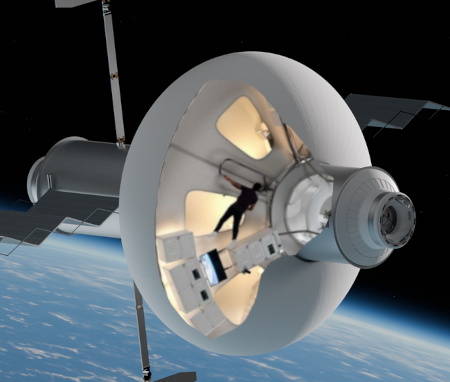
Thunderbird, with cut-out showing interior and person
for scale. Click for original images.
The startup Max Space yesterday unveiled a new larger and upgraded inflatable module, dubbed Thunderbird, that it proposes to sell to the various space stations being built in the U.S. and globally.
Thunderbird Station is built to support 4 or more crew members continuously, with an incredible 350m³ of pressurized volume, more than triple that of a standard ISS module. Launched on a single standard Falcon 9 rocket, the full expandable habitat launches compactly and expands 20x once deployed in orbit, requiring no in-orbit assembly. The interior features a novel reconfigurable architecture, morphic interior structure,that allows astronauts to dynamically adapt the space for research, manufacturing, or living during a mission. The design was developed in collaboration with veteran astronauts to take full advantage of three-dimensional volume in microgravity, not just traditional floor and wall space, to create the most spacious and functional habitable volume ever built. [emphasis in original]
The company also announced that it plans to fly a much smaller demonstration mission of this inflatable module design in the first quarter of 2027, launching on a Falcon 9 rocket and dubbed Mission Evolution.
The primary objective is to test and verify the on-orbit deployment of the expandable module with its exceptional micrometeoroid protection layers. After many years of successful ground testing and development, the flight unit is in full production and is scheduled for launch Q1 2027 onboard a scheduled SpaceX launch.
Max Space first appeared in 2024 when it announced its intention to fly an inflatable demo mission by 2025. Obviously that schedule has undergone some significant delays, though it appears the company used the time to refine its designs considerably. Its management includes one former NASA astronaut and one former member of the Bigelow space station team that built the first private orbiting inflatable modules, Genesis-1, Genesis-2, and BEAM (still operating on ISS).
The company is not trying to build its own space stations. Instead, it is marketing its inflatable modules to all the other space station startups as a quick way to get an additional large module added to their stations.
Hat tip to BtB’s stringer Jay.

On Christmas Eve 1968 three Americans became the first humans to visit another world. What they did to celebrate was unexpected and profound, and will be remembered throughout all human history. Genesis: the Story of Apollo 8, Robert Zimmerman's classic history of humanity's first journey to another world, tells that story, and it is now available as both an ebook and an audiobook, both with a foreword by Valerie Anders and a new introduction by Robert Zimmerman.
The print edition can be purchased at Amazon or from any other book seller. If you want an autographed copy the price is $60 for the hardback and $45 for the paperback, plus $8 shipping for each. Go here for purchasing details. The ebook is available everywhere for $5.99 (before discount) at amazon, or direct from my ebook publisher, ebookit. If you buy it from ebookit you don't support the big tech companies and the author gets a bigger cut much sooner.
The audiobook is also available at all these vendors, and is also free with a 30-day trial membership to Audible.
"Not simply about one mission, [Genesis] is also the history of America's quest for the moon... Zimmerman has done a masterful job of tying disparate events together into a solid account of one of America's greatest human triumphs."--San Antonio Express-News
Thunderbird, with cut-out showing interior and person
for scale. Click for original images.
The startup Max Space yesterday unveiled a new larger and upgraded inflatable module, dubbed Thunderbird, that it proposes to sell to the various space stations being built in the U.S. and globally.
Thunderbird Station is built to support 4 or more crew members continuously, with an incredible 350m³ of pressurized volume, more than triple that of a standard ISS module. Launched on a single standard Falcon 9 rocket, the full expandable habitat launches compactly and expands 20x once deployed in orbit, requiring no in-orbit assembly. The interior features a novel reconfigurable architecture, morphic interior structure,that allows astronauts to dynamically adapt the space for research, manufacturing, or living during a mission. The design was developed in collaboration with veteran astronauts to take full advantage of three-dimensional volume in microgravity, not just traditional floor and wall space, to create the most spacious and functional habitable volume ever built. [emphasis in original]
The company also announced that it plans to fly a much smaller demonstration mission of this inflatable module design in the first quarter of 2027, launching on a Falcon 9 rocket and dubbed Mission Evolution.
The primary objective is to test and verify the on-orbit deployment of the expandable module with its exceptional micrometeoroid protection layers. After many years of successful ground testing and development, the flight unit is in full production and is scheduled for launch Q1 2027 onboard a scheduled SpaceX launch.
Max Space first appeared in 2024 when it announced its intention to fly an inflatable demo mission by 2025. Obviously that schedule has undergone some significant delays, though it appears the company used the time to refine its designs considerably. Its management includes one former NASA astronaut and one former member of the Bigelow space station team that built the first private orbiting inflatable modules, Genesis-1, Genesis-2, and BEAM (still operating on ISS).
The company is not trying to build its own space stations. Instead, it is marketing its inflatable modules to all the other space station startups as a quick way to get an additional large module added to their stations.
Hat tip to BtB’s stringer Jay.
On Christmas Eve 1968 three Americans became the first humans to visit another world. What they did to celebrate was unexpected and profound, and will be remembered throughout all human history. Genesis: the Story of Apollo 8, Robert Zimmerman's classic history of humanity's first journey to another world, tells that story, and it is now available as both an ebook and an audiobook, both with a foreword by Valerie Anders and a new introduction by Robert Zimmerman.
The print edition can be purchased at Amazon or from any other book seller. If you want an autographed copy the price is $60 for the hardback and $45 for the paperback, plus $8 shipping for each. Go here for purchasing details. The ebook is available everywhere for $5.99 (before discount) at amazon, or direct from my ebook publisher, ebookit. If you buy it from ebookit you don't support the big tech companies and the author gets a bigger cut much sooner.
The audiobook is also available at all these vendors, and is also free with a 30-day trial membership to Audible.
"Not simply about one mission, [Genesis] is also the history of America's quest for the moon... Zimmerman has done a masterful job of tying disparate events together into a solid account of one of America's greatest human triumphs."--San Antonio Express-News
I assume it will be best supplied from the Night Train Express launch system.
And here I am wanting them all to have a big 5 on the side. I fear I may be dating myself.