The strange craters in the high northern latitudes of Mars
Click for original image.
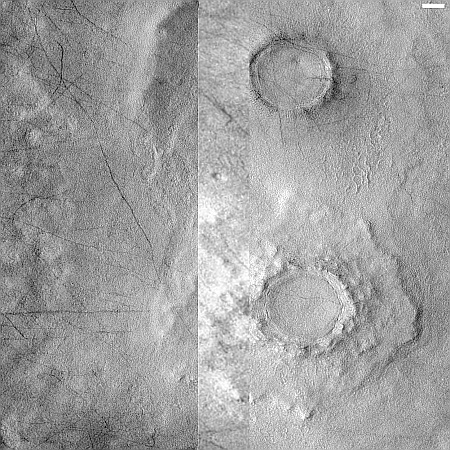
Cool image time! The picture to the right, rotated, cropped, reduced, and enhanced to post here, was taken on August 22, 2023 by the high resolution camera on Mars Reconnaissance Orbiter (MRO). I have also inserted data from a July 28, 2008 context camera image into the blank strip that now exists in the center of high resolution camera images due to the failure of one sensor.
This photo is what the camera team calls a terrain sample, and was probably taken not as part of any specific request but to fill a gap in the camera’s schedule in order to maintain its proper temperature. When the camera team does this they try to find locations that either have not been observed in much detail previously or have interesting features. In this case the team accomplished both. The interesting features are the two pedestal craters, both surrounded by splash aprons. Neither has been observed in high resolution previously, and the context camera has only taken two pictures of this location in total.
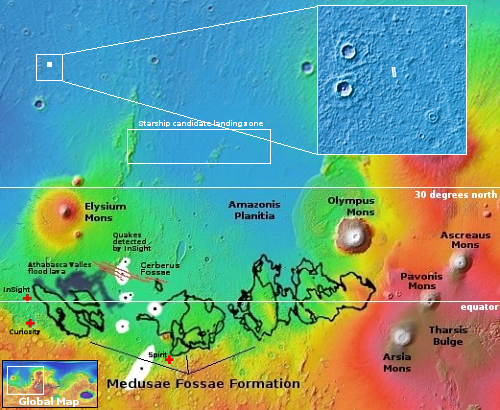
The white dot on the overview map to the right marks the location. As you can see from the inset, craters with splash aprons are not unusual in this region, located in the high northern latitudes above 50 degrees. In fact, from this point north almost all the craters have these aprons, suggesting that every single one smashed into an ice sheet that melted upon impact, flowed like mud for a short time, then refroze.
The two craters above however are also pedastal craters, as they sit above the surrounding terrain. The generally accepted explanation for this circumstance is that the impact hardened the crater floor and made it more erosion-resistant. When the surrounding terrain either eroded or sublimated away, the crater was left high and dry.
The number of pedastal craters in this region — combined with evidence that there is a lot of extensive near-surface ice — suggest however the possibility that they are instead mud volcanoes, whereby some geological process causes the near-surface ice to melt and erupt upward, much like a lava volcano.
There is a third option however. What if these pedastal craters are a combination of both? An asteroid or comet hits the northern Martian ice sheets, creating a crater and the splash apron. The resulting crater then becomes a good location for the formation of a mud volcano that fills the crater and pushes it up above the surrounding terrain.
All guesses, but intriguing nonetheless.

On Christmas Eve 1968 three Americans became the first humans to visit another world. What they did to celebrate was unexpected and profound, and will be remembered throughout all human history. Genesis: the Story of Apollo 8, Robert Zimmerman's classic history of humanity's first journey to another world, tells that story, and it is now available as both an ebook and an audiobook, both with a foreword by Valerie Anders and a new introduction by Robert Zimmerman.
The print edition can be purchased at Amazon or from any other book seller. If you want an autographed copy the price is $60 for the hardback and $45 for the paperback, plus $8 shipping for each. Go here for purchasing details. The ebook is available everywhere for $5.99 (before discount) at amazon, or direct from my ebook publisher, ebookit. If you buy it from ebookit you don't support the big tech companies and the author gets a bigger cut much sooner.
The audiobook is also available at all these vendors, and is also free with a 30-day trial membership to Audible.
"Not simply about one mission, [Genesis] is also the history of America's quest for the moon... Zimmerman has done a masterful job of tying disparate events together into a solid account of one of America's greatest human triumphs."--San Antonio Express-News
Click for original image.
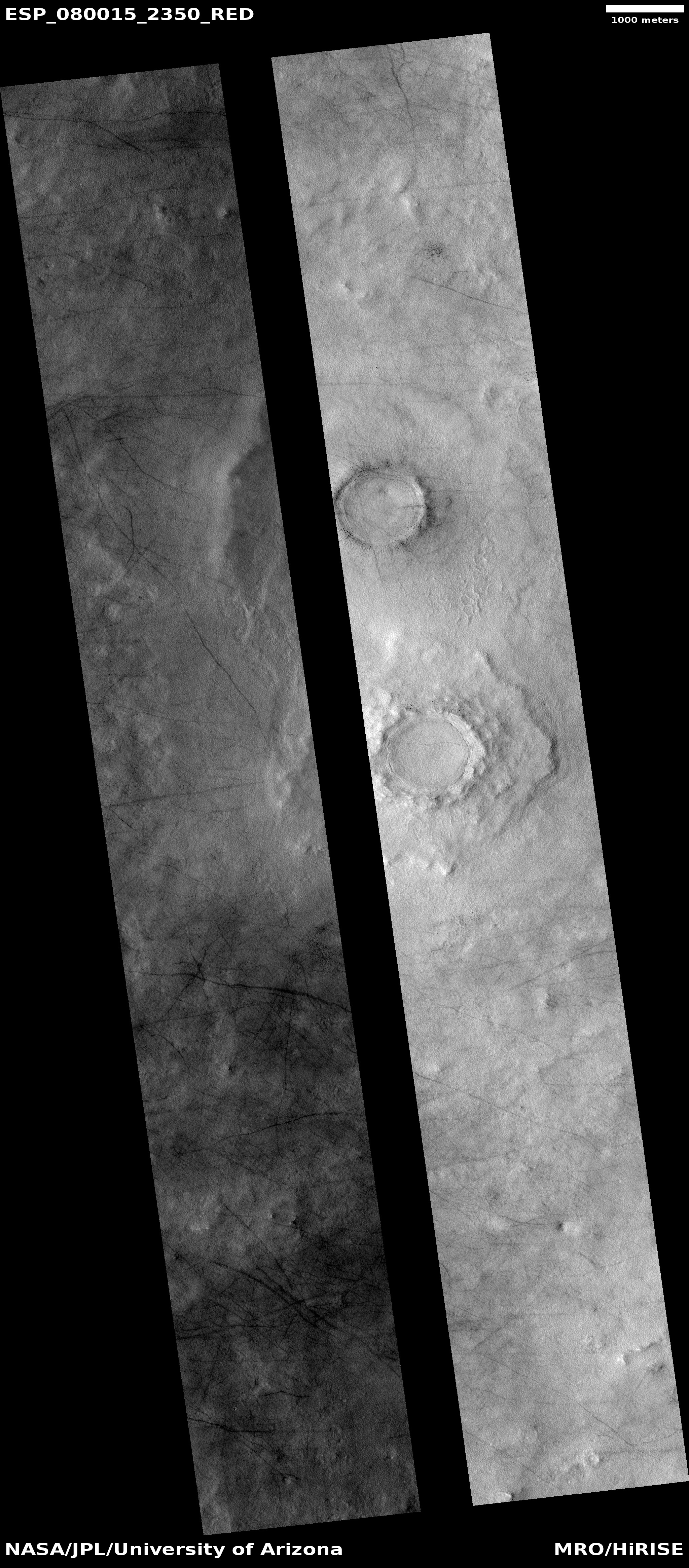
Cool image time! The picture to the right, rotated, cropped, reduced, and enhanced to post here, was taken on August 22, 2023 by the high resolution camera on Mars Reconnaissance Orbiter (MRO). I have also inserted data from a July 28, 2008 context camera image into the blank strip that now exists in the center of high resolution camera images due to the failure of one sensor.
This photo is what the camera team calls a terrain sample, and was probably taken not as part of any specific request but to fill a gap in the camera’s schedule in order to maintain its proper temperature. When the camera team does this they try to find locations that either have not been observed in much detail previously or have interesting features. In this case the team accomplished both. The interesting features are the two pedestal craters, both surrounded by splash aprons. Neither has been observed in high resolution previously, and the context camera has only taken two pictures of this location in total.
The white dot on the overview map to the right marks the location. As you can see from the inset, craters with splash aprons are not unusual in this region, located in the high northern latitudes above 50 degrees. In fact, from this point north almost all the craters have these aprons, suggesting that every single one smashed into an ice sheet that melted upon impact, flowed like mud for a short time, then refroze.
The two craters above however are also pedastal craters, as they sit above the surrounding terrain. The generally accepted explanation for this circumstance is that the impact hardened the crater floor and made it more erosion-resistant. When the surrounding terrain either eroded or sublimated away, the crater was left high and dry.
The number of pedastal craters in this region — combined with evidence that there is a lot of extensive near-surface ice — suggest however the possibility that they are instead mud volcanoes, whereby some geological process causes the near-surface ice to melt and erupt upward, much like a lava volcano.
There is a third option however. What if these pedastal craters are a combination of both? An asteroid or comet hits the northern Martian ice sheets, creating a crater and the splash apron. The resulting crater then becomes a good location for the formation of a mud volcano that fills the crater and pushes it up above the surrounding terrain.
All guesses, but intriguing nonetheless.
On Christmas Eve 1968 three Americans became the first humans to visit another world. What they did to celebrate was unexpected and profound, and will be remembered throughout all human history. Genesis: the Story of Apollo 8, Robert Zimmerman's classic history of humanity's first journey to another world, tells that story, and it is now available as both an ebook and an audiobook, both with a foreword by Valerie Anders and a new introduction by Robert Zimmerman.
The print edition can be purchased at Amazon or from any other book seller. If you want an autographed copy the price is $60 for the hardback and $45 for the paperback, plus $8 shipping for each. Go here for purchasing details. The ebook is available everywhere for $5.99 (before discount) at amazon, or direct from my ebook publisher, ebookit. If you buy it from ebookit you don't support the big tech companies and the author gets a bigger cut much sooner.
The audiobook is also available at all these vendors, and is also free with a 30-day trial membership to Audible.
"Not simply about one mission, [Genesis] is also the history of America's quest for the moon... Zimmerman has done a masterful job of tying disparate events together into a solid account of one of America's greatest human triumphs."--San Antonio Express-News