The weird landscape of Mars’ death valley
Click for original image.
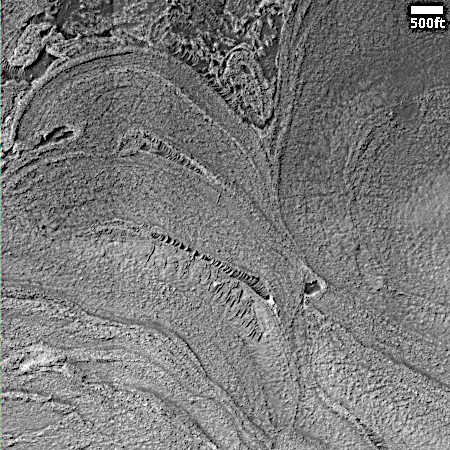
Cool image time! The picture to the right, rotated, cropped, reduced, and enhanced to post here, was taken on October 28, 2025 by the high resolution camera on Mars Reconnaissance Orbiter (MRO).
The science team labels this “bands near mesa,” an apt description. What we are looking at is a geological feature unique to Mars, but also unique to only one particular place on Mars, the planet’s death valley, the place in Hellas Basin with the lowest relative elevation of any spot on Mars.
The feature is called taffy terrain. According to a 2014 paper, the scientists posit that this material must be some sort of “a viscous fluid,” naturally flowing downward into “localized depressions.” Those localized depressions however happen to also be at the very basement of Mars.
Note how in some spots the bands appear to have been stripped off, exposing small hollows in which dust has become trapped over time to form ripple dunes.
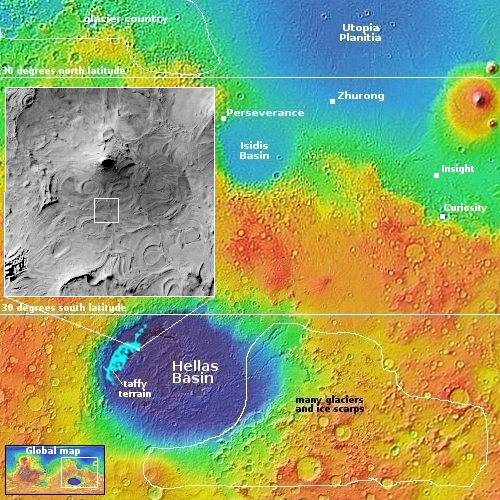
The white dot on the overview map to the right marks the location, on the eastern edge of the region where taffy terrain is located. It essentially fills the floor of the lowest part of Hellas Basin, an arc that parallels its northwest margin.
The inset shows how this taffy material surrounds that pointed mesa nearby. The mesa itself is about 1,500 to 2,000 feet high, depending on where you stand on the taffy that surrounds it.
At present no one really knows the origin of taffy terrain. It might be hardened lava, but it could just as well be hardened mud from a time the ground here was wet. What we do know is that it is very strange landscape, which is why I have posted a lot of images of it over the years.

On Christmas Eve 1968 three Americans became the first humans to visit another world. What they did to celebrate was unexpected and profound, and will be remembered throughout all human history. Genesis: the Story of Apollo 8, Robert Zimmerman's classic history of humanity's first journey to another world, tells that story, and it is now available as both an ebook and an audiobook, both with a foreword by Valerie Anders and a new introduction by Robert Zimmerman.
The print edition can be purchased at Amazon or from any other book seller. If you want an autographed copy the price is $60 for the hardback and $45 for the paperback, plus $8 shipping for each. Go here for purchasing details. The ebook is available everywhere for $5.99 (before discount) at amazon, or direct from my ebook publisher, ebookit. If you buy it from ebookit you don't support the big tech companies and the author gets a bigger cut much sooner.
The audiobook is also available at all these vendors, and is also free with a 30-day trial membership to Audible.
"Not simply about one mission, [Genesis] is also the history of America's quest for the moon... Zimmerman has done a masterful job of tying disparate events together into a solid account of one of America's greatest human triumphs."--San Antonio Express-News

Click for original image.
Cool image time! The picture to the right, rotated, cropped, reduced, and enhanced to post here, was taken on October 28, 2025 by the high resolution camera on Mars Reconnaissance Orbiter (MRO).
The science team labels this “bands near mesa,” an apt description. What we are looking at is a geological feature unique to Mars, but also unique to only one particular place on Mars, the planet’s death valley, the place in Hellas Basin with the lowest relative elevation of any spot on Mars.
The feature is called taffy terrain. According to a 2014 paper, the scientists posit that this material must be some sort of “a viscous fluid,” naturally flowing downward into “localized depressions.” Those localized depressions however happen to also be at the very basement of Mars.
Note how in some spots the bands appear to have been stripped off, exposing small hollows in which dust has become trapped over time to form ripple dunes.
The white dot on the overview map to the right marks the location, on the eastern edge of the region where taffy terrain is located. It essentially fills the floor of the lowest part of Hellas Basin, an arc that parallels its northwest margin.
The inset shows how this taffy material surrounds that pointed mesa nearby. The mesa itself is about 1,500 to 2,000 feet high, depending on where you stand on the taffy that surrounds it.
At present no one really knows the origin of taffy terrain. It might be hardened lava, but it could just as well be hardened mud from a time the ground here was wet. What we do know is that it is very strange landscape, which is why I have posted a lot of images of it over the years.
On Christmas Eve 1968 three Americans became the first humans to visit another world. What they did to celebrate was unexpected and profound, and will be remembered throughout all human history. Genesis: the Story of Apollo 8, Robert Zimmerman's classic history of humanity's first journey to another world, tells that story, and it is now available as both an ebook and an audiobook, both with a foreword by Valerie Anders and a new introduction by Robert Zimmerman.
The print edition can be purchased at Amazon or from any other book seller. If you want an autographed copy the price is $60 for the hardback and $45 for the paperback, plus $8 shipping for each. Go here for purchasing details. The ebook is available everywhere for $5.99 (before discount) at amazon, or direct from my ebook publisher, ebookit. If you buy it from ebookit you don't support the big tech companies and the author gets a bigger cut much sooner.
The audiobook is also available at all these vendors, and is also free with a 30-day trial membership to Audible.
"Not simply about one mission, [Genesis] is also the history of America's quest for the moon... Zimmerman has done a masterful job of tying disparate events together into a solid account of one of America's greatest human triumphs."--San Antonio Express-News
these terrain studies will be useful when we try to find areas with minimal perchlorates
despite the giant dust storms I’m still cautiously optimistic there are areas nontoxic enough for robots to grow food in Martian soil
if only symbolic amounts, and with help from swamp bacteria