Voyager-2 discovered Neptune to be a planet of quickly changing weather
Click for source.
Cool image time! When Voyager-2 flew past Uranus in 1986, the data showed the gas giant’s weather to be relatively sedate and quiet, with little changing during the fly-by. Scientists expected this: Uranus’s distance from the Sun meant it got little energy to fuel an active climate, with any activity produced by internal heating due to the gravitational pressure of its mass. And Uranus did not produce that much heat internally.
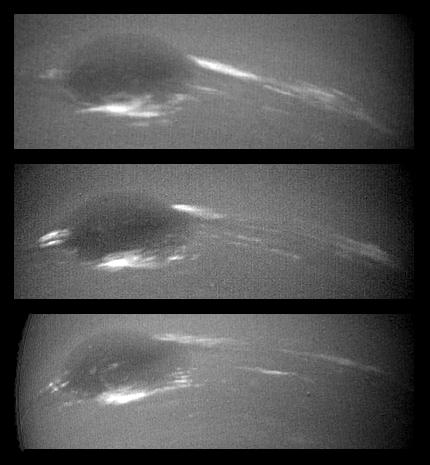
When Voyager-2 passed Neptune three year later, the scientists expected something similar, or even less, due to Neptune’s greater distance from the Sun. Instead, Voyager-2’s data showed Neptune’s weather patterns to be changing constantly and quickly, as illustrated by the three images of the Great Dark Spot to the right, the biggest storm on Neptune at that time and located in the planet’s southern mid-latitudes.
The bright cirrus-like clouds of Neptune change rapidly, often forming and dissipating over periods of several to tens of hours. In this sequence spanning two rotations of Neptune (about 36 hours) Voyager 2 observed cloud evolution in the region around the Great Dark Spot at an effective resolution of about 60 miles per pixel. The surprisingly rapid changes which occur over the 18 hours separating each panel shows that in this region Neptune’s weather is perhaps as dynamic and variable as that of the Earth. However, the scale is immense by our standards — the Earth and the [Great Dark Spot] are of similar size.
In Neptune’s frigid atmosphere, where temperatures are as low as 55 degrees Kelvin (360 F), the cirrus clouds are composed of frozen methane rather than Earth’s crystals of water ice.
Subsequent observations by the Hubble Space Telescope in 1994 found this Great Dark Spot was gone, replaced by a comparable storm in the northern hemisphere. Further Hubble observations found Neptune’s storms tend to last about two years, fading as they drifted towards the equator. Those observations however also detected storms drifting away from the equator. Other research suggested the storms might be influenced by the Sun’s sunspot cycle.
All of the data post-Voyager-2 remains very coarse and uncertain, as we are looking at Neptune at a great distance. Thus, no theory about what is happening carries much weight, especially because we do not know why Neptune produces so much more internal heat than Uranus, fueling this fast-changing weather. For example, Neptune gets 1/20th of the energy received by Jupiter, yet its atmosphere appears even more active and variable.

On Christmas Eve 1968 three Americans became the first humans to visit another world. What they did to celebrate was unexpected and profound, and will be remembered throughout all human history. Genesis: the Story of Apollo 8, Robert Zimmerman's classic history of humanity's first journey to another world, tells that story, and it is now available as both an ebook and an audiobook, both with a foreword by Valerie Anders and a new introduction by Robert Zimmerman.
The print edition can be purchased at Amazon or from any other book seller. If you want an autographed copy the price is $60 for the hardback and $45 for the paperback, plus $8 shipping for each. Go here for purchasing details. The ebook is available everywhere for $5.99 (before discount) at amazon, or direct from my ebook publisher, ebookit. If you buy it from ebookit you don't support the big tech companies and the author gets a bigger cut much sooner.
The audiobook is also available at all these vendors, and is also free with a 30-day trial membership to Audible.
"Not simply about one mission, [Genesis] is also the history of America's quest for the moon... Zimmerman has done a masterful job of tying disparate events together into a solid account of one of America's greatest human triumphs."--San Antonio Express-News
Click for source.
Cool image time! When Voyager-2 flew past Uranus in 1986, the data showed the gas giant’s weather to be relatively sedate and quiet, with little changing during the fly-by. Scientists expected this: Uranus’s distance from the Sun meant it got little energy to fuel an active climate, with any activity produced by internal heating due to the gravitational pressure of its mass. And Uranus did not produce that much heat internally.
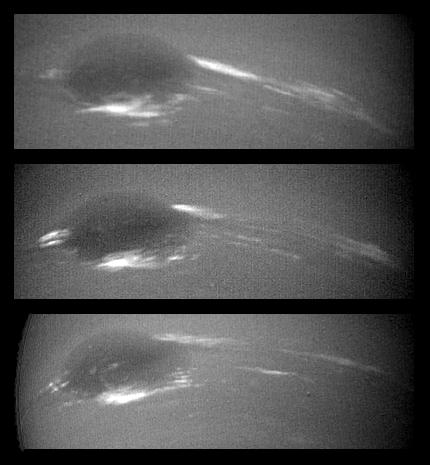
When Voyager-2 passed Neptune three year later, the scientists expected something similar, or even less, due to Neptune’s greater distance from the Sun. Instead, Voyager-2’s data showed Neptune’s weather patterns to be changing constantly and quickly, as illustrated by the three images of the Great Dark Spot to the right, the biggest storm on Neptune at that time and located in the planet’s southern mid-latitudes.
The bright cirrus-like clouds of Neptune change rapidly, often forming and dissipating over periods of several to tens of hours. In this sequence spanning two rotations of Neptune (about 36 hours) Voyager 2 observed cloud evolution in the region around the Great Dark Spot at an effective resolution of about 60 miles per pixel. The surprisingly rapid changes which occur over the 18 hours separating each panel shows that in this region Neptune’s weather is perhaps as dynamic and variable as that of the Earth. However, the scale is immense by our standards — the Earth and the [Great Dark Spot] are of similar size.
In Neptune’s frigid atmosphere, where temperatures are as low as 55 degrees Kelvin (360 F), the cirrus clouds are composed of frozen methane rather than Earth’s crystals of water ice.
Subsequent observations by the Hubble Space Telescope in 1994 found this Great Dark Spot was gone, replaced by a comparable storm in the northern hemisphere. Further Hubble observations found Neptune’s storms tend to last about two years, fading as they drifted towards the equator. Those observations however also detected storms drifting away from the equator. Other research suggested the storms might be influenced by the Sun’s sunspot cycle.
All of the data post-Voyager-2 remains very coarse and uncertain, as we are looking at Neptune at a great distance. Thus, no theory about what is happening carries much weight, especially because we do not know why Neptune produces so much more internal heat than Uranus, fueling this fast-changing weather. For example, Neptune gets 1/20th of the energy received by Jupiter, yet its atmosphere appears even more active and variable.
On Christmas Eve 1968 three Americans became the first humans to visit another world. What they did to celebrate was unexpected and profound, and will be remembered throughout all human history. Genesis: the Story of Apollo 8, Robert Zimmerman's classic history of humanity's first journey to another world, tells that story, and it is now available as both an ebook and an audiobook, both with a foreword by Valerie Anders and a new introduction by Robert Zimmerman.
The print edition can be purchased at Amazon or from any other book seller. If you want an autographed copy the price is $60 for the hardback and $45 for the paperback, plus $8 shipping for each. Go here for purchasing details. The ebook is available everywhere for $5.99 (before discount) at amazon, or direct from my ebook publisher, ebookit. If you buy it from ebookit you don't support the big tech companies and the author gets a bigger cut much sooner.
The audiobook is also available at all these vendors, and is also free with a 30-day trial membership to Audible.
"Not simply about one mission, [Genesis] is also the history of America's quest for the moon... Zimmerman has done a masterful job of tying disparate events together into a solid account of one of America's greatest human triumphs."--San Antonio Express-News