
Voyager to make “a multi-million-dollar strategic investment” in Max Space’s inflatable habitats
Click for original image.
In an expansion of a partnership announced last month, Voyager Technologies — the lead company in the consortium building the Starlab space station — today announced it is now making “a multi-million-dollar strategic investment” in Max Space’s inflatable habitats, aiming at winning contracts both for NASA’s proposed Moon base as well as any other “future deep space missions.”
The actual dollar amount has not yet been released, but my sources say it is in “the low eight figures,” or more than $10 million but probably less than $25 million.
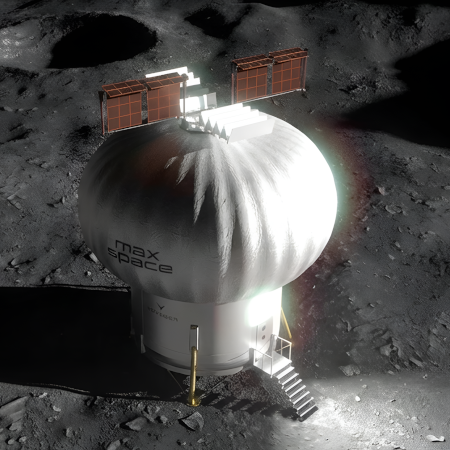
This partnership appears aimed not at NASA’s space station program nor enhancing Starlab. Instead, it is focused on providing NASA (and other commercial operations) inflatable habitats that can be launched and quickly established on the Moon and elsewhere, as shown by the artist’s rendering to the right. It appears Voyager will build the foundation, base, and airlock, while Max will provide the inflatable module above. From the press release:
This initiative directly supports NASA’s historical Artemis Program and aligns precisely with Administrator Isaacman’s announcement to be on the Moon to stay by 2028. Max Space delivers critical enabling infrastructure, maximizing livable volume, enhancing crew safety, and reducing the cost and complexity of surface deployment. It complements Voyager’s broader lunar roadmap, including cislunar mission management, surface logistics, propulsion, power systems, and future surface infrastructure, reinforcing a shared vision of the Moon as an operational domain, not a temporary destination.
In other words, the two companies are aiming to become major suppliers for NASA’s Artemis lunar base, and to do that by offering a way to get it quickly built and operational, at a reasonable cost.
I suspect it will be a few years before NASA issues any such contracts. It will first want to see both companies demonstrate success, both with Voyager’s Starlab and Max Space’s own demo station module scheduled for launch in ’27. Nonetheless, this announcement puts them on the map in the race to get those contracts, and begins to put some commercial reality to the American colonization of the solar system.

On Christmas Eve 1968 three Americans became the first humans to visit another world. What they did to celebrate was unexpected and profound, and will be remembered throughout all human history. Genesis: the Story of Apollo 8, Robert Zimmerman's classic history of humanity's first journey to another world, tells that story, and it is now available as both an ebook and an audiobook, both with a foreword by Valerie Anders and a new introduction by Robert Zimmerman.
The print edition can be purchased at Amazon or from any other book seller. If you want an autographed copy the price is $60 for the hardback and $45 for the paperback, plus $8 shipping for each. Go here for purchasing details. The ebook is available everywhere for $5.99 (before discount) at amazon, or direct from my ebook publisher, ebookit. If you buy it from ebookit you don't support the big tech companies and the author gets a bigger cut much sooner.
The audiobook is also available at all these vendors, and is also free with a 30-day trial membership to Audible.
"Not simply about one mission, [Genesis] is also the history of America's quest for the moon... Zimmerman has done a masterful job of tying disparate events together into a solid account of one of America's greatest human triumphs."--San Antonio Express-News
Click for original image.
In an expansion of a partnership announced last month, Voyager Technologies — the lead company in the consortium building the Starlab space station — today announced it is now making “a multi-million-dollar strategic investment” in Max Space’s inflatable habitats, aiming at winning contracts both for NASA’s proposed Moon base as well as any other “future deep space missions.”
The actual dollar amount has not yet been released, but my sources say it is in “the low eight figures,” or more than $10 million but probably less than $25 million.
This partnership appears aimed not at NASA’s space station program nor enhancing Starlab. Instead, it is focused on providing NASA (and other commercial operations) inflatable habitats that can be launched and quickly established on the Moon and elsewhere, as shown by the artist’s rendering to the right. It appears Voyager will build the foundation, base, and airlock, while Max will provide the inflatable module above. From the press release:
This initiative directly supports NASA’s historical Artemis Program and aligns precisely with Administrator Isaacman’s announcement to be on the Moon to stay by 2028. Max Space delivers critical enabling infrastructure, maximizing livable volume, enhancing crew safety, and reducing the cost and complexity of surface deployment. It complements Voyager’s broader lunar roadmap, including cislunar mission management, surface logistics, propulsion, power systems, and future surface infrastructure, reinforcing a shared vision of the Moon as an operational domain, not a temporary destination.
In other words, the two companies are aiming to become major suppliers for NASA’s Artemis lunar base, and to do that by offering a way to get it quickly built and operational, at a reasonable cost.
I suspect it will be a few years before NASA issues any such contracts. It will first want to see both companies demonstrate success, both with Voyager’s Starlab and Max Space’s own demo station module scheduled for launch in ’27. Nonetheless, this announcement puts them on the map in the race to get those contracts, and begins to put some commercial reality to the American colonization of the solar system.
On Christmas Eve 1968 three Americans became the first humans to visit another world. What they did to celebrate was unexpected and profound, and will be remembered throughout all human history. Genesis: the Story of Apollo 8, Robert Zimmerman's classic history of humanity's first journey to another world, tells that story, and it is now available as both an ebook and an audiobook, both with a foreword by Valerie Anders and a new introduction by Robert Zimmerman.
The print edition can be purchased at Amazon or from any other book seller. If you want an autographed copy the price is $60 for the hardback and $45 for the paperback, plus $8 shipping for each. Go here for purchasing details. The ebook is available everywhere for $5.99 (before discount) at amazon, or direct from my ebook publisher, ebookit. If you buy it from ebookit you don't support the big tech companies and the author gets a bigger cut much sooner.
The audiobook is also available at all these vendors, and is also free with a 30-day trial membership to Audible.
"Not simply about one mission, [Genesis] is also the history of America's quest for the moon... Zimmerman has done a masterful job of tying disparate events together into a solid account of one of America's greatest human triumphs."--San Antonio Express-News
After seeing that illustration I had to look up whether Jiffy Pop was still available. Apparently it is. Looks like the same fold pattern in the habitat shell as Jiffy Pop has used for the last sixty years. I assume the material is a bit sturdier though.
the American colonization of the solar system.
Now, there’s an expression that will trigger some people!
(But I doubt any of them are regular Behind the Black readers.)
“the American colonization of the solar system.”.
let’s hope it’s not on stolen lands
Well, there is a kind of synergy between stingy Grover Norquist types and hate-America Reds/Greens….as a Dandridge Cole fan, I find both exasperating.
OMB (even before Vought) and fans of tax dollars going to folks having kids out of wedlock have both kept America Earthbound.
A pox be upon both their houses.
As for the tech…I’d prefer deployables on the Moon only.
I want metal modules in orbit–surrounded by inflates so to keep astronauts in between layers…no risk of things floating off
Moreover, if you have a layer behind you…you can press hullward with feet with the inflate at your back.
This means you have purchase….that you can * bear down*
You can’t do that while floating.
Musgrave was a natural at space Kabuki, lightly touching items….but I think it is important to have the ability to use brute force on items–and you can’t do that on the end of a manipulator arm either…too limber.