Webb finds another unexpected galaxy in the very early universe
Click for original image.
The uncertainty of science: Using the Webb Space Telescope, astronomers have discovered another galaxy in the very early universe that appears too bright and developed for it to even exist so soon after the Big Bang.
MoM-z14 is one of a growing group of surprisingly bright galaxies in the early universe – 100 times more than theoretical studies predicted before the launch of Webb, according to the research team. “There is a growing chasm between theory and observation related to the early universe, which presents compelling questions to be explored going forward,” said Jacob Shen, a postdoctoral researcher at MIT and a member of the research team.
…With galaxy MoM-z14 existing only 280 million years after the big bang, there was not enough time for generations of stars to produce such high amounts of nitrogen in the way that astronomers would expect. One theory the researchers note is that the dense environment of the early universe resulted in supermassive stars capable of producing more nitrogen than any stars observed in the local universe.
All theories about the Big Bang and the early universe did not predict the existence of this galaxy, or a bunch of others that Webb has now detected.
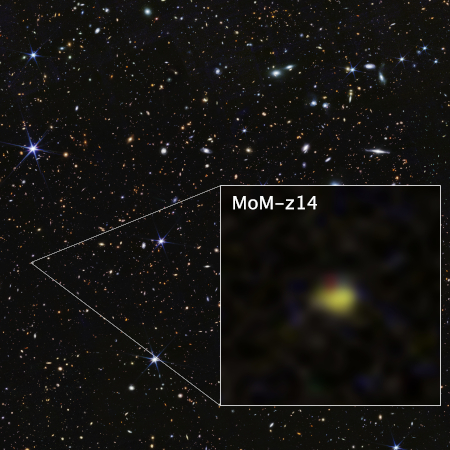
The false color infrared Webb image is to the right, cropped and reduced to post here. The full image covered a much larger area, so this tiny galaxy was not easy to find. Scientists identified it by the very high red shift of its light, due to the expansion of the universe and it being so far away. That expansion away from us causes the wavelengths of its light to stretch into the infrared so that only Webb can see it.

On Christmas Eve 1968 three Americans became the first humans to visit another world. What they did to celebrate was unexpected and profound, and will be remembered throughout all human history. Genesis: the Story of Apollo 8, Robert Zimmerman's classic history of humanity's first journey to another world, tells that story, and it is now available as both an ebook and an audiobook, both with a foreword by Valerie Anders and a new introduction by Robert Zimmerman.
The print edition can be purchased at Amazon or from any other book seller. If you want an autographed copy the price is $60 for the hardback and $45 for the paperback, plus $8 shipping for each. Go here for purchasing details. The ebook is available everywhere for $5.99 (before discount) at amazon, or direct from my ebook publisher, ebookit. If you buy it from ebookit you don't support the big tech companies and the author gets a bigger cut much sooner.
The audiobook is also available at all these vendors, and is also free with a 30-day trial membership to Audible.
"Not simply about one mission, [Genesis] is also the history of America's quest for the moon... Zimmerman has done a masterful job of tying disparate events together into a solid account of one of America's greatest human triumphs."--San Antonio Express-News

Click for original image.
The uncertainty of science: Using the Webb Space Telescope, astronomers have discovered another galaxy in the very early universe that appears too bright and developed for it to even exist so soon after the Big Bang.
MoM-z14 is one of a growing group of surprisingly bright galaxies in the early universe – 100 times more than theoretical studies predicted before the launch of Webb, according to the research team. “There is a growing chasm between theory and observation related to the early universe, which presents compelling questions to be explored going forward,” said Jacob Shen, a postdoctoral researcher at MIT and a member of the research team.
…With galaxy MoM-z14 existing only 280 million years after the big bang, there was not enough time for generations of stars to produce such high amounts of nitrogen in the way that astronomers would expect. One theory the researchers note is that the dense environment of the early universe resulted in supermassive stars capable of producing more nitrogen than any stars observed in the local universe.
All theories about the Big Bang and the early universe did not predict the existence of this galaxy, or a bunch of others that Webb has now detected.
The false color infrared Webb image is to the right, cropped and reduced to post here. The full image covered a much larger area, so this tiny galaxy was not easy to find. Scientists identified it by the very high red shift of its light, due to the expansion of the universe and it being so far away. That expansion away from us causes the wavelengths of its light to stretch into the infrared so that only Webb can see it.
On Christmas Eve 1968 three Americans became the first humans to visit another world. What they did to celebrate was unexpected and profound, and will be remembered throughout all human history. Genesis: the Story of Apollo 8, Robert Zimmerman's classic history of humanity's first journey to another world, tells that story, and it is now available as both an ebook and an audiobook, both with a foreword by Valerie Anders and a new introduction by Robert Zimmerman.
The print edition can be purchased at Amazon or from any other book seller. If you want an autographed copy the price is $60 for the hardback and $45 for the paperback, plus $8 shipping for each. Go here for purchasing details. The ebook is available everywhere for $5.99 (before discount) at amazon, or direct from my ebook publisher, ebookit. If you buy it from ebookit you don't support the big tech companies and the author gets a bigger cut much sooner.
The audiobook is also available at all these vendors, and is also free with a 30-day trial membership to Audible.
"Not simply about one mission, [Genesis] is also the history of America's quest for the moon... Zimmerman has done a masterful job of tying disparate events together into a solid account of one of America's greatest human triumphs."--San Antonio Express-News