Webb takes a look at a strange planetary nebula
Click for original image.
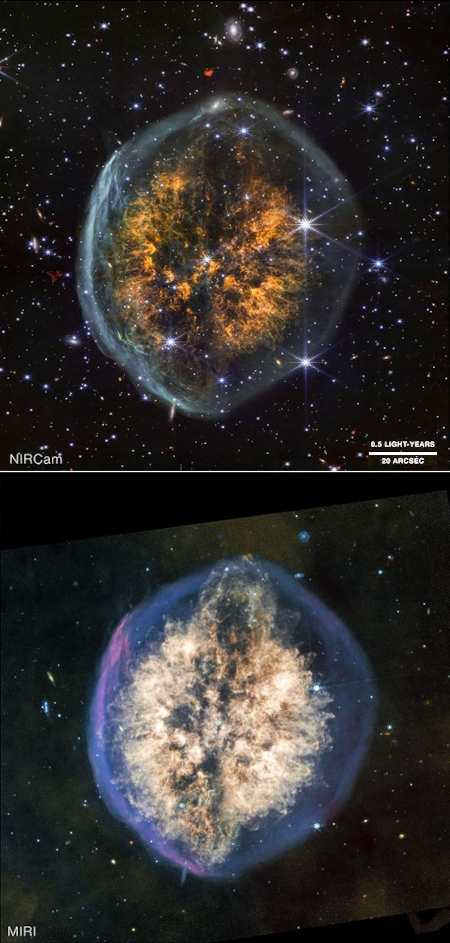
Cool image time! The two false-color pictures to the right, reduced to post here, were taken by two different infrared cameras on the Webb Space Telescope.
The object, PMR-1, is about 5,000 light years away and has apparently not been studied very much in the past. In 2013 astronomers used the Spitzer Space Telescope to get a first look in the infrared, at a much lower resolution. They also gave this object a nickname, the “Exposed Cranium” nebula. From the Webb press release:
The nebula appears to have distinct regions that capture different phases of its evolution — an outer shell of gas that was blown off first and consists mostly of hydrogen, and an inner cloud with more structure that contains a mix of different gases. Both Webb’s NIRCam (Near-Infrared Camera) and MIRI (Mid-Infrared Instrument) show a distinctive dark lane running vertically through the middle of the nebula that defines its brain-like look of left and right hemispheres. Webb’s resolution shows that this lane could be related to an outburst or outflow from the central star, which typically occurs as twin jets burst out in opposite directions. Evidence for this is particularly notable at the top of the nebula in Webb’s MIRI image, where it looks like the inner gas is being ejected outward.
While there is still much to be understood about this nebula, it’s clear that it is being created by a star near the end of its fuel-burning “life.” In their end stages, stars expel their outer layers. It’s a dynamic and fairly fast process, in cosmic terms. Webb has captured a moment in this star’s decline. What ultimately happens will depend on the mass of the star, which is yet to be determined. If it’s massive enough, it will explode in a supernova. A less massive Sun-like star will continue to shed layers until only its core remains as a dense white dwarf, which will cool off over eons.
The dark lane suggests we are looking at the star’s equator, with the two lobes on either side the material being flung out ward from the poles. It is also possible this is wrong, because the lobes on either side do not have a clear distinct jet-like appearance.

On Christmas Eve 1968 three Americans became the first humans to visit another world. What they did to celebrate was unexpected and profound, and will be remembered throughout all human history. Genesis: the Story of Apollo 8, Robert Zimmerman's classic history of humanity's first journey to another world, tells that story, and it is now available as both an ebook and an audiobook, both with a foreword by Valerie Anders and a new introduction by Robert Zimmerman.
The print edition can be purchased at Amazon or from any other book seller. If you want an autographed copy the price is $60 for the hardback and $45 for the paperback, plus $8 shipping for each. Go here for purchasing details. The ebook is available everywhere for $5.99 (before discount) at amazon, or direct from my ebook publisher, ebookit. If you buy it from ebookit you don't support the big tech companies and the author gets a bigger cut much sooner.
The audiobook is also available at all these vendors, and is also free with a 30-day trial membership to Audible.
"Not simply about one mission, [Genesis] is also the history of America's quest for the moon... Zimmerman has done a masterful job of tying disparate events together into a solid account of one of America's greatest human triumphs."--San Antonio Express-News

Click for original image.
Cool image time! The two false-color pictures to the right, reduced to post here, were taken by two different infrared cameras on the Webb Space Telescope.
The object, PMR-1, is about 5,000 light years away and has apparently not been studied very much in the past. In 2013 astronomers used the Spitzer Space Telescope to get a first look in the infrared, at a much lower resolution. They also gave this object a nickname, the “Exposed Cranium” nebula. From the Webb press release:
The nebula appears to have distinct regions that capture different phases of its evolution — an outer shell of gas that was blown off first and consists mostly of hydrogen, and an inner cloud with more structure that contains a mix of different gases. Both Webb’s NIRCam (Near-Infrared Camera) and MIRI (Mid-Infrared Instrument) show a distinctive dark lane running vertically through the middle of the nebula that defines its brain-like look of left and right hemispheres. Webb’s resolution shows that this lane could be related to an outburst or outflow from the central star, which typically occurs as twin jets burst out in opposite directions. Evidence for this is particularly notable at the top of the nebula in Webb’s MIRI image, where it looks like the inner gas is being ejected outward.
While there is still much to be understood about this nebula, it’s clear that it is being created by a star near the end of its fuel-burning “life.” In their end stages, stars expel their outer layers. It’s a dynamic and fairly fast process, in cosmic terms. Webb has captured a moment in this star’s decline. What ultimately happens will depend on the mass of the star, which is yet to be determined. If it’s massive enough, it will explode in a supernova. A less massive Sun-like star will continue to shed layers until only its core remains as a dense white dwarf, which will cool off over eons.
The dark lane suggests we are looking at the star’s equator, with the two lobes on either side the material being flung out ward from the poles. It is also possible this is wrong, because the lobes on either side do not have a clear distinct jet-like appearance.
On Christmas Eve 1968 three Americans became the first humans to visit another world. What they did to celebrate was unexpected and profound, and will be remembered throughout all human history. Genesis: the Story of Apollo 8, Robert Zimmerman's classic history of humanity's first journey to another world, tells that story, and it is now available as both an ebook and an audiobook, both with a foreword by Valerie Anders and a new introduction by Robert Zimmerman.
The print edition can be purchased at Amazon or from any other book seller. If you want an autographed copy the price is $60 for the hardback and $45 for the paperback, plus $8 shipping for each. Go here for purchasing details. The ebook is available everywhere for $5.99 (before discount) at amazon, or direct from my ebook publisher, ebookit. If you buy it from ebookit you don't support the big tech companies and the author gets a bigger cut much sooner.
The audiobook is also available at all these vendors, and is also free with a 30-day trial membership to Audible.
"Not simply about one mission, [Genesis] is also the history of America's quest for the moon... Zimmerman has done a masterful job of tying disparate events together into a solid account of one of America's greatest human triumphs."--San Antonio Express-News
You know that’s actually a giant brain, seen from the top, down, right?
F: Reread the post. Note the nickname the astronomers gave for this nebula.
Wasn’t there a SPACE:1999 episode about this?
It looks like that star done blowed up real good.
This looks like a molecule to me!
…until only its core remains as a dense white dwarf, which will cool off over eons.
“Eons” grossly understates the situation. While an eon can mean up to a couple billion years on earth, it’s worth noting that no “white dwarf” in the universe has yet had time (in a 13.8 billion year old cosmos) to cool off below red hot at this point. Quadrillions of years (not just trillions) is the time-scale required for them all to cool to invisibility.
Agreed Michael, good point.
To understand the cooling of celestial objects, you must first understand the heating mechanism.
All heat is friction.
The thicker the atmosphere around a planet or a Sun, the greater the friction at the bottom of that atmosphere.
(that’s why earth with an “atmosphere” is 100° warmer on average then it’s moon in the same orbit)
The heavier molecules around Jupiter weigh so much that the eternal temperature of Jupiter is nearly 4 times hotter than the surface of our Sun. (photosphere)
Any white dwarf that has the two needed elements of mass/ and an atmosphere, will have frictional heat generated from the mass of that atmosphere.
(Fusion of lighter elements into heavier ones is always measurable by the radiation it produces… If our Sun produced it’s heat by fusion, our planet would be dead! irradiated lifeless from the Sun’s radiation byproducts with every rotation) (I would add my favorite quote, you get more radiation from smoking cigarettes than you do from living in space)
Recent supernovas also have a nuclear signature that sets off earth radiation detectors. (A blast of neutrons) The leading theory is supernovas are a runaway radiological event. (Mostly not found in normal sun’s or interstellar space would be a wash with insurmountable radiation)
Should sci-fi faster than light space travel be possible, supernova remanence would provide strange matter and radiological mass to power a solar systems for millions of years!