OneWeb lost $229 million when Russia canceled its launches and confiscated its satellites

On September 1, 2022, OneWeb revealed that Russia’s cancellation of the last six or so OneWeb launches as well as Russia’s confiscation of 36 satellites cost the company $229 million.

Russia’s actions were the response by then head of Roscosmos, Dmitry Rogozin, to sanctions imposed on Russia by the west because of its invasion of the Ukraine. Rogozin’s petty response ended up shooting his space agency in the foot, because it ended up losing billions of dollars in foreign launch business, business that is not likely to return for decades.

OneWeb has since signed contracts with SpaceX, ISRO (India’s space agency), and Relativity for future launches. None of these have been firmly scheduled, though the first by SpaceX is tentatively planned for sometime before the end of the year.

11 comments

SLS test launch scrubbed again

NASA engineers once again were forced to scrub the launch of the SLS rocket today due to another hydrogen leak during fueling.

The launch director waived off todayโ€™s Artemis I launch attempt at approximately 11:17 a.m. EDT. Teams encountered a liquid hydrogen leak while loading the propellant into the core stage of the Space Launch System rocket. Multiple troubleshooting efforts to address the area of the leak by reseating a seal in the quick disconnect where liquid hydrogen is fed into the rocket did not fix the issue.

NASA has one more chance, on September 5th, to launch this rocket before it must return it to the assembly building to replace the flight termination batteries, used to abort the launch after liftoff should something go seriously wrong during flight. As I understand it, their use-by date is September 6th, and it would require a major safety waiver by the military range officer, who is entirely independent from NASA and under no obligation to it, to allow for a launch after that date with those batteries.

8 comments

September 2, 2022 Quick space links

Courtesy of BtB’s stringer Jay.

The tweet however provides no date for the test, nor any information about this particular engine itself.

This is preliminary design work involving Earth-based tests. A later phase, not yet awarded, will move on to orbital tests.

Most of this new private capital apparently came from Saudi Arabia and Greece, and the constellation will start out focused on serving those regions as well as Luxembourg.

1 comment

Sunspot update: Solar activity continues to exceed sunspot predictions

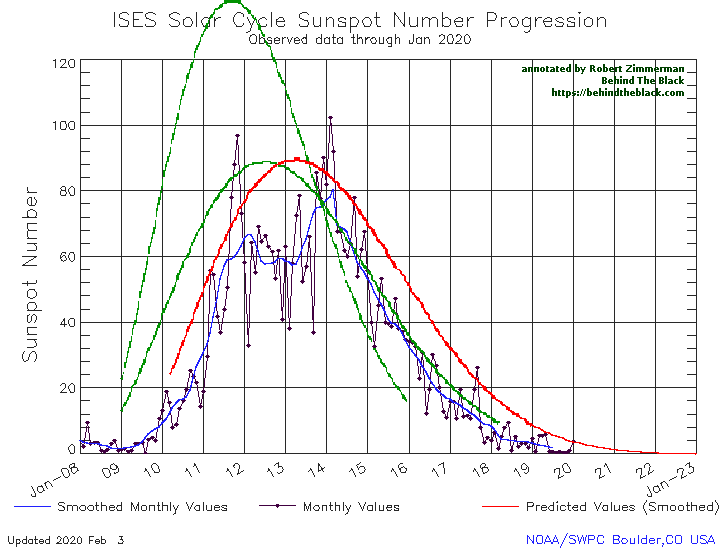
It is the beginning of September and time to post another update on the Sun’s ongoing solar cycle. Below is NOAA’s monthly graph tracking the number of sunspots on the Sun’s Earth-facing hemisphere, with the activity in August now added. I have also added some additional details to the graph to give the numbers a larger context.

Though sunspot activity dropped in August it remained significantly above the predictions of the panel of government solar scientists put together by NOAA. The predicted sunspot number for August, as indicated by the red curve, was supposed to be about 48. The actual number was 75.

» Read more

4 comments

Pushback: Maine parent wins lawsuit against school board for attempting to ban him

McBreairty speaking in front of Hermon Town Council
McBreairty speaking in front of the Hermon town council about the
lawsuit against him. Click for video from which this image was captured.

Bring a gun to a knife fight: Shawn McBreairty, a Maine parent who had repeatedly challenged two different local school districts, including his own, for their efforts to teach the queer agenda to little children, yesterday won a $40K settlement from one of those school boards, Regional School Unit #22, after a court judge had ruled that the board’s actions to ban and censor McBreaity clearly violated his first amendment rights.

This is an update of an earlier August 1, 2022 blacklist column. Because McBreairty had tried to read aloud at a board meeting the pornography contained in several books that the school board had approved for its school children, he was silenced, then banned from attending school board meetings, both in person and virtually, for the next eight months.

When the judge ruled entirely in McBreairty’s favor, issuing a temporary injunction against the school board’s actions, the board clearly recognized its case would not hold up in court, and it chose to settle, paying $40K for McBreairty’s legal fees. As the judge noted in her decision:
» Read more

10 comments

Chinese astronauts complete first spacewalk using new Wentian module

The new colonial movement: Chinese astronauts yesterday completed their first spacewalk using the airlock on the new Wentian module that was recently launched to that nation’s Tiangong-3 space station.

The spacewalk lasted six hours, and was mostly designed to test the airlock itself as well as do the first tests of Wentian’s own robot arm. It appears they also installed an “extended pump set”, whatever that is, and did other work near the hatch. More here.

4 comments

NASA is paying Boeing twice as much as SpaceX for its manned flights

Capitalism in space: in an excellent analysis of the total amount NASA will pay both SpaceX and Boeing for all their manned flights to ISS before the station retires, Eric Berger at Ars Technica has determined that the agency will essentially pay Boeing twice as much per flight.

In 2014, NASA narrowed the crew competition to just two companies, Boeing and SpaceX. At that time, the space agency awarded Boeing $4.2 billion in funding for development of the Starliner spacecraft and six operational crew flights. Later, in an award that NASA’s own inspector general described as “unnecessary,” NASA paid Boeing an additional $287.2 million. This brings Boeing’s total to $4.49 billion, although Finch told Ars that Boeing’s contract value as of August 1, 2022, is $4.39 billion.

For the same services, development of Crew Dragon and six operational missions, NASA paid SpaceX $2.6 billion. After its initial award, NASA has agreed to buy an additional eight flights from SpaceXโ€”Crew-7, -8, -9, -10, -11, -12, -13, and -14โ€”through the year 2030. This brings the total contract awarded to SpaceX to $4.93 billion.

Since we now know how many flights each company will be providing NASA through the lifetime of the International Space Station, and the full cost of those contracts, we can break down the price NASA is paying each company per seat by amortizing the development costs.

Boeing, in flying 24 astronauts, has a per-seat price of $183 million. SpaceX, in flying 56 astronauts during the same time frame, has a seat price of $88 million. Thus, NASA is paying Boeing 2.1 times the price per seat that it is paying SpaceX, inclusive of development costs incurred by NASA.

Despite the larger payments to Boeing, the company could very well lose money on Starliner. The higher cost to NASA from Boeing is due almost entirely because the agency was absorbing more of its initial development cost. SpaceX’s Dragon capsule had already been flying cargo missions to ISS when these manned contracts were awarded. SpaceX merely had to upgrade its manned capsule. Boeing had to design and build it from scratch. Moreover, the contracts were fixed price, which means Boeing had to absorb more than a half billion in additional costs when it had to refly the unmanned demo flight of Starliner.

Finally, because of the delays, Boeing won less NASA business. It also has gotten none of the private commercial manned flights that are going on right now. Those contracts went to SpaceX, including all the profits. Whether Boeing can eventually win some private contracts down the road is unknown. It will certainly have to lower its price to compete with SpaceX.

13 comments

Rocket Lab completes first static fire test of previously flown rocket engine

Capitalism in space: Rocket Lab has successfully completed for the first time a full duration static fire test using one of its Rutherford rocket engines that had been flown on a launch earlier this year, recovered, and refurbished.

The engine was previously successfully launched to space and returned to Earth during Rocket Labโ€™s recent recovery mission, โ€˜There And Back Againโ€™, launched on May 2, 2022. The mission was the first time Rocket Lab attempted a mid-air capture of Electronโ€™s first stage, using parachutes on the rocket to slow its descent from space before a helicopter plucked the rocket from the sky as it approached Earthโ€™s surface. The Electron stage was ultimately released for a soft ocean splashdown, before it was collected by vessel and returned to Rocket Labโ€™s production complex.

The refurbished Rutherford engine passed all of the same rigorous acceptance tests Rocket Lab performs for every engine, including 200 seconds of engine fire and multiple restarts. Data from the test fire shows the engine produced full thrust of 21kNs within 1000 milliseconds of ignition and performed to the same standard of a newly-built Rutherford engine. This Rutherford engine will now continue as an engine life-leader for future Rutherford development.

I have embedded a video of the full test below. This achievement makes Rocket Lab only the third company to successfully refire a previously flown engine, after SpaceX and NASA’s space shuttle engines. It might also be the first time an engine recovered from the ocean has been successfully refurbished. SpaceX had tried to do the same with early Falcon 9 first stages, before they could land vertically, but all accounts suggested the salt water made the engines unusable.

Based on the the quote above, however, this engine will not be used on a future flight, but for testing only. The company still intends to catch the stages as they descend by parachute with a helicopter, which will then transport them safely to land. Further attempts to do so will take place in later launches this year.

» Read more

5 comments
1 708 709 710 711 712 2,914