January 29, 2026 Quick space links

Courtesy of BtB’s stringer Jay. This post is also an open thread. I welcome my readers to post any comments or additional links relating to any space issues, even if unrelated to the links below.

11 comments

Pluto’s mountains of ice surrounded by a sea of frozen nitrogen

Ice mountains floating in nitrogen sea on Pluto
Click for original image.

Cool image time! Though we only have a limited archive of high resolution pictures of Pluto that were taken when New Horizons did its close fly-by of the planet in July 2015, it is worthwhile sometimes to take a second look at some of those images. The picture to the right, cropped and annotated to post here, was taken during that July 14, 2015 fly-by, and shows a mountainous region dubbed Al-Idrisi Montes on the shore of a white frozen ocean. The red dotted line indicates a large trench that separates the Al-Idrisi mountains from the mountainous region to the west.

Sounds similar to an arctic shoreline here on Earth, doesn’t it? Not in the least. Those mountains, ranging from 600 to 9,000 feet high, are made of frozen ice, which on Pluto are as hard as granite due to the endless cold. And the white frozen ocean is frozen nitrogen, broken into polygon shaped blocks. Even stranger: those ice mountains might even be floating in that nitrogen sea! A paper from 2019 [pdf] looked at the New Horizons data and concluded as follows:

Evidence suggests that the Al-Idrisi mountains may have been uplifted by the formation of
the western trench feature. Solid state convection appears to be our best supposition as to how the Al-Idrisi Montes reached their heights.

In other words, as that large trench/depression formed, convection (the bubbles you see when you simmer tomato sauce) pushed these mountains of ice upward to float above the “sea level” of that nitrogen sea.

At least, that’s one hypothesis. The scientists who wrote this paper admit their “our hypothesis still remains in need of study and this trench-mountain system warrants serious further research.” In other words, we simply don’t know enough to have a definitive understanding of the geology of this extremely alien planet.

3 comments

Genesis cover

On Christmas Eve 1968 three Americans became the first humans to visit another world. What they did to celebrate was unexpected and profound, and will be remembered throughout all human history. Genesis: the Story of Apollo 8, Robert Zimmerman's classic history of humanity's first journey to another world, tells that story, and it is now available as both an ebook and an audiobook, both with a foreword by Valerie Anders and a new introduction by Robert Zimmerman.

The print edition can be purchased at Amazon or any other book seller. If you want an autographed copy the price is $60 for the hardback and $45 for the paperback, plus $8 shipping for each. Go here for purchasing details. The ebook is available everywhere for $5.99 (before discount) at amazon, or direct from my ebook publisher, ebookit. If you buy it from ebookit you don't support the big tech companies and the author gets a bigger cut much sooner.


The audiobook is also available at all these vendors, and is also free with a 30-day trial membership to Audible.
 

"Not simply about one mission, [Genesis] is also the history of America's quest for the moon... Zimmerman has done a masterful job of tying disparate events together into a solid account of one of America's greatest human triumphs."--San Antonio Express-News

SpaceX launches 25 more Starlink satellites

The beat goes on: SpaceX today successfully launched another 25 Starlink satellites, its Falcon 9 rocket lifting off from Vandenberg Space Force Base in California.

The first stage completed its 19th flight, landing on a drone ship in the Pacific.

It also appears on this launch SpaceX placed its 11,000th Starlink satellite into orbit. The actual number of satellites in orbit presently is much less than this, as SpaceX retires older Starlink satellites on a regularly basis. Nonetheless, the overall number is impressive, in that it was accomplished in less than seven years.

The 2026 launch race:

12 SpaceX
5 China
1 Rocket Lab

Though it is still early in 2026, note that SpaceX has now launched twice as much as the rest of the world, combined.

0 comments

Artemis-2 proves NASA learned nothing from the Challenger and Columbia failures

NASA: an agency still avoiding reality
NASA: an agency that still avoids reality

Our bankrupt new media continues to fail us. NASA is about to send four astronauts on a ten-day mission around the Moon in a capsule with questionable engineering, and that media continues to ignore the problem. Mainstream news outlets continue to describe the mission in glowing terms, consistently ignoring that questionable engineering. In some cases the stories even make believe NASA has fixed the problem, when it has not.

The most ridiculous example is an article yesterday from an Orlando outlet, Spectrum New 13: “How the lessons learned from the Challenger disaster apply to Artemis rockets”. It focuses entirely on the O-ring problem that destroyed Challenger, noting repeatedly that NASA has fixed this issue in its SLS rocket.

Of course it has. That’s the last war, long over. Engineers fixed this issue almost four decades ago. The article however dismisses entirely the new engineering concern of today, Orion’s heat shield, which did not work as expected during its own test flight in space in 2022. It covers this issue with this single two-sentence paragraph:

However, during re-entry, it broke up into chunks instead of burning away. This issue pushed back the Artemis II and III missions, but NASA has stated it has resolved the problem.

NASA however has not resolved the problem. It is using the same heat shield now on this manned mission, and really has no reason to assume it will work any better, even if the agency has changed the re-entry flight path in an effort to mitigate the heat shield’s questionable design.

You see, NASA with Artemis-2 is doing the exact same thing it did prior to both the Challenger and Columbia accidents. » Read more

40 comments

Conscious Choice cover

Now available in hardback and paperback as well as ebook!

From the press release: In this ground-breaking new history of early America, historian Robert Zimmerman not only exposes the lie behind The New York Times 1619 Project that falsely claims slavery is central to the history of the United States, he also provides profound lessons about the nature of human societies, lessons important for Americans today as well as for all future settlers on Mars and elsewhere in space.

 
Conscious Choice: The origins of slavery in America and why it matters today and for our future in outer space, is a riveting page-turning story that documents how slavery slowly became pervasive in the southern British colonies of North America, colonies founded by a people and culture that not only did not allow slavery but in every way were hostile to the practice.  
Conscious Choice does more however. In telling the tragic history of the Virginia colony and the rise of slavery there, Zimmerman lays out the proper path for creating healthy societies in places like the Moon and Mars.


“Zimmerman’s ground-breaking history provides every future generation the basic framework for establishing new societies on other worlds. We would be wise to heed what he says.” —Robert Zubrin, founder of the Mars Society.


All editions are available at Amazon, Barnes & Noble, and all book vendors, with the ebook priced at $5.99 before discount. All editions can also be purchased direct from the ebook publisher, ebookit, in which case you don't support the big tech companies and the author gets a bigger cut much sooner.


Autographed printed copies are also available at discount directly from the author (hardback $29.95; paperback $14.95; Shipping cost for either: $6.00). Just send an email to zimmerman @ nasw dot org.

The Warning – Dust To Dust/Dull Knives

An evening pause: In 2017 I posted an evening pause of this band, when Daniela (on guitar) was 14 years old, Paulina (on drums) was 12 years old, and Alejandra (on bass guitar) was 9 yrs old. Today’s evening pause is from their 2023 tour in Mexico (where they are from), celebrating the band’s tenth anniversary. To put it mildly, they are a bit older.

Hat tip Matt Falk, who adds, “They are all adults now who’ve become one of the best live rock bands playing today, while still maintaining complete control of their career (a feat in itself).”

4 comments

Leaving Earth cover

Leaving Earth: Space Stations, Rival Superpowers, and the Quest for Interplanetary Travel, can be purchased as an ebook everywhere for only $3.99 (before discount) at amazon, Barnes & Noble, all ebook vendors, or direct from my ebook publisher, ebookit.

If you buy it from ebookit you don't support the big oppressive tech companies and I get a bigger cut much sooner.


Winner of the 2003 Eugene M. Emme Award of the American Astronautical Society.

 
"Leaving Earth is one of the best and certainly the most comprehensive summary of our drive into space that I have ever read. It will be invaluable to future scholars because it will tell them how the next chapter of human history opened." -- Arthur C. Clarke

Saturn’s rings with two of its moons perfectly aligned

Two of Saturn's moons above its rings
Click for original image.

Cool image time! Rather than posting another Mars orbital image, I decided today to delve into the archive of pictures taken by the Cassini orbiter during the thirteen years it circled Saturn, from 2004 until 2017. The picture to the right, cropped to post here, was released on December 14, 2015, and is just one example of the many breath-taking photographs that the Cassini science team took during that mission. From the caption:

Like a cosmic bull’s-eye, Enceladus and Tethys line up almost perfectly for Cassini’s cameras. Since the two moons are not only aligned, but also at relatively similar distances from Cassini, the apparent sizes in this image are a good approximation of the relative sizes of Enceladus (313 miles across) and Tethys (660 miles across).

This view looks toward the un-illuminated side of the rings from 0.34 degrees below the ring plane. The image was taken in red light with the Cassini spacecraft narrow-angle camera on Sept. 24, 2015.

The image was obtained at a distance of approximately 1.3 million miles from Enceladus. Image scale on Enceladus is 7 miles per pixel. Tethys was at a distance of 1.6 million miles with a pixel scale of 10 miles per pixel.

Enceladus is in the foreground, and is the planet that has what scientists have labeled tiger stripe fractures that vent water and other material, including carbon molecules.

6 comments

Astronomers discover a “surprisingly mature” cluster of galaxies in early universe

Proto galaxy cluster
Click for original image.

The uncertainty of science strikes again! Astronomers using both the Webb Space Telescope and the Chandra X-ray Observatory now think they have discovered a just-forming protocluster of galaxies only one billion years after the Big Bang, when such galaxy clusters should not yet exist.

You can read their paper here [pdf]. The image to the right, cropped and reduced to post here, shows the Webb infrared data as the background of stars and galaxies, with the galaxies thought to be part of this protocluster circled. The blue cloud is Chandra’s X-ray data. From the press release:

The Chandra and Webb data reveal that JADES-ID1 contains the two properties that confirm the presence of a protocluster: a large number of galaxies held together by gravity (Webb sees at least 66 potential members) that are also sitting in a huge cloud of hot gas (detected by Chandra). As a galaxy cluster forms, gas falls inward and is heated by shock waves, reaching temperatures of millions of degrees and glowing in X-rays.

What makes JADES-ID1 exceptional is the remarkably early time when it appears in cosmic history. Most models of the universe predict that there likely would not be enough time and a large enough density of galaxies for a protocluster of this size to form only a billion years after the big bang. The previous record holder for a protocluster with X-ray emission is seen much later, about three billion years after the big bang.

It increasingly appears that there are aspects of the universe we simply do not yet understand, which in turn make our theories of its birth and formation either incomplete or invalid. Those theories might be right in principle, but the data suggests they are wrong in detail.

6 comments

New ground-based space antenna startup raises $100 million and wins $50 million Space Force contract

In a clear sign that the space industry in space now requires increased support on the ground, the ground-based space antenna startup, Northwood Space, this week announced it has raised $100 million in private investment capital even as it simultaneously won a $50 million Space Force contract.

The funding round, announced January 27, was led by Washington Harbour Partners and co-led by Andreessen Horowitz. The financing came on the heels of a $49.8 million contract that was signed with the United States Space Force to help improve the “satellite control network,” which “handles a huge variety of consequential space missions for our government,” said Bridgit Mendler, founder and CEO.

Northwood is an end-to-end ground infrastructure provider for space missions. In other words, it manufactures and deploys antennae systems, which are smaller than older models, that allow Earth to communicate with satellites in space.

Northwood was only formed three years ago, so its success is an clear indication that there is a real need for more and better ground-based facilities.

1 comment

German government hires German startup Polaris Spaceplanes to build reusable two-stage hypersonic plane

Mira-II prototype following first flight using aerospike engine
Mira-II prototype following first flight using
aerospike engine in October 2024.

The German government yesterday awarded a contract to the German startup Polaris Spaceplanes to build and fly a reusable two-stage hypersonic plane by 2027.

On 27 January, POLARIS Spaceplanes announced that it had been awarded a contract by the Federal Office of Bundeswehr Equipment, Information Technology and In-Service Support (BAAINBw) to build a fully reusable, horizontal take-off, two-stage hypersonic vehicle. The primary application of the Hypersonic Test and Experimentation Vehicle (HYTEV) will be as a hypersonic testbed for scientific and defence-related research. A variant of the vehicle with an expendable upper stage will also be capable of deploying small satellites into low Earth orbit.

According to the company, the HYTEV will be roughly the size and take-off mass of a fighter jet. The main stage will be powered by two turbofans and one of the company’s in-house developed aerospike rocket engines. The turbofans will be used for take-off and landing, and the rocket engine will accelerate the vehicle before upper-stage deployment. The upper stage will be entirely rocket-powered, with imagery accompanying the announcement appearing to show a more conventional rocket engine configuration compared with the aerospike engine equipped to the main stage. After completing its mission, it will likely be recovered under controlled glide conditions or potentially by a parachute or parafoil.

This deal appears to be an upgrade to a February 2025 German government deal with Polaris. It also follows Polaris’s successful use of an aerospike engine on a prototype test flight in 2024. While the company has shown some success, doing more than a dozen test flights with small scale prototypes (as shown in the image to the right), this program and schedule still seems quite ambitious.

3 comments

Ariane-6 gets a new government launch contract

The European Space Agency, one agency among many
The European Space Agency, one European
agency among many

The government rocket of the European Space Agency (ESA), the Ariane-6, yesterday won a new launch contract to place a pair of Galileo GPS-type satellites into orbit for the European Union (EU).

Arianespace announced today at the European Space Conference in Brussels the signature of the launch contract with the European Union Agency for the Space Programme (EUSPA), under the delegation of the European Commission, to orbit the second pair of second-generation satellites of the Galileo constellation (Galileo L18) on board an Ariane 6 launcher. With this signature, the European Commission and the EUSPA are formalizing the launch contract of Galileo L18, following the initial mission allocation to Arianespace made in April 2024.

All told this will be Ariane-6’s fifth launch of GPS-type satellites for the EU, which appears committed to Ariane-6, even though this expendable rocket costs much more than SpaceX’s Falcon 9, in order to promote European sovereignty. Eventually Europe will develop more cost effective private rockets (in about a decade), but until then its access to space will be limited by cost.

And the extra cost is not simply the expendable nature of Ariane-6. Note also the many layers of bureaucracy listed in the quote above. For the European Union there the European Union Agency for Space Programme, working under the supervision of the EU’s European Commission. It signed a deal with Arianespace, which represents the European Space Agency as its commercial rocket division.

That’s four different bureaucracies, two within the European Union and two more related to Europe’s space effort. Each adds cost to the launch, as well as the need for complex negotiations that delay any deal.

Not

6 comments

Webb finds another unexpected galaxy in the very early universe

Unexpected galaxy
Click for original image.

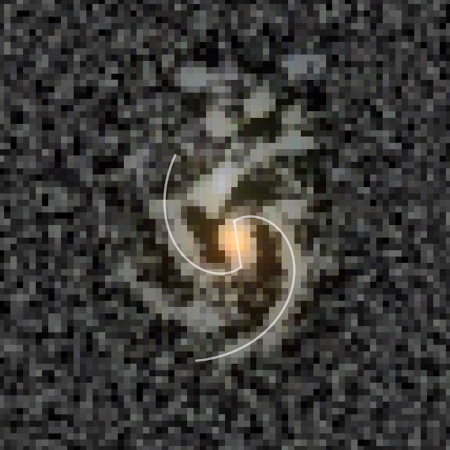
The uncertainty of science: Using the Webb Space Telescope, astronomers have discovered another galaxy in the very early universe that appears too bright and developed for it to even exist so soon after the Big Bang.

MoM-z14 is one of a growing group of surprisingly bright galaxies in the early universe – 100 times more than theoretical studies predicted before the launch of Webb, according to the research team. “There is a growing chasm between theory and observation related to the early universe, which presents compelling questions to be explored going forward,” said Jacob Shen, a postdoctoral researcher at MIT and a member of the research team.

…With galaxy MoM-z14 existing only 280 million years after the big bang, there was not enough time for generations of stars to produce such high amounts of nitrogen in the way that astronomers would expect. One theory the researchers note is that the dense environment of the early universe resulted in supermassive stars capable of producing more nitrogen than any stars observed in the local universe.

All theories about the Big Bang and the early universe did not predict the existence of this galaxy, or a bunch of others that Webb has now detected.

The false color infrared Webb image is to the right, cropped and reduced to post here. The full image covered a much larger area, so this tiny galaxy was not easy to find. Scientists identified it by the very high red shift of its light, due to the expansion of the universe and it being so far away. That expansion away from us causes the wavelengths of its light to stretch into the infrared so that only Webb can see it.

0 comments
1 58 59 60 61 62 2,927