
10,000 Maniacs – Because the night
An evening pause: Performed live 1993.
Hat tip Clark Jerrell.
An evening pause: Performed live 1993.
Hat tip Clark Jerrell.
Courtesy of BtB’s stringer Jay. This post is also an open thread. I welcome my readers to post any comments or additional links relating to any space issues, even if unrelated to the links below.
Note: If the X tweet videos don’t play, right click on the tweet and open it in a new tab. It should play there.

On Christmas Eve 1968 three Americans became the first humans to visit another world. What they did to celebrate was unexpected and profound, and will be remembered throughout all human history. Genesis: the Story of Apollo 8, Robert Zimmerman's classic history of humanity's first journey to another world, tells that story, and it is now available as both an ebook and an audiobook, both with a foreword by Valerie Anders and a new introduction by Robert Zimmerman.
The print edition can be purchased at Amazon or any other book seller. If you want an autographed copy the price is $60 for the hardback and $45 for the paperback, plus $8 shipping for each. Go here for purchasing details. The ebook is available everywhere for $5.99 (before discount) at amazon, or direct from my ebook publisher, ebookit. If you buy it from ebookit you don't support the big tech companies and the author gets a bigger cut much sooner.
"Not simply about one mission, [Genesis] is also the history of America's quest for the moon... Zimmerman has done a masterful job of tying disparate events together into a solid account of one of America's greatest human triumphs."--San Antonio Express-News
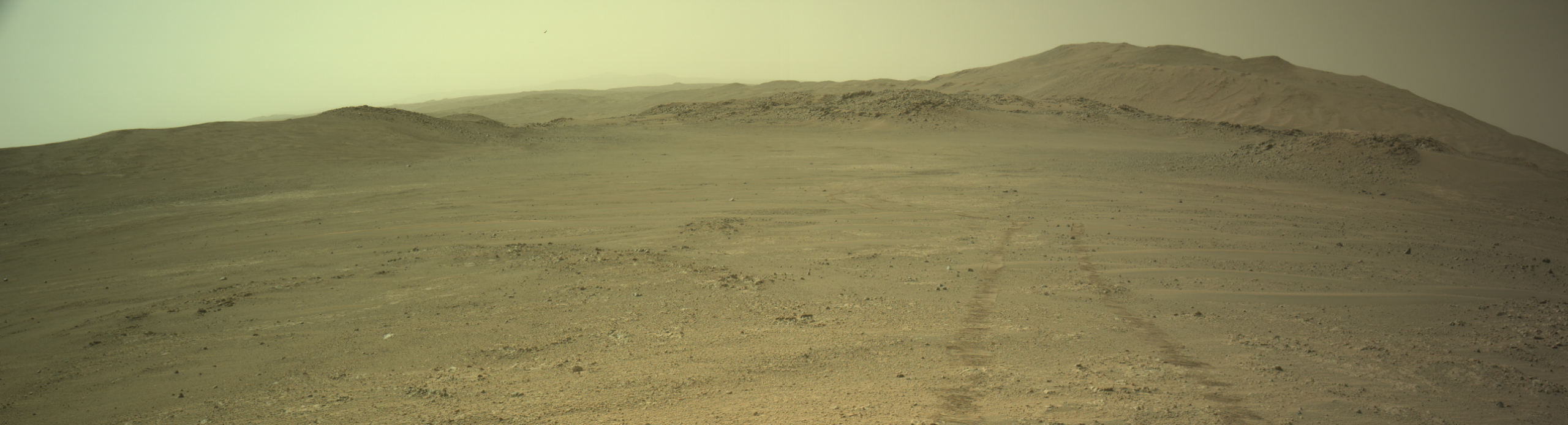
Click for full resolution image. For original images go here and here.
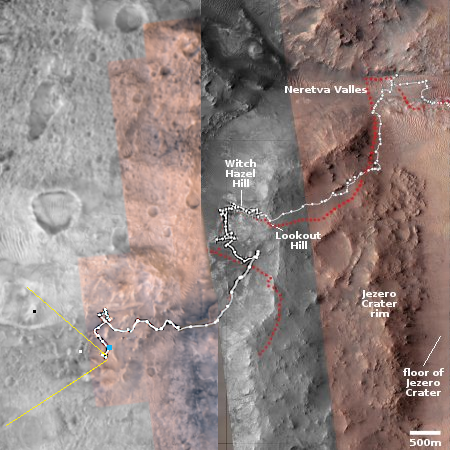
Click for interactive map.
Cool image time! The panorama above was created from two pictures taken on July 1, 2026 (here and here) by the left navigation camera on the Mars rover Perseverance.
The overview map to the right provides the context. The white dotted marks the rover’s travels, with the blue dot marking Perseverance’s last posted location as of July 6, 2026. The yellow lines indicate roughly the area viewed by the panorama, taken five days earlier at a previous location.
The panorama looks west, at a low ridge line about 1,000 feet from the rover (the white dot), with a distant hill beyond (the black dot), about 4,500 feet away. The ridge is only about 50-60 feet high, while the hill rises about 600 feet. The rover’s tracks can be seen on the left.
Once again, the view from Perseverance indicates starkly the lifeless nature of Mars. Maybe it once had microbiology (though this is certainly not indicated so far by any solid evidence), but if it did, it is long long gone, and in fact likely never prospered at this location at all. NASA might claim repeatedly that Perseverance’s mission is to search for life, but every geologist on the mission knows this is a very low priority. What they are doing is studying the alien geology of another world. This image gives one a hint of its alienness.
Most specifically, Perseverance is studying a region in the dry tropics of Mars, where no near surface water remains, but also carries ample evidence of potentially valuable mineralogy. Orbital data strongly suggests the region west of Jezero crater will become a major mining region for future settlers. It might not contain any life, but it carries resources that will sustain the life that is soon to come from Earth.
The Perseverance team has been scouting this region now for the last four months, without doing any additional drilling. In fact, the last drill samples were taken at Witch Hazel Hill, in the spring of 2025. It appears they are taking their time to look for the best place to get core samples.
In a briefing at a recent science conference, a NASA official made it clear that it wants its proposed Habitable Worlds Observatory (HWO) — presently undergoing its initial design studies for launch in the 2040s — be designed in a way that it can be maintained, repaired, and upgraded, much like the Hubble Space Telescope.
NASA is planning for HWO to be serviceable, which means that they will need to figure out a way to work on, repair, and maintain the observatory while it operates roughly a million miles (1.5 million kilometers) away. “HWO will have to be serviceable to some extent,” NASA’s astrophysics division director Shawn Domagal-Goldman told Space.com during a session at the American Astronomical Society’s (AAS) 248th meeting in Pasadena, California.
This design decision not only makes sense, NASA should have made it common practice a decade ago. The ability for robots to do this work is becoming increasingly robust, and in the next decade will become commonplace. For NASA to have launched anything in the past decade without this in mind was shameful.

Now available in hardback and paperback as well as ebook!
From the press release: In this ground-breaking new history of early America, historian Robert Zimmerman not only exposes the lie behind The New York Times 1619 Project that falsely claims slavery is central to the history of the United States, he also provides profound lessons about the nature of human societies, lessons important for Americans today as well as for all future settlers on Mars and elsewhere in space.
“Zimmerman’s ground-breaking history provides every future generation the basic framework for establishing new societies on other worlds. We would be wise to heed what he says.” —Robert Zubrin, founder of the Mars Society.
All editions are available at Amazon, Barnes & Noble, and all book vendors, with the ebook priced at $5.99 before discount. All editions can also be purchased direct from the ebook publisher, ebookit, in which case you don't support the big tech companies and the author gets a bigger cut much sooner.
Autographed printed copies are also available at discount directly from the author (hardback $29.95; paperback $14.95; Shipping cost for either: $6.00). Just send an email to zimmerman @ nasw dot org.
New protocols developed by Search for Extraterrestrial Intelligence (SETI) project and approved by the International Academy of Astronautics (IAA) now tighten significantly what the scientific community is expected to do if anyone detects evidence that might be extraterrestrial life.
You can read the full protocols here [pdf]. From the press release:
At the heart of the new rules is a reaffirmation of a core scientific principle: “extraordinary claims require extraordinary evidence.” Under the revised protocols, no public announcement should be made until a signal or artifact has been rigorously authenticated by independent organisations using different instrumentation.
“We do not shout “alien” the moment we see a strange blip,” Garrett added. “The scientific method demands we check, check again, and then ask others to check. Only when we have reached a consensus that a signal is credible do we bring it to the world.”
SETI’s press release notes this rule is necessary due to the modern nature of social media, which allows the wildest claims to be spread like poison almost immediately. As noted in this story, the new rules almost appear to be a direct slap at hack Harvard scientist Avi Loeb, who with both interstellar objects Oumuamua and Comet 3I/Atlas claimed evidence of alien technology when there was no evidence to say so.
The new rules also underline a second point: Under no condition will any scientist attempt to reply or contact any potential alien source. “The Declaration reaffirms the enduring principle that transmitting a response to an extraterrestrial intelligence is a decision that belongs to all of humanity and should only take place following international consultations, specifically through the United Nations.”
It will be impossible for the science community to enforce this rule, but by stating it they hope to encourage scientists to exercise more caution, and further ostracize those like Loeb who do not. I remain skeptical, especially because it will have no influence on government agencies like NASA, which love to scream “We have found alien biology!” at the slightest hint. Nor will it influence the public, which seems determined to accept such wild claims with no skepticism at all.
Researchers from the Southwest Research Institute (SwRI) have found that all eight AI-generated lunar crater catalogs failed to meet the standards achieved by human catalogs.
Astronomers use crater counts on other planets to roughly determine the age of the surface.The more craters the older the surface. The work is however tedious and time-consuming, and it was hoped that artificial intelligence (AI) could speed up the process and make it more efficient. Unfortunately, this new study [pdf] shows that AI is not ready for prime time. From the abstract:
In this work, we compare eight crater databases using several standardized metric sets, including a tight tolerance based on manual researcher repeatability. Of the six databases that quote metrics, we find that under these strictest criteria, practically all databases return worse metrics—some dropping by factors of >10. When we resolve these metrics in diameter space, we find that most databases do well in some diameter ranges and poorly in others, meaning that single-value overall metrics can be misleading.
Our work shows that the current state of machine learning–based AI still has a long way to go before it can be relied upon to create a database comparable in quality with manual efforts. We recommend researchers examine any database they plan to use and independently determine if it is of sufficient quality for their application.
The researchers are not opposed to using AI for this purpose. They are simply warning others that it is not yet capable of doing what many promise.
Leaving Earth: Space Stations, Rival Superpowers, and the Quest for Interplanetary Travel, can be purchased as an ebook everywhere for only $3.99 (before discount) at amazon, Barnes & Noble, all ebook vendors, or direct from my ebook publisher, ebookit.
If you buy it from ebookit you don't support the big oppressive tech companies and I get a bigger cut much sooner.
"Leaving Earth is one of the best and certainly the most comprehensive summary of our drive into space that I have ever read. It will be invaluable to future scholars because it will tell them how the next chapter of human history opened." -- Arthur C. Clarke
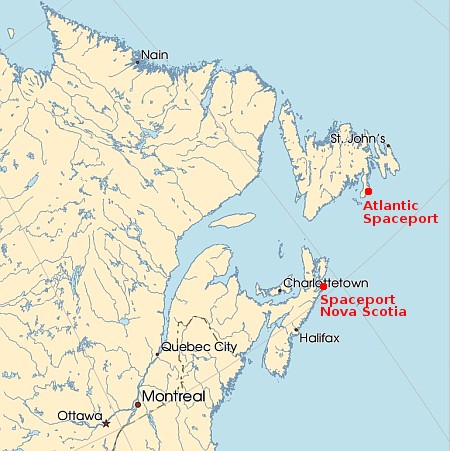
Proposed Canadian spaceports
After a decade of effort, Canada’s Spaceport Nova Scotia has finally closed a deal with a rocket company. German rocket startup Isar Aerospace yesterday announced it has finalized a deal first signed in May 2026 with Maritime Launch Services, which operates the spaceport for the Canadian government on a 10-year $200 million lease, to launch its Spectrum rocket there.
Maritime Launch Services will provide the licensed launch site, including the launch pad, assembly, integration and testing (AIT) facilities, a launch operations center, and a facility for payload integration. Build-out is planned to begin in 2026, with first orbital launches targeted for 2028. The launch site will be designed to support frequent launches, with the potential for Spaceport Nova Scotia to offer additional capacity for future expansion. To anchor its North American presence, Isar Aerospace has established a dedicated Canadian entity, Isar Aerospace Canada Inc.
Maritime was formed in 2016, but for a decade was unable to attract any customers. That changed in March 2026 when the present Canadian government signed its ten year lease, committing itself to finance the spaceport in order to develop what it called a “sovereign” Canadian launch capability.
This deal apparently convinced Isar that Nova Scotia was a viable launch site. The deal is for ten years, with the option for two more five year extensions. During the first 2.5 years all fees will be waived, after which Isar will pay Maritime $3.75 million quarterly, with the intention to ramp up to 40 launches per year by 2029. It will also pay additional per launch fees.
Isar however still has to successfully complete its first launch. It has had one launch failure in 2025, and has repeatedly scrubbed for technical reasons its second attempt in 2026, first in January, then in March, and then in June. Though there are indications it will try again later this month, no new launch date has been announced. All these launches have been from Norway’s Andoya spaceport.
The irony here is that the Canadian government isn’t really getting its own rocket capability. It is buying it from a German company.
SpaceX last night successfully placed 81 different commercial payloads in orbit, its Falcon 9 rocket lifting off from Vandenderg Space Force Base in California.
This was the company’s 17th Transporter mission, designed to provide launch services to very small satellites and payloads, including “cubesats, microsats, hosted payloads, and orbital transfer vehicles carrying eight of those payloads to be deployed at a later time.”
The first stage (B1097) completed its eleventh flight (30 days after its previous flight), landing on a drone ship in the Pacific. The two fairing halves completed their 19th and 35th flights respectively.
The leaders in the 2026 launch race:
81 SpaceX
44 China
10 Rocket Lab (plus two suborbital HASTE launches)
8 Russia
For the third straight year SpaceX leads the entire world combined in total launches, 81 to 76.
After four years of operation, NASA has terminated its participation in the privately built and operated lunar orbiter CAPSTONE.
The orbiter was built jointly by Terran Orbital and Rocket Lab, and launched by Rocket Lab. In space it was operated not by NASA but by the private company Advanced Space. On its way to the Moon Advanced Space’s engineers lost contact with the spacecraft twice, but were able to re-establish communications in time to save the mission, get it into orbit, where it spent four years testing a host of technologies NASA then planned to use in its Artemis program.
The orbiter is not dead however. Advanced Space “will continue to use the spacecraft as a technology development testbed.”
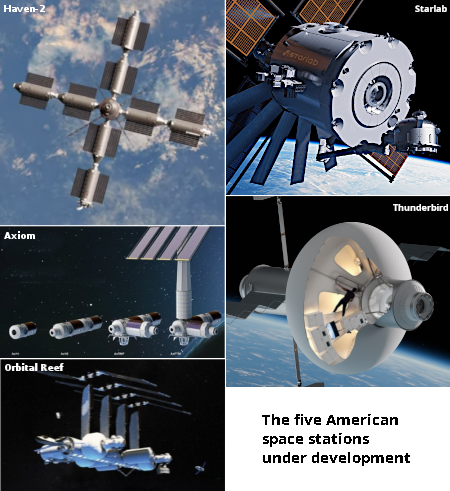
Having abandoned its short-lived NASA-built core module concept due to industry opposition, NASA is now requesting new proposals from the private sector for its space station program to replace ISS.
Based on industry’s input, NASA will proceed with its original plan to procure commercial services through FAR-based contract(s) awarded via full and open competition. Industry has indicated there is significant capital investment behind this approach and expressed high confidence in their ability to attract additional capital investment and expand future market opportunities after NASA makes an award.
NASA intends to award firm-fixed-price, multi-award, indefinite-delivery/indefinite-quantity contracts supporting development, certification, and services. This approach would allow NASA to select two or more contractors through early development, followed by a competitive task order for final design, test, evaluation, as well as certification and services from one or more contractors. [emphasis mine]
The deadline for submission is July 27, 2026. From these proposals NASA will proceed with its original plan to award construction contracts to build at least one new space station. The highlighted words above however suggest a significant change in the program. Under the original plan, NASA said it could only afford to finance one private station, something NASA administrator Jared Isaacman found unsatisfactory. NASA officials also did not believe there was sufficient private investment capital to make up the difference if NASA spread the money around to more than one station.
It looks like the industry has changed his mind. It now appears NASA will entertain multiple station proposals, and could conceivably award as many as three contracts. Of the five stations being built (see my list below), three are very robust at this point — Vast, Starlab, and Axiom — with a lot of private investment, a slew of customers, and some construction completed. Choosing one or two of these would be difficult, and possibly counter-productive, as all three have viable plans.
While I am speculating wildly, it looks to me that this NASA request for proposals is laying the groundwork for awarding at least three space station contracts, with these three stations in the lead. The amount of money in NASA’s space station budget might not be sufficient to finance all three, but it appears it might be enough once supplemented with the private capital all three stations have on hand.
Stay tuned. Some very exciting developments might very well be in the offing.
My updated ranking of the five American space stations presently under development:
» Read more
An evening pause: Performed (mostly) live at the 1978 Saturn awards event, given out by the Academy of Science Fiction, Fantasy and Horror Films. Though the song is by Elton John, this performance makes it William Shatner personified.
Hat tip Mike Nelson.
William Shatner’s unforgettable performance of Elton John’s ‘Rocket Man’ at the 1978 Saturn Awards. pic.twitter.com/VkoFRuNueI
— Time Capsule Tales (@timecaptales) June 8, 2026
Courtesy of BtB’s stringer Jay, as well as the first from Nate P. This post is also an open thread. I welcome my readers to post any comments or additional links relating to any space issues, even if unrelated to the links below.

Click for original Webb image. For the original Hubble image, go here.
Cool image time! The false color mid-infrared image above, reduced and annotated to post here, was taken reeently by the mid-infrared instrument on the Webb Space Telescope of the galaxy Centaurus A, 11 million light years away and known for more than a century as an elliptical galaxy crossed by a dark streak of dust, as shown by the inset, an optical Hubble Space Telescope photograph taken in July 2014. More recent research has shown the galaxy is very active, caused by the existence of a supermassive black hole in the center pulling in matter around it.
Webb’s infrared data reveals an entirely different shape. From the press release today:
Webb’s mid-infrared vision highlights the galaxy’s rich dust structures, which glow in intricate shapes that surprise and even perplex astronomers. A warped, parallelogram-like band cuts across the galaxy’s center, while wisps of material stretch outward like cosmic clouds.
An “S” shaped feature, most notable in the image from Webb’s MIRI (Mid-Infrared Instrument), is also unusual and invites questions that need further study to answer. What created this shape? How does the black hole influence it? Is it influenced by merger-induced star formation?
Many of the glowing red points in the MIRI image are dust-rich stars or stellar nurseries, where aging stars are shedding material back into space or new stars are forming. This dust is the raw ingredient for future generations of stars and planets, making it central to the ongoing life cycle of the galaxy.
Once again, this data illustrates the need for astronomers to have telescopes observing in all wavelengths and from space, since a large fraction of the electromagnetic spectrum is blocked by the atmosphere.
The uncertainty of science: The Europe Space Agency’s (ESA) Euclid optical space telescope — with a mirror half the size of Hubble’s — has now identified 31 new quasars in the very early universe, all of which really shouldn’t be there based on present theories as to how long it should take for them to form.
The European Space Agency’s Euclid space telescope has discovered 31 of the most ancient quasars ever found. Two of these giant and dazzling galaxy cores, powered by gargantuan black holes, are the earliest quasars yet observed in cosmic history. They shone with the light of a trillion Suns back when the Universe was 670 million years old – just 5% of its current age.
UPDATE: Astronomers using the Keck telescopes in Hawaii have now confirmed 21 of the 31 one quasars identified by Euclid.
The scientific problem is that, according to most theories on the evolution and formation of galaxies and black holes and quasars, it takes billions of years for such large supermassive black holes to accrete their mass. Yet, these exist less than a billion years after the Big Bang. The numbers do not compute.
Euclid doesn’t get the publicity of Hubble, partly because ESA does not do as good a job of selling its work as NASA, partly because it is a European project and the American propaganda press is thus generally uninterested, and partly because it is simply smaller and a later telescope, thus not ground-breaking. Nonetheless, with a mirror 1.2 meters across, it is capable of truly spectacular optical astronomy, being above the atmosphere as well as above the many satellite constellations now in orbit. It is placed in the Lagrange point 2, a million miles from Earth.
In fact, Euclid is exactly the kind of space telescope the astronomy community should be building, in huge numbers, rather than whining about those satellite constellations blocking its big ground-based telescopes. The future of astronomy is in space, and it is high time astronomers recognized this.
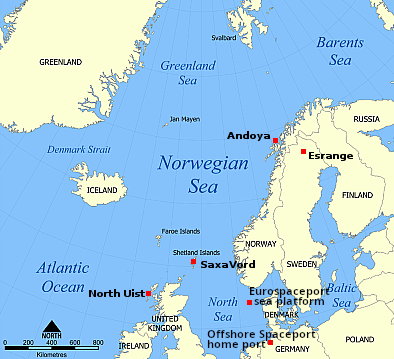
Proposed or active spaceports in north Europe
In what might cause another delay in the first launch from the United Kingdom’s Saxavord spaceport on the Shetland Islands, the spaceport’s management last week suddenly submitted a plan to spend £120K to build a security fence around the spaceport, even as the launch window for the German startup Rocket Factory Augsburg’s first launch had opened.
SaxaVord Spaceport has submitted a building warrant application detailing plans for a perimeter fence, which would be built at an estimated cost of around £120,000. The application was submitted last week, just ahead of the provisional launch window sought by German aerospace company Rocket Factory Augsburg, which took effect from 1st July.
It is part of wide ranging safety and security plans set out as part of SaxaVord’s range control licence, which was approved by the Civil Aviation Authority (CAA) in 2024.
Since Rocket Factory announced in April its application to launch during this July launch window, there has been no word from Saxavord if that window was approved. Nor has Rocket Factory provided any updates on any specific launch dates. It has delivered both rocket stages to Saxavord, but beyond that there have been no other updates.
This new security fencing suggests that a launch approval was denied by the CAA, because that fencing was not in place as ordered in 2024. It appears Saxavord is now scrambling to get it done so Rocket Factory can launch.
The CAA has a bad track record. The delays caused by that government agency due to its regulatory burdens has resulted in two rocket companies going bankrupt (Virgin Orbit and Orbex) and one spaceport shutting down (Sutherland). It would not surprise me if Rocket Factory does not launch in July. In fact, I predicted this in April. Hopefully my pessimism about the CAA is wrong, but at present I am skeptical.
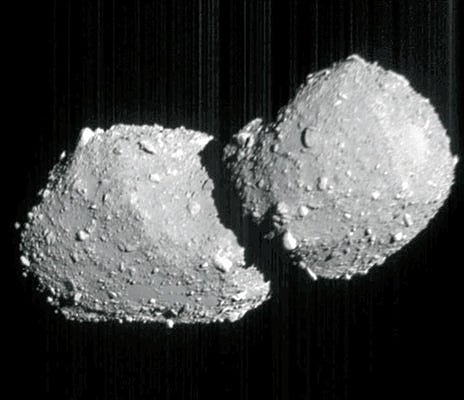
Japan’s Hayabusa-2 asteroid probe successfully flew past the asteroid Torifune yesterday, getting less than 2,000 feet from its surface as it zipped past at a relative speed of more than 10,000 miles per hour.
The picture to the right is the first image released by Japan’s space agency, JAXA. It shows that Torifune appears to be a contact binary, made up of two rubble-pile asteroids that gentle fused together in their dance in space. Contact binaries are presently thought to comprise about 15% of all asteroids, but that estimate might prove to be an understatement as we gather more information. This is the first seen close-up that appears made up of two rubble piles.
While Japan’s press and its space agency touted this fly-by success loudly, both failed to mention the technical problems facing Hayabusa-2, which made the fly-by even more impressive. The spacecraft, which was launched in 2014, rendezvoused and grabbed samples from the asteroid Ryugu from 2018 to 2019, and then returned those samples to Earth in 2020, has been flying somewhat crippled. It has four ion engines for maneuvering, three of which no longer work and a fourth that is showing signs of failure. Thus, it could not do much during this fly-by to control its path or orientation. That it could grab this image as it zipped by is a testament to its engineers.
Hayabusa-2 is on its way to asteroid 1998 KY26 in 2031. Whether it will be capable of doing much when it gets there remains at this moment an unknown.
Click for original image.
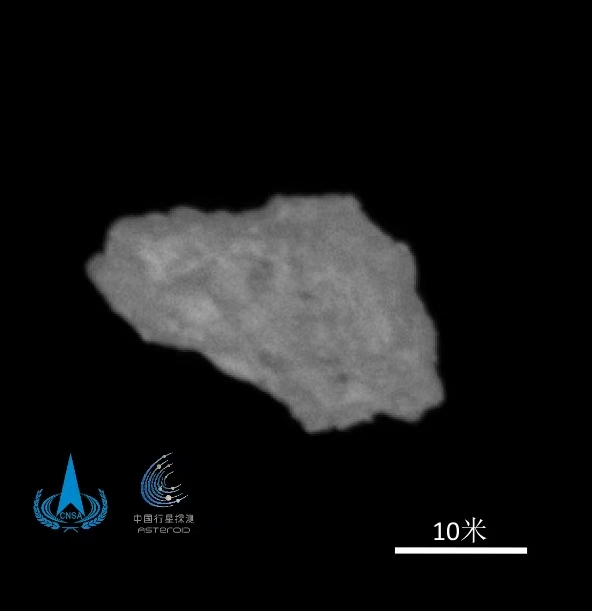
China has finally confirmed that its first asteroid probe, Tianwen-2, has reached and successfully begun proximity operations next to the asteroid Kamoʻoalewa (2016HO3).
The picture to the right is the first released by China’s state-run press, apparently taken during approach to help guide it.
China’s Tianwen-2 probe has successfully arrived at a distance of 20 kilometers from the asteroid 2016HO3, enabling it to begin scientific exploration after an approximately 400-day journey of about 1 billion kilometers, the China National Space Administration (CNSA) announced on Monday.
The spacecraft will spend a year at Kamo’oalewa — which is only 130 to 440 feet across — where it will attempt to grab samples using two different methods. The first is a copy of the touch-and-go technique used by OSIRIS-REx on Bennu. The second method, dubbed “anchor and attach,” is untried, and involves using four robot arms, each with their own drill.
After delivering these samples back to Earth the plan is to send Tianwen-2 out to visit Comet 311P.
Though not yet identified, a half dozen round metal spheres that resemble the internal helium tanks rockets use to maintain pressure have washed up on beaches in Australia.
The Australian Space Agency confirmed on Sunday it was working to determine the nature and origin of the mysterious objects, which police said were suspected of containing hazardous chemicals.
Reports showed the objects, washed up on beaches in the Forrest Beach area of Townsville, appeared to be large spheres. The Queensland Fire Department said on Sunday a total of six objects had been found washed up on beaches. Five had been “secured into drums” and a sixth was being “rendered safe” on Sunday, a spokesperson said.
Assuming these spheres are rocket related, their most likely source would be from either a Chinese launch from its coastal Wenchang spaceport, an Indian launch from its east coast Sriharikota spaceport, or possibly a Russian launch from its Vostochny spaceport in far east Russia. All three dump lower stages in the Indian and Pacific Oceans.
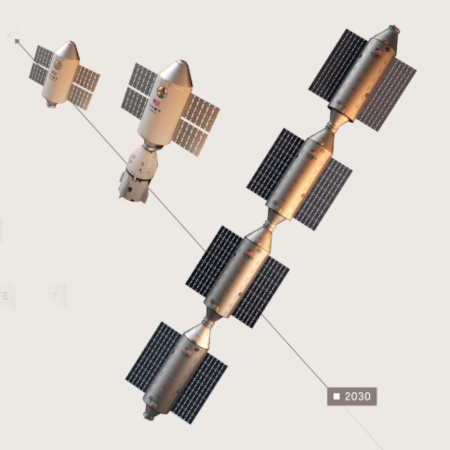
Click for original animation.
In a X tweet in early May that I only saw today, the space station startup Vast touts its series of orbital missions, beginning with its Haven demo test satellite that flew last year, followed by its Haven-1 single module station that will launch in 2027, and finally its proposed full multi-module Haven-2 station targeting a 2030 launch date.
The screen capture to the right shows Haven-1 (unmanned and manned with a docked Dragon capsule) and the Haven-2 station, comprising four Haven-1 modules attached in a single line.
What makes this newsworthy to me is that it is a major simplification and reduction in size for Haven-2. Until recently the company had planned to build Haven-2 with a central docking hub with eight modules attached in a cross, two for each arm (See the graphic here).
It appears the company has scaled down Haven-2 in anticipation of reduced funding from NASA. The original plan was to win a big contract allowing the company to build the full Haven-2 station. This smaller Haven-2 appears to recognize that even if Vast gets a contract from NASA, it won’t be enough to build the full station. This smaller design can serve NASA’s needs, while also serving the needs of Vast’s other private customers, which include foreign nations who want to send their astronauts to space and a number of companies that want to use Haven-2 to manufacture pharmaceuticals and other products for sale back on Earth.
This configuration also allows the company some flexibility. Because it uses those Haven-1 modules, it can always add that docking hub later, and add or shift modules to recreate the full original design.
Two more launches so far today, one by SpaceX in the early morning and a second by China in the evening.
First SpaceX placed 29 more Starlink satellites in orbit, its Falcon 9 rocket lifting off from Cape Canaveral Space Force Station in Florida. The first stage (B1090) completed its 13th flight, landing on a drone ship in the Atlantic.
Next China placed another 20 Qianfan (Spacesail) satellites into orbit, its Long March 8A rocket lifting off from its coastal Wenchang spaceport. Video of the launch can be seen here. China’s state-run press provided no information about the number of satellites, but this site stated it was 20. Previous Long March 8A Qianfan launches had carried 18 however. Either way, this planned 12,000 satellite internet constellation now has approximately 239 satellites in space, with a goal to place 648 in orbit by the end of this year.
The leaders in the 2026 launch race:
80 SpaceX
44 China
10 Rocket Lab (plus two suborbital HASTE launches)
8 Russia
For the third straight year SpaceX leads the entire world combined in total launches, 80 to 76.

