One last look at a Martian mountaintop

Siccar Point
For the original images go here and here.

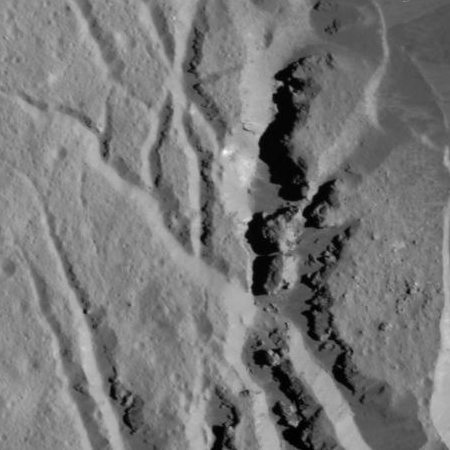
The image above is a mosaic made from two Curiosity navigation photos taken on October 23, 2021 and combined, cropped, and reduced to post here. It shows the top 30 feet or so of Siccar Point, the spectacular outcrop that I have featured several times previously.

Curiosity has now traveled past this outcrop, so that this view above is no longer visible to the rover. I post it now as a farewell image of what I think is the most breath-taking feature yet seen by any planetary lander — manned or unmanned — since the first set down on the Moon in the mid-1960s. It also illustrates with great clarity the alien nature of Mars. Those delicate overhanging rocks would not be possible on Earth, with a gravity about two and a half times heavier than Mars.

Note too that I have not enhanced the contrast or brightness. I think the twilight light here actually gives us a sense of the real brightness of a clear Martian day. Because the Sun is much farther away, even at high noon it provides much less illumination than on Earth. A bright day on Mars to our Earth-adapted eyes will always feel like dusk.

Meanwhile the science team is quickly pushing the rover south, to get…

…closer to the area we are targeting for our next drill campaign. This drive should leave us with bedrock in the workspace for additional contact science on the weekend. This terrain continues to be very challenging, with large boulders, sharp rocks that are wheel hazards, and sand ripples, like the terrain shown in the image. These drives take a while to plan to make sure we are avoiding all the hazards while getting to where science wants to go. Our paths end up looking a little “drunk” as we weave our way around obstacles.

7 comments

Astra’s 4th attempt to reach orbit now scheduled for early November

Capitalism in space: The new smallsat rocket company Astra has revealed that it will make its fourth attempt to reach orbit with a launch window opening on November 5th.

That this launch could take place only a little over two months since Astra’s last attempt, which failed, speaks well of the company. They have very quickly fixed the fuel line issues that caused that August 28th failure and then moved immediately to fly again.

Moreover, the company’s overall pace of launch is excellent. This will be their fourth launch attempt since September 2020, less than fourteen months, suggesting that when they finally succeed and begin operational launches they will also keep their promise of frequent and rapid launches.

1 comment

Genesis cover

On Christmas Eve 1968 three Americans became the first humans to visit another world. What they did to celebrate was unexpected and profound, and will be remembered throughout all human history. Genesis: the Story of Apollo 8, Robert Zimmerman's classic history of humanity's first journey to another world, tells that story, and it is now available as both an ebook and an audiobook, both with a foreword by Valerie Anders and a new introduction by Robert Zimmerman.

The print edition can be purchased at Amazon or any other book seller. If you want an autographed copy the price is $60 for the hardback and $45 for the paperback, plus $8 shipping for each. Go here for purchasing details. The ebook is available everywhere for $5.99 (before discount) at amazon, or direct from my ebook publisher, ebookit. If you buy it from ebookit you don't support the big tech companies and the author gets a bigger cut much sooner.


The audiobook is also available at all these vendors, and is also free with a 30-day trial membership to Audible.
 

"Not simply about one mission, [Genesis] is also the history of America's quest for the moon... Zimmerman has done a masterful job of tying disparate events together into a solid account of one of America's greatest human triumphs."--San Antonio Express-News

Starliner delays have cost Boeing another $185 million

Capitalism in space: Boeing today announced that it has had to taken another $185 million charge out of its earnings, in addition to the $410 million previously deducted, in order to cover the problems and delays in developing its Starliner manned capsule.

When Boeing took the original earnings charge, it said it did so because it committed to redo the uncrewed flight test at no expense to NASA, a point a Boeing executive reaffirmed at the Oct. 19 briefing. “There’s no additional charges that will be going to the government for this. This is something that The Boeing Company will make sure we’ve got covered as we get this vehicle prepared,” said John Vollmer, vice president and program manager for Boeing’s commercial crew program.

These costs are beginning to pile up. Boeing has got to get this capsule fixed and flying, not only to begin bringing in some income but to show the world that it can do this right.

6 comments

Conscious Choice cover

Now available in hardback and paperback as well as ebook!

From the press release: In this ground-breaking new history of early America, historian Robert Zimmerman not only exposes the lie behind The New York Times 1619 Project that falsely claims slavery is central to the history of the United States, he also provides profound lessons about the nature of human societies, lessons important for Americans today as well as for all future settlers on Mars and elsewhere in space.

 
Conscious Choice: The origins of slavery in America and why it matters today and for our future in outer space, is a riveting page-turning story that documents how slavery slowly became pervasive in the southern British colonies of North America, colonies founded by a people and culture that not only did not allow slavery but in every way were hostile to the practice.  
Conscious Choice does more however. In telling the tragic history of the Virginia colony and the rise of slavery there, Zimmerman lays out the proper path for creating healthy societies in places like the Moon and Mars.


“Zimmerman’s ground-breaking history provides every future generation the basic framework for establishing new societies on other worlds. We would be wise to heed what he says.” —Robert Zubrin, founder of the Mars Society.


All editions are available at Amazon, Barnes & Noble, and all book vendors, with the ebook priced at $5.99 before discount. All editions can also be purchased direct from the ebook publisher, ebookit, in which case you don't support the big tech companies and the author gets a bigger cut much sooner.


Autographed printed copies are also available at discount directly from the author (hardback $29.95; paperback $14.95; Shipping cost for either: $6.00). Just send an email to zimmerman @ nasw dot org.

Russia launches Progress freighter to ISS

Using its Soyuz-2 rocket, Russia today successfully launched a Progress freighter to ISS, carrying more than 5,000 pounds of cargo.

The freighter is scheduled to dock with ISS Friday evening at 9:34 pm (Eastern). It will dock with the port on the 20-year-old Zvezda module, which has remained unused for the past six months because of concerns that the docking and undocking at the port was causing stress fractures in the sections of Zvezda closest to the port. The Russians have decided to do this docking for the express purpose of studying its impact on the module.

The Progress MS-18 spacecraft will link up with the rear docking port on Zvezda. With the help of cosmonauts on the station, Russian engineers have traced a small air leak on the station to the transfer compartment leading to Zvezda’s rear port. The compartment has been sealed from the rest of the space station since the departure of a previous Progress spacecraft from the rear docking port in April. But cosmonauts will re-open the compartment to unload cargo delivered by the Progress MS-18 spacecraft.

The leaders in the 2021 launch race:

38 China
23 SpaceX
18 Russia
4 Northrop Grumman
4 ULA
4 Arianespace (Europe)

China remains ahead of the U.S. 38 to 36 in the national rankings.

7 comments

Leaving Earth cover

Leaving Earth: Space Stations, Rival Superpowers, and the Quest for Interplanetary Travel, can be purchased as an ebook everywhere for only $3.99 (before discount) at amazon, Barnes & Noble, all ebook vendors, or direct from my ebook publisher, ebookit.

If you buy it from ebookit you don't support the big oppressive tech companies and I get a bigger cut much sooner.


Winner of the 2003 Eugene M. Emme Award of the American Astronautical Society.

 
"Leaving Earth is one of the best and certainly the most comprehensive summary of our drive into space that I have ever read. It will be invaluable to future scholars because it will tell them how the next chapter of human history opened." -- Arthur C. Clarke

Curiosity marches on into the mountains

Curiosity marches onward to Maria Gordon Notch
Click for full image.

Overview map
Click for interactive map

With the end of the solar conjunction in the first half of October, blocking communications with Mars because the Sun was in the way, Curiosity has resumed its travels. It has moved past the spectacular outcrop I have highlighted previously, an outcrop the science team has labeled Siccar Point.

They are now moving south at the base of the cliff to the west, the top of which is a plateau they call the Greenheugh Pediment, heading for a gap where the rover will be able to turn right and head up onto that pediment. The red dotted line on the overview map to the right shows this route, which corresponds to the red dotted line on the photo above.

I estimate the cliffs on both sides of Maria Gordon Notch are about 100 feet high. The notch itself I estimate is about 750 feet away. At the pace Curiosity has been traveling across this rough ground, it could probably reach it in about two to three weeks. However, I expect the science team will stop at least once along the way to do more detailed science work, so that journey might take a month or slightly more.

0 comments

Today’s blacklisted American: American Geophysical Union rejects candidates for awards because they are white

Discriminated against in Seattle
Eagerly discriminated against by the
American Geophysical Union

“Segregation today, segregation tomorrow, segregation forever!” An awards committee of the American Geophysical Union, assigned to give fellowships to scientists of note, decided to reject all the candidates this year because they happened to be white.

Five of the nation’s top ice scientists found themselves in a conundrum. They’d been tasked with a formidable job: reviewing candidates for the American Geophysical Union’s fellows program, the most prestigious award given by the world’s largest earth and space science society. But when the group looked at its list of candidates, all nominated by peers, it spotted a problem.

Every nominee on the list was a white man.

….“That was kind of a bit of a showstopper for me,” said Helen Fricker, a glaciologist at Scripps Institution of Oceanography and one of the five committee members. Fricker and her colleagues — Jeff Dozier, Sinead Farrell, Bob Hawley, Don Perovich and Michele Koppes — represented the AGU’s cryosphere section, comprising scientists focused on the Earth’s snow and ice. The group was just one of about two dozen different committees, all reviewing their own lists of candidates.

The homogeneous pool of nominees didn’t sit right. … So the committee members made an uncomfortable decision. They declined to recommend any nominees at all.

Let me make this very clear: They bluntly rejected the nominees for only one reason: their race. If this isn’t outright bigotry and racism I do not know what is. And if you don’t believe me, you should read the public letter these committee members wrote explaining their decision. In it they say:
» Read more

25 comments

Water and carbon monoxide detected in exoplanet’s atmosphere

Astronomers, using both the Hubble Space Telescope and the ground-based Gemini Telescope, have detected water and carbon monoxide in the atmosphere of an exoplanet 320 light years away.

Previously hydrogen, helium, hydrogen cyanide, iron, and magnesium have been detected in the atmospheres of a variety of exoplanets. In other cases scientists found exoplanets that were devoid of water.

This detection of water and carbon monoxide is a first for these two materials, and is somewhat significant as it is the first detection that suggests an exoplanet atmosphere that might have similarities to Earth.

0 comments

Poland becomes thirteenth nation to sign Artemis Accords

The new colonial movement: Poland yesterday announced that it has signed the U.S.-led Artemis Accords.

In brief comments at the ceremony, [Polish Space Agency (POLSA) President Grzegorz Wrochna] said he saw the Artemis Accords as a first step toward greater cooperation with the United States. He noted that while Poland is a member of the European Space Agency, Polish space companies are looking to expand their business outside Europe. “They want to reach for new markets, especially the U.S. market,” he said. “They want to participate in missions of other agencies, especially NASA. We would like to open the door for them, and I believe this is the first step.”

The full list of signatories at this moment: Australia, Brazil, Canada, Italy, Japan, Luxembourg, New Zealand, Poland, South Korea, the United Kingdom, the United Arab Emirates, Ukraine, and the United States.

While the accords — introduced by the Trump administration — are cleverly written to appear to endorse the mandates of the Outer Space Treaty, they are also written to bluntly minimize that treaty’s hostility to private property. With each new signatory, the ability to overturn that treaty’s limitations preventing legal protection to private property in space grows, as it binds a growing number of nations in an alliance to do so.

Not surprisingly, Russia and China have said they oppose the Artemis Accords. Both of these nations do not want legal protections in space to private citizens or companies. Instead, they wish that power to reside with them, or with the United Nations.

Whether the strategy behind the Artemis Accords will work however remains unclear. That strategy requires the U.S. to maintain its strong support for private property in space. Any wavering of that support will weaken the ability of this new Artemis alliance to overturn the Outer Space Treaty’s provisions that make private ownership of territory in space impossible.

3 comments

China’s Kuaizhou-1A solid rocket successfully launches a remote sensing satellite

China’s Kuaizhou-1A smallsat solid rocket today successfully launched a commercial remote sensing satellite.

This launch, the 38th successful launch this year by China, ties its previous high in 2018. The country had two additional launches this year, but those were failures.

The leaders in the 2021 launch race:

38 China
23 SpaceX
17 Russia
4 Northrop Grumman
4 ULA
4 Arianespace (Europe)

China now leads the U.S. 38 to 36 in the national rankings.

0 comments
1 860 861 862 863 864 2,928