New Webb data says asteroid 2024 YR4 will miss the Moon in 2032
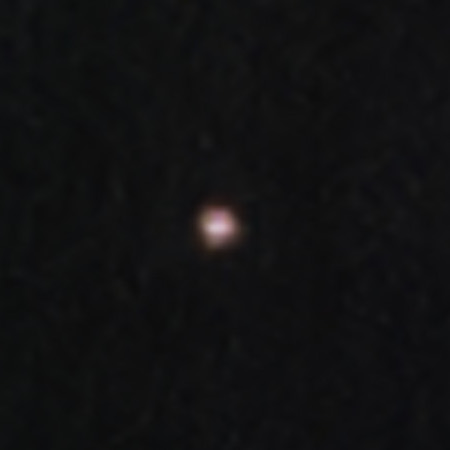
Asteroid 2024 YR4 as seen by Webb in the mid-infrared
Asteroid 2024 YR4 as seen by Webb in the
mid-infrared in April 2025. Click for original image.

New Webb data collected in February has now eliminated any chance the potentially dangerous asteroid 2024 YR4 will hit either the Earth or the Moon when it makes its next close pass on December 22, 2032.

Using data from NASA’s James Webb Space Telescope observations collected on Feb. 18 and 26, experts from NASA’s Center for Near-Earth Object Studies at the agency’s Jet Propulsion Laboratory in Southern California have refined near-Earth asteroid 2024 YR4’s orbit and are ruling out a chance of lunar impact on Dec. 22, 2032. With the new data, 2024 YR4 is expected to pass by the lunar surface at a distance of 13,200 miles (21,200 km).

Earlier less precise data had suggested 2024 YR4 had a 4.3% chance of hitting the Moon in 2032. That chance is now zero. This result is actually disappointing, in that an impact of this asteroid, estimated to be about 200 feet in diameter, would have not only been spectacular, but would have been scientifically useful. We would have been able to observe it closely with many ground- and space-based telescopes, and garnered a lot of useful information about the asteroid, the Moon, and the very nature of impacts.

The impact would have also eliminated the chance this asteroid might hit the Earth in the future. 2024 YR4 orbits the Sun about every four years. Previous calculations suggested another potentially dangerous fly-by of Earth in 2047, but these numbers are unreliable because the orbit will be changed by the 2032 fly-by in ways that cannot be predicted as yet.

Scientists increase the odds asteroid 2024 YR4 will impact the Moon in 2032

Asteroid 2024 YR4 in 2032
Click for original image.

Using additional data obtained by the Webb Space Telescope, scientists have now refined the orbit of potentially dangerous asteroid 2024 YR4 and confirmed that while it will almost certainly not hit the Earth in 2032, the odds of it impacting the Moon have increased.

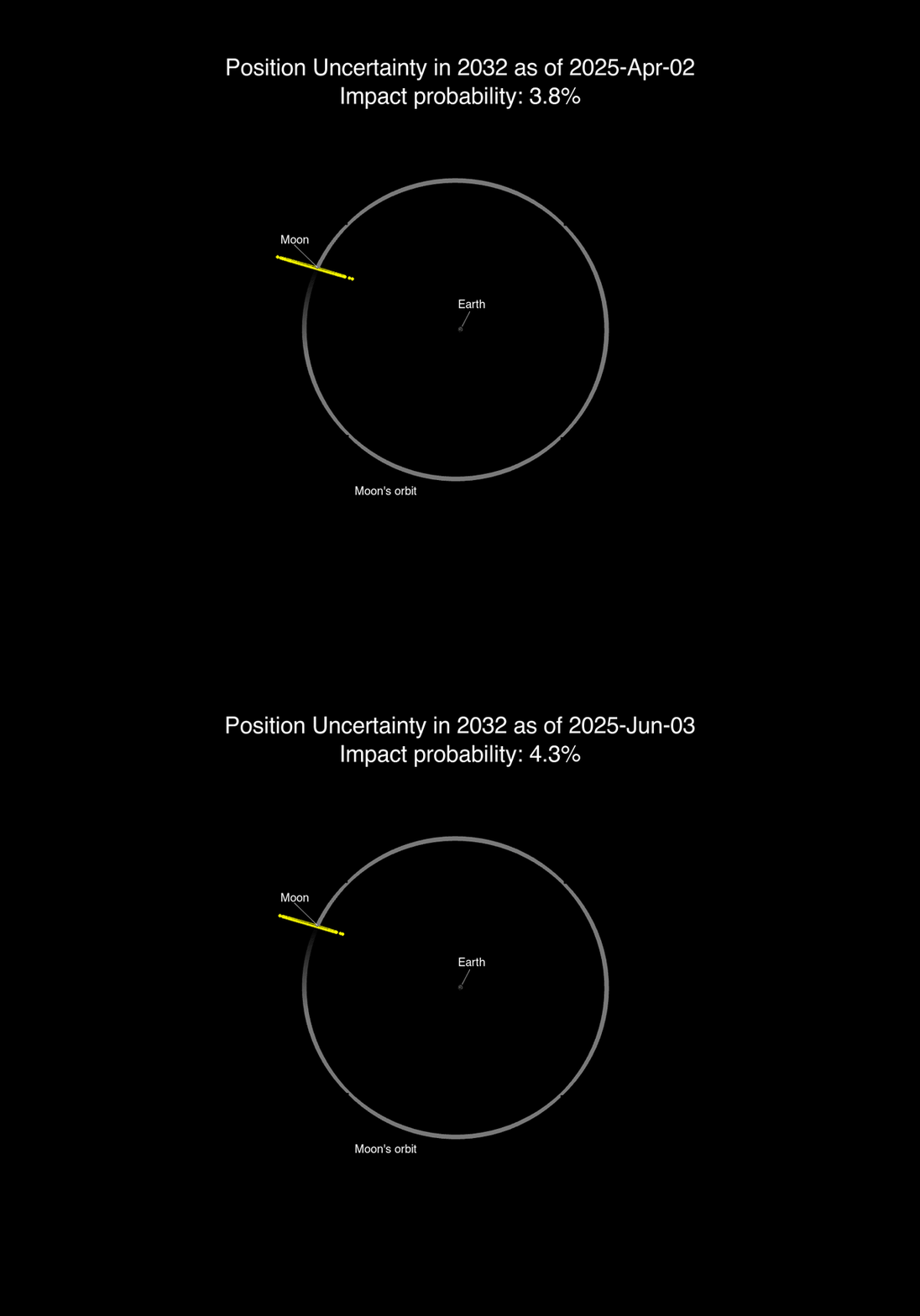
With the additional data, experts from NASA’s Center for Near-Earth Object Studies at the agency’s Jet Propulsion Laboratory in Southern California further refined the asteroid’s orbit. The Webb data improved our knowledge of where the asteroid will be on Dec. 22, 2032, by nearly 20%. As a result, the asteroid’s probability of impacting the Moon has slightly increased from 3.8% to 4.3%. In the small chance that the asteroid were to impact, it would not alter the Moon’s orbit.

The yellow line in the image to the right shows the present range of positions the asteroid could be in as it passes the Moon on that date. It is expected this range will be narrowed further when the asteroid flies past the Earth harmlessly in 2028.

If the asteroid should hit the Moon, the impact will provide scientists a great opportunity to learn more about asteroids and the Moon. If it should miss, it will then be essential to recalculate its orbit to see what will happen on later near approaches, whether the fly-by increased or decreased the chances of a later Earth impact.

Astronomers: Potentially dangerous asteroid 2024 YR4 originally came from main asteroid belt

Using new data from ground-based telescopes, astronomers now believe that the potentially dangerous asteroid 2024 YR4 originally came from main asteroid belt and is a stony solid body, not a rubble pile.

The study reveals YR4 is a solid, stony type that likely originated from an asteroid family in the central Main Belt between Mars and Jupiter, a region not previously known to produce Earth-crossing asteroids. “YR4 spins once every 20 minutes, rotates in a retrograde direction, has a flattened, irregular shape, and is the density of solid rock,” said Bryce Bolin, research scientist with Eureka Scientific and lead author of the study.

You can read the paper here [pdf].

At present calculations suggest it has an almost zero chance of hitting the Earth in 2032, though during that close approach the chances of it hitting the Moon range from 2% to 4%, depending on which scientist you ask.

Webb infrared data increases odds asteroid 2024 YR4 will impact Moon in 2032

Asteroid 2024 YR4 as seen by Webb in the mid-infrared
Asteroid 2024 YR4 as seen by Webb in the
mid-infrared. Click for original image.

Using new infrared images and data from the Webb Space Telescope, astronomers have further refined the orbit and size of the potentially dangerous asteroid 2024 YR4.

The image of 2024 YR4 to the right was taken by Webb’s mid-infrared camera, and provides information on its thermal surface characteristics.

First, the Webb data narrowed the uncertainty about the asteroid’s size, suggesting it is about 200 feet in diameter. You can read the paper outlining this result here. The data also suggested nature of the asteroid’s surface, which is important in determining its future path. The pressure from sunlight can change the orbits of small asteroids, but figuring out how much is extremely difficult without knowing the rotation of the asteroid and the reflective qualities of its entire surface.

Second, based on this new data, other astronomers are increasingly certain 2024 YR4 will not hit the Earth in 2032, but the odds of it impacting the Moon have now increased to 4%.

New calculations now say asteroid 2024 YR4 will almost certainly not hit the Earth in 2032

According to an announcement from NASA yesterday, the chances of asteroid 2024 YR4 hitting the Earth in 2032 is now reduced to 0.004%, meaning that it almost certainly not a threat at that time.

There remains a 1.7% chance it will instead impact the Moon in 2032.

These refined calculations were likely achieved by looking not at the asteroid itself (it is now too far away), but at places where it might have been visible to ground-based telescopes in the past, assuming it had an orbit that will hit the Earth in 2032. Since those past observations did not see it, those orbits are thus eliminated, and the threat goes down.

Of course, the uncertainty remains. It also remains important that we obtain more detailed information about this asteroid, because it is still a potential threat to the Earth.

New observations reduce odds of asteroid 2024 YR4’s 2032 Earth impact to practically zero

The uncertainty of science: According to a short update from NASA late yesterday, new ground-based observations have now reduced the odds that asteroid 2024 YR4’s will hit the Earth in 2032 to only 0.28 percent.

Observations made overnight on Feb. 19 – 20 of asteroid 2024 YR4 have further decreased its chance of Earth impact on Dec. 22, 2032, to 0.28%. NASA’s planetary defense teams will continue to monitor the asteroid to improve our predictions of the asteroid’s trajectory. With this new data, the chance of an impact with the Moon increased slightly to 1%.

Expect these numbers to change again in March, when the Webb telescope tracks the asteroid. And do not assume Webb will confirm these numbers. There remains great uncertainty in all these calculations, especially because there is great uncertainty about the size, mass, and make-up of 2024 YR4. It could be anywhere from 130 feet to 320 feet in diameter, and that difference makes these calculations uncertain.

In other words, it remains essential that work should begin on putting together a mission to visit and study this asteroid, now. Though it isn’t large enough to cause a worldwide extinction, it is big enough to do very significant damage, depending on where it hits.

The uncertainty of science: Astronomers keep changing the odds of asteroid 2024 YR4 hitting the Earth in 2032

In the past three days three different reports from both NASA and the European Space Agency have given three different percentages for the chances that asteroid 2024 YR4 will hit the Earth in 2032.

On Tuesday, NASA calculated that the space rock had a 3.1% chance of hitting Earth in 2032, while the European Space Agency’s risk assessment sits at 2.8%.

The narrow difference is due to the two agencies’ use of different tools for determining the asteroid’s orbit and modeling its potential impact. But both percentages rise above the 2.7% chance of collision once associated with an asteroid discovered in 2004 called Apophis, making 2024 YR4 the most significant space rock to be spotted within the past two decades.

However, another update shared by NASA on Wednesday showed that 2024 YR4 has a 1.5% chance of colliding with Earth in December 2032, based on new observations now that the full moon has passed. Astronomers have anticipated that such fluctuations are possible as they gather more observational data.

While the media has generally focused mostly on the higher numbers in their knee-jerk “We’re all gonna die” approach to everything, all these different numbers simply illustrate is the generally limited nature of our data about the asteroid’s orbit and its future path. For example because such asteroids are so small, it isn’t just gravity that influences their flight path through the solar system. The Sun’s light pressure can actually have an impact, but to determine how much you need to know the exact size, shape, and rotation of the object. Right now 2024 YR4’s size is estimated to range from 130 to 320 feet in width, determining this effect is presently impossible. Nor is this the only such variable.

At the same time, the data continues to suggest that the chances of this asteroid hitting the Earth are not trivial. The sooner we can find out everything about it the better. Getting a mission to it quickly would be the best way, but so far I have heard little from NASA or anyone about such an idea.

New calculations raise odds from 1.2% to 2.3% that asteroid will impact Earth in ’32

New calculations have increased the chances that the recently discovered asteroid 2024 YR4 will hit the Earth in 2032 from 1.2% to 2.3%.

Ongoing observations from ground-based telescopes involved with the International Asteroid Warning Network will continue while the asteroid is still visible through April, after which it will be too faint to observe until around June 2028.

NASA’s James Webb Space Telescope will also observe the asteroid in March 2025 to better assess the asteroid’s size. Currently the asteroid is estimated to be 130-300 feet across.

There remains great uncertainty in these numbers. We will really not know for certain if the asteroid will hit us until its orbit is studied for the next few years. Moreover, its size and make-up is also not known precisely yet. It could be as large as 320 feet, or as small as 130 feet. If the larger size, it poses a much greater risk, though that risk shrinks again if it is a rubble-pile asteroid that will simply break apart upon hitting the atmosphere.

This is not something to take lightly. Though the asteroid is not a world-destroyer, it does have the ability to cause significant damage, depending on where it hits. As its arrival is not for eight years, there is even time to quickly put together an unmanned mission to study it. (In the past I would never said this, but the domination of private enterprise in our present competitive space industry makes many things possible that were impossible when NASA and the government ran everything.)

200-foot-wide asteroid has a 1-in-83 chance of hitting the Earth in 2032

New data that has refined the solar orbit of 200-foot-wide asteroid discovered in 2024, dubbed 2024 YR4, suggests it has a 1-in-83 chance of hitting the Earth on December 22, 2032.

“Odds have slightly increased to 1 in 83,” Catalina Sky Survey engineer and asteroid hunter David Rankin wrote on BlueSky. “This is one of the highest probabilities of an impact from a significantly sized rock ever.”

Amateur astronomer Tony Dunn shared a simulation of the asteroid approach on his X feed. “Recently-discovered #asteroid 2024 YR4 may make a very close approach to Earth in 8 years. It is thought to be 40-100 meters wide. Uncertainty is still high and more and more observations are needed confirm this.”

The asteroid is rated three on the Torino risk scale, which indicates a close encounter that warrants close attention from astronomers and an over 1% chance of impact.

Though most reports say the asteroid is about 200 feet across, there is great uncertainty in that number. It could also be as large as 320 feet, or as small as 130 feet.

At the moment the risk of impact is still small. If it does occur, there is a chance it could either cause a major airburst similar to the Chelyabinsk meteor impact in 2013 that injured more than 400 people, or even impact the ground or ocean. If it hits the ocean there is a considerable risk of tsunamis. At the moment it appears its path will cross from South America to Africa in the southern hemisphere, but this data remains very uncertain at this time.

Though there will be doom-sayers, overall this is not a world destroyer. It carries some risk, but we have eight years to refine our knowledge significantly, especially when it will make a close approach of five million miles in 2028. At that time scientists should be able to better measure its size as well as its future orbit, determining more precisely whether it will even hit the Earth in 2032.