After 100 orbits, an overview of Messenger’s survey of Mercury
After 100 orbits, an overview of Messenger’s survey of Mercury.
A judge has ordered the Obama administration to act on six offshore drilling permits within 30 days.
The first Soyuz launch from the European spaceport in French Guiana is now scheduled for October.
The delays in launching Endeavour has pushed back the last shuttle mission to mid-July.
NASA management appears ready to approve combining SpaceX’s next two test flights of the Dragon capsule and Falcon 9 rocket into one test flight. This despite Russian opposition.
Websites run by NASA, JPL, and Stanford University were hacked by search engine scammers today.
Endeavour’s last launch is now set for May 16 at 8:56 am.
The last launch of Endeavour has now slipped to at least May 16.
An evening pause: Fifty years ago today, America’s response to Gagarin and the Soviets, Alan Shepard’s suborbital flight.
Or as he said as he lifted off, “The clock has started.”
The flight actually lasted 15 minutes 22 seconds. Though only a fourth the size of Gagarin’s much bigger Vostok capsule, the Mercury capsule was steerable. During the flight Shepard adjusted the capsule’s pitch, roll, and yaw, proving that humans could pilot a spacecraft manually.
Space Adventures and tourists to the Moon.
After consultation with Rocket Space Corporation Energia, modifications to the Soyuz TMA configuration have been agreed upon. The most important of which is the addition of a second habitation module to the Soyuz TMA lunar complex. The additional module would launch with the Block DM propulsion module and rendezvous with the Soyuz spacecraft in low-Earth orbit.
“Space Adventures will once again grace the pages of aerospace history, when the first private circumlunar mission launches. We have sold one of the two seats for this flight and anticipate that the launch will occur in 2015,” said Richard Garriott, Vice-Chairman of Space Adventures. “Having flown on the Soyuz, I can attest to how comfortable the spacecraft is, but the addition of the second habitation module will only make the flight that more enjoyable.”
How shall Europe’s ATV freighter to ISS be upgraded?
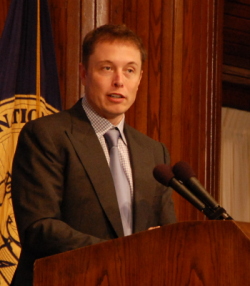
Elon Musk defends his vision and success. Key quote:
For the first time in more than three decades, America last year began taking back international market-share in commercial satellite launch. This remarkable turn-around was sparked by a small investment NASA made in SpaceX in 2006 as part of the Commercial Orbital Transportation Services (COTS) program. A unique public-private partnership, COTS has proven that under the right conditions, a properly incentivized contractor — even an all-American one — can develop extremely complex systems on rapid timelines and a fixed-price basis, significantly beating historical industry-standard costs.
China has the fastest growing economy in the world. But the American free enterprise system, which allows anyone with a better mouse-trap to compete, is what will ensure that the United States remains the world’s greatest superpower of innovation.
To put it simply, Musk is right, on all counts.
The last launch of Endeavour could be delayed to as late as May 13.
SpaceShipTwo’s has successfully completed its first “feathered” flight.
After a 45 minute climb to the desired altitude of 51,500 feet, SpaceShip2 (SS2) was released cleanly from VMS Eve [WhiteKnightTwo] and established a stable glide profile before deploying, for the first time, its re-entry or “feathered” configuration by rotating the tail section of the vehicle upwards to a 65 degree angle to the fuselage. It remained in this configuration with the vehicle’s body at a level pitch for approximately 1 minute and 15 seconds whilst descending, almost vertically, at around 15,500 feet per minute, slowed by the powerful shuttlecock-like drag created by the raised tail section. At around 33,500 feet the pilots reconfigured the spaceship to its normal glide mode and executed a smooth runway touch down, approximately 11 minutes and 5 seconds after its release from VMS Eve.
The story behind China’s planned space station begins to emerge.
China first said it would build a space station in 1992. But the need for a manned outpost “has been continually contested by Chinese space professionals who, like their counterparts in the United States, question the scientific utility and expense of human space flight”, says Gregory Kulacki, China project manager at the Union of Concerned Scientists, headquartered in Cambridge, Massachusetts. “That battle is effectively over now, however, and the funds for the space station seem to have been allocated, which is why more concrete details are finally beginning to emerge.”
Though I am always skeptical of comments from the Union of Concerned Scientists, in this case Kulacki makes sense. He also illustrates a further example of what I wrote in 2005, “After more than 40 years of debate, the argument is over and the supporters of manned spaceflight have won.”
An amateur astronomer has grabbed some spectacular images of solar sail Nanosail-D.
A mock Soyuz countdown is under way at Kourou, French Guiana.
The very last shuttle launch, scheduled for June 28, may be delayed due to the Endeavour launch delay.
Dawn has begun its final if slow approach to the asteroid Vesta.
Indian scientists are about to begin drilling a five-mile-deep borehole to study earthquakes.
Using lasers instead of spark plugs in your car.
New Space: Sierra Nevada plans to drop test its Dream Chaser spaceplane in 2012 using Scaled Composites’ WhiteKnightTwo.
Endeavour’s last launch has slipped to at least May 10, possibly later.
An evening pause: Let’s go for a drive! Jeff Zwart in a Porsche runs Pikes Peak, setting a record for the fastest time.
Scaled Composites is ramping up the test rate for SpaceShipTwo.
The launch of space shuttle Endeavour has now been delayed by NASA until May 8 at the earliest.
An evening pause: The last part of “The Guns of John Browning” from Tales of the Gun.
The documentary correctly honors Browning for the quality of his designs and workmanship. To me, it is more important to honor him for making the weapons that allowed the United States to defend freedom in the twentieth century. Without these tools in the hands of our soldiers, the wars would have been longer and many more lives would have been lost. And worse, the fascists and Nazis and dictators might have won.
As George Bernard Shaw wrote in Major Barbara, “The people must have power.”