Astra cancels second launch attempt in Alaska
Astra has scrubbed its second attempt in Alaska to complete its first test launch of a suborbital rocket.
They provided no explanation, nor have they said when they try again.
Astra has scrubbed its second attempt in Alaska to complete its first test launch of a suborbital rocket.
They provided no explanation, nor have they said when they try again.
This really isn’t news: Work on the core stage for the first SLS rocket launch appears to face another three month delay, threatening the scheduled June 2020 launch date.
The article outlines in great detail the work being done on the SLS core stage, and where the delays might be coming from, while also being vague about what exactly is causing the delay.
It is unknown if the additional time for completion of final assembly of the whole rocket stage is based on the engine section, the other four elements, or continuing refinement of forward work. Most of the hardware and systems that will fly on EM-1 are being built for the first time and the procedures to connect the five pieces of the Core Stage together will also be attempted for the first time.
Of the five elements, the most recent news had the Forward Skirt near completion of its individual work by the end of the month. Work to cover the liquid oxygen tank with its Thermal Protection System (TPS) foam was in final phases, with the liquid hydrogen tank to follow behind it. The engine section and intertank elements continue to be outfitted with propellant lines, pressure tanks, avionics boxes, wiring, and other equipment.
Once complete, the elements will be assembled vertically in two stacks before a horizontal join of the halves of the rocket kicks off final assembly.
In fact, reading the article’s detailed description of the testing and assembly of SLS’s core stage struck me as incredibly slow-paced, so slow paced that it actually filled me with a sense of ennui. In the time they seem to need to only do an equipment review, SpaceX appears to have upgraded and flown a new version of its Falcon 9 first stage, while also redesigning a new core stage for its Falcon Heavy.
Using old Galileo data and new techniques of analysis scientists have uncovered a water plume on Europa that the spacecraft flew through in 1997.
Over the course of 5 minutes, spikes the spacecraft recorded with its magnetic and plasma sensors reflected the alterations that a veil of ejected water, from one or many vents, could cause in a region matching the telescope observations, they report today in Nature Astronomy. This indicates that a region of the moon potentially 1000 kilometers long could host such activity, though it is impossible to say whether this is a single plume or many, like the complex system of fractures and vents seen on Enceladus. Indeed, on its own, this evidence was too weak to tie to erupting water in a 2001 study describing it, the authors add, but it fits well with the Hubble and modeled evidence.
As indicated by the quote above, the result has a lot of uncertainty.
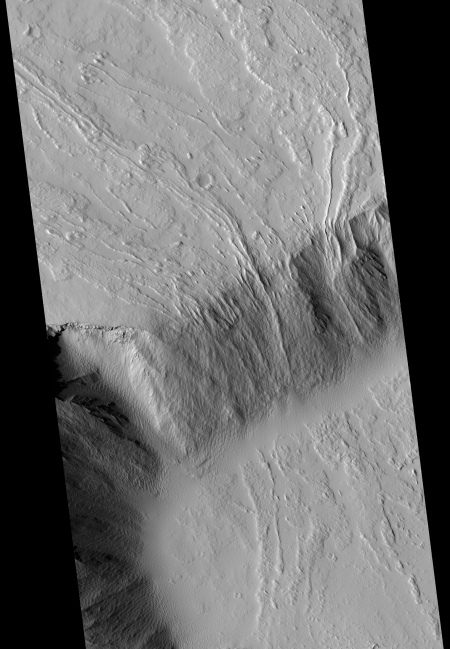
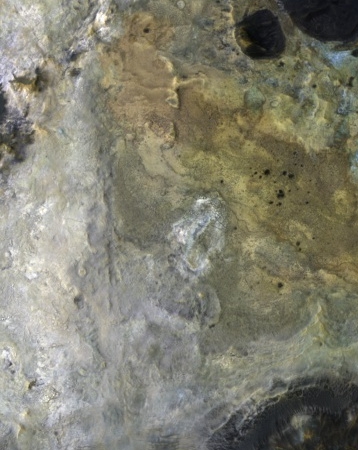
Cool image time! The image on the right, cropped and reduced in resolution to post here, shows an area on Mars that geologists have dubbed “Chaos Terrain.” If you click on the image you can see the full image, which also includes several canyons oriented in what seem to be random directions.
I first heard this geological term for regions on Mars shortly after the first orbital missions circling Mars began taking images back in the 1970s. It applied to places where the terrain was hummocky, a crazy collection of hills forming no pattern at all. Earth does not really have such terrain.
The close-up to the right also shows that at least one of these hills is fractured, made up of several large pieces that have separated over time.
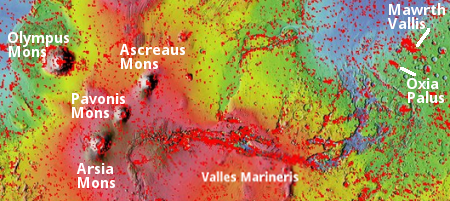
This image was part of the May 2nd image release from the high resolution camera on Mars Reconnaissance Orbiter. What makes it interesting is its location on Mars. The image below shows that location, indicated by a white cross.
» Read more
Capitalism in space: ULA has chosen an Aerojet Rocketdyne engine to power the upper stage of its next generation rocket Vulcan.
The company has not yet made a decision on the engine for the first stage, where Blue Origin’s BE-4 still appears favored over Aerojet Rocketdyne’s AR-1 engine. This decision on the upper stage could partly be a political move, giving Aerojet the upper stage in order to make it easier to give the lower stage to Blue Origin.
ULA is forced to play politics here because politicians are involved. A number of power members of Congress want Aerojet Rocketdyne to get the business, and ULA risks offending these legislators should it abandon that company entirely.
A new computer technique has been developed that uses subtle changes to a document’s fonts to encode secret messages and data.
Using Columbia University’s FontCode system, however, users can hide messages within unrelated text via virtually-invisible changes to the displayed letters.
Developed by a team led by associate professor of computer science Changxi Zheng, FontCode works with commonly-used fonts such as Times Roman, Helvetica, and Calibri, plus it’s compatible with most word processing programs. Additionally, the hidden messages are retained even when the document is printed on paper or converted to a different file type.
The video at the link explains very nicely how this works. The technology has some excellent potentially positive applications, such as providing a method of finding out if an original document has been modified. It also carries with it a great potential for misuse because of its ability to hide information unobtrusively in a written document.
NASA today announced that a test drone, dubbed Mars Helicopter, will be flown on the 2020 Mars rover mission.
Once the rover is on the planet’s surface, a suitable location will be found to deploy the helicopter down from the vehicle and place it onto the ground. The rover then will be driven away from the helicopter to a safe distance from which it will relay commands. After its batteries are charged and a myriad of tests are performed, controllers on Earth will command the Mars Helicopter to take its first autonomous flight into history.
“We don’t have a pilot and Earth will be several light minutes away, so there is no way to joystick this mission in real time,” said Aung. “Instead, we have an autonomous capability that will be able to receive and interpret commands from the ground, and then fly the mission on its own.”
The full 30-day flight test campaign will include up to five flights of incrementally farther flight distances, up to a few hundred meters, and longer durations as long as 90 seconds, over a period. On its first flight, the helicopter will make a short vertical climb to 10 feet (3 meters), where it will hover for about 30 seconds.
As a technology demonstration, the Mars Helicopter is considered a high-risk, high-reward project. If it does not work, the Mars 2020 mission will not be impacted. If it does work, helicopters may have a real future as low-flying scouts and aerial vehicles to access locations not reachable by ground travel.
The only word I can think of to express my thoughts on this is “Cool!”
Capitalism in space: SpaceX today successfully placed in orbit Bangladesh’s first communications satellite, successfully using its upgraded Block 5 version of the Falcon 9 rocket, its first stage designed to be reused a minimum of ten times.
They successfully recovered the first stage, and will now take it apart to confirm this new version worked as planned. If so, it will be put back together and returned to service.
The leaders in the 2018 launch standings:
14 China
9 SpaceX
5 Russia
5 ULA
The U.S. and China are once again tied at 14 for the nation lead. SpaceX’s launch rate is presently double what it achieved last year, when it launched the most rockets of any private company ever.
In creating its new Google assistant, called Duplex, and designing it to be able to make phone calls to schedule appointments, the company made it indistinguishable from a human and successfully hid the fact that it was a robot.
The company was then surprised that many were horrified by this and objected.
The demonstration of the technology at the conference was both impressive and startling. The first example showed Duplex calling a hair salon and scheduling an appointment. The second example involved an even more complex conversation, with the system calling a restaurant to try to make a reservation. In the course of the conversation the system is told it wouldn’t need a reservation for that many people on that particular day. Understanding this, Duplex thanks the person on the other end and hangs up.
These examples of a human-sounding AI interacting with a real person are undeniably impressive, but the technology’s ability to so blatantly fool another human being into thinking it is real has left many unnerved. From suggestions Google had failed at ethical and creative AI design to more explicit accusations that the company was ethically lost, rudderless and outright deceptive, it seems something had gone drastically wrong.
You can watch the demonstration at the link. The robocall technology is quite amazing, and it is also incredibly dishonest and morally bankrupt. Google makes no effort to identify its robot to the listener, and is actually proud that it successfully fools them into thinking they are talking to a human.
The article notes that the company has gotten a lot of negative response to this, and has since said it will always make full disclosure in the future. I have my doubts. I also expect that politicians and survey companies will soon take advantage of this as well. I now routinely hang up on surveys that use robots. To discover that they can fool us makes me want to hang up on all surveys, in all cases.
The first launch of SpaceX’s Block 5 iteration of its Falcon 9 rocket was scrubbed today after an automatic abort at T-minus 59 seconds.
The next launch window is tomorrow afternoon. No word yet if they will go for that window.
Cracks found in a Florida pedestrian bridge prior to its collapse, killing six, might have indicated the upcoming failure.
A key concrete support truss in the doomed Florida International University pedestrian bridge developed worrisome cracks 10 days before the structure was lifted into place over the Tamiami Trail, photographs and an internal email unintentionally released by the school show.
The documents, released in response to public records requests from the Miami Herald, show that FIU’s construction and engineering team discovered potentially problematic cracks in the bridge earlier than officials have previously acknowledged.
Because of the ongoing investigation we do not yet how the engineering company building the bridge responded to the cracks. They might have analyzed them and dismissed them. Or the might have ignored them entirely.
The Mars Odyssey team today released an image the spacecraft took of Gale Crater on January 16, 2018. This image, reduced in resolution, is posted on the right and captures the entire region that the rover Curiosity has been traversing for the past six years. If you click on the image you can view the full resolution original.
I have placed Curiosity’s full route since its landing on this image so that we can see where the rover has been. The actual peak of Mount Sharp is a considerable distance to the south and is not visible in this image. (For the full context of the crater and Curiosity’s travels see my March 2016 post, Pinpointing Curiosityโs location in Gale Crater)
The river-like flow feature cutting through the north rim is called Peace Vallis. Scientists think this was formed by water flowing into the crater when the climate of Mars was wetter and there was a lake inside the crater floor.
You can get another perspective of this same view by looking at the panorama looking north that Curiosity took once it climbed up onto Vera Rubin Ridge.
I have said this before, but this Mars Odyssey image once again illustrates how little of Mars we have so far seen. Curiosity has barely begun its climb into the foothills of Mount Sharp. The mile-high mountains that form the rim of Gale Crater are far away, and will not be walked for probably generations. I do not expect any space probe or explorer to enter Peace Vallis for at least a hundred years, since there are so many other places on Mars to visit and Gale Crater has already gotten its first reconnaissance by Curiosity.
The image also gives as a view of Curiosity’s future travels. Based on this October 3, 2016 press release, Curiosity will eventually head into the mouth of the large canyon directly to the south of its present position. Whether the mission will continue up this canyon wash, using it as the route up Mount Sharp, will depend on many things, including the roughness of the terrain in that canyon and the simple question of whether the rover will be able to operate that long.
If it does, the views then from inside that canyon should be quite breathtaking.
Several Juno images that have been cleverly processed by citizen scientists are being highlighted at a Jupiter conference being held in London this week.
JunoCam images presented at the meeting by citizen scientists Gerald Eichstรคdt and Seรกn Doran include an animation showing the evolution of swirling features in the giant planetโs atmosphere and a composite image of Jupiterโs cloud tops.
Gerald Eichstรคdt, a mathematician working as a software professional, has taken two images from JunoCam and reprojected them to the same vantage point to enable a direct comparison between the images and show the subtle motions within the atmosphere. By modelling the movement of individual pixels in the images, he has created an animation that extrapolates the swirling evolution of the vortices in the atmosphere.
Eichstรคdt explains: โThis animation represents a โfeasibility testโ. Building on this initial work, we can add in more variables that will give us a more detailed description and physical understanding of Jupiterโs atmosphere.โ
Seรกn Doran, in collaboration with Eichstรคdt, has created a new composite image of Jupiter as seen by Juno as it swung away from Jupiterโs south pole on 1st April 2018. Because Jupiter was larger than JunoCamโs field of view when the main portion of the image was taken, Eichstรคdt rendered four other images to the same viewing geometry to reconstruct a mosaic of the whole planet. Doran then processed the composite image to balance and blend the overlapping components, sharpen the contrast, and fill gaps.
I have myself highlighted images by both previously at Behind the Black, here and here and here and here. This press release nicely places both in the limelight at last.
The new colonial movement: Kenya’s first satellite, a cubesat built by students at the engineering school at the University of Nairobi, will be deployed tomorrow from ISS.
The cubesat was launched by SpaceX in its Dragon cargo freighter in early April, and was built using funding from the UN with technical help from Japan.
Because the Air Force wishes to do more testing and review of both its payload and the rocket, the second launch of SpaceX’s Falcon Heavy has been delayed several months.
The Falcon Heavy mission for the Air Force will be its first for a paying customer. STP-2 has a number of objectives, including demonstrating the new rocketโs capabilities and launching several satellites.
The launch had been set for June.
That the Air Force is on board Falcon Heavy now indicates that it wants to get this rocket certified for military launches as quickly as possible, thus giving it another heavy lift launch option besides the much more expensive Delta Heavy of ULA. This strategy is good for the Air Force, good for the taxpayer, and good for the launch industry. It will lower launch costs while encouraging competition.
Photos of the ship, Mr. Steven, that SpaceX wants to use to recover its rocket fairings show that the company has installed a new net for catching those fairings.
The article theorizes that this heftier net has actually been installed for eventually catching the Falcon 9’s upper stage.
[T]he newly-installed net is by all appearances magnitudes larger, heavier, and stronger than the minimal mesh specimen it is clearly replacing. Given the fact that SpaceX thus far has self-admittedly failed to catch a gliding fairing half in the net, it seems unlikely that such a drastic upgrade would be necessitated by any field-testing that occurred since Mr. Stevenโs debut late last year. Rather, a significantly more capable net seems to more readily fit alongside CEO Elon Muskโs tweet reveal three weeks prior that SpaceX would attempt to close the final major loop of Falcon reusability by recovering the orbital upper stage (S2). Estimated to weigh approximately 4000 kilograms empty, the upper stage is a minimum of four times heavier than Falcon 9โs payload fairing halves, Mr Stevenโs current meal of choice.
Judging from the new netโs beefy rigging, broader bars, and general appearance, one could safely argue that it looks at least several times stronger than the mesh net before it. One could also argue that the absolutely massive metal arms installed on Mr. Steven are far larger than what might be required to catch the extremely low mass-to-area ratio payload fairings, with structural heft and bulky netting more reminiscent of safety nets present on naval vessels that are designed to catch aircraft and helicopters weighing five metric tons or more.
This is an interesting theory, but I have my doubts. At the same time, I would not dismiss Musk’s willingness to try daring engineering approaches.
China’s Long March 4C rocket today launched an Earth observation remote sensing satellite.
I think I need to put together an outline of all of China’s operational rockets. The 4C appears to be similar to the 4B, but knowing how it differs from their other rockets, and why they have each, would be helpful information.
The leaders in the 2018 launch standings:
14 China
8 SpaceX
5 Russia
5 ULA
China has once again pulled ahead of the U.S., 14-13, in the national standings.
Sources in the investigation of an accident where a self-driving car hit and killed a pedestrian in Arizona in March now say that the car’s programming was at fault.
According to two anonymous sources who talked to Efrati, Uber’s sensors did, in fact, detect Herzberg as she crossed the street with her bicycle. Unfortunately, the software classified her as a “false positive” and decided it didn’t need to stop for her.
Distinguishing between real objects and illusory ones is one of the most basic challenges of developing self-driving car software. Software needs to detect objects like cars, pedestrians, and large rocks in its path and stop or swerve to avoid them. However, there may be other objectsโlike a plastic bag in the road or a trash can on the sidewalkโthat a car can safely ignore. Sensor anomalies may also cause software to detect apparent objects where no objects actually exist.
Software designers face a basic tradeoff here. If the software is programmed to be too cautious, the ride will be slow and jerky, as the car constantly slows down for objects that pose no threat to the car or aren’t there at all. Tuning the software in the opposite direction will produce a smooth ride most of the timeโbut at the risk that the software will occasionally ignore a real object. According to Efrati, that’s what happened in Tempe in Marchโand unfortunately the “real object” was a human being.
I honestly do not understand the need for self-driving cars. In the end, I simply cannot see the software ever being capable of handling all the variables created by the presence of the unpredictable life that will surround it. And should it get that good, I wonder if we will then regret it.
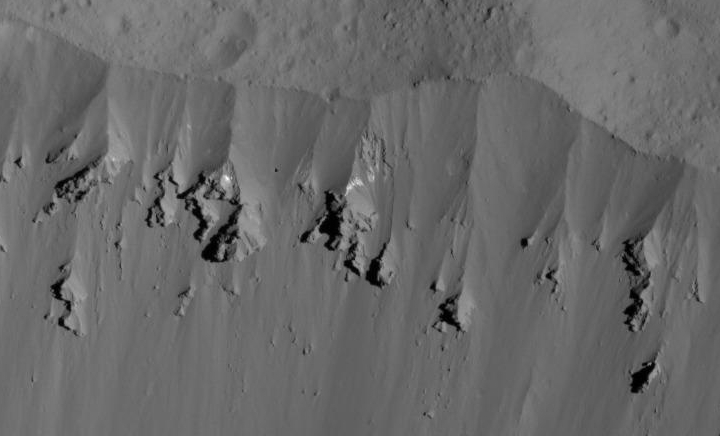
Cool image time! Buried in the catalog of recent high resolution images from Mars Reconnaissance Orbiter are places on Mars that are inexplicable and fascinating, while also indicative of its vastness. The image on the right, reduced in resolution and cropped to post here, shows us one such place. If you click on the image you can see the full image at high resolution.
The archive posting of this image is titled “Cones near Pits.” As you can see, to the north and east of the pits are some mesas (why they call them cones I do not know).
The pits are unusual, and appear to be some form of collapse. In the larger image several additional mesas can be seen at farther distances, but most of the overall terrain is remarkably flat and featureless, except for numerous small craters that appear either partly buried by dust or significantly eroded.
I am not going to guess at the geology that caused the pits and mesas. What I do want to focus on is the vastness of Mars. This location is on the southern edge of Utopia Basin, the second deepest basin on Mars. It is part of the planet’s endless northern plains, an immense region covering almost half the planet that tends to be at a lower elevation, is relatively smooth, and is thought by some scientists to be evidence of what was once an intermittent ocean. The global map of Mars below indicates the location of the above image with a black cross.
» Read more
Capitalism in space: Another new smallsat company, Rocket Crafters, has entered the competition, focusing on the development of 3D-printed rocket engines using hybrid fuels.
The companyโs Cidco Road facility is notable for what is not there, Gutierrez said. Unlike a more typical rocket engine site, there are no signs warning of explosive materials, no use of super-cold or toxic propellants, and no engines equipped with turbo pumps.
Instead, the rocket fuel consisted of plastic tubes made from the same base materials as Legos, measuring two feet long and weighing about five pounds, that were stacked on shelves and safe to touch. Combined with nitrous oxide โ commonly known as โlaughing gasโ โ the small-scale test engine on Monday generated about 200 pounds of thrust firing at half-power. It was one of more than 20 such firings over the past year at the facility Cocoa officials rezoned to allow the tests, which were deemed safe to the surrounding people and environment.
โWeโre not the noisiest neighbor in the area,โ joked Robert Fabian, senior vice president of the propulsion division.
Most rockets rely on super-cold or โcryogenicโ propellants such as liquid oxygen or liquid hydrogen, or solid fuel like the space shuttleโs twin solid rocket boosters used.
Hybrid motors have suffered from uneven burns producing bumpy rides, Fabian said. But Rocket Crafters believes it has found a low-cost solution providing a smooth, consistent burn: 3-D printed cylinders of fuel formed in ridged and beaded layers.
We shall see. They hope to fly by 2020, at the earliest. They will be joining an increasingly crowded field. If their design works, however, they will certainly carve out a significant market share, as hybrid fuels are so much safer and easier to handle than traditional propellants.