Venturi Space expands investment in new French factory for building Astrolab’s rover

Venturi Space, the European half of the partnership with the rover startup Astrolab, is increasing its investment in a new French factory from 100 million to 250 million euros.

On 1 June, Venturi Space announced that it had increased its expected investment in the new facility to €250 million. The announcement indicated that it would no longer begin with the initial smaller facility and would instead move directly to the full 16,000-square-metre planned “technology centre.” This likely accounts for the additional €150 million in funding.

According to the company’s 1 June press release, the facility will be used for the “design and manufacture of critical technologies for lunar and Martian mobility, as well as [for] the assembly of the rovers developed by the company.” …Venturi Space is providing wheels, batteries, and battery management systems to US-based Venturi Astrolab for use aboard its rovers. During a 26 May event, NASA announced that Venturi Astrolab was one of two companies selected to build rovers for the agency’s Artemis programme.

The partnership is an unusual one. Venturi Space and Astrolab are separate companies, working together to build Astrolab’s rovers for NASA. Venturi however is also developing its own rover for the European Space Agency.

3 comments

Axiom’s CEO provides update on corrosion and the timetable for its space station

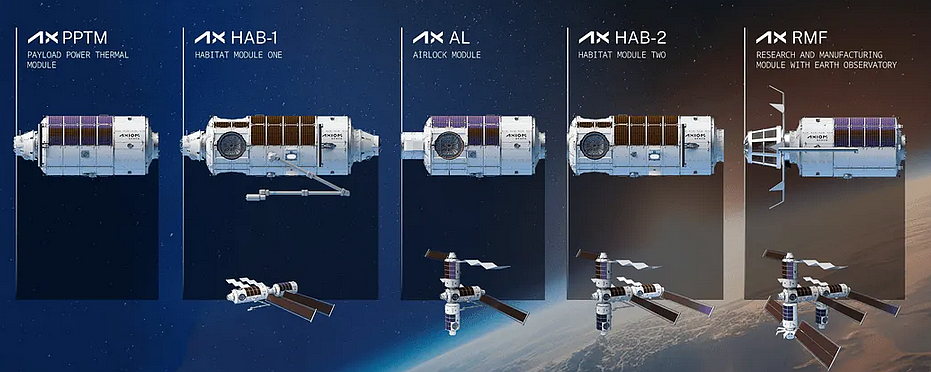
Axiom's module assembly sequence
Axiom’s module assembly sequence

Jonathan Cirtain, the CEO of the space station startup Axiom, this week gave an interview where he provided a short update on the status of their station’s construction, including the present launch timetable as well as the corrosion issue known to exist on the two module hulls that Thales-Alenia is presently building for the company.

It [the corrosion] was actually observed during ISS using a similar manufacturing technique. They mitigated it.

Now it’s come back. … We’re going to fix it the same way they fixed it for the International Space Station, the Columbus module, which has been operational now for eighteen, nineteen years. Had that same challenge. So we’re working our way through that. That should get resolved by the end of the month of June.

Because this interview took place just prior to NASA’s announcement yesterday that it has abandoned its core module concept proposed last month, Cirtain describes how the company was considering some design and construction changes to deal with it. That issue however has now vanished.

Cirtain added that the module’s hulls will next be shipped from the Thales-Alenia factory in Europe to the U.S., where Axiom will then begin installing the interior and exterior components of each, with a planned launch of the first, dubbed the PPTM, by 2028, the same target date the company announced in January 2026. That the date has not changed six months later suggests either the corrosion issue did not delay things, or it was the cause of that delay.

As I noted in January, Axiom’s schedule margins for getting its station launched, docked to ISS, loaded with ISS equipment, and then separated before ISS retires in 2030 are extremely tight. It cannot afford any further delays.

In other Axiom news, the company announced yesterday that it has established a a wholly owned subsidiary based in Switzerland, dubbed Axiom Switzerland, thus establishing itself within the Europe to facilitate future contracts with the European Space Agency, the European Union, and the member nations of both.

Below are my updated rankings of the five American space stations presently under development:
» Read more

3 comments

Redwire completes testing on robot arm prototype for ESA

The European division of the American space manufacturing company Redwire last week delivered to the European Space Agency (ESA) a full developed and tested robot arm prototype, as per a 2024 contract.

The project is being led by Redwire’s Luxembourg team, which recently completed several project milestones including preliminary design and performance assessment.

Before successful delivery, the MANUS Breadboard Model underwent a comprehensive test campaign to verify the functionality and performance of the manipulator and tool-changer subsystems, and to demonstrate operational scenarios aligned with system requirements. All planned operations, including payload handling, end-effector actuation with wireless data and power transfer, range extender manipulation, and automatic deployment, were executed successfully, confirming overall system readiness. Functional testing validated safe and reliable mechanical performance, demonstrating strong joint-space accuracy and stable interaction among subsystems.

The arm is intended for ESA’s Argonaut lunar lander, allowing it to unload cargo from the lander to the lunar surface. ESA’s 2024 development contract was issued to both Redwire and the Polish company PIAP. PIAP however has not even built the actual prototype. It appears ESA is now moving forward on the full contract phase for the entire rover, and it appears Redwire’s Luxembourg division is in the best position to win the robot arm contract portion.

Not surprisingly, Redwire’s stock surged by 24% following this announcement.

0 comments

France’s space agency CNES gives ESA 5-year extension at French Guiana spaceport

French Guiana spaceport
The French Guiana spaceport. The Diamant launchsite is labeled “B.”
Click for full resolution image. (Note: The Ariane-5 pad is now the
Ariane-6 pad, and the Soyuz pad is now controlled by rocket startup
MaiaSpace.)

France’s space agency CNES and the European Space Agency (ESA) yesterday announced a new five year agreement extending ESA’s operations at France’s French Guiana spaceport.

The contract covers all activities required to operate Europe’s Spaceport that is on French territory and so falls under the responsibility of the French government represented by CNES. The contract includes both daily operations and running of the facilities and continuous upgrades to adapt the Spaceport to changes taking place in the space sector, including the arrival of new rockets and launch services.

The signature covers three years of operations, renewable for a further two years, including a total investment of over €1 billion with €635 million funded by the European Space Agency – showing the agency’s central role in supporting the operation of Europe’s Spaceport. In support of the transformation of the space sector, the contract takes new launch operators into account as well as sharpening safety requirements even more – ensuring launches from Europe’s Spaceport are reliable, safe and competitive.

While the deal is not surprising — neither ESA nor CNES have any reason to end this arrangement — there is one aspect of the deal that is significant: Nowhere in the press release or agreement is there any mention of Arianespace, ESA’s commercial division. For decades Arianespace ran French Guiana for ESA and France. It is now gone, eliminated as an unnecessary middle-man as Europe shifts to the capitalism model.

At the moment, ESA has reduced Arianespace’s role to just one task, marketing and launching the Ariane-6 rocket. At the same time numerous European nations are doing whatever they can to encourage the development of competing independent rocket companies, all aimed at replacing Ariane-6 eventually, and as soon as possible. While that effort will take at least a decade, it is definitely happening.

1 comment

Avio completes its first Vega-C launch for ESA

The Italian rocket company Avio today successfully completed its first Vega-C launch for the European Space Agency (ESA), placing into orbit ESA’s SMILE telescope, designed to study the Sun’s solar wind and its interaction with the Earth’s magnetic field.

The significance of this launch is that it is the first time the Vega-C was launched under the management of Avio, which manufactures it, rather than ESA’s commercial division Arianespace. Arianespace is being cut out of the picture. At the moment I think it only has one more Vega-C launch on its manifest. All other future Vega-C launches will be sold and managed by Avio directly.

As this was Avio’s first official launch in 2026 (or ever), the leader board for the 2026 launch race remains unchanged.

57 SpaceX
28 China
8 Russia
6 Rocket Lab

For the third straight year SpaceX leads the entire world combined in total launches, 57 to 50.

0 comments

ESA announces new round of funding for new rocket companies

Capitalism in space: The European Space Agency (ESA) yesterday announced a new round in its Boost! program to provide new startup rocket companies funding.

The new round will accept new submissions through 2028. The program is designed to encourage the development of private and independent rocket companies, competing for market share, with the added ability to provide ESA its needed launch services. What makes this ESA program different than all its previous rocket programs is that ESA does not own or control the rockets. It is helping to get these companies started, and will simply then be a customer buying the product from them once operation. Ownership will belong to the companies, not ESA.

To emphasize the ownership point, to get funding under this program “requires private co-funding. For every euro invested by ESA in commercial space businesses, often more than five euros are leveraged from private investors.”

So far ESA has provided funding to eleven different European startups, including Isar Aerospace, Rocket Factory Augsburg, and PLD, all three of which hope to make their first orbital launch this year. This new round is being offered to these companies and any new ones that might come forward. Of the 110 million euros so far allocated 20 million euros remains available for distribution.

3 comments

Avio makes more from its Vega-C rocket now that Arianespace is out of the picture

According to a report today at Europeanspaceflight.com, the European Space Agency (ESA) paid Arianespace €51.65 million ($60.6 million) for a December 2024 launch using the Vega-C rocket that the Italian company Avio produces.

That flight was one of the last ones managed by Arianespace. In November 2025 ESA completed the transfer of ownership back to Avio, so that the company now manages and sells its own rocket, rather than have a middle-man government agency run things and take a cut.

Since then Avio has won three separate launch contracts, one from Taiwan for $81 million, another from Brazil for $35.6 million, and a third from Airbus for $84.4 million (see here).

Based on these numbers, it appears that Avio is doing much better selling this rocket directly to the market than having Arianespace and ESA run things for it. It is not only generally getting slightly more revenue per launch (about $67 million average compared to $60.6 million under Arianespace), but it is keeping all the profits, rather than having the Arianespace government bureaucracy take a percentage.

These numbers however won’t hold in the coming years. In the U.S. in the next year at least two reusable rockets — Rocket Lab’s Neutron and Stoke Space’s Nova — are coming on line, and will drive these launch prices down. Furthermore, new smallsat rockets being developed in Germany (two), Spain, India (two), South Korea, and Australia should do the same.

At the moment however Avio is benefiting from the present state of the market, though even that advantage is threatened because it has had to delay the next Vega-C launch due to a technical issue.

Regardless, these numbers give us a strong sense of the present competitive launch costs in today’s market, averaging about $60 million per launch. Before SpaceX came along, that price generally exceeded more than $100 million, and often as high as $200 to $500 million. No more. SpaceX has forced competition on the industry, and the result has been a notable drop in price, with more to come.

0 comments

ESA: Full-sized model of its Space Rider reusable capsule is ready for landing drop tests

Artist rendering of Space Rider in orbit
Artist rendering of Space Rider in orbit. Click for original.

My heart be still! The European Space Agency (ESA) yesterday announced that a full-sized model of its Space Rider reusable capsule is now ready for landing drop tests from a helicopter.

The avionics – Space Rider’s ‘brain’ – were installed in the second week of March. This computer hosts the Guidance, Navigation and Control algorithms that will steer the parafoil, adapting to the wind – including any gusts– to guide Space Rider to a soft landing.

Roughly the size of a mini-van, the drop-test model is a full-size stand-in for the 4.6-m long reentry module, Space Rider lands on skis with the landing gear permanently open on this model as the mechanism is not part of the drop test.

To get an idea how unserious ESA is, we need to review this project’s overall schedule. This reusable capsule concept — which appears to be a variation of either Varda’s returnable capsule or Boeing’s X-37B — was first tested by ESA in 2015. By 2017 the agency was promising it would be flying commercially by 2025. A decade later and they have not yet begun testing a full scale spacecraft.

And the development pace now is glacial. Last summer ESA did helicopter drop tests of just the “brain” and parafoil. It is now going to do those drop tests again, a year later, with this full scale model. Expect another year to pass — at a minimum — before it tries another set of helicopter drop tests, this time with the first actual Space Rider capsule.

At this pace, Space Rider might fly by 2030, maybe. In the meantime, expect at least a half dozen private capsules to fly commercially, for profit. Following Varda’s success investment capital has poured into this industry. All will go from a blank sheet of paper to a flight model in less than five years.

And even if ESA finally gets Space Rider operational, it has established some very complex rules about who can use it commercially, rules so complex I predict few will be interested.

8 comments

The space agencies of Canada and Europe agree to exchange classified information

Canada:
Canada: “We let our government do it all!”

In what appears to be the increasing policy of the Canadian Liberal government to align its space program with Europe, the Canadian Space Agency this week signed an agreement with the European Space Agency that will make it possible for them to freely exchange classified information.

The European Space Agency (ESA) and Canada have signed a General Security of Information Agreement (GSOIA), which will establish a legally binding framework for the exchange of classified information. The agreement was signed on 14 April at the 41st Space Symposium in Colorado Springs, USA, by ESA Director General Josef Aschbacher and President of the Canadian Space Agency Lisa Campbell, on behalf of the Government of Canada.

The GSOIA will ensure that both parties uphold the highest standards of security while enabling the secure exchange of sensitive information entrusted to authorised institutions and industrial partners. It provides a robust foundation for cooperation in areas where the protection of classified information is essential. In particular, the agreement will facilitate closer collaboration in strategic domains such as space-based surveillance, disaster response and security-related technologies. It will also support the development of dual-use capabilities, including advanced sensing systems, secure communications and emerging space technologies.

Canada is the only country not in Europe that is a partner in ESA. This deal, plus Canada’s recent commitment to provide a half billion dollars of funding to ESA projects, illustrates the Liberal government’s policy to look to Europe more for its space effort, rather than the United States.

This appears also to be part of the Liberal government’s shift away from capitalism and towards a government-based space effort, a decision that is certain to produce few results while wasting a lot of money.

20 comments

Scientists: First data from Europe’s Proba-3 satellites suggest the Sun’s slow solar wind is faster and more chaotic than expected

Figure 4 showing variable speeds of slow solar wind
Click for original image.

The uncertainty of science: According to the first published paper [pdf] from Europe’s two Proba-3 satellites, scientists have found the slow solar wind that comes from the Sun is sometimes far faster than expected, and is also far more chaotic. From the second link above:

Just like wind on Earth, solar wind can be fast or slow, smooth or gusty. Fast solar wind usually flows in a smooth current from magnetic structures called coronal holes. In contrast, slow solar wind is variable and gusty, making understanding how it works more difficult.

Scientists think that slow solar wind is generated by the Sun’s magnetic field lines changing how they are connected, merging and separating again. This process pushes out blobs of plasma (electrically charged gas) in so-called ‘streamers’: large, bright rays in the corona.

…Previously, scientists found that close to the Sun’s surface, slow solar wind should have speeds around 100 km/s. Instead, Andrei’s team tracked some blobs of plasma moving at 250–500 km/s.

The graph to the right, Figure 4 in the paper, shows Proba-3’s tracking of a variety of these blobs. Not only did some move faster than expected (the arrows above the gray line marking earlier data), their speeds changed with time, with some actually speeding up.

The reason the Sun’s fast wind is relatively stable is that it emanates from magnetic structures dubbed coronal holes because the magnetic field lines there are is somewhat calm and stable. The slow wind meanwhile comes out through much more active and unstable regions of the magnetic field, with its field lines jumping about as well as connecting and unconnecting from the field’s structure in a chaotic manner.

This research suggests that the slow wind is chaotic and thus unpredictable, almost like the weather on Earth.

2 comments

ESA paid Arianespace about $96 million for an Ariane-6 launch

According to a story today on European Spaceflight, the European Space Agency (ESA) paid its commercial division Arianespace €82 million [about $96 million] for its Ariane-6 launch in November 2025 of ESA’s Earth observation Sentinel-1D satellite.

The European Space Agency has disclosed that launching the Sentinel-1D Earth observation satellite aboard an Ariane 62 rocket in November 2025 cost €82,070,773. As part of its involvement in the development of the European Union’s Copernicus Earth observation satellite constellation, ESA is responsible for placing contracts with European industry for the development, launch, and operation of satellites. As part of this responsibility, the agency publishes an annual list of all contracts awarded with a value of more than €15,000. In 2025, this included the disclosure of the cost of launching Sentinel-1D aboard an Ariane 6 rocket in its two-booster variant [dubbed Ariane-62].

This is the first time ESA or Arianespace have revealed any price figures for using Ariane-6, and shows that Arianespace is attempting to price Ariane-6 competitively with SpaceX’s Falcon 9 rocket. The article notes that SpaceX charged ESA about $90 million for an earlier Sentinel launch.

Because Falcon 9 is mostly reusable, SpaceX’s profit margin is far higher than Arianespace’s. Ariane-6 is expendable, and thus costs more. Thus, if necessary SpaceX could significantly lower its price, but hasn’t because it hasn’t yet felt any competitive pressure to do so. When the new reusable rockets from Stoke Space and Rocket Lab begin launching sometime this year, then launch prices will drop considerably, and Ariane-6 will find itself very over-priced, with no way to lower its cost enough to compete.

3 comments

Avio delays next Vega-C launch due to “technical issue”

The Italian rocket company Avio announced yesterday that is has postponed the May 9, 2026 launch of the European Space Agency’s (ESA) Smile solar wind spacecraft due to “a technical issue” discovered by a subcontractor in a component used by the Vega-C rocket.

The press release provided little information:

The launch of the Smile satellite has been postponed, due to a technical issue occurred on a subsystem component production line after VV29 launcher integration. Additional investigations are needed to exclude any relation between such issue and the VV29 launcher in order to safeguard flightworthiness. The new launch date will be announced following the completion of these activities, as agreed with the supplier.

This launch will be the first entirely managed by Avio since it regained control of its rockets from ESA’s Arianespace division. The rocket itself was grounded for two years in 2023 and 2024 due to nozzle issues. It has since flown four times successfully.

1 comment

Rocket Lab launches GPS-type demo satellite for Europe

Rocket Lab this morning successfully placed a European Space Agency (ESA) smallsat into orbit, its Electron rocket lifting off from one of its two launchpads in New Zealand.

The smallsat, dubbed Celeste, is the first of two such demo satellites that ESA has contracted Rocket Lab to launch. They are designed to test a low Earth orbit constellation for providing global navigation and location information to users on the ground, similar to the U.S.’s GPS constellation. Celeste will work from low orbit with Europe’s medium orbit Galileo constellation, but being smaller will be cheaper and faster to build and launch.

The leaders in the 2026 launch race:

38 SpaceX
15 China
5 Rocket Lab
4 Russia

SpaceX continues to lead the entire world combined in total launches, as it did in both ’24 and ’25.

4 comments

ESA to rent SpaceX Dragon capsule to do a European manned mission to ISS

ESA logo

Capitalism in space: At a European Space Agency (ESA) this week in Switzerland, agency officials announced that it is purchasing use of a Dragon capsule from SpaceX in order to do an extended manned mission to ISS in 2028.

Member states endorsed the concept of EPIC — short for ESA Provided Institutional Crew — a proposed mission intended to provide a medium-duration stay for ESA astronauts aboard the ISS.

The plan foresees acquiring a Crew Dragon mission in the first quarter of 2028 in collaboration with “interested international partners.” Crew Dragon is the crew spacecraft built by US company SpaceX.

According to those officials, this mission will be for at least one month, and include astronauts from ESA and some as yet undetermined international partner astronauts.

This contract illustrates the fundamental shift in power and control in manned space in the past decade. Until 2011, all manned missions were flown on government-built rockets and spacecraft. The agencies controlled everything, and actually acted to stymie competition from the private sector.

Now, those agencies are dependent on that private sector for their manned missions. They are instead merely customers, buying services from competing commercial companies that own the rockets and spacecraft, and rent them out for profit. That SpaceX at present is the only one capable of doing these manned missions for hire makes no different. Soon others will enter the fray.

Moreover, this capitalism model actually gives these agencies more flexibility. Beforehand, ESA had to go through NASA to do such a manned mission, and that would involve a lot of negotiations. Now it simply buys the mission from SpaceX, and flies it when ready.

7 comments

Engineers regain contact with Proba-3’s Coronagraph probe

The Proba-3 mission
The Proba-3 mission. Click for original.

A month after all contact was lost with the Coronagraph probe of Europe’s two-spacecraft Proba-3 solar observatory, engineers have regained contact with it this week, and have been able to place it in safe mode in preparation for re-establishing science operations.

After more than a month of silence, ESA’s ground station in Villafranca, Spain, received telemetry from the Coronagraph spacecraft. Telemetry is a package of data sent by a spacecraft including information on its temperature, voltages, and health of onboard systems.

The Coronagraph is now in safe mode and stable, and the mission team and operators are running health checks on the spacecraft to understand if any parts of it have been damaged.

The spacecraft’s solar panel is facing the Sun, powering the essential electronics on board, and charging the battery with the remaining power.

Before it can resume observations engineers need to get the spacecraft back up to operating temperature after a month without power.

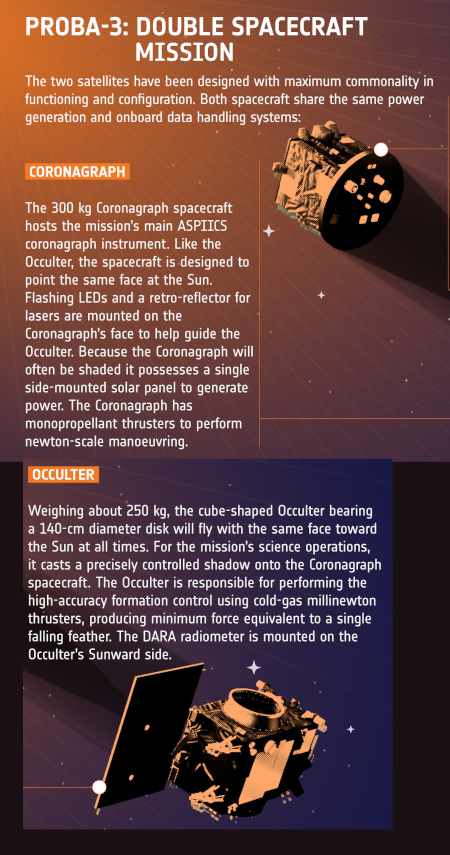
As shown in the graphic to the right, the Coronograph satellite is the heart of this mission. It records the data, available because the Occulter blocks the Sun from view so that the corona, the Sun’s atmosphere, can be seen. It is almost a miracle that it has survived that month, and can soon resume observations.

1 comment

OHB wins $285 million contract to build weather satellite constellation for ESA

ESA logo

Capitalism in space The Swedish subsidiary of the European aerospace company OHB yesterday announced it has won a $285 million contract from the European Space Agency (ESA) to build and maintain a six satellite weather satellite constellation.

The company had already successfully launched and tested a single demo satellite, proving a small satellite could do the job.

The foundation for this is the Arctic Weather Satellite (AWS), which OHB Sweden successfully placed in orbit as a demonstrator more than a year ago. The OHB SE subsidiary developed the small satellite on behalf of the European Space Agency ESA in record time, using a deliberately chosen New Space approach. Only three years passed between contract award and launch.

This new constellation is dubbed EUMETSAT Polar System – Sterna (EPS-Sterna), and will supplement and eventually replace the expensive government-built Eumetsat weather constellation presently in orbit.

OHB Sweden is the prime contractor for the delivery of the satellites for the EPS Sterna constellation. The consortium also includes Omnisys in Sweden as the supplier of the microwave instruments, which constitute the primary meteorological payload. A total of 20 satellites will be delivered under the contract. The industrial team includes approximately 30 companies. Germany is also strongly represented by SMEs that will contribute key hardware for the instrument and the satellite platform. The satellites will be procured by EUMETSAT through ESA. EUMETSAT itself will develop the ground segment, procure and provide the launch services, operate the satellites, manage the constellation and distribute the data through its data distribution mechanisms, which has a planned operational lifetime of 13 years.

This contract is another example of Europe’s fast shift in the past three years from the government model to the capitalism model. It took ESA almost a decade to finally decide to make that shift, but once it did it seems to be moving far faster than NASA did to implement it.

0 comments

Italian rocket company Avio wins $65 million War department contract

The Italian rocket company Avio announced last week that it has won a $65 million contract to build a solid-fueled motor for the U.S. Department of War.

Defense Systems and Solutions (DSS), a joint venture between Yulista Integrated Solutions, LLC (YIS) and Science and Engineering Services, LLC (SES), acting as a prime contractor for the US Department of War, selects Avio Group for the development, qualification and initial production of a solid rocket motor for air defense applications.

The contract, amounting approximately to $65 million and covering a three-year period, paves the way for a broader cooperation between the Parties, to exploit respective competences to provide US Government and NATO Allies with critical Defense Systems.

This contract award is significant in several ways. First, it signals the success of Avio’s policy in the past two years to establish itself as a U.S. military contractor, despite being a long-time Italian company. To do this it created a U.S. division, begun construction of a U.S-based manufacturing facility, and committed $500 million to its construction.

Second, Avio’s quick success also illustrates a general weakness in the American solid-rocket industry. It appears the American company that previously dominated this field of military solid-fueled rockets is Northrop Grumman, and its work in recent years has been problematic. Others might also do this work, but it appears no U.S. company has been doing it well enough to satisfy the War Department. The result has been an opportunity for Avio, and it appears it is taking advantage of it.

Finally, this success proves the rightness of the capitalism model. For almost two decades Avio built solid-fueled rockets for the European Space Agency’s commercial division, Arianespace, which controlled the marketing and sale of the rockets. That government control not only created a government middle-man that eat into the profits, it discouraged competition and innovation. Last year ESA completed transfer back to Avio, and the result has been new contracts from many new sources for the company.

0 comments

ESA asks for proposals on building its own space station

ESA logo

The European Space Agency (ESA) last week issued an open call for proposals outlining the construction of its own space station, independent of the five American stations presently in development to replace ISS.

On 27 February, ESA published an intended call for tenders for two Pre-Phase A studies under Scenario 3. According to the call, the studies will consolidate the “feasibility, architecture, utilisation, and technology requirements of a European-led LEO outpost” and propose cooperation with the Canadian Space Agency, Japan’s national space agency JAXA, and “additional partners.” The results of the two parallel studies will be used to enable ESA decision-making for its post-ISS transition by the end of 2026.

Do not expect these “studies” to produce a European-led space station any time soon. It is the ESA way to do lots of studies, and then after reading these to do more detailed follow-up studies outlining what they will do. Then, after years of review, it might finally get started on construction, which always proceeds somewhat slowly.

In the meantime, ESA has signed agreements with three of the five American space station projects (Axiom, Starlab, Vast), with its deal with the Starlab station the most extensive. All three deals leave open the possibility that Europe will rent time at each station to fly experiments and astronauts there.

0 comments

Japan to do vertical tests of its own Grasshopper-type demo stage this month

Japan’s space agency is about to attempt two test vertical take-off-and-landing test flights of of its own Grasshopper-type demo stage, dubbed RV-X later this month.

First flight of a small experimental version of a reusable launch vehicle has been scheduled for March 6 by the Japan Aerospace Exploration Agency (JAXA). The 24-ft.-tall vertical-takeoff-and-vertical-landing (VTVL) RV-X is planned to make a short hop at the agency’s Noshiro Rocket Testing Center on the Sea of Japan coast.

RV-X is the first of two flight experiments planned by JAXA on the path to development of a reusable first stage for a next-generation launch vehicle. A second vehicle is planned to fly in 2027 under the multinational Callisto program.

Callisto is being developed jointly with the European Space Agency. Both it and RV-X have been in development for about a decade. Both were initiated in response to SpaceX’s successful reuse of its Falcon 9 first stage. Both projects however appeared stalled until the last two years or so, with little happening.

The JAXA engine on RV-X is apparently the engine it is providing for Callisto. If the flight tests are successful this March, it will be the be transferred to French Guiana for Callisto tests planned no sooner than ’27.

0 comments

Europe’s Jupiter probe Juice releases its first image of interstellar comet 3I/Atlas

Comet 3I/Atlas as seen by Juice
Click for original image.

The European Space Agency’s (ESA) probe Juice, presently on its way to Jupiter, yesterday released its first image of interstellar comet 3I/Atlas from the data it gathered in November 2025 but only now has been able to send back to Earth.

That picture is to the right, cropped and reduced to post here. From the press release:

[T]he science camera on ESA’s Jupiter Icy Moons Explorer (Juice) shows interstellar comet 3I/ATLAS spewing dust and gas. The tiny nucleus of the comet (not visible) is surrounded by a bright halo of gas known as the coma. A long tail stretches away from the comet, and we see hints of rays, jets, streams and filaments. The inset in the image shows the same data, but processed to highlight the coma structure.

As also noted in the release, though this comet is from outside our solar system, “its behaviour is completely in line with that expected from a ‘normal’ comet.”

The picture was taken on November 6, 2025, just seven days after the comet made its closest pass to the Sun. At that time Juice took 120 images, which could not be sent back until now because the Sun was in the way. The science team is presently analyzing that data, and plans a full release of its work next month.

0 comments
1 2 3 14