Hubble update: Engineers narrow possible failed hardware to one of two units

Engineers working to pinpoint the cause of the computer hardware issue that has placed the Hubble Space Telescope in safe mode since June 13th have now narrowed the possible failed hardware to one of two units.

The source of the computer problem lies in the Science Instrument Command and Data Handling (SI C&DH) unit, where the payload computer resides. A few hardware pieces on the SI C&DH could be the culprit(s).

The team is currently scrutinizing the Command Unit/Science Data Formatter (CU/SDF), which sends and formats commands and data. They are also looking at a power regulator within the Power Control Unit, which is designed to ensure a steady voltage supply to the payload computer’s hardware. If one of these systems is determined to be the likely cause, the team must complete a more complicated operations procedure to switch to the backup units. This procedure would be more complex and riskier than those the team executed last week, which involved switching to the backup payload computer hardware and memory modules. To switch to the backup CU/SDF or power regulator, several other hardware boxes on the spacecraft must also be switched due to the way they are connected to the SI C&DH unit.

Over the next week or so, the team will review and update all of the operations procedures, commands and other related items necessary to perform the switch to backup hardware. They will then test their execution against a high-fidelity simulator.

The team performed a similar switch in 2008, which allowed Hubble to continue normal science operations after a CU/SDF module failed.

That such a switch was done successfully in the past is a very hopeful sign. However, it sounds as though they are not 100% sure they have pinpointed the actual issue, which means that this switch still might not fix the problem.

We can only wait and hope. And even if the fix works, Hubble will no longer have working backup units for these pieces of hardware. Should any of the backup that are now being activated fail, the telescope will fail, and this time it won’t be fixable with the equipment on board.

Hubble update: Still no solution

An update today from the engineers trouble-shooting the problem on the Hubble Space Telescope that put it into safe mode on June 13 continue to show the problem is complex, and has not yet been traced to its source.

Additional tests performed on June 23 and 24 included turning on the backup computer for the first time in space. The tests showed that numerous combinations of [a number of] hardware pieces from both the primary and backup payload computer all experienced the same error – commands to write into or read from memory were not successful.

Since it is highly unlikely that all individual hardware elements have a problem, the team is now looking at other hardware as the possible culprit, including the Command Unit/Science Data Formatter (CU/SDF), another module on the SI C&DH [the module that holds the telescope’s computers]. The CU formats and sends commands and data to specific destinations, including the science instruments. The SDF formats the science data from the science instruments for transmission to the ground. The team is also looking at the power regulator to see if possibly the voltages being supplied to hardware are not what they should be. A power regulator ensures a steady constant voltage supply. If the voltage is out of limits, it could cause the problems observed.

They remain hopeful they can find the problem and fix it, though the longer it takes the more worrisome it becomes.

Update on attempts to bring Hubble back to life

Engineers have released an update on their attempts to bring Hubble out of safe mode that are indicating that they are honing in on the cause of the problem.

After performing tests on several of the computer’s memory modules, the results indicate that a different piece of computer hardware may have caused the problem, with the memory errors being only a symptom. The operations team is investigating whether the Standard Interface (STINT) hardware, which bridges communications between the computer’s Central Processing Module (CPM) and other components, or the CPM itself is responsible for the issue. The team is currently designing tests that will be run in the next few days to attempt to further isolate the problem and identify a potential solution.

This step is important for determining what hardware is still working properly for future reference. If the problem with the payload computer can’t be fixed, the operations team will be prepared to switch to the STINT and CPM hardware onboard the backup payload computer. The team has conducted ground tests and operations procedure reviews to verify all the commanding required to perform that switch on the spacecraft.

It appears that no matter what solution they arrive at, they will still require several days to test the solution to make sure it works. This update however is very hopeful, as it does appear they are locating the cause and have avenues for fixing it.

Hubble went into safe mode on June 13, which means it has now been out of operation for more than ten days.

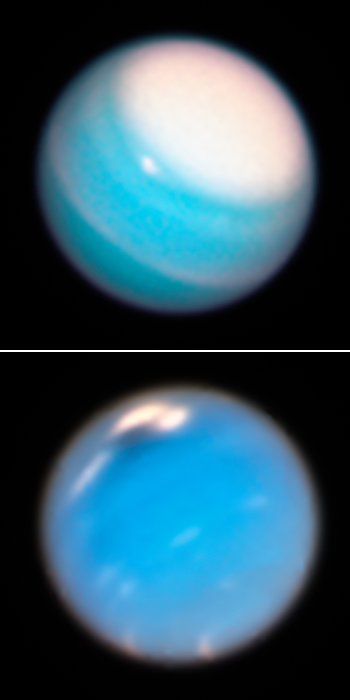
New Hubble images of Uranus and Neptune

Uranus (top) and Neptune

The Hubble Space Telescope’s new annual images of Uranus (top) and Neptune (bottom) has revealed new atmospheric features for both, a giant north pole cloud cap on Uranus and a new dark storm developing on Neptune.

For Neptune:

The new Hubble view of Neptune shows the dark storm, seen at top center. Appearing during the planet’s southern summer, the feature is the fourth and latest mysterious dark vortex captured by Hubble since 1993. Two other dark storms were discovered by the Voyager 2 spacecraft in 1989 as it flew by the remote planet. Since then, only Hubble has had the sensitivity in blue light to track these elusive features, which have appeared and faded quickly. A study led by University of California, Berkeley, undergraduate student Andrew Hsu estimated that the dark spots appear every four to six years at different latitudes and disappear after about two years.

Hubble uncovered the latest storm in September 2018 in Neptune’s northern hemisphere. The feature is roughly 6,800 miles across.

For Uranus:

The snapshot of Uranus, like the image of Neptune, reveals a dominant feature: a vast bright cloud cap across the north pole.

Scientists believe this feature is a result of Uranus’ unique rotation. Unlike every other planet in the solar system, Uranus is tipped over almost onto its side. Because of this extreme tilt, during the planet’s summer the Sun shines almost directly onto the north pole and never sets. Uranus is now approaching the middle of its summer season, and the polar-cap region is becoming more prominent. This polar hood may have formed by seasonal changes in atmospheric flow.

The images are part of an annual program that monitors both planets with images every year when the Earth is best placed to view them. This allows scientists to track atmospheric changes over time.

The sharpness of both images matches that of previous Hubble images, so these photographs do not show any decline in the telescope’s image capability. However, when they lose that next gyroscope and shift to one gyroscope mode, I believe it will be very difficult to get images even this sharp of the outer planets. In fact, I suspect this monitoring program will likely have to end, or will be badly crippled.

A Hubble Space Telescope status report

Five years after the last shuttle repair mission, the Hubble Space Telescope continues to operate almost perfectly.

Jeletic said other than a single gyro failure, the observatory is operating in near-flawless fashion five years after the final shuttle crew departed. “Batteries are fine, solar arrays are fine, all the communications equipment is fine, we don’t see any glitches with the computers, the instruments are all fine,” he said. “In fact, an interesting statistic, the Advanced Camera for Surveys, which was repaired by the astronauts during the last servicing mission, that’s actually now run longer on the repair than it did originally for the Wide Field Camera part of it.”

The ACS, like the repaired Space Telescope Imaging Spectrograph, no longer has any internal redundancy. “It’s amazing. It truly is,” Jeletic said. “Given all the things that can fail, a lot of people were hoping for one or two years of continued work with it. Now we’ve gotten over five.” Likewise, the Space Telescope Imaging Spectrograph, which also is operating in “single-string” mode, is still going strong.

When they completed the 2009 servicing mission, the goal was to give Hubble five more years of operation. They’ve done that, and are now looking to keep the telescope going till at least 2020, marking 30 years in orbit.

The only issue, not surprisingly, is the failure of one of the six gyros on board. These have traditionally been the telescope’s biggest problem, and have been replaced twice over during shuttle missions. Three of today’s six however are using a new design which will hopefully extend their life significantly.

Exoplanets with no water

The uncertainty of science: Though planet formation theories said they should have water, in looking for water on three exoplanets astronomers were surprised to discover practically none there.

The three planets, known as HD 189733b, HD 209458b, and WASP-12b, are between 60 and 900 light-years away from Earth and were thought to be ideal candidates for detecting water vapor in their atmospheres because of their high temperatures where water turns into a measurable vapor. These so-called “hot Jupiters” are so close to their star they have temperatures between 1,500 and 4,000 degrees Fahrenheit, however, the planets were found to have only one-tenth to one one-thousandth the amount of water predicted by standard planet-formation theories.

“Our water measurement in one of the planets, HD 209458b, is the highest-precision measurement of any chemical compound in a planet outside our solar system, and we can now say with much greater certainty than ever before that we’ve found water in an exoplanet,” said Nikku Madhusudhan of the Institute of Astronomy at the University of Cambridge, England. “However, the low water abundance we have found so far is quite astonishing.” Madhusudhan, who led the research, said that this finding presents a major challenge to exoplanet theory. “It basically opens a whole can of worms in planet formation. We expected all these planets to have lots of water in them. We have to revisit planet formation and migration models of giant planets, especially “hot Jupiters,” and investigate how they’re formed.”

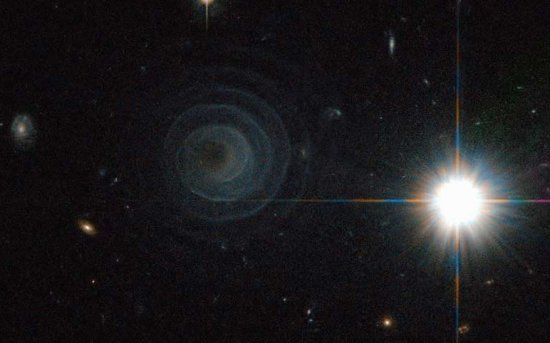
As imagined by SF authors: the Celestial Spiral

This amazing Hubble image, showing a strange spiral to the left of the bright star, is not of a galaxy. Instead, it is a binary star system where the material from one star is being sucked away from it by the other, thus producing the spiral pattern.

celestial spiral

What is most fascinating about this discovery is that this kind of phenomenon has been predicted for decades, by both astronomers and science fiction writers. Consider for example this quote from Larry Niven from his short story, The Soft Weapon, where he describes what he thinks the binary star Beta Lyrae might look like:

There was smoke across the sky, a trail of red smoke wound in a tight spiral coil. At the center of the coil was the source of the fire: a double star. One member was violet-white, a flame to brand holes in a human retina, its force held in check by the polarized window. The companion was small and yellow. They seemed to burn inches apart, so close that their masses had pulled them both into flattened eggs, so close that a red belt of lesser flame looped around them to link their bulging equators togehter. The belt was hydrogen, still mating in fusion fire, pulled loose from the stellar surfaces by two gravitional wells in conflict.

The gravity did more than that. It sent a loose end of the red belt flailing away, away and out in a burning Maypole spiral that expanded and dimmed as it rose toward interstellar space, until it turned from flame-red to smoke-red, bracketing the sky and painting a spiral path of stars deep red across half the universe.

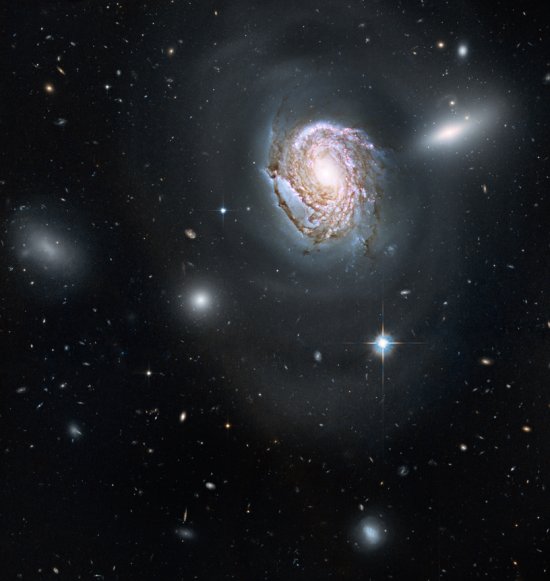
Hubble image of face-on galaxy

Another spectacular Hubble Space Telescope image was released today, showing a face-on spiral galaxy in the Coma cluster, located about 320 million light years away. Key quote:

The galaxy, known as NGC 4911, contains rich lanes of dust and gas near its center. These are silhouetted against glowing newborn star clusters and iridescent pink clouds of hydrogen, the existence of which indicates ongoing star formation. Hubble has also captured the outer spiral arms of NGC 4911, along with thousands of other galaxies of varying sizes.

NGC 4911

1 4 5 6