
A close-up of the dark side of Saturn’s moon Iapetus
Click for original image.
Click for original image.
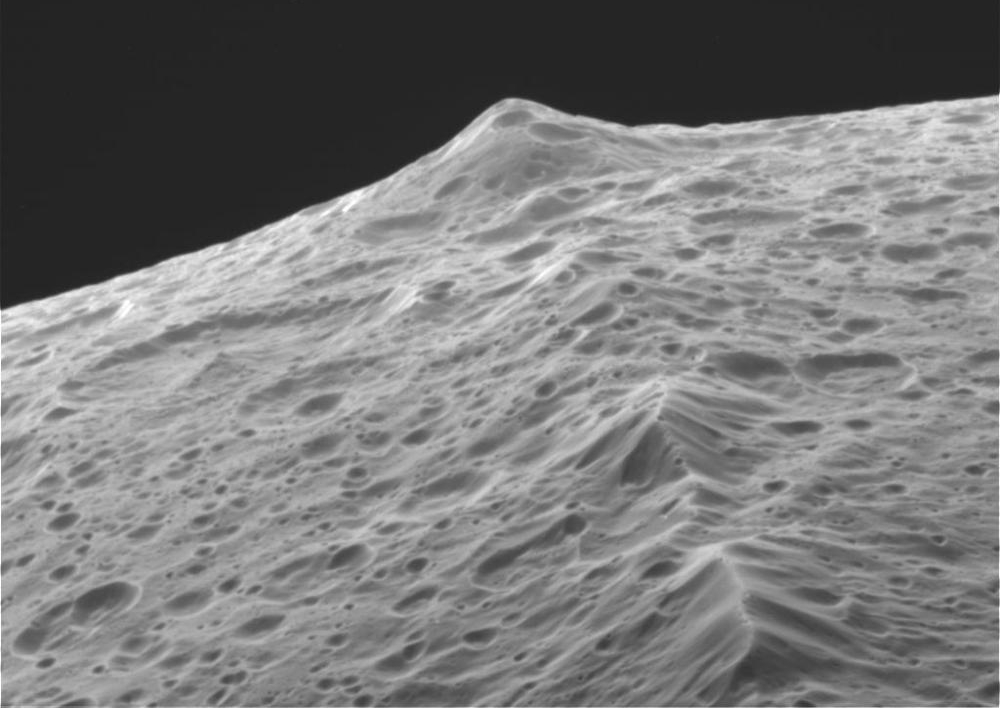
Today’s cool image is a double-header! The picture above, cropped to post here, was taken on September 10, 2007 during Cassini’s fly-by of Saturn’s moon Iapetus, taken from approximately 1,000 miles above the surface. It looks at the dark side of this two-toned planet (see yesterday’s cool image). As the moon’s rotation is tidally locked so that one side always faces Saturn, one hemisphere always leads while the other always trails. For some reason still unexplained, the leading hemisphere is covered with an almost pitch-black material, while the trailing hemisphere is bright and very white, its icy surface quite visible.
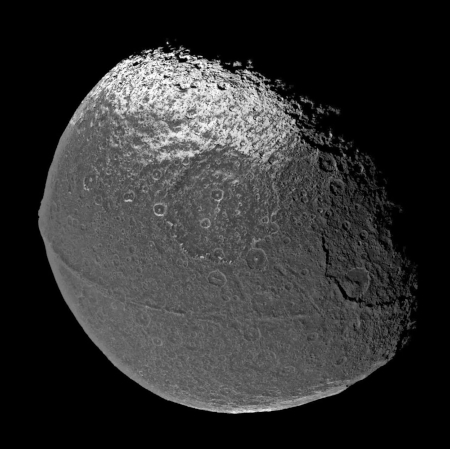
For context, to the right is a global image of that dark side taken during Cassini’s first fly-by of Iapetus on December 31, 2004. This picture highlights the long ridge that runs along the planet’s dark hemisphere’s equator that was the focus of the close-up image above. From the 2005 press release:
The most unique, and perhaps most remarkable feature discovered on Iapetus in Cassini images is a topographic ridge that coincides almost exactly with the geographic equator. The ridge is conspicuous in the picture as an approximately 12 miles band that extends from the western (left) side of the disc almost to the day/night boundary on the right. On the left horizon, the peak of the ridge reaches at least 8 miles above the surrounding terrain. Along the roughly 800-mile-length over which it can be traced in this picture, it remains almost exactly parallel to the equator within a couple of degrees. The physical origin of the ridge has yet to be explained. It is not yet clear whether the ridge is a mountain belt that has folded upward, or an extensional crack in the surface through which material from inside Iapetus erupted onto the surface and accumulated locally, forming the ridge.
Iapetus itself has a diameter of about 900 miles, so this ridge essentially crosses most of the dark hemisphere.
The 2007 press release did not provide enough information to pinpoint exactly where along that ridge the close-up is located, but no matter. Both images make very clear what we are looking at.
Click for original image.

Click for original image.
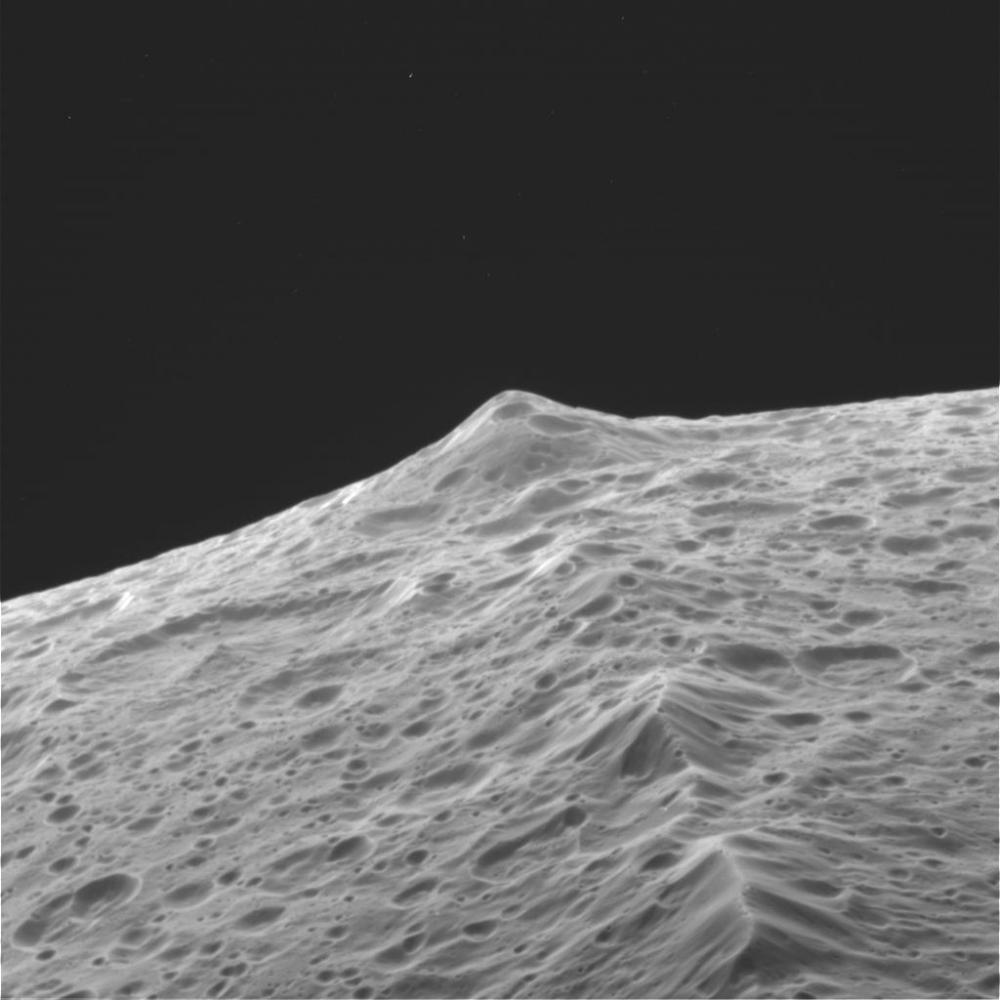
Today’s cool image is a double-header! The picture above, cropped to post here, was taken on September 10, 2007 during Cassini’s fly-by of Saturn’s moon Iapetus, taken from approximately 1,000 miles above the surface. It looks at the dark side of this two-toned planet (see yesterday’s cool image). As the moon’s rotation is tidally locked so that one side always faces Saturn, one hemisphere always leads while the other always trails. For some reason still unexplained, the leading hemisphere is covered with an almost pitch-black material, while the trailing hemisphere is bright and very white, its icy surface quite visible.
For context, to the right is a global image of that dark side taken during Cassini’s first fly-by of Iapetus on December 31, 2004. This picture highlights the long ridge that runs along the planet’s dark hemisphere’s equator that was the focus of the close-up image above. From the 2005 press release:
The most unique, and perhaps most remarkable feature discovered on Iapetus in Cassini images is a topographic ridge that coincides almost exactly with the geographic equator. The ridge is conspicuous in the picture as an approximately 12 miles band that extends from the western (left) side of the disc almost to the day/night boundary on the right. On the left horizon, the peak of the ridge reaches at least 8 miles above the surrounding terrain. Along the roughly 800-mile-length over which it can be traced in this picture, it remains almost exactly parallel to the equator within a couple of degrees. The physical origin of the ridge has yet to be explained. It is not yet clear whether the ridge is a mountain belt that has folded upward, or an extensional crack in the surface through which material from inside Iapetus erupted onto the surface and accumulated locally, forming the ridge.
Iapetus itself has a diameter of about 900 miles, so this ridge essentially crosses most of the dark hemisphere.
The 2007 press release did not provide enough information to pinpoint exactly where along that ridge the close-up is located, but no matter. Both images make very clear what we are looking at.