Russia launches three astronauts to ISS

Russia early on April 8, 2025 successfully launched two Russians and one American to ISS on a six month mission, its Soyuz-2 rocket lifting off from its Baikonur spaceport in Kazakhstan.

They will dock with ISS after only two orbits, three hours after launch.

The leaders in the 2025 launch race:

40 SpaceX
18 China
5 Rocket Lab
5 Russia

SpaceX still leads the rest of the world in successful launches, 40 to 32.

0 comments

Starliner’s troubles were much worse than NASA made clear

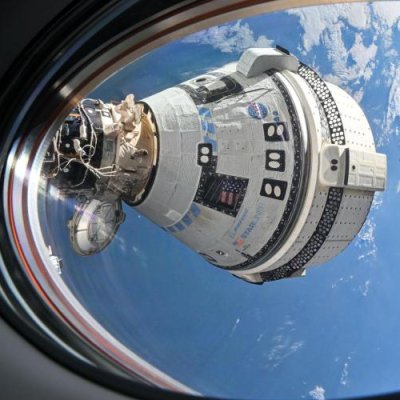
Starliner docked to ISS
Starliner docked to ISS.

According to a long interview given to Eric Berger of Ars Technica, the astronauts flying Boeing’s Starliner capsule on its first manned mission in June 2024 were much more vulnerable than NASA made it appear at the time.

First, the thruster problem when they tried to dock to ISS was more serious than revealed. At several points Butch Wilmore, who was piloting the spacecraft, was unsure if he had enough thrusters to safely dock the capsule to ISS. Worse, if he couldn’t dock he also did not know if had enough thrusters to de-orbit Starliner properly.

In other words, he and his fellow astronaut Sunni Williams might only have a few hours to live.

The situation was saved by mission control engineers, who figured out a way to reset the thrusters and get enough back on line so that the spacecraft could dock autonomously.

Second, once docked it was very clear to the astronauts and NASA management that Starliner was a very unreliable lifeboat.
» Read more

22 comments

NASA/Boeing: More Starliner ground engine tests throughout 2025; Next flight likely in 2026

Starliner docked to ISS
Starliner docked to ISS.

According to a press release from NASA late yesterday, both the agency and Boeing will spend most of the rest of this year doing additional Starliner static fire engine tests of thruster redesigns before considering another flight of the capsule to ISS.

NASA and Boeing are working to finalize the scope and timelines for various propulsion system test campaigns and analysis that is targeted throughout the spring and summer. Testing at White Sands Test Facility in New Mexico will include integrated firing of key Starliner thrusters within a single service module doghouse to validate detailed thermal models and inform potential propulsion and spacecraft thermal protection system upgrades, as well as operational solutions for future flights. These solutions include adding thermal barriers within the doghouse to better regulate temperatures and changing the thruster pulse profiles in flight to prevent overheating. Meanwhile, teams are continuing testing of new helium system seal options to mitigate the risk of future leaks.

โ€œOnce we get through these planned test campaigns, we will have a better idea of when we can go fly the next Boeing flight,โ€ said Steve Stich, manager, NASAโ€™s Commercial Crew Program at the agencyโ€™s Kennedy Space Center in Florida. โ€œWeโ€™ll continue to work through certification toward the end of this year and then go figure out where Starliner fits best in the schedule for the International Space Station and its crew and cargo missions. It is likely to be in the timeframe of late this calendar year or early next year for the next Starliner flight.โ€

The release indicated that the goal is to get the capsule certified prior to the next flight so that it can carry a crew on a fully operational mission. The release however left open the option that this next ISS flight might instead be an unmanned cargo mission. The announcement said nothing about who will pay for this flight. Under Boeing’s fixed-priced contract, it should foot the bill, but no one should be surprised if NASA works a deal to funnel money Boeing’s way.

Meanwhile, the agency has changed some of the crew assignments for that first and long-delayed operational Starliner flight, switching astronaut Mike Fincke from that mission to the next Dragon mission to launch later this year. (I suspect Fincke wanted to fly again, and was tired of sitting on his hands waiting for Boeing to get Starliner working.)

9 comments

NASA: Cygnus capsule damaged in transit to launchpad is too damaged to launch

According to this Ars Technica article today, the Cygnus cargo capsule that was reported to be damaged several weeks ago while being transported in a shipping container to its launchpad has now been found too damaged for launch, according to NASA.

On Wednesday, after a query from Ars Technica, the space agency acknowledged that the Cygnus spacecraft designated for NG-22 is too damaged to fly, at least in the nearterm. “Following initial evaluation, there also is damage to the cargo module,” the agency said in a statement. “The International Space Station Program will continue working with Northrop Grumman to assess whether the Cygnus cargo module is able to safely fly to the space station on a future flight.” That future flight, NG-23, will launch no earlier than this fall.

As a result, NASA is modifying the cargo on its next cargo flight to the space station, the 32nd SpaceX Cargo Dragon mission, due to launch in April. The agency says it will “add more consumable supplies and food to help ensure sufficient reserves of supplies aboard the station” to the Dragon vehicle.

It will be at least half a year before the next Cygnus will be ready for launch.

As the article notes (and immediately occurred to me also), this incident creates an opportunity to help Boeing and Starliner. Last year there were rumors that NASA might pay Boeing to fly Starliner as an unmanned cargo flight to ISS. This would allow the company to test its fixes to the capsule without having to pay for another test flight. These rumors however have faded since Trump took power, suggesting the new administration did not want to pay that extra money.

The loss however of this Cygnus cargo mission not only frees up NASA cash that could be transferred to a Starliner cargo mission, it frees up a slot in the cargo schedule. It actually makes a lot of sense to give Boeing the job.

Unfortunately, unless someone higher up in the Trump administration (possibly Trump himself) makes the decision, we should not expect any action on this idea until NASA’s new administrator is confirmed by the Senate and takes office. And that event remains in limbo at this point.

In the meantime, NASA has no redundancy for getting cargo to ISS, and must rely entirely on SpaceX and its Dragon cargo capsules. A third option, Sierra Nevada’s Tenacity Dream Chaser reusable cargo mini-shuttle, is still not ready to launch. It was supposed to do its first test flight to ISS a year ago, but could not because ground testing had to be done first, and for reasons that are very unclear, it appears that testing has not yet been completed.

8 comments

Freedom capsule splashes down successfully

SpaceX’s Freedom capsule has successfully splashed down off the coast of Florida, and has now been fished out of the water.

UPDATE: All four astronauts have now exited the capsule.

In watching the live stream, it is important to once again note that no one involved in this recovery operation is a government employee. The entire operation is being run by SpaceX, a private American company doing this work for profit.

It will take a bit more time before the astronauts come out of the capsule, as they must do some leak checks to make sure everything is safe.

25 comments

SpaceX’s manned Freedom capsule has undocked with ISS with its crew of four

SpaceX’s manned Freedom capsule tonight undocked with ISS, carrying with it the two astronauts that launched with it in September as well as the two astronauts that launched on Boeing’s Starliner capsule in June.

At 1:05 a.m. EDT Tuesday, NASA astronauts Nick Hague, Suni Williams, and Butch Wilmore, along with Roscosmos cosmonaut Aleksandr Gorbunov undocked from the space-facing port of International Space Stationโ€™s Harmony module aboard the SpaceX Dragon spacecraft.

Splashdown is scheduled for 5:57 pm (Eastern) March 18, 2025 off the coast of Florida. I have embedded the NASA live stream below.

Normally the transfer of control of the station from the old crew to the new one takes about a week. In this case NASA cut that transfer time to only three days because of the political desire to get the Starliner astronauts home more quickly. The irony is that NASA decided to leave them up there for almost seven months more than planned in order to disturb its normal ISS launch and crew schedule as little as possible. This effort now to shorten their spaceflight by a few measly days seems quite trivial in comparison.
» Read more

6 comments

SpaceX launches new crew to ISS

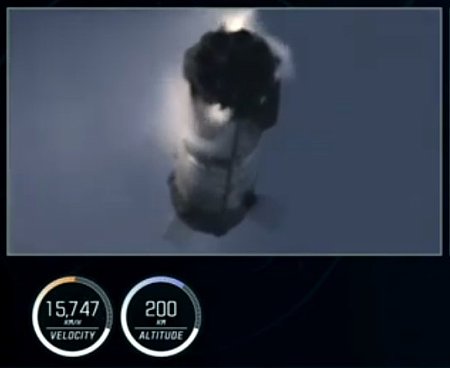
Falcon 9 first stage barreling home to Florida
Falcon 9 first stage barreling home to Florida tonight.

After a scrub two days ago due to a ground equipment issue, SpaceX tonight successfully launched a new crew of four to ISS, its Falcon 9 rocket lifting off from Kennedy in Florida.

The Dragon capsule is Endurance, on its fourth flight. The first stage completed its third flight, landing back in Florida.

This launch will allow the two-person crews launched by Boeing’s Starliner capsule in June and SpaceX’s Freedom capsule in September to come back home on Freedom.

When it was decided not to allow the Starliner astronauts to come home on Starliner because of thruster issues on the capsule, NASA decided to keep its ISS launch schedule as normal as possible, thus forcing that crew to complete a mission of about eight months, with a planned return in February 2025. Initially their Starliner mission was expected to last anywhere from two weeks to two months-plus, depending on how well Starliner functioned while docked to ISS.
» Read more

20 comments

Russia successfully launches new Progress freighter to ISS

Russia today successfully placed a new Progress freighter into orbit, its Soyuz-2 rocket lifting off from Kazakhstan.

The freighter will dock with ISS on March 2, 2025, docking with the aft port of the Zvezda module, the core module of the Russian half of the station. I guarantee that during that docking the hatch will be closed between the American and Russian segments, as that is now NASA’s policy because of its concern about the stress fractures in Zvezda.

The leaders in the 2025 launch race:

25 SpaceX
9 China
2 Rocket Lab
2 Russia

6 comments

Musk: ISS should be de-orbited quickly! And he may be right.

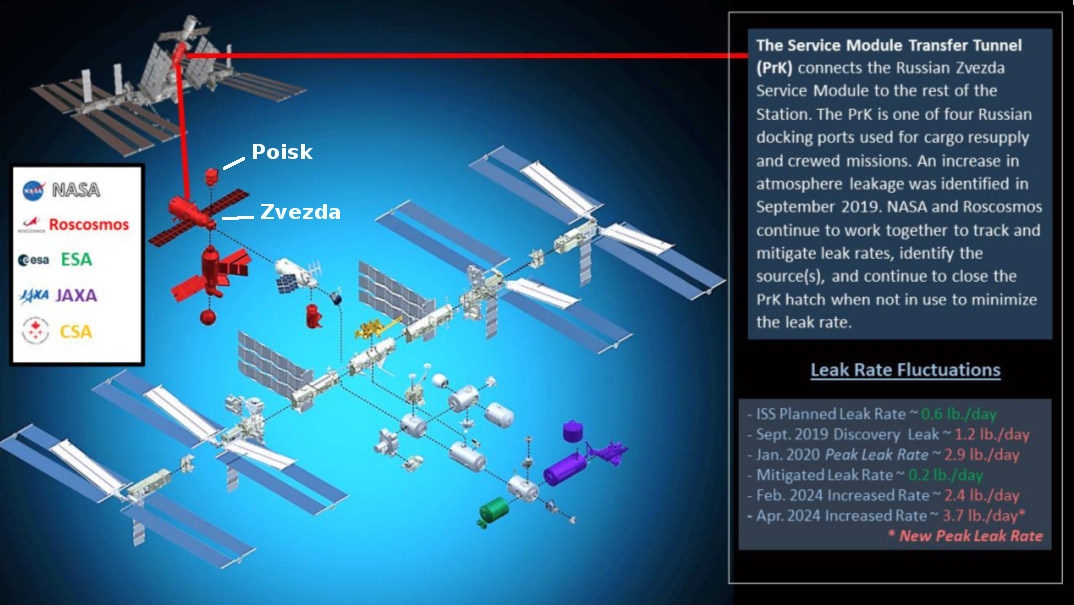
Figure 3 from September Inspector General report
Figure 3 from September Inspector General report, showing ISS and outlining the airlieak annotated to show Zvezda and Poisk locations.

Food fight! Yesterday Elon Musk did a Donald Trump, issuing a bunch of tweets that are likely causing some heads to explode inside NASA, Congress, and Europe.

First — and far less significant — Musk got into a war of insults with European Space Agency astronaut Andreas Mogensen over his comments in recent days accusing the Biden administration of delaying the return of the two Starliner astronauts “for political reasons.” Mogensen accused Musk lying about this, and Musk responded by calling Mogenson “fully retarded” and an “idiot,” adding that “SpaceX could have brought them back several months ago. I OFFERED THIS DIRECTLY to the Biden administration and they refused. Return WAS pushed back for political reasons.”

Since Musk was there and Mogensen was not, it seems Musk won that battle. NASA meanwhile issued a mild statement saying everything it has done has been to maximize safety, a statement that matches the facts quite accurately.

Then Musk — on a far more important topic — stirred the pot more by tweeting his belief that ISS should be retired now.

It is time to begin preparations for deorbiting the Space_Station. It has served its purpose. There is very little incremental utility. Letโ€™s go to Mars.

In a second tweet he recommended the de-orbit should occur “two years from now.”

Left unstated by Musk was what might be his most important reason for retiring ISS so quickly: the fragile condition of the Russian-built Zvezda module. » Read more

26 comments

French startup The Exploration Company wins major contract from Germany

Germany’s space agency, DLR, announced today that it has signed a major contract with the French startup The Exploration Company to use its Nyx reusable capsule, still under development, for in-orbit weightlessness research.

On 20 February, during its DLR TecDays in Bonn, the German aerospace agency announced that it had signed a contract with The Exploration Company and would serve as an anchor customer for its microgravity research service. The contract secures space for 160 kilograms of scientific payloads aboard the inaugural flight of the Nyx Earth capsule in 2028. โ€œWe are supporting a startup that provides services that will be particularly valuable in a post-ISS era,โ€ explained Dr. Walther Pelzer, Head of the German Space Agency at DLR.

Nyx’s main customer base was originally to serve as a cargo freighter for all of planned commercial space stations, having already been chosen by the European Space Agency as one of two European companies (the other being Thales-Alenia) to fly cargo demonstration missions to ISS in 2028.

This new contract illustrates the wider possibilities for profit for these capsules that has appeared in the past two years. If you can launch a returnable capsule to bring cargo, why not launch it to do in-orbit research and manufacturing? Varda in the U.S. has already demonstrated this possibility. Others apparently are now recognizing it as well.

0 comments

Musk: Biden delayed the return of Starliner’s astronauts “for political reasons”

During a television interview with President Trump, Elon Musk suggested that the reason the two Starliner astronauts have been forced to remain on ISS for months was because of a political decision by the Biden administration last year.

The billionaire SpaceX CEO said his company was โ€œaccelerating the return of the astronautsโ€ as per Trumpโ€™s instructions. Musk then appeared to take a shot at the Biden administration, saying the move was โ€œpostponed kind of to a ridiculous degree,โ€ before the president chimed in saying โ€œthey got left in space.โ€

When Hannity pointed out the astronauts have been on the ISS for almost 300 days instead of the planned 8 days, Trump simply said โ€œBiden,โ€ before Musk claimed they were โ€œleft up there for political reasons, which is not good.โ€

While the decision to return Starliner unmanned certainly had a political component (a desire to avoid a disaster in the final year of Biden’s term), Musk’s claim is greatly exaggerated. Worse, Musk is papering over his own company’s contribution to the delays. Had SpaceX and NASA chosen in December to use an already existing Dragon capsule instead of a brand new capsule to launch the next crew to ISS, the astronauts would be home already. Instead, they decided to get that new capsule ready, requiring an almost two month delay in their return.

When it became obvious last month that even this extra time was insufficient to get the new capsule ready, only then did SpaceX and NASA choose to switch capsules. That switch allowed them to move up the return date by about a week.

In reporting Musk’s words here, our ignorant press has generally left these details out, allowing both Musk and Trump to make it appear as they are saviors for these poor astronauts. This is simply not true. SpaceX is certainly making it possible to bring them home (something Boeing was unable to do), but it also contributed to the delay in doing so.

16 comments

ESA astronaut with no right leg cleared by medical board to fly to ISS

An international medical board has now cleared ESA astronaut John McFall to fly on a future long-duration mission to ISS, despite the fact that his right leg had been lost due to a motorcycle accident when he was nineteen and wears a prosthesis.

He is the first person with such a disability to be medically approved to train for missions to the station. โ€œJohn is today certified as an astronaut who can fly on a long-duration mission on the International Space Station, and I think this is an incredible step ahead in our ambition to broaden the access to society to space,โ€ Daniel Neuenschwander, ESAโ€™s director of human and robotic exploration, said at a briefing to announce the certification.

ESA selected McFall as part of an astronaut class announced in 2022. That selection process included an effort by ESA to pick what it called at the time a โ€œparastronautโ€ to see if people with some physical disabilities could safely fly to space.

This is actually a great idea. As one Russia astronaut once said to me, “The legs are mostly useless in weightlessness.” Testing to see how McFall does on a six-month mission will tell us whether the weightlessness environment is a good one for people who can’t walk, as has been theorized for decades.

At the moment McFall has not yet been assigned to any scheduled flight. He joins a class of twelve astronauts selected by ESA in 2022. He is also being considered as a possible astronaut on a proposed all-British tourist flight that Axiom is considering flying.

It is unfortunate that the racist Diversity, Equity, and Inclusion policies of the past decade poison this decision. I am certain many will assume McFall’s future flight will be done just for those reasons, and thus will discount it.

7 comments

NASA announces March 12, 2025 as new launch date for next crew to ISS

NASA yesterday announced that it is now targeting March 12, 2025 as new launch date for sending the next crew to ISS, thus moving that date up about one week.

The earlier launch opportunity is available following a decision by mission management to adjust the agencyโ€™s original plan to fly a new Dragon spacecraft for the Crew-10 mission that requires additional processing time. The flight now will use a previously flown Dragon, called Endurance, and joint teams are working to complete assessments of the spacecraftโ€™s previously flown hardware to ensure it meets the agencyโ€™s Commercial Crew Program safety and certification requirements. Teams will work to complete Dragonโ€™s refurbishment and ready the spacecraft for flight, which includes trunk stack, propellant load, and transportation to SpaceXโ€™s hangar at 39A at NASAโ€™s Kennedy Space Center in Florida to be mated with the missionโ€™s Falcon 9 rocket. This will be the fourth mission to the station for this Dragon, which previously supported the agencyโ€™s Crew-3, Crew-5, and Crew-7 flights.

Both NASA and SpaceX are touting this as a great decision because it will allow the present ISS crew (which includes the two astronauts initially launched on Starliner last year) to get home quicker.

The truth is that this decision really hides the fact that both the agency and company made a wrong decision to use a new capsule for this mission. SpaceX needed more time than expected to prepare it, and those delays pushed back both the launch of a new crew and the return of the old. So, while everyone is spinning this as SpaceX and NASA brilliantly improvising to get those Starliner astronauts home sooner, the real story is that their return had been significantly delayed by almost two months by SpaceX’s inability to get the capsule ready as promised.

8 comments

SpaceX to use older Dragon capsule for next manned launch because of issues with new capsule

Ars Technica today reported that because of continuing battery issues with the new Dragon manned capsule, SpaceX now plans to use the older Endurance Dragon capsule for the next manned launch to ISS and prevent further delays in bringing home the two Starliner astronauts.

NASA now believes the vehicle will not be ready for its debut launch until late April. Therefore, according to sources at the agency, NASA has decided to swap vehicles for Crew-10. The space agency has asked SpaceX to bring forward the C210 vehicle, which returned to Earth last March after completing the Crew-7 mission.

Known as Endurance, the spacecraft was next due to fly the private Axiom-4 mission to the space station later this spring. Sources said SpaceX is now working toward a no-earlier-than March 12 launch date for Crew-10 on Endurance. If this flight occurs on timeโ€”and the date is not certain, as it depends on other missions on SpaceX’s Falcon 9 manifestโ€”the Crew-9 astronauts, including Wilmore and Williams, could fly home on March 19. They would have spent 286 days in space. Although not a record for a NASA human spaceflight, this would be far longer than their original mission, which was expected to last eight to 30 days.

The new capsule will then be used for Axiom’s fourth commercial flight to ISS, AX-4, presently scheduled for later in the spring.

4 comments

The crew and passengers for Axiom’s fourth tourist flight to ISS

Axiom this week publicly introduced the international crew and passengers for its fourth tourist flight to ISS, presently planned for this spring.

During a Thursday press conference, former NASA astronaut and Axiom commander Peggy Whitson introduced her team. Shubhanshu Shukla will pilot the fourth mission to the ISS. He has been a fighter pilot for 15 years and will be the first Indian pilot to travel to the ISS.

The private mission also carries the first astronauts from Poland and Hungary to stay aboard the space station. Sล‚awosz Uznaล„ski-Wiล›niewski is an ESA astronaut representing Poland. Tibor Kapu is a mechanical engineer who was selected as an astronaut for Hungary’s Hungarian to Orbit (HUNOR) program in May of last year.

Axiom had made deals with India, Poland, and Hungary years ago to fly astronauts in space, and this flight fulfills those deals. Launched on SpaceX’s Falcon 9 rocket, their Dragon capsule will spend 14 days in space, most of which will be docked to ISS.

0 comments

Musk posts a silly tweet saying Trump wants SpaceX to rescue the Starliner astronauts and the press goes stupid again

Yesterday Elon Musk posted what appeared to be a completely silly tweet stating that Trump “has asked SpaceX to bring home the 2 astronauts stranded on the Space_Station as soon as possible. We will do so. Terrible that the Biden administration left them there so long.”

Since a Dragon capsule for bringing these astronaut back to Earth is already docked to ISS and is scheduled to return in April, there is nothing really new about Musk’s tweet. Moreover, that April return was delayed an extra two months because of SpaceX, not Boeing or Biden. The company had requested that extra time to prepare the next crew capsule for launch, because it is a new capsule never used before.

It is of course possible that Trump requested SpaceX and NASA to reconsider this extra two month delay, and move the crew return back to February, but that change would either require SpaceX to find a different older capsule for the next crew, fly the new capsule sooner than planned, or have the total number of NASA astronauts on ISS reduced to just one until the new capsule launches with the new crew in March. None of these options seems wise.

I suspect nothing will change, and Musk was merely trolling the press. And the press mostly fell for it, hook, line, and sinker.

Most of these stories fail to outline the reasons for the most recent delays, having nothing to do with Biden. The last four especially make it sound as if SpaceX has suddenly been enlisted for a rescue mission, a claim that is utterly false.

None have been able to get any confirmation of any change of schedule from NASA or SpaceX, suggesting that Musk’s tweet was entirely blarney that a smart press would have ignored without that confirmation. Our stupid mainstream press however could not do that. It went whole hog based on nothing.

Until NASA announces a change in schedule there simply is no story here, and that’s what I am reporting.

12 comments

Vast signs deal with SpaceX for two ISS tourist missions

Depending on whether it gets NASA contractual approval, the space station startup Vast has now signed a deal with SpaceX for flying two tourist missions to ISS.

These two missions expand Vastโ€™s launch manifest with SpaceX, which includes the companyโ€™s Falcon 9 rocket delivering Haven-1 to low-Earth orbit and a subsequent Dragon mission to fly crew to the commercial space station. Haven-1 will also be supported by Starlink laser-based high-speed internet.

Axiom, which has flown three tourist missions to ISS and has a fourth planned, is also bidding for the next two tourist slots NASA has made available for ISS in the coming years. It is not clear who will get those slots. Axiom has the advantage it has done it before, but the rumors that it lost money on those flights and now has a cash shortage work against it. Vast hasn’t yet flown, but it is moving fast to fly and occupy Haven-1 next year. NASA might want to give it at least one of those slots to balance the scales.

Hat tip to BtB’s stringer Jay.

3 comments

Axiom to speed up assembly of its space station

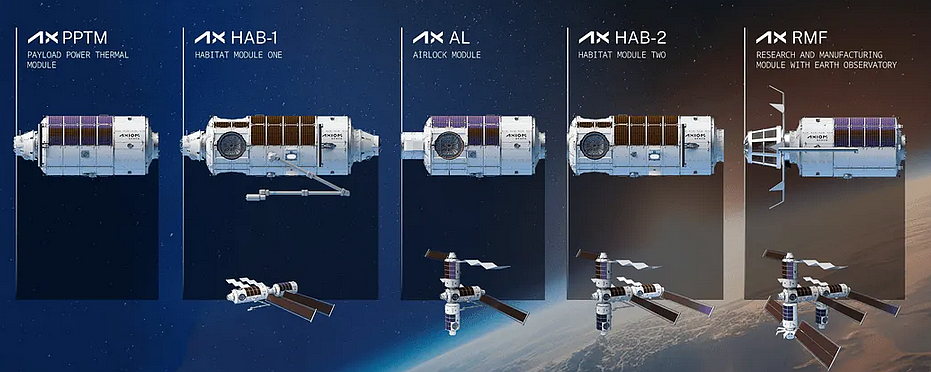
Axiom's new module assembly sequence
Axiom’s new module assembly sequence

Capitalism in space: In order to be able to fly its space station independent of ISS more quickly, Axiom has rearranged the order it will launch some modules.

Originally, the plan was to attach Habitat 1 (AxH1) first, before the power and thermal module. Now, the on-orbit assembly sequence will start with the Payload Power Thermal Module (AxPPTM), followed by AxH1, an airlock, Habitat 2 (AxH2), and finally the Research and Manufacturing Facility (AxRMF). โ€œThe result โ€“ free-flight capability after the launch and berthing of PPTM,โ€ [Mark Greeley, Axiom Space COO and station program manager,] explained, โ€œ[will allow] us to add modules while on orbit once we have separated from station. Our goal is to ensure a smooth transition from a government to a commercial platform, maintaining a continuous human presence on orbit to serve a community of global customers and partners, to include NASA.โ€

The AxPPTM primary structure will be built by Thales Alenia Space in Turin, Italy, and then relocated to Houston no earlier than fall 2025, where the integration of the internal structure and systems will take place at Axiom Space facilities.

The new sequence is shown in the graphic above. This change will allow Axiom to fly free two years sooner than previously planned, in 2028. It appears NASA pushed for this change possibly because it considers remaining attached to ISS until 2030 a risk that should be avoided. NASA apparently is increasingly concerned about the state of Russia’s Zvezda module, and fears it might have a catastrophic failure due to the stress fractures in its hull. The sooner Axiom can get free of ISS the better.

This modification also appears to include some major changes from previous Axiom graphics. It appears the airlock module and its solar panels have undergone a major design change.

Below is my present ranking for the launch of the four space stations being designed and built:

  • Haven-1, being built by Vast, with no NASA funds. The company is moving fast, and plans to launch and occupy it in 2025 for a 30 day mission. It will then build its mult-module Haven-2 station.
  • Axiom, being built by Axiom, which has also launched three tourist flights to ISS. Though there are rumors it is experiencing cash flow issues, today’s announcement suggests those rumors might be unfounded.
  • Orbital Reef, being built by a consortium led by Blue Origin and Sierra Space. Though Blue Origin has apparently done little, Sierra Space has successfully tested its inflatable modules, including a full scale version, and appears ready to start building the station’s modules for launch.
  • Starlab, being built by a consortium led by Voyager Space, Airbus, and Northrop Grumman.
6 comments

New manned Dragon capsule forces NASA to shuffle ISS crew launch and return schedules

In order to give SpaceX more time to complete work on a new manned Dragon capsule, raising its fleet of capsules to five, NASA has shuffled its springtime ISS crew launch and return schedules.

The change gives NASA and SpaceX teams time to complete processing on a new Dragon spacecraft for the mission. The new spacecraft is set to arrive to the companyโ€™s processing facility in Florida in early January. โ€œFabrication, assembly, testing, and final integration of a new spacecraft is a painstaking endeavor that requires great attention to detail,โ€ said Steve Stich, manager, NASAโ€™s Commercial Crew Program.

…NASA and SpaceX assessed various options for managing the next crewed handover, including using another Dragon spacecraft and manifest adjustments. After careful consideration, the team determined that launching Crew-10 in late March, following completion of the new Dragon spacecraft, was the best option for meeting NASAโ€™s requirements and achieving space station objectives for 2025.

This decision however impacts the return of the Dragon crew presently on board ISS, including the two astronauts launched in June on Boeing’s Starliner capsule and whose stay was extended from its initial length of one-to-eight weeks to more than six months when NASA made the decision to bring Starliner home unmanned. Instead of returning in February 2024, that crew will now have to return after the next crew arrives in late March.

Most of the press has focused on this two month extension to the Starliner crew, but to me the real news is that SpaceX is building a fifth manned capsule, as yet unnamed. Having five reusable capsules will give the company greater flexibility. I suspect SpaceX decided to build this additional capsule because, in addition to its ISS missions for NASA, it is going to be flying in 2025 both an Axiom mission to ISS as well as a 30-day mission to Vast’s Haven-1 space station. That latter mission will tie up one manned capsule for many months both before and after that long flight.

6 comments
1 3 4 5 6 7 75